



 Healthcare App Development Services
 Real Estate Web Development Services
 E-Commerce App Development Services
 E-Commerce Web Development Services
 Blockchain E-commerce Development Company
 Fintech App Development Services
 Fintech Web Development
 Blockchain Fintech Development Company
 E-Learning App Development Services
 Restaurant App Development Company
 Mobile Game Development Company
 Travel App Development Company
 Automotive Web Design
 AI Traffic Management System
 AI Inventory Management Software
 Machine Learning Development
 ChatGPT integration services
  AI Development Company
  AI Integration Services
  Generative AI Development Services
  Natural Language Processing Company
 Mobile App Development
  IOS App Development
  Android App Development
  Cross-Platform App Development
  Augmented Reality (AR) App Development
  Virtual Reality (VR) App Development
  Web App Development
  SaaS App Development
 Flutter
  React Native
  Swift (IOS)
  Kotlin (Android)
  Mean Stack Development
  AngularJS Development
  MongoDB Development
  Nodejs Development
  Database Development
 Ruby on Rails Development
 Expressjs Development
  Full Stack Development
  Web Development Services
  Laravel Development
  LAMP Development
  Custom PHP Development
  .Net Development
  User Experience Design Services
  User Interface Design Services
  Automated Testing
  Manual Testing
  Digital Marketing Services
 Ride-Sharing And Taxi Services
 Food Delivery Services
 Grocery Delivery Services
 Transportation And Logistics
 Car Wash App
 Home Services App
 ERP Development Services
 CMS Development Services
 LMS Development
 CRM Development
 DevOps Development Services
 AI Business Solutions
 AI Cloud Solutions
 AI Chatbot Development
 API Development
 Blockchain Product Development
 Cryptocurrency Wallet Development
 About Talentelgia
  Our Team
  Our Culture
 Healthcare App Development Services
 Real Estate Web Development Services
 E-Commerce App Development Services
 E-Commerce Web Development Services
 Blockchain E-commerce
Development Company
Blockchain E-commerce
Development Company Fintech App Development Services
 Finance Web Development
 Blockchain Fintech
Development Company
Blockchain Fintech
Development Company E-Learning App Development Services
 Restaurant App Development Company
 Mobile Game Development Company
 Travel App Development Company
 Automotive Web Design
 AI Traffic Management System
 AI Inventory Management Software
 AI Development Company
 ChatGPT integration services
 AI Integration Services
 Machine Learning Development
 Machine learning consulting services
 Blockchain Development
 Blockchain Software Development
 Smart contract development company
 NFT marketplace development services
 Asset tokenization companies
 DeFi Wallet Development Company
 IOS App Development
 Android App Development
 Cross-Platform App Development
 Augmented Reality (AR) App
Development
Augmented Reality (AR) App
Development Virtual Reality (VR) App Development
 Web App Development
 Flutter
 React
Native
React
Native Swift
(IOS)
Swift
(IOS) Kotlin (Android)
 MEAN Stack Development
 AngularJS Development
 MongoDB Development
 Nodejs Development
 Database development services
 Expressjs Development
 Full Stack Development
 Web Development Services
 Laravel Development
 LAMP
Development
LAMP
Development Custom PHP Development
 User Experience Design Services
 User Interface Design Services
 Automated Testing
 Manual
Testing
Manual
Testing About Talentelgia
 Our Team
 Our Culture
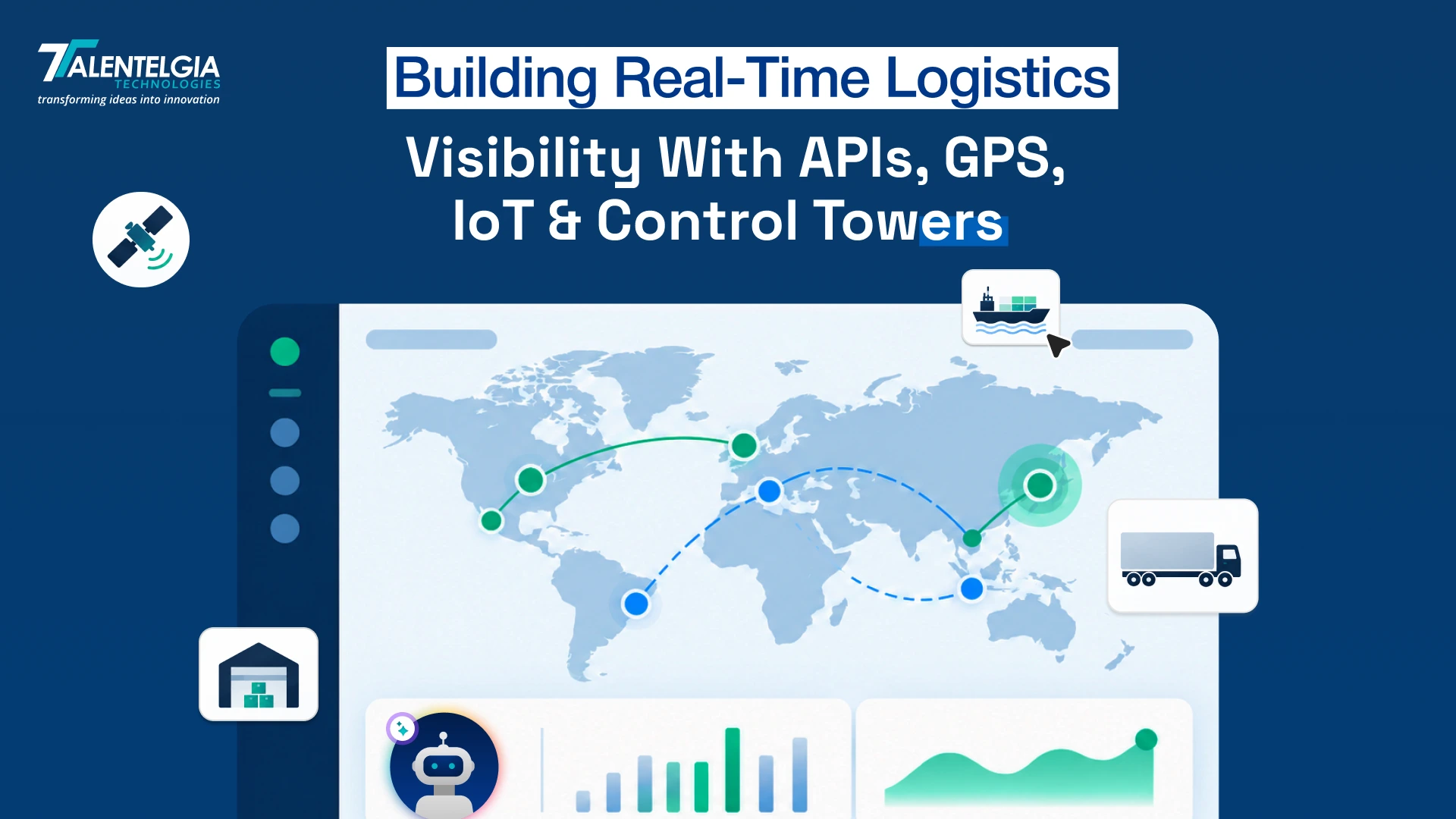
Reliable logistics visibility software gives operations teams more than a vehicle location on a map. It connects shipment events, vehicle telemetry, carrier updates, warehouse activity, and business systems into one operational view. That view becomes useful when the data is timely, contextual, trusted, and actionable.
Many organizations already have tracking tools, TMS platforms, ERP systems, carrier portals, and telematics feeds. The problem is that these systems often describe different parts of the same shipment. Real-time visibility requires an architecture that connects those signals and reconciles them into a shared operational picture.
This is where APIs, GPS, IoT, event processing, and control towers become important. Each technology solves a different visibility problem. Together, they can create continuous transportation visibility across vehicles, shipments, facilities, carriers, and exceptions.
For technology leaders, the challenge is therefore not simply choosing a logistics tracking platform. It is designing the right data architecture, integration model, operating workflows, and scalability strategy.
What Does Real-Time Logistics Visibility Actually Mean?
Real-time logistics visibility means having timely, contextual information about where shipments and assets are, what has happened, and what requires attention.
A useful visibility system should answer several questions without forcing teams across multiple applications:
- Where is the shipment or vehicle now?
- What was the latest confirmed event?
- Which carrier or asset is responsible?
- Is the shipment following its expected journey?
- Has a milestone been missed?
- What operational exception requires action?
- Which customers, orders, or facilities could be affected?
- What should the operations team do next?
That distinction matters because location data alone is not visibility.
GPS can tell a platform where an asset is located. A TMS can describe the planned movement. A WMS can confirm warehouse events. A carrier system can provide status updates. IoT sensors can report environmental conditions.
Visibility emerges when those signals are connected and interpreted against the shipment’s business context.
GS1’s EPCIS standard provides a useful model for thinking about this problem. It represents visibility through event information describing what happened, where it happened, when it happened, and why it matters. EPCIS 2.0 also supports sensor data and REST-based interfaces.
A strong logistics visibility platform therefore maintains an event history rather than simply overwriting the latest shipment status.
That history becomes important when teams investigate delays, disputes, missed handoffs, temperature excursions, or carrier performance.
Also read: Logistics Management Software – Top 10 List
Why Traditional Tracking Creates Visibility Gaps
Traditional tracking usually focuses on status updates rather than continuous operational context.
A shipment may show statuses such as:
Booked → Picked Up → In Transit → Arrived → Delivered
Those milestones are useful, but they leave substantial gaps between events.
Consider a shipment that remains marked “in transit” for several hours. The system may technically have a status. The operations team still lacks answers. The truck could be moving normally. It could be waiting at a facility. It could have deviated from its route. Its telematics connection could have stopped reporting. The shipment could also have reached a cross-dock without the corresponding system update.
These gaps usually come from several architectural problems.
Siloed Operational Systems
TMS, WMS, ERP, order management, telematics, carrier systems, and customer platforms often maintain separate records. Without integration, each system provides only part of the operational picture.
Inconsistent Identifiers
One platform may identify a movement through a shipment ID. Another may use a load number, consignment number, vehicle ID, or carrier reference. Without a canonical data model, correlating those records becomes difficult.
Different Event Definitions
“Dispatched,” “departed,” “picked up,” and “in transit” can mean different things across systems. A visibility platform needs a shared event vocabulary and clear business semantics.
Delayed Data Exchange
Batch uploads and manual updates can create substantial latency. The platform may therefore display information that was technically correct earlier but is no longer operationally useful.
Missing Context
A GPS coordinate does not automatically explain whether a vehicle is late. The system needs planned routes, expected arrival windows, stops, shipment priorities, facility schedules, and relevant business rules.
Real-time visibility is consequently a data integration and interpretation problem, not merely a tracking problem.
The Core Architecture Behind Real-Time Logistics Visibility
A practical architecture typically contains six connected layers.
| Layer | Primary Responsibility | Typical Technologies |
|---|---|---|
| Data sources | Generate operational signals | GPS, telematics, IoT, TMS, WMS, ERP |
| Connectivity | Move data between systems | REST APIs, webhooks, MQTT, EDI |
| Ingestion | Receive and normalize signals | API gateways, message brokers, IoT platforms |
| Processing | Correlate and interpret events | Stream processing, rules engines, event services |
| Intelligence | Detect exceptions and trends | Analytics, alerts, ML models |
| Experience | Present and operationalize information | Control towers, dashboards, mobile apps |
The important design principle is separation. A telematics provider should not need direct knowledge of every application consuming its data. Likewise, the control tower should not depend on one carrier’s proprietary data format.
An integration layer should absorb those differences and expose standardized internal events. OpenAPI provides a formal way to describe HTTP APIs so systems and logistics development agencies can understand available operations and schemas consistently.
For IoT workloads, MQTT provides a lightweight publish-subscribe model suited to constrained devices and machine-to-machine communication. Its quality-of-service options also allow architects to choose different delivery semantics for different message types.
The Role of APIs in Logistics Visibility
APIs are the connective tissue of modern visibility architecture.
A typical logistics environment may need to exchange information between:
- Transportation management systems
- Warehouse management systems
- Enterprise resource planning platforms
- Order management systems
- Carrier platforms
- Freight marketplaces
- Telematics providers
- GPS and mapping services
- IoT platforms
- Customer applications
- Analytics platforms
The integration strategy should not simply ask whether an API exists. It should ask what information the API provides, how frequently it changes, and how reliably it can be consumed.
Custom logistics application development for visibility typically involves several categories of API integration:
| Integration Type | Systems Connected | Typical Data Exchanged |
|---|---|---|
| Carrier and telematics APIs | Carrier tracking systems, ELDs, GPS devices | Location, ETA, hours of service |
| Enterprise system APIs | TMS, WMS, ERP | Orders, inventory, shipment records |
| Standards-based APIs | DCSA, GS1 EPCIS-compliant partners | Container events, product movement events |
| External data APIs | Weather, traffic, port congestion services | Conditions affecting ETA accuracy |
What should logistics APIs exchange?
Useful API payloads can include:
- Shipment creation and updates
- Pickup and delivery milestones
- Vehicle assignments
- Driver information
- Stop sequences
- GPS coordinates
- Estimated arrival times
- Proof-of-delivery information
- Exception codes
- Temperature readings
- Door-open events
- Asset status
- Carrier capacity
- Appointment information
The architecture should also distinguish between commands and events. A request such as “retrieve shipment status” is different from an event saying “shipment departed facility.”
That distinction becomes increasingly important when building event-driven visibility systems.
API Integration Needs a Canonical Model
Suppose three carriers represent delivery completion differently.
One may send DELIVERED.
Another may send POD_COMPLETE.
A third may provide a timestamp without a status field.
The visibility layer should map those representations into a common business event. This is where a canonical data model reduces downstream complexity.
Do not Overlook API Security
External integrations expand the attack surface. OWASP identifies broken authorization, authentication weaknesses, unrestricted resource consumption, security misconfiguration, poor API inventory, and unsafe third-party API consumption among major API security risks.
GPS and Telematics: The Foundation of Fleet Visibility
GPS provides positioning, navigation, and timing information through receiver-based positioning. For logistics organizations, that positioning becomes valuable when it is associated with the correct vehicle, shipment, route, driver, and operational event.
A GPS feed can provide coordinates at recurring intervals. Telematics can add information from the vehicle and connected equipment. Depending on the platform, those signals may include engine-related information, mileage, motion status, diagnostic information, or driver-related data.
This distinction matters because GPS and telematics are not interchangeable. GPS answers a location question. Telematics can provide broader vehicle and operational context.
FMCSA’s ELD guidance illustrates this distinction clearly. ELDs automatically record information such as location, engine hours, vehicle miles, and driver identification at specified intervals. The ELD rules also do not require collection of parameters such as braking or steering performance. Therefore, a supply chain visibility platform should understand the capabilities and limitations of each connected source.
GPS Data Should Become Business Context
A raw coordinate is rarely enough.
The platform can enrich it with:
- Geofences
- Planned routes
- Stop locations
- Facility boundaries
- Expected arrival windows
- Traffic information
- Shipment priority
- Vehicle assignments
- Delivery constraints
That enrichment allows the system to transform coordinates into operational events.
For example, entering a facility geofence can trigger an “arrived at destination” candidate event. Leaving the geofence can trigger a departure event. A prolonged stop outside a planned location can trigger an exception.
The system should still distinguish between inferred events and confirmed events. That distinction prevents automation from presenting assumptions as facts.
IoT-Enabled Logistics: Monitoring Shipment Conditions Beyond Location
IoT devices alone do not create visibility. The value comes from connecting sensor data with business systems.
A typical IoT logistics architecture includes four layers.
Physical Sensors
Sensors capture temperature, humidity, shock, tilt, light exposure, and door-open events. Cold chain shipments typically place several sensors throughout a single load rather than one, since temperature at the front of a trailer can differ meaningfully from the rear. Pharma-grade sensors are calibrated to tighter tolerances than general-purpose units, since regulatory thresholds leave less margin for sensor error.
Connectivity Layer
The right protocol depends on the shipment’s route and reporting needs, not a default choice:
- Cellular (LTE-M, NB-IoT): suited to long-haul road freight with consistent network coverage, where sensors report every few minutes.
- Bluetooth Low Energy: suited to short-range, item-level tracking inside a facility, container, or trailer, usually relayed to the network through a gateway device.
- LPWAN (LoRaWAN): suited to assets that report infrequently over longer distances at low power, useful for yard and warehouse tracking where battery life matters more than update frequency.
- Satellite connectivity: fills coverage gaps for ocean freight and remote routes where no cellular network reaches.
IoT Platform
The platform manages device registration, data ingestion, connectivity monitoring, and security controls. Most platforms use MQTT’s publish-subscribe model rather than a request-response API, since it handles constrained devices and intermittent connectivity better. A device publishes a reading to a topic; the platform routes it to whatever service needs it, without the device needing to track who’s listening or hold a persistent connection open.
Logistics Visibility Application
The visibility platform combines sensor data with shipment records, customer orders, carrier information, and delivery schedules, matching each reading to the correct shipment ID before it means anything operationally.
| For example, a refrigerated shipment generating a reading above its temperature threshold should trigger the same event-processing and exception pipeline used for a GPS-based route deviation, not a separate, disconnected alert path. The logistics platform can then automatically notify operations teams, contact the carrier, update shipment risk status, and create an exception workflow. |
Event Streaming and Logistics Data Platforms
Real-time logistics visibility depends on more than collecting GPS, telematics, IoT, and carrier data. The platform must interpret those signals and convert them into meaningful operational events.
What Is Event-Driven Architecture in Logistics?
An event-driven architecture provides that processing layer. It evaluates incoming data against shipment records, planned routes, delivery windows, facility locations, and business rules. For example, a vehicle entering a facility geofence can generate an arrival event when its location is matched with the correct shipment and planned stop.
The same approach can identify exceptions by combining multiple signals. If a vehicle remains stationary beyond an expected dwell period, the platform can evaluate its location, schedule, shipment priority, and elapsed time before creating an alert.
A reliable event-processing layer should handle:
- Validation: Reject incomplete or malformed events.
- Deduplication: Prevent repeated messages from creating duplicate events.
- Idempotency: Ensure repeated processing does not repeat business actions.
- Event ordering: Account for messages arriving out of sequence.
- Timestamp normalization: Standardize time interpretation across systems.
- Retries: Recover from temporary processing or connectivity failures.
This layer also reduces unnecessary point-to-point integrations. A standardized delay event could simultaneously update the control tower, recalculate an ETA, notify a customer, and create an operational task.
For logistics visibility software, event processing is therefore the bridge between raw data and actionable supply chain visibility. It transforms individual signals into trusted operational context that teams and downstream systems can use to respond quickly.
Alerts Should Detect Exceptions, Not Create Noise
A control tower that generates hundreds of alerts is not necessarily intelligent. The objective should be to surface exceptions that require attention. Useful alert categories can include:
- Shipment delay
- Route deviation
- Missed pickup
- Missed delivery window
- Facility dwell
- Temperature excursion
- Unexpected stop
- Communication loss
- Vehicle issue
- Documentation exception
Each alert should include enough context to support a decision.
A useful alert might show:
Shipment: 78421
Current location: Northbound near destination corridor
Expected arrival: 14:30
Current estimate: 15:25
Exception: Traffic-related delay
Customer impact: Delivery window at risk
Recommended action: Notify consignee and reassess downstream appointment
The goal is to reduce investigation time. A good alert therefore connects the event to the business consequence.
Control Towers Provide the Operational View
A supply chain control tower is a centralized operational interface that combines data, metrics, events, and exceptions across the network.
- IBM describes control towers as connected dashboards that help organizations understand, prioritize, and resolve critical supply-chain issues.
- SAP similarly describes supply chain control towers as environments that consolidate information from internal and external systems for real-time monitoring, alerts, analysis, and response.
For logistics organizations, the control tower should become the operational layer above individual systems. It should not replace every underlying platform.
- The TMS can remain responsible for transportation execution.
- The WMS can remain responsible for warehouse execution.
- The ERP can remain responsible for enterprise transactions.
The control tower provides the cross-system context.
A useful control tower should support four activities
- See: Understand current network conditions.
- Explain: Identify why an exception occurred.
- Prioritize: Determine which exceptions matter most.
- Act: Trigger or coordinate the appropriate response.
That final capability separates monitoring from operational intelligence.
What Capabilities Should Logistics Visibility Software Include?
Enterprise logistics visibility software should do more than display vehicles on a map. It must connect fragmented operational data, establish shipment context, interpret events, preserve history, identify exceptions, and deliver the right information to each stakeholder.
Real-Time Shipment and Fleet Visibility
The logistics tracking software should maintain a unified view of shipments, vehicles, trailers, containers, and other tracked assets. Location data becomes useful when associated with shipment IDs, planned stops, route legs, delivery windows, and operational milestones.
Carrier and System Integration
Carrier visibility depends on reliable data exchange across external and internal systems. Logistics APIs should connect TMS, WMS, ERP, carrier platforms, telematics providers, and customer applications while normalizing different status codes, identifiers, timestamps, and data formats.
ETA and Milestone Intelligence
ETA management should combine location, route progress, planned schedules, historical events, and incoming carrier updates. The system should distinguish meaningful ETA changes from minor fluctuations and update downstream workflows when delivery expectations materially change.
Geofencing and Event Detection
Geofences can convert location coordinates into business events, including arrival, departure, unauthorized movement, and excessive dwell. These events become more valuable when correlated with shipment schedules and facility information rather than treated as isolated GPS points.
Exception Management and Alerts
A mature platform should continuously evaluate operational conditions against configurable rules. Examples include:
- Delayed departure or arrival
- Route deviation or unauthorized movement
- Excessive facility dwell
- Temperature or other sensor threshold breaches
- Missing or stale carrier updates
- ETA deterioration beyond defined thresholds
Historical Traceability
Current location alone cannot explain why a shipment is late. The platform should retain timestamped events, status changes, sensor readings, location history, and relevant operational actions. EPCIS is built specifically around this kind of retained record.
Role-Based and Customer-Facing Visibility
Different stakeholders require different levels of access. Customers may need shipment status and ETA, carriers may manage assigned movements, operations teams may investigate exceptions, while executives may require network-level performance views.
Analytics and Operational Intelligence
Dashboards should turn accumulated visibility data into measurable operational insight. Useful metrics include dwell duration, milestone adherence, ETA accuracy, carrier performance, exception frequency, route deviations, and recurring disruption patterns.
The strongest logistics tracking software therefore connects data capture, integration, event processing, visualization, alerting, and analytics into one operational workflow rather than treating tracking as a standalone map feature.
Integration and Data Quality Are Usually the Hardest Problems
The hardest part of building supply chain visibility is rarely the dashboard. It is creating a trustworthy data layer from systems that were designed independently, use different identifiers, and report events at different levels of accuracy.
A visibility platform may receive orders from an ERP, shipment plans from a TMS, warehouse events from a WMS, location data from telematics, milestones from carriers, and condition readings from IoT sensors. These sources rarely share identical schemas, identifiers, timestamps, or event definitions. Integration architecture must therefore normalize data without destroying the context or confidence associated with the source.
Identity Resolution
Every visibility event must be connected to the correct business object. A robust canonical model should establish relationships such as:
Order → Shipment → Load → Leg → Stop → Facility → Vehicle → Asset → Carrier
This becomes particularly important when identifiers differ between systems. A carrier may use its own shipment reference while the shipper uses an internal order number. The platform needs mapping and master-data rules that prevent one shipment from being represented as multiple unrelated records.
Timestamp and Event Semantics
Time is not simply a field; it determines how operational events are interpreted. Systems may report UTC, local time, scheduled time, estimated time, or device-generated time. A strong data model should retain the source timestamp and timezone while maintaining normalized timestamps for cross-system processing.
Event semantics matter equally. “Arrived,” “delivered,” “departed,” and “in transit” should have defined meanings rather than being treated as interchangeable status labels.
Location Normalization
Raw coordinates become operationally useful only when the platform can associate them with facilities, routes, geofences, stops, and shipment legs. The system should distinguish GPS observations from derived business events, such as arrived at facility or departed delivery location.
Deduplication and Idempotency
APIs, brokers, and connected devices can produce duplicate or repeated messages. Visibility software should use event IDs, source identifiers, sequence information, or idempotency controls to prevent one physical event from triggering multiple updates, notifications, or workflows.
Source Reliability and Data Confidence
Different sources provide different levels of certainty. A carrier may explicitly confirm delivery, while GPS coordinates may only indicate that a vehicle is near the destination. The data model should preserve source, timestamp, event type, and confidence or provenance, rather than flattening every signal into the same status.
Missing and Stale Data
Silence should not automatically mean that nothing happened. The platform should monitor expected reporting intervals and identify stale telemetry, failed integrations, delayed carrier updates, and disconnected devices. A missing signal can itself become an operational exception.
Ultimately, high-quality logistics visibility software must answer not only “Where is the shipment?” but also “How do we know, which source reported it, when was it reported, and can the organization trust the event?”
Build vs. Buy: How Should Logistics Leaders Decide?
Buying is often attractive when the requirement closely matches established visibility workflows.
Custom software development for logistics becomes more compelling when the organization needs unusual workflows, proprietary operating logic, deep integration, or control over the underlying platform.
| Decision Factor | Buy | Build |
|---|---|---|
| Standard tracking workflows | Strong fit | Potentially unnecessary |
| Unique operational processes | May require customization | Strong fit |
| Existing legacy systems | Integration required | Integration can be purpose-built |
| Control over data model | Vendor dependent | High |
| Time to initial deployment | Usually shorter | Usually longer |
| Product differentiation | Limited by platform | Greater control |
| Long-term customization | Vendor constraints may apply | High flexibility |
| Internal engineering capacity | Less critical | Important |
A third option is often practical. Organizations can buy commodity infrastructure while building the differentiated visibility layer. For example, a company could use established telematics, mapping, messaging, or cloud services while developing its own operational data model and workflows. That approach avoids rebuilding commodity capabilities unnecessarily.
Security, Scalability, Interoperability, and Reliability
Real-time visibility touches operationally sensitive information. That makes security an architectural requirement. NIST’s zero-trust guidance recommends removing implicit trust based on network location and enforcing authentication and authorization around users, devices, services, and resources.
For IoT environments, NIST’s updated 2026 guidance highlights capabilities including device identification, configuration, data protection, logical access control, software updates, and cybersecurity state awareness.
A logistics visibility architecture should therefore consider:
- Device identity
- API authentication
- Role-based authorization
- Encryption in transit
- Encryption at rest
- Secret rotation
- Network segmentation
- Audit trails
- Security monitoring
- Software update controls
- Data retention
- Tenant isolation
Scalability needs to be tested by event volume. Fleet size alone does not determine system load. The architecture must consider:
vehicles × reporting frequency × sensors × shipments × users × integrations
A platform handling thousands of vehicles may behave very differently under one-minute telemetry than under fifteen-minute updates. Load testing should therefore reflect realistic event patterns. Performance testing should also include peak ingestion, downstream processing, database writes, alert generation, and dashboard queries.
Where AI and Automation Actually Fit
AI can improve visibility, but it should not be used simply because the platform needs an “AI feature.” The strongest use cases begin with reliable historical and real-time data.
Potential applications include:
ETA Prediction
Models can estimate arrival times using historical journeys, current movement, route conditions, and operational context.
Anomaly Detection
Machine learning can identify unusual dwell, movement, temperature, or telemetry patterns.
Exception Prioritization
AI can help rank exceptions based on potential operational impact.
Predictive Maintenance
Vehicle and equipment telemetry can support models that identify patterns associated with maintenance needs.
Automated Recommendations
The system can suggest actions when specific combinations of events occur.
However, AI should operate above a trustworthy data foundation. A model cannot compensate for inconsistent shipment identifiers, missing timestamps, unreliable integrations, or poor event definitions.
The sequence should therefore be:
Reliable data → standardized events → operational rules → analytics → AI-assisted decisions
Not the reverse.
Also read: AI In Logistics: Everything You Need To Know
A Practical Implementation Roadmap
A visibility program does not need to connect every system on day one. A phased approach can reduce technical and operational risk.
Phase 1: Define the Visibility Scope
Choose a focused business problem.
Examples include:
- Last-mile delivery visibility
- Fleet tracking
- Cold-chain monitoring
- Carrier milestone visibility
- Cross-border shipment monitoring
Define measurable operational questions before selecting technology. For last-mile visibility, that might mean cutting “where is my order” support tickets by a target percentage. For cold-chain monitoring, it might mean reducing temperature-excursion claims per quarter. Vague goals like “improve visibility” produce systems nobody can validate against.
Phase 2: Map the Existing Data Ecosystem
Document every relevant system and data source.
Identify:
- System owner
- Data owner
- API availability
- Update frequency
- Identifier structure
- Data quality
- Security requirements
- Failure behavior
This exercise often exposes the real integration challenges. API availability is rarely binary. A TMS might expose REST endpoints for orders but still rely on flat-file EDI (204, 214, 990) for tender and status updates with carriers. Update frequency varies by source too: GPS pings can arrive every 30 to 60 seconds, while a WMS inventory sync might run on a nightly batch. Identifier structure matters because a shipment might carry a PRO number in the TMS, a BOL number on paper documents, and a different reference number in the carrier’s own system, with no shared key across all three. Mapping this mismatch early avoids building a reconciliation layer after launch instead of before it.
Phase 3: Establish the Canonical Data Model
Define entities such as shipments, loads, vehicles, stops, facilities, carriers, and events. Then define how external identifiers map to those entities.
This is where a GS1-aligned model earns its keep. Using GLNs (Global Location Numbers) for facilities and SSCCs (Serial Shipping Container Codes) for logistic units gives every event a stable anchor, regardless of which system generated it. Model events on the EPCIS “what, where, when, why” structure even if you are not implementing EPCIS directly, since it forces a consistent event shape: object, location, timestamp, business step. Without this step, every new integration becomes a one-off mapping exercise instead of a repeatable pattern.
Phase 4: Build the Integration Foundation
Connect the highest-value sources first. TMS integration is usually the logical starting point, since it holds the shipment and order data everything else needs to reconcile against, followed by carrier feeds, the telematics platform, or WMS. Use APIs, webhooks, messaging, or other appropriate integration methods.
The integration pattern should match the data’s actual behavior, not a default preference. Telematics and GPS data, which arrives continuously, fits a push model: webhooks or an MQTT broker for device data, rather than the platform polling every source every few seconds. Carrier milestone updates that arrive irregularly often fit a webhook-plus-fallback-polling pattern, since not every carrier’s webhook delivery is reliable. Legacy EDI feeds usually require a translation layer (X12 or EDIFACT parsing into your canonical model) rather than direct consumption. Every external call needs idempotency handling, since retries after a timeout can otherwise create duplicate events.
Phase 5: Implement Event Processing
Normalize incoming events. Add validation, deduplication, correlation, enrichment, and business rules.
Deduplication typically relies on a combination of source ID, timestamp, and event type, since two systems can report the same physical event moments apart. Correlation links events across systems: a GPS ping, a geofence trigger, and a carrier’s “arrived” milestone should resolve to one logical event, not three unrelated ones. Enrichment adds context the raw event lacks, such as attaching weather or traffic conditions to a delay alert before it reaches a dashboard. Late-arriving data is common with cellular-connected devices, so the processing layer needs a policy for out-of-order events, not just an assumption that data arrives in sequence.
Phase 6: Launch Operational Visibility
Build dashboards around actual decisions. Avoid creating a screen that simply displays every available data point.
A dispatcher deciding whether to reroute a shipment needs different information than a customer service rep confirming a delivery window. Design each view around the decision it supports, and resist the instinct to surface every field the data model contains just because it is available.
Phase 7: Add Exception Workflows
Connect alerts to owners and actions. An exception should have a clear operational destination.
An alert with no assigned owner or next step becomes noise within a few weeks. Route exceptions into the tools teams already use (a TMS task queue, a Slack channel, a ticketing system) rather than a separate visibility-only inbox nobody checks. Define escalation paths for unacknowledged alerts, since a threshold breach that sits unread for two hours has the same effect as no alert at all.
Phase 8: Expand IoT and Advanced Analytics
Add condition monitoring, predictive analytics, and AI when the underlying data supports them.
This ordering matters. Predictive ETA models and anomaly detection need months of clean, structured event history to train against. Deploying them before Phases 4 through 7 are stable means training models on inconsistent or duplicated data, which produces confident but unreliable output.
Phase 9: Scale and Continuously Govern
Monitor data quality, API performance, event latency, security, system reliability, and user adoption.
Treat these as ongoing metrics, not a one-time launch checklist. Data quality can be tracked through completeness (percentage of expected events received), timeliness (lag between event occurrence and system ingestion), and accuracy (agreement rate between independent sources for the same event). API performance and event latency should be monitored with the same rigor as any production system, using tools like Prometheus, Datadog, or an equivalent observability stack.
Visibility should become an operating capability rather than a one-time technology project.
How to Evaluate a Logistics Technology Partner
Choosing a technology partner for logistics software development services requires more than reviewing a feature list. Ask prospective partners to explain how they would solve your actual integration problems.
Architecture Capability
Can they explain the data flow from device or carrier through ingestion, processing, storage, and user interface?
Ask them to walk through a specific scenario: a GPS ping arrives, then gets normalized, correlated to a shipment, checked against business rules, and surfaced on a dashboard. A partner who can only describe this in generic terms, without naming where queuing, deduplication, or storage decisions happen, likely has not built this before.
Integration Experience
Can they work across APIs, legacy systems, enterprise platforms, telematics providers, and IoT services?
This means comfort with REST and SOAP APIs, EDI translation (X12/EDIFACT), OAuth2 and API-key authentication schemes, and device protocols like MQTT for IoT sensors. Many logistics environments still run on decades-old EDI infrastructure alongside modern APIs, and a partner needs a plan for both, not just the newer half.
Data Engineering
Do they understand canonical models, event normalization, deduplication, timestamps, and data quality?
Ask how the logistics agency would design a schema that accommodates multiple identifier systems for the same physical shipment. Ask how they handle time zone normalization across international carriers, since a timestamp without explicit time zone handling is a common source of incorrect ETA calculations.
Real-time Architecture
Can they explain when to use synchronous APIs, asynchronous messaging, webhooks, or event streams?
A partner should be able to explain the tradeoffs directly: synchronous REST calls for on-demand lookups, message queues (Kafka, RabbitMQ, or a managed cloud equivalent) for high-volume event streams, and webhooks with retry and backoff logic for carrier status pushes. If every answer defaults to “we’ll build a REST API for that,” they may not have handled high-throughput telematics or IoT data before.
Security
Can they describe authentication, authorization, encryption, auditability, and third-party API controls?
Look for specifics: OAuth2 or mutual TLS for service-to-service authentication, role-based access control for internal users, encryption at rest and in transit, and audit logging for who accessed or modified shipment data. Third-party API controls matter too, since a compromised carrier integration credential can expose far more than one connection.
Scalability
Can they explain how the system behaves as event volume increases?
Ask what happens when sensor volume triples during peak season. A well-architected system uses horizontal scaling and partitioned message queues so that load increases distribute across resources, rather than a single ingestion service becoming a bottleneck.
Testing
Do they test APIs, integrations, load conditions, failure scenarios, device connectivity, and real-world network conditions?
This includes contract testing between services, load testing under realistic peak volumes, and chaos-style testing that simulates a carrier API going down or a device losing connectivity mid-transit. A logistics service provider who only mentions unit tests has not tested the integration layer where most visibility failures actually occur.
Operational Understanding
Can they connect technical events to logistics workflows?
This final point is especially important. A technically sound platform can still fail if it does not reflect how dispatchers, transport managers, warehouse teams, carriers, and customers actually work.
Where Talentelgia Fits Into a Visibility Strategy
Talentelgia Technologies works with logistics and transportation companies on custom logistics software development services, including API integrations, cloud-based platforms, and AI/ML-driven applications. Its portfolio includes Soren Logistics, a SaaS-based logistics platform built to manage carrier data and shipment records at scale. It also includes connected-vehicle and fleet management software for automotive clients. For organizations building or extending a real-time visibility system, that combination of integration experience and logistics-specific development work is directly relevant. It does not require a full platform replacement.
Frequently Asked Questions (FAQs)
Custom logistics visibility software typically costs $150,000–$500,000+ to develop. A focused visibility module can cost around $60,000–$150,000, while a broader platform with real-time tracking, carrier and ERP integrations, IoT, analytics, and control-tower capabilities can reach $500,000 or more.
Logistics visibility software connects shipment, vehicle, carrier, warehouse, and sensor data into a unified operational view. It typically combines integrations, location data, event processing, alerts, analytics, and dashboards. The strongest platforms also connect exceptions to workflows, allowing operations teams to understand both what happened and which action deserves attention.
APIs improve visibility by allowing logistics systems to exchange operational data without relying on manual transfers. They can connect TMS, WMS, ERP, carrier, telematics, mapping, and customer applications. A strong integration architecture also normalizes different data formats, manages authentication, handles failures, and preserves consistent business identifiers across connected systems.
GPS provides positioning data that allows platforms to determine where connected vehicles or assets are located. Logistics tracking software becomes more useful when GPS coordinates are combined with routes, stops, geofences, shipment identifiers, and expected arrival times. That context allows the platform to identify meaningful events rather than simply display moving vehicle markers.
Logistics companies should use IoT sensors when shipment or asset condition affects operational decisions. Temperature-controlled freight, sensitive equipment, high-value goods, and specialized assets can benefit from condition monitoring. Sensors can report temperature, humidity, shock, vibration, door status, or other signals, which can then feed exception workflows and shipment monitoring systems.
The decision depends on how closely existing products match the organization’s workflows and integration requirements. Buying can suit standardized visibility needs, while building can provide greater control over proprietary processes. A hybrid approach can combine commercial infrastructure with custom applications, integrations, data models, and workflows that create operational differentiation.
A tracking platform primarily provides shipment or asset status and location information. A control tower adds broader operational context by combining data from multiple systems, correlating events, prioritizing exceptions, and supporting coordinated decisions. In practice, logistics tracking software can become one important data source within a broader control-tower architecture.
Companies should prioritize data architecture, integration reliability, canonical identifiers, event processing, security, scalability, and operational workflows. User interfaces should follow those foundations. During logistics software development, teams should also design for duplicate events, missing telemetry, intermittent connectivity, API failures, schema changes, and increasing event volumes across fleets and shipments.
AI can improve visibility when reliable operational data already exists. Useful applications include ETA prediction, anomaly detection, exception prioritization, predictive maintenance, and action recommendations. AI should not replace data-quality controls or deterministic business rules. Organizations should first establish trustworthy integrations, standardized events, and historical data before introducing machine-learning workflows.










 Sales Enquiries:
  Business queries:
  HR:
HR: 


