



 Healthcare Software Development Services
 Healthcare App Development Services
 Real Estate Web Development Services
 Real Estate App Development Company
 E-Commerce App Development Services
 E-Commerce Web Development Services
 Blockchain E-commerce Development Company
 Fintech Software Development
 Fintech App Development Services
 E-Learning App Development Services
 Restaurant App Development Company
 Mobile Game Development Company
 Travel App Development Company
 Automotive Web Design
 AI Traffic Management System
 AI Inventory Management Software
 Logistics App Development Services
 Machine Learning Development
 ChatGPT integration services
  AI Development Company
  AI Integration Services
  Natural Language Processing Company
 Mobile App Development
  IOS App Development
  Android App Development
  Cross-Platform App Development
  Augmented Reality (AR) App Development
  Virtual Reality (VR) App Development
  Web App Development
  SaaS App Development
 Custom Software Development Services
  Flutter
  React Native
  Swift (IOS)
  Kotlin (Android)
  Mean Stack Development
  AngularJS Development
  MongoDB Development
  Nodejs Development
  Database Development
 Ruby on Rails Development
 Expressjs Development
  Full Stack Development
  Web Development Services
  Laravel Development
  LAMP Development
  Custom PHP Development
  .Net Development
  User Experience Design Services
  User Interface Design Services
  Automated Testing
  Manual Testing
  Digital Marketing Services
 Ride-Sharing And Taxi Services
 Food Delivery Services
 Grocery Delivery Services
 Transportation And Logistics
 Car Wash App
 Home Services App
 ERP Development Services
 CMS Development Services
 LMS Development
 CRM Development
 DevOps Development Services
 AI Business Solutions
 AI Cloud Solutions
 AI Chatbot Development
 API Development
 Blockchain Product Development
 Cryptocurrency Wallet Development
 About Talentelgia
  Our Team
  Our Culture
 Healthcare App Development Services
 Real Estate Web Development Services
 E-Commerce App Development Services
 E-Commerce Web Development Services
 Blockchain E-commerce
Development Company
Blockchain E-commerce
Development Company Fintech App Development Services
 Blockchain Fintech
Development Company
Blockchain Fintech
Development Company E-Learning App Development Services
 Restaurant App Development Company
 Mobile Game Development Company
 Travel App Development Company
 AI Traffic Management System
 AI Inventory Management Software
 AI Development Company
 ChatGPT integration services
 AI Integration Services
 Machine Learning Development
 Machine learning consulting services
 Blockchain Development
 Blockchain Software Development
 Smart contract development company
 NFT marketplace development services
 Asset tokenization companies
 DeFi Wallet Development Company
 IOS App Development
 Android App Development
 Cross-Platform App Development
 Augmented Reality (AR) App
Development
Augmented Reality (AR) App
Development Virtual Reality (VR) App Development
 Web App Development
 Flutter
 React
Native
React
Native Swift
(IOS)
Swift
(IOS) Kotlin (Android)
 MEAN Stack Development
 AngularJS Development
 MongoDB Development
 Nodejs Development
 Database development services
 Expressjs Development
 Full Stack Development
 Web Development Services
 Laravel Development
 LAMP
Development
LAMP
Development Custom PHP Development
 User Experience Design Services
 User Interface Design Services
 Automated Testing
 Manual
Testing
Manual
Testing About Talentelgia
 Our Team
 Our Culture
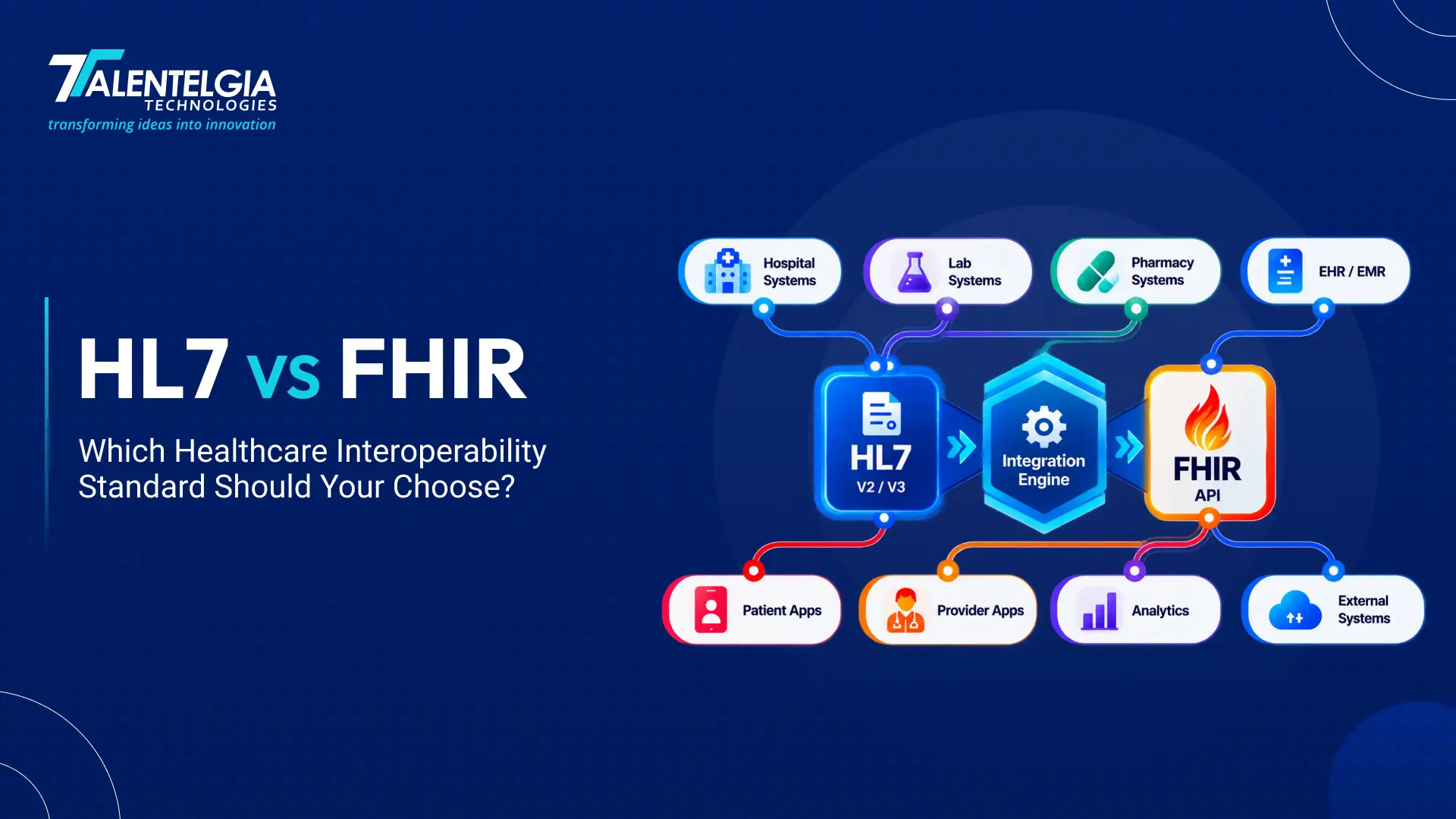
Choosing between FHIR and HL7 is not a simple decision between an older standard and a newer one. FHIR is generally the stronger fit for new API-driven healthcare applications, patient-facing platforms, mobile products, and third-party integrations. HL7 V2 remains highly relevant for established hospital workflows such as admissions, discharges, transfers, laboratory results, orders, pharmacy, and billing. For many healthcare organizations, the right architecture uses both.
The reason is straightforward: HL7 is not one standard. Health Level Seven International maintains multiple healthcare interoperability standards, including HL7 V2, V3, CDA, and FHIR. FHIR itself is an HL7 standard designed around modular resources and modern web-based exchange.
For CTOs, CIOs, and healthcare architects, the real question is therefore not “FHIR or HL7?” It is which standard should handle which part of the product and integration architecture? The answer depends on existing systems, data exchange patterns, application requirements, regulatory obligations, and the organization’s modernization strategy.
HL7 vs FHIR: What Is the Difference?
The key difference between HL7 V2 and FHIR is their approach to exchanging healthcare information. HL7 V2 primarily represents clinical and administrative events as structured messages made up of segments and fields. FHIR represents healthcare information as modular resources that can be accessed and exchanged through APIs, including RESTful interfaces.
The term “HL7” needs clarification because it can refer to the standards family rather than one specific technical format. HL7 V2 is a widely used messaging standard. HL7 V3 introduced a more formal information model. CDA provides a structured approach to exchanging clinical documents. FHIR takes a resource-oriented approach designed to work with contemporary web technologies.
That distinction matters when planning healthcare interoperability. A hospital may already depend on HL7 V2 interfaces for internal workflows while a new patient application needs FHIR integration to retrieve specific clinical information through APIs.
| Standard | Data Model | Primary Exchange Pattern | Typical Use |
|---|---|---|---|
| HL7 V2 | Segments and fields | Messages | Hospital workflows |
| HL7 V3 | RIM-based structured model | Messages and documents | Structured clinical exchange |
| CDA | Structured clinical documents | Documents | Clinical summaries |
| FHIR | Resources | APIs, messages, documents | Modern application interoperability |
FHIR is therefore not a replacement label for every form of HL7. It is a newer HL7 interoperability standard that can coexist with earlier standards and, in many architectures, provide the API layer over established healthcare systems.
How HL7 Evolved From V2 and V3 to FHIR
2.1 HL7 V2: The Messaging Standard Behind Hospital Workflows
HL7 V2 is built around messages triggered by healthcare events. A message is divided into segments, and each segment contains fields and components defined for a particular type of transaction.
A typical message may contain segments such as:
- MSH: message header and routing information
- PID: patient identification and demographic information
- PV1: patient visit information
- OBR: observation or diagnostic order information
- OBX: observation results
For example, a laboratory system can generate an HL7 V2 result message after a test is completed, allowing an interface engine to route the result into an EHR.
This model remains important because healthcare organizations have invested heavily in systems and interfaces built around event-driven messaging. Replacing a stable V2 interface simply because FHIR is newer can introduce migration risk without solving an actual business or technical problem. HL7 integration services can help organizations maintain these existing interfaces while connecting EHRs, laboratory systems, clinical applications, and other healthcare systems through controlled data exchange.
2.2 HL7 V3: A More Formal Information Model
HL7 V3 took a more formal modeling approach centered on the Reference Information Model (RIM). Its goal was to create a consistent representation of healthcare concepts across different exchange scenarios.
The approach provided a rigorous foundation, but implementations could become difficult to understand and maintain because healthcare software developers had to work with a more complex model and XML-based structures.
V3 is therefore important when understanding the evolution of healthcare interoperability, but it is not the primary modernization target for most teams evaluating a new application architecture today.
2.3 CDA: Standardized Clinical Documents
Clinical Document Architecture (CDA) is designed around the exchange of clinical documents. A CDA document contains structured information such as a header and body, with sections and entries representing clinical content.
This makes CDA appropriate when the exchange requirement is a complete clinical document, such as a clinical summary, rather than an application needing individual data elements through an API.
CDA and HL7 V2 can therefore continue to exist alongside FHIR. The choice depends on whether the product needs document exchange, event messaging, granular resource access, or a combination of these patterns.
2.4 FHIR: A Resource-Based Approach to Healthcare Data
FHIR introduced a modular approach based on Resources. Examples include Patient, Observation, Encounter, MedicationRequest, Condition, and DiagnosticReport.
FHIR also defines an API framework based on established web standards. JSON and XML are supported representations, while RESTful interactions provide common operations for working with resources. FHIR R4 implementation made important parts of the RESTful API, JSON/XML formats, terminology layer, conformance framework, Patient, and Observation resources normative.
This architecture makes FHIR particularly relevant to applications that need granular healthcare data access rather than only receiving predefined messages.
HL7 V2 vs FHIR: How Their Technical Architectures Differ
Uses Message-Based Data Exchange
HL7 V2 generally works by sending a message when a defined healthcare event occurs. The message contains a known structure, with delimiters separating segments, fields, components, and subcomponents.
A simplified example might look like:
MSH|^~\&|LAB|HOSPITAL|EHR|HOSPITAL|202609101200||ORU^R01|12345|P|2.5
PID|1||123456||DOE^JOHN||19800101|M
OBX|1|NM|2345-7^Glucose||102|mg/dL|70-110|N
The value of this model is its reliability within established workflows. An integration engine can receive the message, interpret the trigger event, transform fields where required, and route the result to another system. HL7 V2 commonly operates through Minimal Lower Layer Protocol (MLLP) over TCP/IP. MLLP provides a transport framing mechanism for HL7 messages, while the message itself defines the healthcare content.
This is why HL7 V2 remains common in hospital environments. The technology may not look like a modern web API, but it can perform well for tightly defined, event-driven transactions.
FHIR Uses Resources and APIs
FHIR takes a different approach. Instead of sending one large event-specific message as the primary model, it defines reusable resources representing healthcare concepts. A FHIR R4 API can expose these resources through standardized HTTP interactions, allowing applications to retrieve, create, update, and exchange healthcare data according to the capabilities of the implementation.
A healthcare application might request:
GET /Patient/12345
or:
GET /Observation?patient=12345
The server can return the requested resource in JSON or XML.
FHIR also supports Bundles when multiple resources need to be exchanged together. This allows an application to retrieve related information while retaining a standardized resource model.
FHIR’s architecture is particularly useful for healthcare APIs because applications can request the information they need rather than building every integration around a predefined message feed. ONC describes FHIR as an API-focused standard for representing and exchanging health information, with Resources forming its basic data exchange model.
Architecture Comparison
| Technical Factor | HL7 V2 | FHIR |
|---|---|---|
| Core model | Messages | Resources |
| Typical transport | MLLP/TCP | HTTPS for REST APIs |
| Common representation | Delimited text | JSON/XML |
| Exchange style | Event/message based | API/resource based |
| Data access | Delivered through messages | Query and exchange |
| Extensibility | Local implementation/customization | Profiles and extensions |
| Application integration | Often interface-engine dependent | API-oriented |
| Typical strength | Established internal workflows | Modern application and external integration |
Neither model is universally superior. The architecture should follow the product’s exchange requirements.
HL7 V3 and CDA vs FHIR: Where Do They Fit?
HL7 V3 and CDA are important because “FHIR vs HL7” can otherwise create an inaccurate comparison between FHIR and the entire HL7 standards family.
It is associated with the RIM and more formal XML-based representations. CDA uses structured XML documents for clinical information exchange. FHIR instead organizes information into modular resources that can be accessed individually or assembled into larger exchanges.
The distinction becomes clearer when the unit of exchange is considered:
| Standard | Architecture | Format | Exchange Model | Common Use |
|---|---|---|---|---|
| HL7 V2 | Segment-based | Delimited text | Event messages | ADT, lab, orders |
| HL7 V3 | RIM-based | XML | Structured messages | Formal clinical exchange |
| CDA | Document-based | XML | Clinical documents | Summaries and records |
| FHIR | Resource-based | JSON/XML | APIs, messages, documents | Application interoperability |
FHIR is also capable of supporting document and messaging paradigms, so it should not be reduced to “REST APIs only.” HL7’s own documentation describes FHIR as supporting RESTful architectures as well as messaging, documents, and service-oriented approaches.
For a product team, the practical distinction is this: CDA is useful when a complete clinical document is the required exchange unit, while FHIR is especially useful when applications need structured, granular access to healthcare data.
HL7 vs FHIR: Which Standard Is Better for Different Healthcare Use Cases?
There is no single winner across every healthcare integration scenario. The better choice changes with the workflow.
Hospital ADT and Internal System Integration
HL7 V2 is often the practical choice.
Admission, discharge, and transfer workflows are frequently event-driven. Existing EHRs and departmental systems may already have stable HL7 V2 interfaces for these transactions. Maintaining them can be more sensible than replacing working infrastructure solely to introduce FHIR.
Laboratory and Diagnostic Result Exchange
Both standards can have a role.
An established laboratory feed may continue using HL7 V2 ORU messages to send results to an EHR. A modern application, analytics platform, or partner-facing system may consume the same information through FHIR resources such as Observation and DiagnosticReport.
The important architectural question is not simply which format is newer. It is whether the receiving system needs event-based delivery, API-based access, or both.
Patient Portals and Mobile Healthcare Apps
FHIR is generally the stronger fit.
Patient-facing applications often need specific information such as medications, allergies, immunizations, observations, conditions, and encounters. A resource-based API makes this granular access more natural than building a separate message interface for every application requirement.
The adoption data supports this direction. In 2024, approximately 9 in 10 U.S. hospitals enabled patients to access their health information through an API, and 7 in 10 hospitals reported using standards-based APIs, such as HL7 FHIR, for patient access.
Authorization also becomes a major consideration. FHIR ecosystems can use OAuth-based authorization and SMART on FHIR patterns where supported by the implementation.
EHR-to-Third-Party Integration
FHIR is generally preferable for new API-based integrations.
Healthcare APIs provide a defined interface through which applications can request and exchange standardized data. This is particularly useful for EMR integration when a healthcare product needs to connect with patient records, clinical workflows, and other external healthcare systems without building one-off interfaces for every vendor. FHIR can provide a standardized way to access resources such as Patient, Observation, Condition, MedicationRequest, and Encounter, depending on what the connected system supports.
Clinical Document Exchange
CDA or FHIR can be appropriate depending on the requirement.
If the receiving party needs a complete structured clinical document, CDA may remain appropriate. If the application needs discrete data elements or resource-level access, FHIR may be a better fit. FHIR can also represent documents through appropriate resources and exchange mechanisms.
Analytics and Population Health
FHIR can provide standardized access to data, including bulk data exchange patterns, but the API standard alone does not determine analytical performance. Architecture matters.
Large-scale analytics may require ingestion pipelines, data transformation, terminology normalization, storage optimized for analytical queries, and controls that prevent heavy workloads from affecting operational clinical systems.
When Should Healthcare Organizations Choose HL7 V2 Instead of FHIR?
Choose HL7 V2 when the product must integrate deeply with an established healthcare environment that already depends on V2 interfaces and event-driven workflows.
This is particularly relevant when:
- Existing EHR, LIS, RIS, PACS, pharmacy, or billing systems already expose HL7 V2 interfaces
- Internal workflows depend on real-time event messages
- The integration is primarily system-to-system
- Existing interfaces are stable and operationally important
- Replacing them would create significant migration or validation work without a clear product benefit
Current interoperability data reinforces why V2 cannot simply be treated as legacy technology that should be removed. In an ONC national survey, more than 80% of health information exchange organizations reported routinely or sometimes sending and receiving HL7 V2 messages, while 90% routinely received HL7 V2 ADT messages. The important distinction is that retaining HL7 V2 is not the same as rejecting modernization.
A healthcare organization can keep V2 interfaces for internal clinical workflows while adding a FHIR layer for newer applications. This approach can reduce disruption because the core systems continue operating while modern applications gain access through standardized APIs.
The decision should therefore be based on the role of the interface within the architecture, not on the age of the underlying standard.
When Should Healthcare Organizations Choose FHIR Instead of HL7 V2?
FHIR is generally the stronger choice when a new product needs standardized, API-based access to healthcare information.
It is particularly relevant when building:
- New healthcare applications
- Patient-facing web or mobile products
- Provider-facing applications
- Third-party integrations
- Cloud-based healthcare platforms
- Interoperability services
- Healthcare APIs that expose granular clinical data
FHIR’s use of resources, profiles, JSON/XML, HTTP-based APIs, and established web technologies reduces the need to create an entirely custom exchange model for every application.
FHIR is also relevant to regulatory environments where certified health IT must support standardized API-based exchange. In the United States, ONC’s certification program includes requirements around standardized APIs and continues to evolve its interoperability standards. HTI-1 established USCDI v3 as a baseline for certain certification criteria beginning January 1, 2026, while ONC continues to advance subsequent USCDI versions.
However, choosing FHIR does not eliminate the need for architecture, terminology management, authorization, validation, security controls, or vendor-specific integration work.
Why a Hybrid HL7 V2 and FHIR Architecture Often Makes More Sense
For many established healthcare environments, the most practical architecture looks like this:
Legacy clinical systems → HL7 V2 → Integration Engine → Transformation and Mapping → FHIR Server/API → Applications and External Systems
Keep HL7 V2 Where It Already Works
Existing systems can continue using V2 for:
- Admissions, discharges, and transfers
- Laboratory results
- Orders
- Pharmacy workflows
- Billing-related transactions
There is no inherent requirement to convert every internal message to FHIR simply because a new application is being developed.
Introduce FHIR at the API and Application Layer
FHIR can then provide standardized access for:
- Patient applications
- Provider applications
- Partner systems
- Digital health platforms
- Analytics services
- Other healthcare applications
This approach also supports progressive modernization. New capabilities can use FHIR without requiring the organization to immediately rebuild every legacy interface.
| Talentelgia Experience: FHIR-Based Healthcare Data and AI Workflows Our healthcare app development company has hands-on experience building healthcare products around FHIR-based data structures and healthcare APIs. Healthful AI, a healthcare technology platform, was developed with FHIR R4 healthcare data, clinical data workflows, healthcare API integrations, secure authentication and access control, and AI/ML-powered functionality. The platform uses Python, FastAPI, Next.js, FHIR R4, Supabase, PostgreSQL, and AI/ML pipelines to support structured healthcare data processing and workflow automation. This experience is directly relevant to products that need to expose or consume structured clinical information through modern healthcare APIs while maintaining controlled access to sensitive data. |
HL7 V2-to-FHIR Transformation
A transformation layer may map information such as:
- PID → Patient
- PV1 → Encounter
- OBX → Observation
- OBR → DiagnosticReport or related resources
- IN1 → Coverage
But this should never be treated as a simple one-to-one field conversion exercise.
Legacy interfaces frequently contain local codes, implementation-specific fields, custom Z-segments, optional values, and assumptions that exist only within a particular organization. FHIR implementations may also impose profiles, terminology bindings, cardinality constraints, and other requirements.
That makes mapping, terminology normalization, validation, patient identity, and data quality central parts of a real HL7-to-FHIR modernization project.
HL7 maintains an official Version 2-to-FHIR Implementation Guide to support this type of transformation work.
Also Read: Popular Types of Healthcare Software In 2025
HL7-to-FHIR Migration: Key Challenges Healthcare Organizations Need to Plan For
Moving from an HL7 V2 environment to FHIR is rarely a matter of changing the message format. The underlying information and workflows must also be understood.
Data Mapping and Transformation
A single HL7 V2 message may contain information that needs to be distributed across several FHIR resources. The transformation process must determine what the data means, where it belongs, and which relationships need to be preserved.
Terminology Normalization
Local codes may not directly correspond to the terminology expected by a FHIR implementation. Depending on the use case, teams may need to work with standards such as LOINC, SNOMED CT, or RxNorm and establish mappings for local terminology.
Patient Identity and Matching
FHIR does not solve poor source data. Duplicate patient records, inconsistent identifiers, missing demographics, or conflicting source information can create problems even after data is exposed through a technically valid API.
Legacy System Constraints
Some systems may not support FHIR natively. Others may expose only specific resources or implementation-specific APIs. The integration architecture must account for these limitations instead of assuming uniform FHIR support across the ecosystem.
Security and Access Control
FHIR supports modern security mechanisms, but implementing FHIR alone does not guarantee security or compliance. Teams need appropriate authentication, authorization, transport security, auditability, identity management, consent handling, and operational controls.
SMART on FHIR establishes a framework for application authorization in FHIR environments, while developers commonly use OAuth 2.0 within the authorization architecture.
Validation and Testing
FHIR profiles, implementation guides, terminology bindings, resource validation, integration testing, and clinical data quality checks should be part of the implementation lifecycle.
The objective is not merely to produce syntactically valid FHIR. The data must also have the intended clinical meaning.
FHIR Facade vs HL7-to-FHIR ETL: Which Modernization Pattern Fits?
Healthcare organizations do not always need to migrate their entire data platform before introducing FHIR.
FHIR Facade
A FHIR facade places a FHIR-compatible API layer over an existing system or data source. The underlying clinical database or legacy system can remain in place while external applications interact through FHIR endpoints.
This can be useful when:
- Existing data should remain in its current system
- The immediate objective is API access
- A full data migration is not justified
- The organization needs a gradual modernization path
The trade-off is that requests may require runtime transformation or queries against the underlying system. Complex or high-volume workloads therefore need careful performance planning.
HL7-to-FHIR ETL Pipeline
An ETL approach can ingest HL7 V2 messages, transform them into FHIR resources, normalize terminology, validate the output, and store the resulting resources in a dedicated FHIR data environment.
This can be preferable when:
- A separate standardized data layer is required
- API workloads should be isolated from operational systems
- Large volumes of historical or streaming data need transformation
- Analytics and application workloads require a read-optimized environment
| Requirement | Better Fit |
|---|---|
| API access over an existing source | FHIR Facade |
| Separate standardized data layer | ETL |
| Minimize data duplication | Facade |
| Isolate API workloads from clinical systems | ETL |
| Progressive modernization | Either, based on architecture |
The correct pattern depends on data volume, latency requirements, source-system capabilities, query patterns, governance, and the product’s long-term architecture.
HL7 vs FHIR: Security, Compliance and Interoperability Considerations
Security should not be treated as a simple advantage of one standard over the other.
FHIR provides mechanisms that fit modern application security architectures, including HTTPS-based transport and OAuth-based authorization patterns. SMART on FHIR adds standardized approaches for application authorization. However, these mechanisms still need to be correctly implemented and operated.
HL7 V2 environments may rely more heavily on secured networks, interface engines, transport controls, application-level authentication, and other infrastructure controls.
In either environment, compliance depends on more than the interoperability standard. Healthcare products must consider identity and access management, encryption, audit logging, least-privilege access, data retention, consent, monitoring, vulnerability management, and applicable regulatory requirements.
For organizations operating in the United States, regulatory developments also make API-based interoperability strategically important. ONC’s certification framework includes standardized API requirements and continues to update interoperability standards and implementation specifications.
The right question is therefore not “Is FHIR compliant?” or “Is HL7 secure?” It is how will the selected interoperability architecture be secured, governed, tested, and operated?
HL7 vs FHIR: A Practical Decision Framework for Healthcare Leaders
A useful decision framework starts with the product rather than the standard.
| Requirement | Recommended Direction |
|---|---|
| Existing hospital interfaces | HL7 V2 |
| Internal event-driven workflows | HL7 V2 |
| New healthcare application | FHIR |
| Patient-facing application | FHIR |
| Third-party API integration | FHIR |
| Existing V2 infrastructure plus new APIs | Hybrid |
| Clinical document exchange | CDA or FHIR, based on requirements |
| Modernization without replacing core systems | Hybrid |
| Large-scale transformation | HL7 V2 + FHIR transformation layer |
Choose HL7 V2 if
Your product primarily needs to communicate with established hospital systems through existing event-driven interfaces.
Choose FHIR if
You are building new healthcare APIs, patient or provider applications, or external integrations that require granular access to standardized healthcare data.
Choose Both if
Your organization has substantial legacy infrastructure but also needs modern application interoperability.
For most enterprise healthcare environments, that third option deserves serious consideration. The goal is not to force every system onto one standard. It is to establish an interoperability architecture in which each standard performs the role it is best suited to perform.
Also Read: Healthcare App Development Cost
The Future of Healthcare Interoperability Is Not HL7 vs FHIR
Healthcare organizations do not need to choose one interoperability standard for every system.
HL7 V2 remains valuable for established, event-driven clinical workflows. FHIR provides a strong foundation for modern healthcare APIs, application integration, patient access, and new digital products. CDA remains relevant where structured clinical documents are the required exchange unit.
The more practical strategy is to connect these technologies through a controlled interoperability architecture that supports healthcare interoperability software across existing and modern technology environments.
That can mean retaining proven HL7 V2 interfaces internally, introducing FHIR APIs for new applications, adding transformation and terminology services between systems, and progressively modernizing the data layer where there is a clear business or technical reason to do so.
For healthcare product teams, this approach reduces the pressure to choose between stability and modernization. It allows new healthcare capabilities to use modern interoperability patterns without requiring the immediate replacement of systems that already support critical clinical workflows.
Modernize Healthcare Interoperability Without Rebuilding Your Core
If your healthcare product needs to connect with EHRs, patient applications, clinical systems, or external healthcare platforms, the interoperability architecture needs to be designed alongside the product itself.
Talentelgia’s healthcare app development services include EHR integration services and emphasize integration with existing healthcare systems. Our healthcare development company’s published capabilities also cover hospital and clinic management applications, telemedicine, pharmacy applications, wearable integration, and healthcare application development.
For a new healthcare product, that means evaluating the complete path from existing HL7 interfaces to FHIR-based healthcare APIs, data transformation, application requirements, and security controls rather than treating interoperability as a final integration task.
Frequently Asked Questions (FAQs)
FHIR is an HL7 standard designed around modular healthcare resources and modern API-based exchange, while HL7 V2 is primarily a message-based standard used widely in existing clinical integrations. HL7 also includes standards such as V3 and CDA, so FHIR and “HL7” are not directly equivalent terms.
FHIR is not simply replacing HL7 V2. Many healthcare organizations continue using HL7 V2 for established internal workflows while adopting FHIR for APIs, patient applications, and external integrations. A hybrid architecture can preserve existing HL7 integration while exposing selected healthcare data through FHIR APIs.
FHIR is usually the stronger choice for new healthcare applications, API integrations, and patient-facing products, while HL7 V2 remains practical for established hospital messaging workflows. The decision should consider existing systems, integration requirements, data access patterns, regulatory needs, and the cost and risk of changing operational interfaces.
Yes. HL7 V2 and FHIR can operate within the same healthcare architecture. An integration engine can receive HL7 V2 messages, transform relevant information into FHIR resources, validate the output, and expose it through FHIR APIs. This lets organizations modernize application access without immediately replacing established clinical interfaces.
HL7 V2 typically exchanges structured messages triggered by healthcare events, whereas FHIR APIs provide resource-oriented access through web-based interfaces. A laboratory may send an HL7 V2 result message to an EHR, while an application could use a FHIR API to retrieve Observation or Diagnostic Report resources.
A healthcare application should consider FHIR when it needs standardized API access to clinical or administrative information, especially for patient-facing apps, provider applications, cloud platforms, or third-party integrations. FHIR is particularly useful when applications need granular resources instead of relying solely on predefined event-driven message feeds.
At Talentelgia, we approach FHIR integration around the application’s data, workflow, and interoperability requirements. Our healthcare software development process can include FHIR resource modeling, API integration, authentication, data validation, and EHR connectivity. This helps ensure interoperability is designed into the product rather than added after development.
HL7 V2-to-FHIR conversion requires message parsing, field and segment mapping, terminology normalization, resource construction, validation, and testing. For example, PID information may contribute to a Patient resource and OBX information to an Observation. The exact mapping depends on the source implementation, use case, and applicable FHIR profiles.
Yes. Our healthcare software development services can include HL7 integration for applications that need to exchange information with existing hospital, laboratory, pharmacy, or clinical systems. We assess the source system, message structure, interface requirements, and integration workflows before implementing the appropriate HL7 connectivity and transformation approach.
Yes. Our healthcare development company develops healthcare APIs around application-specific interoperability requirements, including FHIR-based integrations. Our approach can cover resource mapping, API development, authentication, validation, and integration with healthcare systems. This supports healthcare software development projects that need structured clinical data exchange between applications, EHRs, providers, and external platforms.












 Sales Enquiries:
  Business queries:
  HR:
HR: 


