



 Healthcare Software Development Services
 Healthcare App Development Services
 Real Estate Web Development Services
 Real Estate App Development Company
 E-Commerce App Development Services
 E-Commerce Web Development Services
 Blockchain E-commerce Development Company
 Fintech Software Development
 Fintech App Development Services
 E-Learning App Development Services
 Restaurant App Development Company
 Mobile Game Development Company
 Travel App Development Company
 Automotive Web Design
 AI Traffic Management System
 AI Inventory Management Software
 Logistics App Development Services
 Machine Learning Development
 ChatGPT integration services
  AI Development Company
  AI Integration Services
  Natural Language Processing Company
 Mobile App Development
  IOS App Development
  Android App Development
  Cross-Platform App Development
  Augmented Reality (AR) App Development
  Virtual Reality (VR) App Development
  Web App Development
  SaaS App Development
 Custom Software Development Services
  Flutter
  React Native
  Swift (IOS)
  Kotlin (Android)
  Mean Stack Development
  AngularJS Development
  MongoDB Development
  Nodejs Development
  Database Development
 Ruby on Rails Development
 Expressjs Development
  Full Stack Development
  Web Development Services
  Laravel Development
  LAMP Development
  Custom PHP Development
  .Net Development
  User Experience Design Services
  User Interface Design Services
  Automated Testing
  Manual Testing
  Digital Marketing Services
 Ride-Sharing And Taxi Services
 Food Delivery Services
 Grocery Delivery Services
 Transportation And Logistics
 Car Wash App
 Home Services App
 ERP Development Services
 CMS Development Services
 LMS Development
 CRM Development
 DevOps Development Services
 AI Business Solutions
 AI Cloud Solutions
 AI Chatbot Development
 API Development
 Blockchain Product Development
 Cryptocurrency Wallet Development
 About Talentelgia
  Our Team
  Our Culture
 Healthcare App Development Services
 Real Estate Web Development Services
 E-Commerce App Development Services
 E-Commerce Web Development Services
 Blockchain E-commerce
Development Company
Blockchain E-commerce
Development Company Fintech App Development Services
 Blockchain Fintech
Development Company
Blockchain Fintech
Development Company E-Learning App Development Services
 Restaurant App Development Company
 Mobile Game Development Company
 Travel App Development Company
 AI Traffic Management System
 AI Inventory Management Software
 AI Development Company
 ChatGPT integration services
 AI Integration Services
 Machine Learning Development
 Machine learning consulting services
 Blockchain Development
 Blockchain Software Development
 Smart contract development company
 NFT marketplace development services
 Asset tokenization companies
 DeFi Wallet Development Company
 IOS App Development
 Android App Development
 Cross-Platform App Development
 Augmented Reality (AR) App
Development
Augmented Reality (AR) App
Development Virtual Reality (VR) App Development
 Web App Development
 Flutter
 React
Native
React
Native Swift
(IOS)
Swift
(IOS) Kotlin (Android)
 MEAN Stack Development
 AngularJS Development
 MongoDB Development
 Nodejs Development
 Database development services
 Expressjs Development
 Full Stack Development
 Web Development Services
 Laravel Development
 LAMP
Development
LAMP
Development Custom PHP Development
 User Experience Design Services
 User Interface Design Services
 Automated Testing
 Manual
Testing
Manual
Testing About Talentelgia
 Our Team
 Our Culture
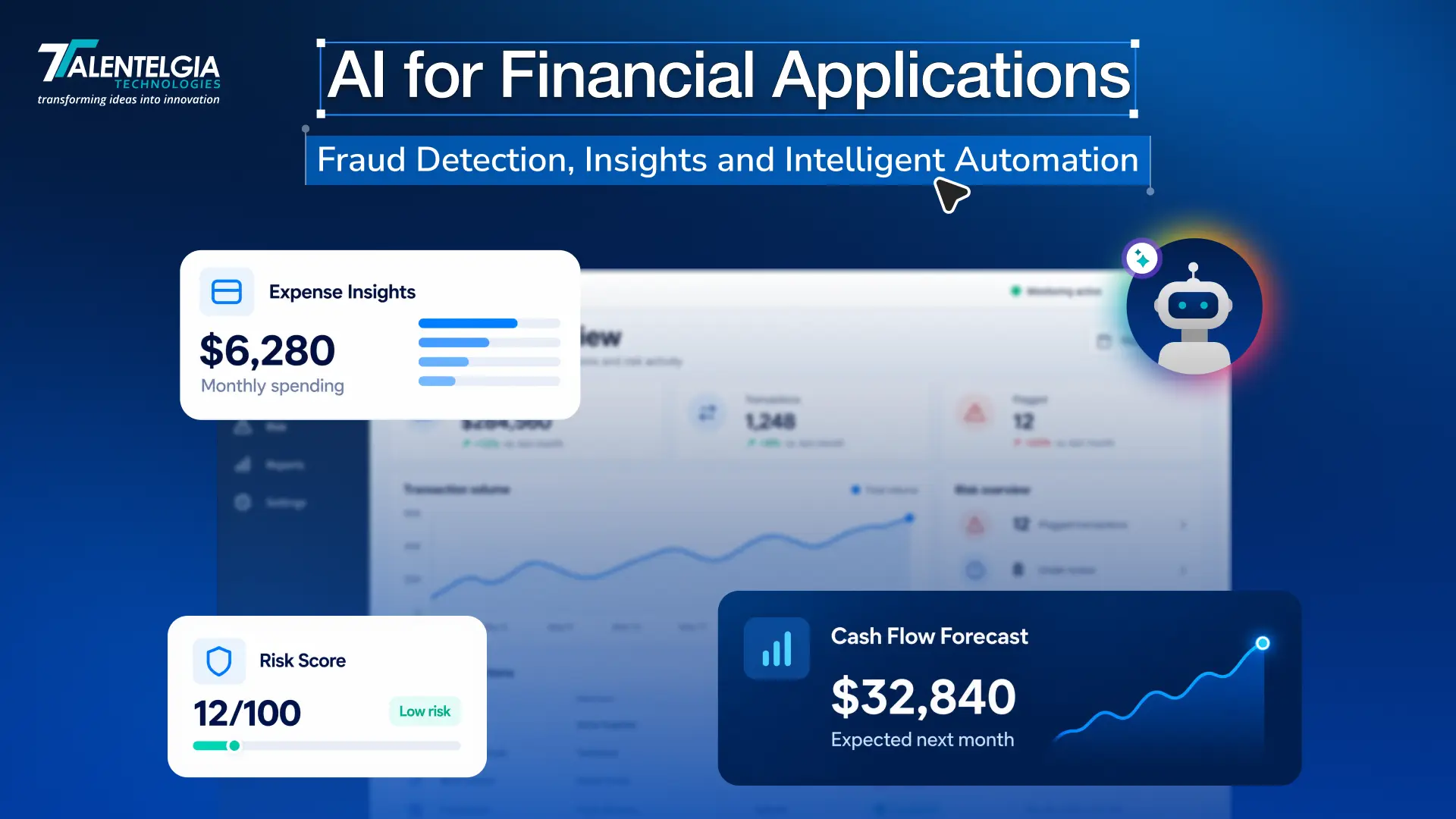
AI for financial applications can detect suspicious activity, analyze transaction behavior, generate financial insights, predict patterns, and automate repetitive workflows. Its value, however, is not simply adding a chatbot to a banking or fintech product. The stronger applications connect AI to transaction data, customer behavior, financial records, business rules, and operational workflows.
The technology is already being applied to core financial processes. PwC’s 2025 Global Compliance Survey found that 36% of respondents were piloting or using AI for fraud detection, while 46% were piloting or using AI for data and predictive analytics.
For businesses exploring AI in financial services, the engineering question is therefore not whether AI can be added, but where it can produce measurable value while maintaining security, accuracy, and appropriate human control.
Where AI Fits Into Financial Applications
AI shows up in a financial product wherever there’s a repetitive judgment call to make at scale. That’s the common thread across the use cases below:
AI shows up in a financial product wherever there’s a repetitive judgment call to make at scale. That’s the common thread across the use cases below:
- Fraud and anomaly detection: The model learns what normal activity looks like for an account. It flags transactions that break that pattern.
- Financial insights and personalization: AI reads spending and account activity. It surfaces recommendations built for that specific user, not generic tips.
- Transaction monitoring: The system watches transaction and behavioral signals in real time. It scores risk continuously instead of waiting for a periodic check.
- Risk assessment: Predictive models plug into existing risk workflows. Underwriters get a starting score instead of a raw dataset to sort through.
- Document and data processing: AI classifies incoming documents and pulls out the relevant fields. It routes each one to the right queue for review.
- Customer support automation: Routine questions get answered automatically. Anything sensitive or unclear gets escalated to a person.
- Operational automation: Cases get prioritized and requests get classified on their own. Teams stop manually triaging every ticket that comes in.
- Forecasting: Models trained on historical data project cash flow, demand, or other financial indicators forward.
What ties these together is specificity. AI fintech solutions work best when they’re built to solve one of these problems directly, not bolted on as a generic feature.
AI for Fraud Detection and Transaction Monitoring
Fraud detection is where AI earns its keep fastest, simply because financial systems throw off so much behavioral data to learn from. And the problem isn’t shrinking: consumers reported losing over $12.5 billion to fraud in 2024, a jump of 25% from the year before, according to the FTC.
A detection system built on AI looks at more than one signal at a time. It weighs transaction amount and frequency alongside account behavior, device and session details, geographic anomalies, past transaction history, and anything that deviates from a customer’s usual pattern.
The important distinction is between rules and models.
| Traditional Rules | AI-Based Detection |
|---|---|
| Predefined conditions | Learns patterns from data |
| Strong for known scenarios | Can identify unusual patterns |
| Requires manual rule updates | Can be retrained with new data |
| Predictable decision logic | Requires ongoing validation |
A production financial application does not need to choose one over the other. Rules can handle known conditions and mandatory controls, while machine learning can provide a risk score or identify patterns that are difficult to encode manually. A case can then be routed for automated action or human review according to its risk level.
This approach is important because AI does not identify every fraudulent transaction. Model quality depends on data, features, thresholds, validation, and how outputs are incorporated into the surrounding fraud workflow.
AI-Powered Financial Insights
Financial applications already collect large amounts of transaction and account data. The harder problem is turning that data into information users can understand and act on.
AI can analyze historical activity to identify spending patterns, categorize expenses, detect unusual spending, estimate future cash flow, surface savings opportunities, and generate personalized notifications. Similar capabilities can also support business users by identifying changes in revenue, expenses, account activity, or other financial indicators.
The difference between data collection and useful intelligence is the interpretation layer. Instead of showing hundreds of transactions, an AI-powered financial application can identify a meaningful pattern and present it as an actionable insight.
These outputs should be framed appropriately as insights, predictions, or recommendations. Financial software should not imply that an AI model automatically provides reliable financial advice. The application should define what the model is permitted to recommend and when additional validation is required.
Intelligent Automation for Financial Workflows
AI-powered financial applications can also reduce manual work in operational processes. Practical examples include document classification, data extraction, transaction review, customer query handling, case prioritization, internal workflow routing, report generation, exception handling, and repetitive back-office processing.
AI is particularly suitable where a workflow involves high data volume, repetitive work, pattern recognition, or clearly defined decision boundaries. Document processing, for example, can extract information from incoming records before a human validates important fields. A suspicious transaction can trigger case creation and routing rather than requiring an employee to identify and assign it manually.
More autonomous AI agents can coordinate multiple predefined actions, but sensitive workflows should retain permissions, validation, and human approval where the consequences of an incorrect action are significant. OWASP specifically identifies excessive agency and sensitive information disclosure as important risks in AI applications.
How AI Works Inside a Financial Application
AI does not operate independently from the financial application. A practical architecture can follow this flow:
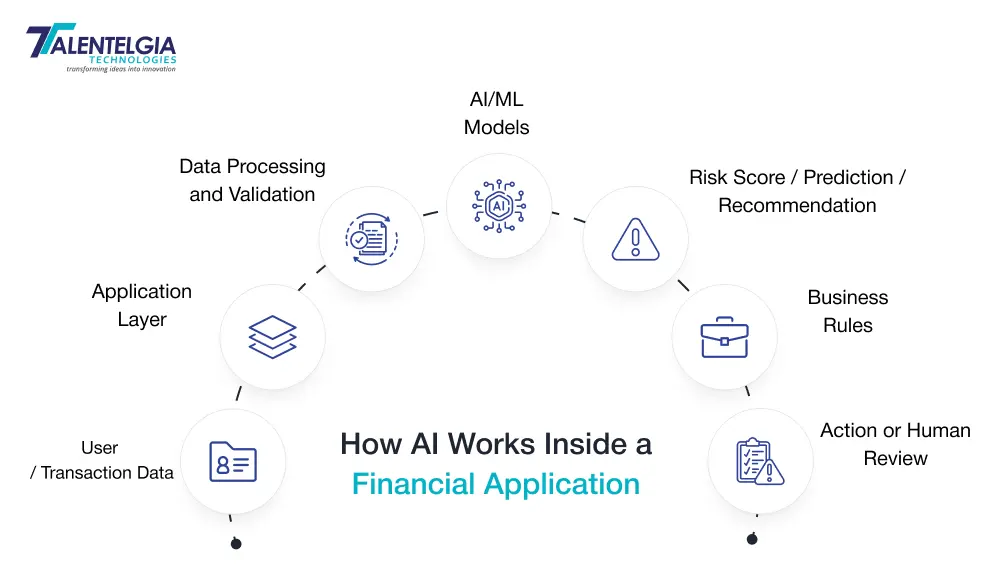
The surrounding architecture determines how model outputs are used. APIs can connect transaction systems and external data sources. Databases and data pipelines provide the information required for analysis. Authentication and authorization restrict access to sensitive information, while notification and workflow systems can act on approved model outputs.
This is where AI/ML development intersects with fintech software development. A successful implementation may involve API development and integration, secure backend services, web application development, mobile application development, and scalable data infrastructure alongside model development.
What Data Does Financial AI Need?
The data foundation often determines whether an AI implementation is useful.
Data quality: Incomplete, inconsistent, or inaccurate records can reduce model reliability.
Historical data: Fraud detection, behavioral analysis, and forecasting generally require relevant historical examples from the target use case.
Real-time data: Transaction monitoring may require current transaction, device, session, and account signals to make timely assessments.
Feature engineering: Raw financial data often needs to be transformed into useful signals, such as transaction frequency, average amount, velocity, or behavioral deviation.
Data governance: Sensitive financial information needs controlled collection, processing, storage, and access. Security must cover both the application and the data used by AI systems. NIST identifies privacy, security, reliability, explainability, accountability, and fairness among the characteristics relevant to trustworthy AI.
When Should Financial Applications Use AI?
AI should solve a genuine data, prediction, classification, or decision-support problem.
| Use Case | AI Fit |
|---|---|
| Detecting unusual transaction behavior | High |
| Categorizing financial transactions | High |
| Generating personalized insights | High |
| Processing large document volumes | High |
| Simple deterministic validation | Usually rules are better |
| Basic calculations | Usually traditional logic is better |
| High-impact financial decisions without review | Requires careful controls |
The question should therefore be, “What problem requires AI?” rather than, “Where can we add AI?”
Building AI-Powered Financial Applications
A practical fintech AI development process should move from the business problem to controlled production use:
- Define the financial problem: Establish the workflow, expected outcome, decision boundary, and success criteria.
- Identify the required data: Determine what historical, transactional, behavioral, and real-time signals are actually available.
- Select the AI/ML approach: Choose the simplest suitable model or AI technique rather than defaulting to generative AI.
- Integrate with application workflows: Connect model outputs to APIs, transaction systems, business rules, and user interfaces.
- Add security controls: Apply authentication, authorization, data protection, logging, and appropriate access restrictions.
- Validate performance: Test accuracy, false positives, false negatives, reliability, and relevant edge cases.
- Introduce human oversight: Define when employees must review or approve model-supported actions.
- Monitor continuously: Track model performance, data changes, application behavior, and operational outcomes.
- Improve with new data: Retrain or refine the system when validated evidence shows that performance needs improvement.
Talentelgia can support this type of implementation through AI/ML development, custom financial application development, API integration, web and mobile development, and secure software architecture. The right approach depends on the financial workflow, available data, technical environment, and level of automation required.
Wrapping Up
AI creates meaningful value in financial applications when it is connected to reliable data, real workflows, and appropriate controls. From fraud detection and transaction monitoring to financial insights, prediction, and workflow automation, the right implementation can make financial software more intelligent without removing the rules and human oversight that critical processes require.
Talentelgia Technologies is an AI and fintech software development company helping businesses build practical, secure, and scalable financial solutions. Our developers bring together AI/ML development, financial application development, API integration, web and mobile development, and secure software architecture to integrate intelligent capabilities into financial products.
The focus is simple: use AI where it solves a genuine business problem and creates measurable value for users and financial operations.
Frequently Asked Questions
Financial applications commonly use machine learning models, anomaly detection, behavioral analytics, and risk scoring to identify unusual transaction patterns. AI fintech solutions can combine these techniques with deterministic rules to improve fraud detection without removing established financial controls.
AI analyzes transaction history, account behavior, device signals, transaction frequency, amounts, and other patterns to identify potentially suspicious activity. In fintech software development, these signals can generate risk scores that trigger additional verification, investigation, or human review.
AI and automation can classify documents, extract financial data, prioritize cases, route workflows, handle customer queries, monitor transactions, generate reports, and identify exceptions. This allows financial application development teams to automate repetitive processes while keeping sensitive decisions under appropriate controls.
AI can be integrated through APIs, data pipelines, model services, and application workflows. A custom implementation can connect AI models with existing databases, transaction systems, business rules, authentication, and notification services without replacing the entire financial software architecture.
The right model depends on the use case. Classification models can support fraud detection, anomaly detection can identify unusual behavior, forecasting models can predict trends, and language models can assist document or customer-support workflows.
A focused AI feature or MVP typically costs $30,000 to $80,000, while a broader production-grade financial application can range from $100,000 to $250,000+. Cost depends on integrations, data complexity, security requirements, AI scope, and development effort.
Yes. We can develop custom AI-powered financial applications around your data, workflows, business rules, user roles, and operational requirements. Our developers can integrate AI with existing financial systems to create solutions aligned with specific business processes.
Talentelgia can develop custom AI-powered financial applications for fraud detection, transaction monitoring, financial insights, forecasting, document processing, workflow automation, and intelligent customer experiences, combining AI/ML development with secure financial application development.













 Sales Enquiries:
  Business queries:
  HR:
HR: 


