



 Healthcare Software Development Services
 Healthcare App Development Services
 Real Estate Web Development Services
 Real Estate App Development Company
 E-Commerce App Development Services
 E-Commerce Web Development Services
 Blockchain E-commerce Development Company
 Fintech Software Development
 Fintech App Development Services
 E-Learning App Development Services
 Restaurant App Development Company
 Mobile Game Development Company
 Travel App Development Company
 Automotive Web Design
 AI Traffic Management System
 AI Inventory Management Software
 Logistics App Development Services
 Machine Learning Development
 ChatGPT integration services
  AI Development Company
  AI Integration Services
  Natural Language Processing Company
 Mobile App Development
  IOS App Development
  Android App Development
  Cross-Platform App Development
  Augmented Reality (AR) App Development
  Virtual Reality (VR) App Development
  Web App Development
  SaaS App Development
 Custom Software Development Services
  Flutter
  React Native
  Swift (IOS)
  Kotlin (Android)
  Mean Stack Development
  AngularJS Development
  MongoDB Development
  Nodejs Development
  Database Development
 Ruby on Rails Development
 Expressjs Development
  Full Stack Development
  Web Development Services
  Laravel Development
  LAMP Development
  Custom PHP Development
  .Net Development
  User Experience Design Services
  User Interface Design Services
  Automated Testing
  Manual Testing
  Digital Marketing Services
 Ride-Sharing And Taxi Services
 Food Delivery Services
 Grocery Delivery Services
 Transportation And Logistics
 Car Wash App
 Home Services App
 ERP Development Services
 CMS Development Services
 LMS Development
 CRM Development
 DevOps Development Services
 AI Business Solutions
 AI Cloud Solutions
 AI Chatbot Development
 API Development
 Blockchain Product Development
 Cryptocurrency Wallet Development
 About Talentelgia
  Our Team
  Our Culture
 Healthcare App Development Services
 Real Estate Web Development Services
 E-Commerce App Development Services
 E-Commerce Web Development Services
 Blockchain E-commerce
Development Company
Blockchain E-commerce
Development Company Fintech App Development Services
 Blockchain Fintech
Development Company
Blockchain Fintech
Development Company E-Learning App Development Services
 Restaurant App Development Company
 Mobile Game Development Company
 Travel App Development Company
 AI Traffic Management System
 AI Inventory Management Software
 AI Development Company
 ChatGPT integration services
 AI Integration Services
 Machine Learning Development
 Machine learning consulting services
 Blockchain Development
 Blockchain Software Development
 Smart contract development company
 NFT marketplace development services
 Asset tokenization companies
 DeFi Wallet Development Company
 IOS App Development
 Android App Development
 Cross-Platform App Development
 Augmented Reality (AR) App
Development
Augmented Reality (AR) App
Development Virtual Reality (VR) App Development
 Web App Development
 Flutter
 React
Native
React
Native Swift
(IOS)
Swift
(IOS) Kotlin (Android)
 MEAN Stack Development
 AngularJS Development
 MongoDB Development
 Nodejs Development
 Database development services
 Expressjs Development
 Full Stack Development
 Web Development Services
 Laravel Development
 LAMP
Development
LAMP
Development Custom PHP Development
 User Experience Design Services
 User Interface Design Services
 Automated Testing
 Manual
Testing
Manual
Testing About Talentelgia
 Our Team
 Our Culture
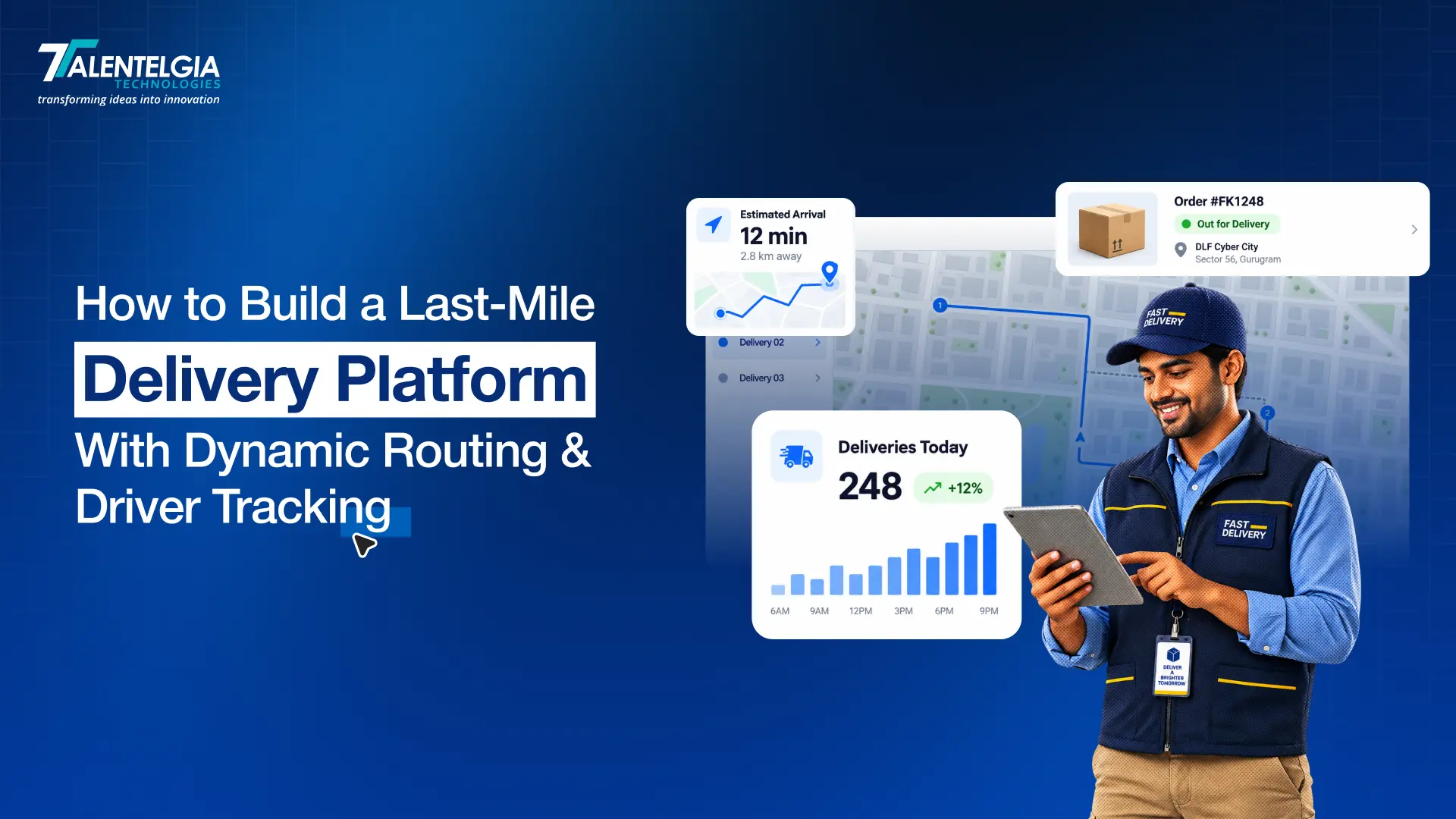
Last-mile delivery platforms are difficult to build because deliveries rarely follow the plan created at dispatch time. Traffic changes, drivers become unavailable, customers change delivery windows, and new orders enter the system.
A useful platform must therefore connect route planning, driver location, dispatch, customer updates, and operational data in one system. Last-mile delivery software should not treat routing and tracking as separate features. Each should continuously inform the other. The business case is also significant. Last-mile delivery represented 53% of total shipping costs in 2023, up from 41% in 2018, according to Statista’s cited worldwide data.
For businesses evaluating this type of platform, the decision is usually whether to buy existing software, build internally, or work with a technology partner. This guide explains the architecture, routing logic, tracking pipeline, integrations, development process, costs, and key engineering decisions behind such a platform.
What Is a Last-Mile Delivery Platform?
A last-mile delivery platform coordinates the operational journey between an order becoming ready for delivery and the delivery being completed.
At minimum, it needs to answer five questions:
- What needs to be delivered? Orders, stops, packages, quantities, service requirements, and delivery windows.
- Who can deliver it? Drivers, vehicles, capabilities, availability, territories, and capacity.
- What should happen next? Assignment, sequencing, navigation, and dispatch decisions.
- What is happening now? Driver location, stop status, delays, failed attempts, and exceptions.
- What should customers and operators see? ETAs, statuses, notifications, proof of delivery, and operational alerts.
This makes the platform a coordination system rather than simply a navigation application.
A typical product has five user-facing components:
- Dispatcher dashboard for planning, assignment, monitoring, and intervention.
- Driver application for routes, navigation, task execution, proof of delivery, and status updates.
- Customer experience for tracking, ETA visibility, notifications, and delivery information.
- Administration layer for users, vehicles, territories, rules, permissions, and configuration.
- Backend and event layer connecting orders, routing, location, dispatch, notifications, and analytics.
Building these components together is the core of logistics software development, where operational workflows, real-time data, mobile applications, and backend services have to work as one system.
Why Last-Mile Delivery Platforms Are Difficult to Build
Delivery Data Changes Continuously
Orders can be added, cancelled, rescheduled, delayed, or modified after the initial route has been created.
The system therefore needs a clear operational state model. A delivery might move through states such as:
Created → Ready → Assigned → Dispatched → En Route → Arrived → Completed
Exceptions need their own state transitions. A failed delivery, customer unavailable event, vehicle breakdown, or address correction should not simply overwrite the previous status.
Routes Have Operational Constraints
The shortest route is not necessarily the feasible route.
A route may need to respect:
- Vehicle weight or volume capacity
- Driver working hours
- Delivery time windows
- Pickup-before-delivery dependencies
- Service duration at each stop
- Vehicle restrictions
- Priority deliveries
- Maximum route duration
- Depot start and return requirements
Modern optimization systems explicitly model these constraints. Google Maps Platform, for example, supports time windows, load demands, vehicle limits, work periods, route-duration constraints, and other parameters.
Driver Location Is Real-Time Data
GPS data is noisy, intermittent, and device-dependent. A driver can lose connectivity, stop transmitting, disable permissions, or move through an area with weak coverage.
The platform therefore needs more than a location marker. It needs timestamps, accuracy information, freshness checks, route matching, status events, and a strategy for stale or missing positions.
Dispatch Decisions Affect Everything Downstream
Moving one stop from one driver to another can change:
- Route sequence
- Arrival times
- Vehicle capacity
- Customer ETA
- Driver workload
- Navigation instructions
- Notifications
This is why dispatch cannot be designed independently from routing and tracking.
Driver Connectivity Is Unreliable
A driver application should continue to support critical actions when the network disappears.
The app can store location samples and delivery events locally, then synchronize them when connectivity returns. Navigation platforms such as Mapbox explicitly support offline regions and predictive caching for environments with poor connectivity.
Core Architecture of a Last-Mile Delivery Platform
A practical architecture can be organized around a shared backend and event layer:
| Layer | Primary responsibility |
|---|---|
| Dispatcher dashboard | Planning, assignment, monitoring, intervention |
| Driver application | Navigation, location, task execution, proof of delivery |
| Customer experience | Tracking, ETA, notifications, delivery status |
| API/application layer | Business rules, workflows, authentication, integrations |
| Event layer | Location events, delivery events, route changes, notifications |
| Operational database | Orders, drivers, vehicles, routes, tasks, statuses |
| Geospatial services | Geocoding, routing, distance matrices, map matching |
| Optimization engine | Assignment, sequencing, capacity and constraint optimization |
| Cloud infrastructure | Compute, storage, queues, monitoring, scaling |
The important design principle is shared state with controlled responsibilities.
The driver app should not independently decide the official route. The dispatcher should not manually maintain driver location. The routing engine should not become the system of record for orders.
Instead, each component contributes to the operational state.
| Talentelgia’s documented Soren work demonstrates experience with logistics software, APIs, large datasets, dashboards, and technologies including React, Redux-Saga, Laravel, and MSSQL.For a mobile-heavy platform, Talentelgia also documents cloud-connected applications with real-time synchronization, offline support, and backend integration capabilities. |
How Dynamic Routing Works
Dynamic routing begins with inputs, not a map.
1. Define Route Inputs and Constraints
The optimizer needs structured information about:
- Stops and coordinates
- Pickup and delivery relationships
- Delivery windows
- Vehicle capacity
- Driver availability
- Service time
- Route start and end points
- Priority
- Traffic or travel-time information
- Business-specific restrictions
A routing request can then optimize against one or more objectives, such as travel time, operating cost, on-time performance, or fleet utilization. Google’s Route Optimization API supports both objectives and constraints in its optimization model.
2. Geocode Locations and Build Travel-Time Data
Addresses first need to become usable geographic coordinates.
The platform may then use a routing provider to calculate travel times and distances between locations. For multiple stops and vehicles, this often means generating a travel-time matrix rather than calculating every route independently.
Travel time is more useful than straight-line distance because the optimizer needs to understand the road network.
3. Assign Drivers and Sequence Stops
The optimization problem can then determine which driver should serve which stops and in what order.
This is where mathematical optimization and heuristics become useful. Vehicle routing problems can become computationally expensive as the number of vehicles, stops, and constraints increases. A production system therefore has to balance solution quality against computation time.
Not every operation needs machine learning. A conventional optimizer or well-designed heuristic may be entirely appropriate when the rules and objectives are known.
4. Monitor the Route
Once a route is active, the original plan becomes a baseline.
The system compares expected and actual execution:
- Is the driver on the planned route?
- Has the vehicle stopped for longer than expected?
- Is the next delivery still achievable within its window?
- Has a new order appeared?
- Has a driver become unavailable?
- Has traffic materially changed the ETA?
5. Trigger Re-Routing
Re-routing should be event-driven rather than continuous for every GPS update.
Useful triggers can include:
- Significant route deviation
- Vehicle breakdown
- Driver cancellation
- New high-priority order
- Delivery-window risk
- Major traffic disruption
- Failed delivery
- Stop cancellation
Google’s Fleet Engine documentation describes workflows where planned routes can be re-optimized during the day when traffic, time windows, or new stops change the operating situation.
6. Re-Optimize Only What Needs to Change
A common architectural mistake is rebuilding the entire fleet plan every time something changes. Instead, the platform can identify the affected routes and preserve completed stops and operational commitments where possible.
This reduces unnecessary changes for drivers and dispatchers while still allowing the system to respond to reality.
Building this routing layer requires more than connecting a map API. It involves defining optimization rules, managing route state, handling real-time events, and integrating routing decisions with the wider delivery workflow.
Need to validate your routing workflow? Discuss your delivery operation with Talentelgia’s logistics software development team.
How Real-Time Driver Tracking Works
Driver tracking is a data pipeline, not just a map feature.
GPS Collection
The driver application obtains location information from the mobile device. The application can capture coordinates, timestamp, speed, heading, accuracy, and related context depending on the platform and permissions.
Location frequency should be configurable. High-frequency tracking increases data volume and battery consumption, while low-frequency updates can reduce ETA and monitoring accuracy.
Navigation SDKs can also enhance raw location by snapping it to the road network and detecting route deviation.
Location Pipeline
A typical flow looks like:
Driver device → mobile location service → ingestion API → event/stream layer → operational services → live dashboard/customer experience
The ingestion layer should validate the event before it becomes trusted operational data.
For example, the system can reject malformed coordinates, identify stale timestamps, and associate the update with the correct driver and active route.
Live Location Broadcasting
The latest valid position can be published through a real-time mechanism such as WebSockets or another event-driven channel.
Dispatchers then receive changes without repeatedly refreshing the page.
Customers do not necessarily need the same level of detail. The customer interface may receive a filtered location, ETA, or status based on privacy rules.
Google Fleet Engine is an example of a backend model that combines vehicle state, driver updates, routing information, ETAs, and consumer visibility.
Geofencing
Geofences allow the platform to define geographic boundaries around locations.
Entering or leaving a defined area can trigger operational events such as:
- Driver approaching a stop
- Driver arriving at a destination
- Vehicle leaving a depot
- Delivery completed within a service area
Geofencing should support business rules rather than automatically determining every delivery state. GPS accuracy, urban density, parking locations, and building layouts can all affect the reliability of proximity-based events.
Delivery Events
The application should capture explicit events such as:
- Arrived
- Started service
- Delivered
- Failed
- Rescheduled
- Customer unavailable
- Proof of delivery uploaded
These events are more useful to the business than raw GPS alone.
Location History and ETA
Historical location data can support route replay, operational analysis, dispute investigation, and performance reporting.
ETA should be treated as a calculated value rather than a static field. It can change as the driver’s position, traffic, route sequence, and remaining service times change.
Offline Tracking and Synchronization
When connectivity disappears, the mobile app should queue essential events locally.
Each event should have an identifier and timestamp so synchronization can be idempotent. The backend should be able to recognize a previously received event instead of creating a duplicate delivery action.
How Dispatch, Routing and Tracking Work Together
This is the operational core of the platform:
Tracking detects reality → exceptions modify operational state → dispatch decides what changes → routing recalculates the feasible plan → driver app receives the update.
Consider a driver with 18 scheduled deliveries.
The driver begins the route according to the planned sequence. GPS updates show that progress is slower than expected. The ETA service detects that the fifth delivery is approaching its time-window limit.
That does not automatically mean the system should reorder every stop.
First, the platform updates the operational state: the route is at risk. Dispatch rules can determine whether the affected stop is high priority, whether another driver can take it, or whether the delay is acceptable.
If intervention is required, the routing engine receives the current state. It can calculate an alternative assignment or sequence using remaining stops, current driver locations, capacity, service time, and delivery constraints.
The resulting route change becomes a dispatch decision. The driver application receives the revised stop sequence and navigation information. The customer-facing system receives the new ETA where appropriate.
This creates a closed operational loop instead of three disconnected features.
Technology Architecture
Mobile Layer
The driver application needs:
- Location services
- Navigation
- Background processing
- Local storage
- Push notifications
- Task management
- Proof of delivery
- Offline synchronization
The logistics application should minimize driver interaction while driving. Critical actions should be clear and quick.
Application and API Layer
The backend should own business rules, authorization, task state, route versions, driver assignments, and integration logic.
REST or gRPC APIs can support synchronous operations, while asynchronous messaging is useful for events that do not require an immediate response.
Real-Time and Event Layer
Location and operational events can be distributed through a message broker or streaming platform.
This decouples producers from consumers. A location event might feed the live dashboard, ETA calculation, analytics pipeline, and alerting service without requiring the driver application to call each service separately.
Operational and Geospatial Data
A relational database is often appropriate for transactional entities such as orders, drivers, vehicles, routes, and delivery tasks.
Geospatial workloads may require spatial indexing or a specialized geospatial store depending on volume and query patterns.
Historical location data can be separated from frequently accessed operational data to prevent tracking history from overwhelming transactional workloads.
The OGC Moving Features standard illustrates the broader geospatial requirement: moving-object data needs to be represented and queried across both location and time.
Routing and Mapping
The platform can integrate a third-party mapping and optimization provider rather than building a routing engine from scratch.
Google, HERE, and Mapbox provide different combinations of mapping, routing, navigation, location, and optimization capabilities. The appropriate choice depends on geographic coverage, commercial requirements, routing constraints, SDK support, offline needs, and expected volume.
Cloud Infrastructure
Cloud infrastructure can provide managed databases, object storage, queues, container orchestration, monitoring, autoscaling, and disaster-recovery capabilities.
The architecture should scale independently where necessary. Location ingestion, route optimization, dashboards, and analytics do not necessarily have the same workload pattern.
Integrations a Platform May Need
A production delivery platform rarely operates alone.
Maps and Routing
Mapping providers supply geocoding, routes, distance matrices, navigation, traffic information, or optimization capabilities.
ERP, WMS, OMS and E-Commerce
Orders and inventory often originate outside the delivery platform.
APIs should support order creation, updates, cancellations, inventory state, fulfillment readiness, and delivery completion.
Communication
SMS, email, push notifications, and customer messaging can communicate dispatch, ETA, delay, and completion events.
Payments
If the delivery process involves collection or payment, the platform may integrate payment providers while keeping payment credentials and sensitive information outside the core application where appropriate.
Fleet and IoT
Telematics, vehicle sensors, barcode scanners, temperature sensors, and other devices can provide additional operational signals.
Talentelgia’s API development services explicitly cover cloud APIs and IoT API integration, which are relevant patterns for connected logistics systems.
Analytics
Operational analytics can combine delivery events, route performance, driver activity, distance, service time, exceptions, and customer outcomes.
Security, Reliability and Scalability
A delivery platform handles customer information, driver information, location data, credentials, operational records, and potentially payment-related information.
Security should therefore be part of the architecture rather than an end-stage feature.
Key controls include:
- Strong authentication
- Role-based authorization
- Short-lived access tokens where appropriate
- Encryption in transit and at rest
- API authentication and rate limiting
- Secrets management
- Audit logs
- Location-data access controls
- Data-retention policies
- Secure mobile storage
- Dependency and vulnerability management
Location privacy deserves special consideration. Drivers and customers should not receive more location information than their role requires.
Reliability requires equally deliberate design. The platform should tolerate temporary service failures, delayed events, duplicate messages, mobile disconnections, and integration outages.
For scale, stateless application services can be horizontally replicated, while queues can absorb bursts in location and order traffic. Monitoring should cover API latency, event lag, GPS freshness, optimization failures, database performance, mobile synchronization failures, and external-provider errors.
CTA: Planning a logistics platform? Let our architects assess the integrations, real-time workloads, and infrastructure requirements first.
Common Development Mistakes
Treating Routing as a Simple Map Problem
A route that looks shortest on a map may violate capacity, delivery windows, driver hours, or service requirements.
Ignoring Operational Constraints
Optimization is only as good as the rules supplied to it. Missing service duration or vehicle restrictions can produce routes that are mathematically attractive but operationally unusable.
Building Tracking Without Offline Support
A delivery application that stops recording events whenever connectivity disappears creates gaps exactly when operators need reliable execution data.
Overloading the Driver Application
Drivers need to complete tasks, navigate, capture proof, and report exceptions. Excessive screens and manual inputs increase friction.
Tight Coupling Between Routing and Dispatch
Routing should provide feasible options. Dispatch needs to apply business rules and operational judgment. Combining them too tightly makes changes harder to test and maintain.
Ignoring Integration Failure
External APIs can time out, reject requests, return incomplete data, or become temporarily unavailable. Integrations need retries, timeouts, circuit-breaking strategies, idempotency, and monitoring.
Designing for Average Volume
A platform may perform well with normal weekday traffic but fail when thousands of orders arrive simultaneously. Capacity testing should model peak order ingestion, route calculations, location updates, and notification bursts.
Building Too Much Before Validating the Workflow
The first release does not need every optimization strategy, analytics dashboard, AI capability, and integration. Validate the core operational loop first.
Step-by-Step Process to Build the Platform
A structured logistics development process helps translate operational requirements into a working delivery platform. Logistics software development services typically cover discovery, architecture, application development, integrations, testing, deployment, and ongoing improvements.
1. Map the Existing Delivery Workflow
Document how orders currently enter the operation, how dispatchers assign drivers, what exceptions occur, and how delivery completion is recorded.
The goal is to identify the real workflow rather than reproduce assumptions in software.
2. Define Operational Rules and the Data Model
Define entities such as orders, stops, routes, drivers, vehicles, locations, events, service windows, and exceptions.
Also define who can change each state and what happens when an operation fails.
3. Design the MVP
An initial release may include:
- Order ingestion
- Driver management
- Basic dispatch
- Route generation
- Driver application
- GPS tracking
- Delivery status
- Proof of delivery
- Basic customer tracking
Advanced re-optimization and predictive capabilities can follow once the underlying workflow is proven.
4. Build and Integrate Core Systems
Connect the operational backend to mapping, routing, communication, order systems, and mobile applications.
At this stage, API contracts and event schemas should be versioned because they become dependencies across the platform.
5. Test With Real Delivery Scenarios
Test more than successful deliveries.
Simulate:
- Driver goes offline
- Vehicle breaks down
- Customer cancels
- Address changes
- Delivery window becomes infeasible
- New order appears mid-route
- GPS becomes stale
- Routing provider fails
- Two events arrive out of order
These scenarios reveal architectural weaknesses much earlier than normal happy-path testing.
6. Introduce Advanced Automation
After the basic operational loop is reliable, add sophisticated optimization, predictive ETA, demand forecasting, anomaly detection, automated exception handling, or AI-assisted decision support where the business case justifies them.
The technology should solve a defined operational problem rather than exist as a feature requirement.
What Determines Development Cost?
There is no reliable universal price for this type of delivery management software because architecture and scope can vary substantially.
The main cost drivers are:
- Number of user roles
- Dispatcher functionality
- Driver application complexity
- Customer tracking requirements
- Routing constraints
- Re-optimization frequency
- Number and type of integrations
- Mapping and routing provider usage
- Geographic coverage
- Real-time event volume
- Cloud architecture
- Security requirements
- Testing depth
- Offline functionality
- Analytics
- Maintenance and support
A single-fleet internal application has very different requirements from a multi-tenant platform serving multiple logistics companies across countries.
The most useful way to estimate cost is therefore to define the operational scope, architecture, integrations, volume assumptions, and non-functional requirements first.
How to Choose a Logistics Software Development Company
When evaluating a logistics software development company, assess the prospective partner against the architecture and operational requirements of the actual project.
Look for evidence of:
- Logistics or field-operations experience
- System architecture capability
- API and integration engineering
- Mobile development
- Geospatial technology knowledge
- Real-time event systems
- Cloud engineering
- Database and performance expertise
- Automated and load testing
- Security engineering
- Post-launch support
Ask technical questions during discovery.
- How will location events be stored?
- What happens when a driver goes offline?
- How will duplicate events be handled?
- What triggers re-optimization?
- How will route changes reach the driver?
- What happens if the mapping provider becomes unavailable?
The answers will reveal considerably more than a feature checklist.
FAQs
Building a custom last-mile delivery platform typically costs between $15,000 and $250,000+. The final cost depends on feature complexity, the number of standalone applications required, such as driver, dispatcher, and customer apps, integrations, and the chosen development approach.
A last-mile delivery platform should include route planning, dynamic re-routing, driver tracking, dispatch management, delivery status updates, ETA calculation, proof of delivery, customer notifications, offline support, and analytics. Logistics software development should also account for integrations with mapping, ERP, WMS, OMS, e-commerce, communication, and fleet systems.
Dynamic routing uses current driver locations, traffic conditions, delivery windows, vehicle capacity, service times, and operational constraints to adjust planned routes. Instead of rebuilding every route after each change, the platform identifies affected deliveries and re-optimizes where necessary. This makes logistics software development more responsive to real-world delivery conditions.
Development time varies according to platform scope, integrations, mobile requirements, routing complexity, and testing needs. A basic MVP can be delivered faster than a multi-tenant enterprise platform. Logistics software development services should begin with workflow discovery and architecture planning before estimating timelines for development, integration, testing, and deployment.
Real-time driver tracking helps dispatchers monitor route progress, identify delays, update ETAs, and respond to operational exceptions. A reliable system should handle GPS inaccuracies, connectivity loss, stale locations, and synchronization. For custom software development for logistics, tracking should connect directly with dispatch, routing, customer visibility, and delivery events.
The decision depends on operational complexity, existing systems, customization requirements, budget, and long-term product goals. Off-the-shelf software may cover standard workflows, while custom logistics software development allows organizations to design routing, dispatch, tracking, and integrations around their processes. A technical assessment can help define the appropriate approach.
Look for experience across logistics workflows, mobile applications, APIs, geospatial systems, real-time event processing, cloud architecture, integrations, testing, and post-launch support. A logistics software development company should also explain how it will handle offline drivers, route changes, duplicate events, provider failures, data synchronization, and operational exceptions.
Our logistics development company provides software engineering capabilities covering application development, APIs, cloud-connected systems, mobile applications, real-time synchronization, and complex data workflows. Its documented Soren work includes logistics software, APIs, large datasets, dashboards, React, Redux-Saga, Laravel, and MSSQL, supporting projects that require tailored logistics technology solutions.
Yes. Talentelgia can develop solutions around specific operational workflows, integrations, user roles, data models, and delivery requirements. Its approach can support custom logistics software development where routing, driver applications, real-time tracking, APIs, dashboards, and backend systems need to operate together rather than as disconnected products.
Our logistics software development agency brings experience across software architecture, API development, mobile applications, cloud systems, dashboards, and data-intensive applications. For logistics custom software development services, the team can evaluate operational workflows, integrations, real-time workloads, and infrastructure requirements before development, helping define an architecture aligned with the platform’s actual business and technical needs.











 Sales Enquiries:
  Business queries:
  HR:
HR: 


