


 Healthcare App Development Services
 Real Estate Web Development Services
 E-Commerce App Development Services
 E-Commerce Web Development Services
 Blockchain E-commerce Development Company
 Fintech App Development Services
 Fintech Web Development
 Blockchain Fintech Development Company
 E-Learning App Development Services
 Restaurant App Development Company
 Mobile Game Development Company
 Travel App Development Company
 Automotive Web Design
 AI Traffic Management System
 AI Inventory Management Software
 Machine Learning Development
 ChatGPT integration services
  AI Development Company
  AI Integration Services
  Generative AI Development Services
  Natural Language Processing Company
 Mobile App Development
  IOS App Development
  Android App Development
  Cross-Platform App Development
  Augmented Reality (AR) App Development
  Virtual Reality (VR) App Development
  Web App Development
  SaaS App Development
 Flutter
  React Native
  Swift (IOS)
  Kotlin (Android)
  Mean Stack Development
  AngularJS Development
  MongoDB Development
  Nodejs Development
  Database Development
 Ruby on Rails Development
 Expressjs Development
  Full Stack Development
  Web Development Services
  Laravel Development
  LAMP Development
  Custom PHP Development
  .Net Development
  User Experience Design Services
  User Interface Design Services
  Automated Testing
  Manual Testing
  Digital Marketing Services
 Ride-Sharing And Taxi Services
 Food Delivery Services
 Grocery Delivery Services
 Transportation And Logistics
 Car Wash App
 Home Services App
 ERP Development Services
 CMS Development Services
 LMS Development
 CRM Development
 DevOps Development Services
 AI Business Solutions
 AI Cloud Solutions
 AI Chatbot Development
 API Development
 Blockchain Product Development
 Cryptocurrency Wallet Development
 About Talentelgia
  Our Team
  Our Culture
 Healthcare App Development Services
 Real Estate Web Development Services
 E-Commerce App Development Services
 E-Commerce Web Development Services
 Blockchain E-commerce
Development Company
Blockchain E-commerce
Development Company Fintech App Development Services
 Finance Web Development
 Blockchain Fintech
Development Company
Blockchain Fintech
Development Company E-Learning App Development Services
 Restaurant App Development Company
 Mobile Game Development Company
 Travel App Development Company
 Automotive Web Design
 AI Traffic Management System
 AI Inventory Management Software
 AI Development Company
 ChatGPT integration services
 AI Integration Services
 Machine Learning Development
 Machine learning consulting services
 Blockchain Development
 Blockchain Software Development
 Smart contract development company
 NFT marketplace development services
 Asset tokenization companies
 DeFi Wallet Development Company
 IOS App Development
 Android App Development
 Cross-Platform App Development
 Augmented Reality (AR) App
Development
Augmented Reality (AR) App
Development Virtual Reality (VR) App Development
 Web App Development
 Flutter
 React
Native
React
Native Swift
(IOS)
Swift
(IOS) Kotlin (Android)
 MEAN Stack Development
 AngularJS Development
 MongoDB Development
 Nodejs Development
 Database development services
 Expressjs Development
 Full Stack Development
 Web Development Services
 Laravel Development
 LAMP
Development
LAMP
Development Custom PHP Development
 User Experience Design Services
 User Interface Design Services
 Automated Testing
 Manual
Testing
Manual
Testing About Talentelgia
 Our Team
 Our Culture
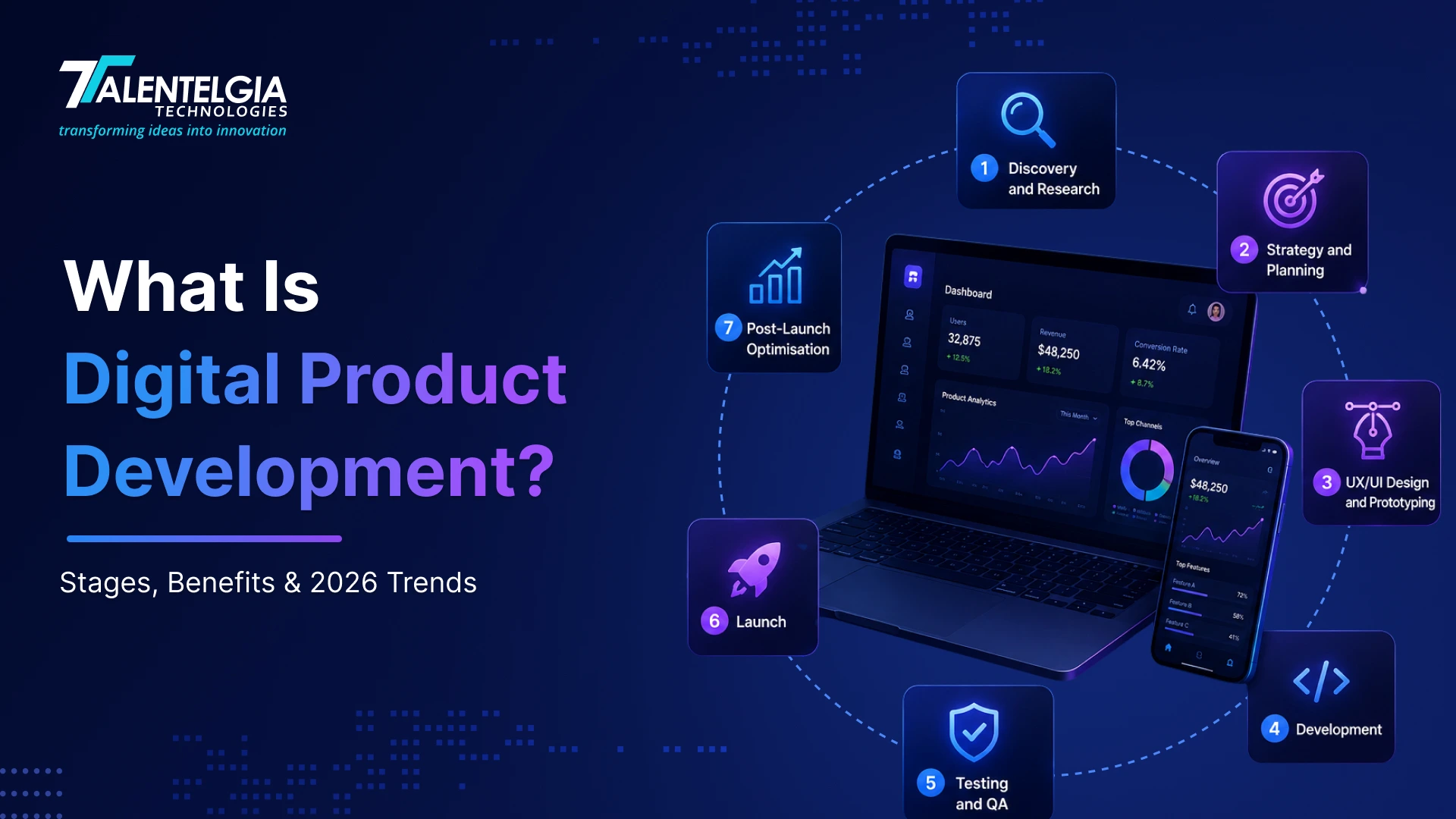
Any application that you use, any SaaS platform that you interact with, anything that does all the background work for you, this is all digital product development.
It starts right from identifying the true problem of a customer, ensuring there is a need for your product, moving on to designing it, developing it, marketing it, and enhancing it according to user feedback. Your end product might be a mobile application, or a web platform, or even an artificial intelligence-powered dashboard, basically any software product that serves to solve a true problem of its users.
In 2025, the software market across the world achieved a value of $823.92 billion and is expected to reach $2.24 trillion by 2034. Digital products stand at the very heart of this trend. Every business building for the future is built digitally.
If you’re trying to understand what this process actually involves, how it works, and what it means for your business, you’re in the right place. Let’s get into it.
What Are The Benefits Of Digital Product Development For Your Business?
Here’s what it delivers when done right:
Faster Time to Market
Thanks to agile methodologies, your team is not waiting for perfection in order to go ahead with launching the product. Iterative development allows for continuous feedback and correction, offering an advantage over other companies that are following a traditional approach.
Lower Costs at Every Stage
Digital products don’t carry inventory, manufacturing overhead, or physical distribution costs. Lean strategies help teams experiment with prototype models before investing resources in finalizing the project. Based on the findings of PwC’s “Digital Product Development 2025,” digital product development has the potential to decrease production costs by an average of 13%.
Stronger User Experience and Retention
81% of those surveyed indicated that positive digital product experiences have a direct and positive influence on business growth, which is very logical if one considers what experiences do. The experience is not an added-on layer to product design; it is rather a tool to ensure that users remain loyal and continue spending more and referring the business to other potential customers.
New and Recurring Revenue Streams
Subscriptions, usage-based billing, licensing, marketplace commissions, and digital products unlock monetization models that physical products structurally cannot. What makes these models genuinely powerful is the margin profile. SaaS platforms and B2B tools, in particular, generate recurring revenue where the cost of serving one additional user is close to zero. That means as your user base grows, your margins improve rather than compress, which is the opposite of how physical product economics work.
Competitive Differentiation
PwC’s research found that digital product development accelerates time to market by 17%, and in fast-moving markets, that gap is rarely recoverable for whoever finishes second. But differentiation through digital product development runs deeper than speed. A well-built product signals to your market that your business understands its users, invests in quality, and is built to evolve. That perception compounds. Customers trust you more, partners take you more seriously, and competitors find it harder to replicate what you’ve built because the advantage isn’t just the product, it’s the capability behind it.
Also Read: Top SaaS Product Development Companies
Digital Product Development vs. Software Development Cycle
Most people use these terms interchangeably. They shouldn’t.
Think of it this way: software development is one chapter. Digital product development is the entire book.
| Digital Product Development | Software Development Cycle | |
|---|---|---|
| Scope | End-to-end – from idea to market to iteration | Focused on coding, testing, and releasing |
| Primary focus | User experience, market fit, business strategy | Technical execution and functional requirements |
| Who’s involved | Product managers, designers, marketers, and engineers | Primarily, developers and QA teams |
| Success metric | Does it solve the right problem for the right user? | Does it work as specified? |
| Lifecycle | Continuous – the product evolves indefinitely | Linear or cyclical per release |
| Starting point | Market research and user discovery | Requirements and technical specifications |
The software development cycle is concerned with how something gets built. Digital product development is concerned with what gets built, why, and for whom, and the technical build is just one phase within it.
In practice, this distinction matters enormously.
Even when using only the software development cycle, a team could produce an absolutely functioning product but fail in selling it. This happens due to the absence of problem validation, user analysis, and an adoption strategy. The digital product development process includes all stages of creating a product, with a focus on user experience, research, and strategy as a priority from day one.
- Software development asks: Can we build this?
- Digital product development asks: Should we build this, and will people actually use it?
That’s the difference that determines whether a product succeeds or disappears.
Digital Product Development in Action: Real-World Case Studies
The best way to understand what digital product development actually delivers is to look at what it has done for businesses that got it right.
Let’s have a look at some of the best digital product development examples: –
| Duolingo – Building a product so good it markets itself Duolingo created a behavioral engine through its language learning application. By focusing on retention and conducting multiple A/B tests, Duolingo was able to create streaks, leaderboards, and gamified lesson sessions to make its product fun to use. As a result, about 80% of new users come in organically. Once the company introduced AI to its product in 2024, paid subscribers increased by 37% to 10.9 million while revenue came in at $252.3 million for the quarter, marking an increase of 41% compared to last year. |
| Nike – Turning fitness apps into a revenue ecosystem Nike leveraged their fitness apps, such as Nike Training Club and Nike Run Club, to make utility-centric products that analyzed behaviors such as workout frequency, goals, and preferences for equipment. In fiscal 2023, Nike Direct sales accounted for $21.3 billion, up 14% from the previous year, thanks to digital sales growing at about 24% year over year. Their digital sales have grown from 10% in 2019 to over 26% in 2023. |
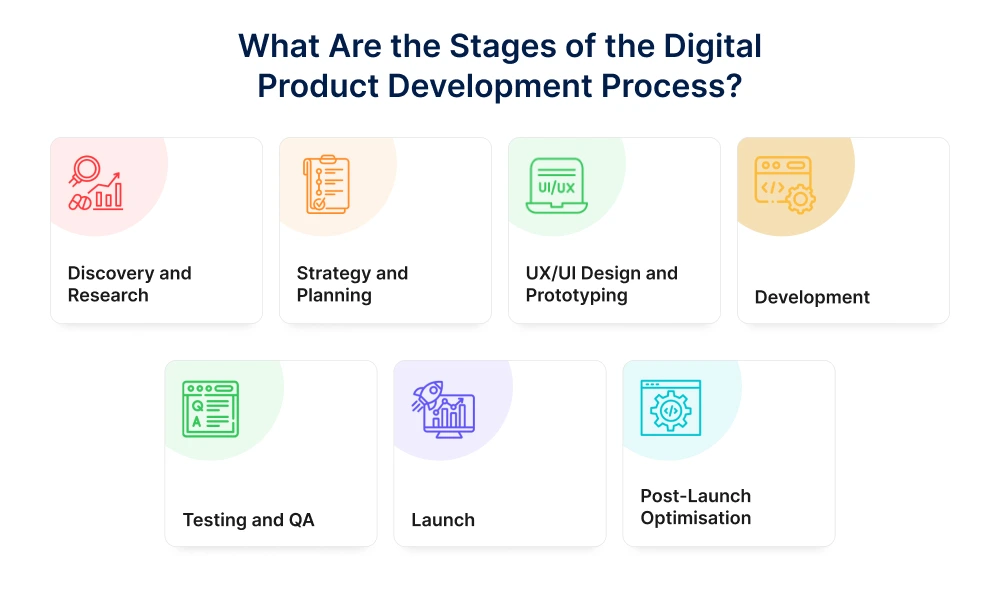
What Are the Stages of the Digital Product Development Process?
Here’s what a solid digital product development process actually looks like, stage by stage:
Stage 1: Discovery and Research
Discovery is about deeply understanding the problem before you touch the solution.
- User interviews and surveys to find genuine problems, rather than those that seem likely
- Competitive analysis for identifying the holes and potential positions, as well as table stakes
- Market sizing and trends to make sure there really is an opportunity worth exploring
- Stakeholder alignment to ensure the product vision is tied to clear business outcomes
Stage 2: Strategy and Planning
Once you know what you’re building and why, the next step is figuring out exactly how you’ll build it, and in what order.
- MVP definition — what’s the leanest version that still delivers genuine value?
- KPI setting — what does success look like, and how will you measure it?
- Tech stack selection — what technologies support your product’s performance, scalability, and budget?
- Timeline and resource planning — who does what, and by when?
Stage 3: UX/UI Design and Prototyping
A product is only as good as the experience it delivers. The best backend engineering in the world means nothing if users can’t figure out how to use what you’ve built.
UX design maps how users move through the product, every screen, every decision point, every interaction. UI design makes those interactions feel intuitive and visually coherent. And critically, both happen before development begins, not alongside it.
- User flows and wireframes that map the complete journey from entry to conversion
- Interactive prototypes built in tools like Figma — clickable, testable, shareable before a single line of code is written
- Usability testing with real users to identify friction points and refine the experience based on actual behaviour, not assumptions
Every UX problem caught at the prototype stage costs a fraction of what it costs to fix in development. This is where you earn your speed later.
Stage 4: Development
This is where the product takes technical form. Engineers develop the user-facing front-end and back-end systems that power it: databases, APIs, authentication, data pipelines, and integrations with third-party software.
The development stage in modern digital product teams runs on agile methodology, divided into short sprints ranging from one to four weeks, during which functional increments of the product are produced.
- Sprint-based delivery keeps the team focused, prevents scope creep, and produces tangible progress on a predictable schedule
- Code integration is carried out continuously, meaning testing and merging code happen frequently, rather than once in a risky rush right before the final deadline.
- Security and performance are built in from the start — not bolted on before launch
Stage 5: Testing and QA
No matter how experienced your development team is, bugs exist. Edge cases exist. Flows that seemed obvious in design turn out to be confusing in practice. Testing is what stands between your team and a bad first impression.
- Unit testing — verifying that individual components function as intended in isolation
- Integration testing — ensuring different modules work correctly when connected
- Performance testing — stress-testing the product under high traffic to identify breaking points before users do
- User Acceptance Testing (UAT) — real users interact with the product and surface issues the team couldn’t anticipate internally
Stage 6: Launch
The product is ready, but ready doesn’t mean you push it live to everyone simultaneously and hope for the best.
- Soft launches or beta testing to a limited user set to identify any problems that will occur in the real world.
- Incremental roll-outs with each one being monitored to address any problems that arise.
- Onboarding flows that reduce the learning curve and get users to value as quickly as possible
- Go-to-market execution — positioning, messaging, and channel strategy to ensure the right users actually find the product
Stage 7: Post-Launch Optimisation
The launch point is where feedback truly begins. Actual users will act differently from your beta testers, will use your product in unanticipated ways, and will highlight problems that were not apparent during beta testing.
- Behavioral analysis (Mixpanel, Hotjar, GA4, etc.) to gain insights into how actual users interact with the product
- A/B testing for evaluating feature iterations and UI changes
- Feedback loops that allow you to integrate direct feedback (surveys, support tickets, user interviews) directly into your roadmap
- Continuous iteration — regular release cycles that ship improvements, fix issues, and expand functionality based on real usage data
Approaches to Digital Product Development: Choosing What Works for Your Product
Not all digital products can be made with a standard process. There are different methods of building digital products depending on your product’s intricacy, requirements, time frame, and flexibility. What is important is to pick a method that will work for you rather than the one that looks better in your presentation.
Here are the most widely used approaches and what each one is actually suited for:
| Approach | Best For | How It Works | Watch Out For |
|---|---|---|---|
| Agile | Products with evolving requirements and user-driven roadmaps | Work is broken into short sprints of 1–4 weeks, each delivering a testable product increment. Feedback shapes the next cycle. | Requires strong team discipline and consistent stakeholder involvement |
| Scrum | Complex, cross-functional product builds with shifting priorities | Structured sprints with defined rituals — planning, standups, retrospectives — keep every team member aligned and accountable | Can feel process-heavy without the right team culture in place |
| Lean | Resource-constrained teams that need to move fast without overbuilding | Focuses on delivering only what creates user value, cutting everything else. Short cycles, continuous quality checks, zero waste. | Risk of under-building core functionality in the rush to stay lean |
| Waterfall | Regulated industries or projects with fully defined, stable requirements | Sequential phases — requirements, design, development, testing, deployment — each completed before the next begins. Predictable timelines and costs. | Almost no room to pivot mid-build if requirements change |
| Hybrid | Large teams managing mixed project types with varying levels of complexity | Combines Waterfall’s upfront structure and documentation with Agile’s flexible, iterative execution. Each team works to its strengths. | Requires careful coordination to prevent methodology clashes between teams |
| RAD (Rapid Application Development) | Products that need a working prototype fast for early user validation | Prioritises prototyping over planning. Heavy use of user testing, feedback loops, and reusable components to compress development timelines. | Not suitable for large-scale, long-term builds that require architectural rigour |
Wrapping Up
Creating digital products seems to be a simple process: develop, launch, scale. Those who have gone through it know about all kinds of decisions, tradeoffs, and corrections that take place between having a concept and creating a truly loved digital product.
The stages, strategies, and digital product development frameworks covered in this blog aren’t theory. They’re the difference between a product that finds its market and one that quietly disappears six months after launch. If you need a partner that knows the whole deal about it, Talentelgia Technologies has more than 14 years of experience working on more than 1,200 projects like this. Come and start with us!












 Write us on:
  Business queries:
  HR:
HR: 


