



 Healthcare Software Development Services
 Healthcare App Development Services
 Real Estate Web Development Services
 Real Estate App Development Company
 E-Commerce App Development Services
 E-Commerce Web Development Services
 Blockchain E-commerce Development Company
 Fintech Software Development
 Fintech App Development Services
 E-Learning App Development Services
 Restaurant App Development Company
 Mobile Game Development Company
 Travel App Development Company
 Automotive Web Design
 AI Traffic Management System
 AI Inventory Management Software
 Logistics App Development Services
 Machine Learning Development
 ChatGPT integration services
  AI Development Company
  AI Integration Services
  Natural Language Processing Company
 Mobile App Development
  IOS App Development
  Android App Development
  Cross-Platform App Development
  Augmented Reality (AR) App Development
  Virtual Reality (VR) App Development
  Web App Development
  SaaS App Development
 Custom Software Development Services
  Flutter
  React Native
  Swift (IOS)
  Kotlin (Android)
  Mean Stack Development
  AngularJS Development
  MongoDB Development
  Nodejs Development
  Database Development
 Ruby on Rails Development
 Expressjs Development
  Full Stack Development
  Web Development Services
  Laravel Development
  LAMP Development
  Custom PHP Development
  .Net Development
  User Experience Design Services
  User Interface Design Services
  Automated Testing
  Manual Testing
  Digital Marketing Services
 Ride-Sharing And Taxi Services
 Food Delivery Services
 Grocery Delivery Services
 Transportation And Logistics
 Car Wash App
 Home Services App
 ERP Development Services
 CMS Development Services
 LMS Development
 CRM Development
 DevOps Development Services
 AI Business Solutions
 AI Cloud Solutions
 AI Chatbot Development
 API Development
 Blockchain Product Development
 Cryptocurrency Wallet Development
 About Talentelgia
  Our Team
  Our Culture
 Healthcare App Development Services
 Real Estate Web Development Services
 E-Commerce App Development Services
 E-Commerce Web Development Services
 Blockchain E-commerce
Development Company
Blockchain E-commerce
Development Company Fintech App Development Services
 Blockchain Fintech
Development Company
Blockchain Fintech
Development Company E-Learning App Development Services
 Restaurant App Development Company
 Mobile Game Development Company
 Travel App Development Company
 AI Traffic Management System
 AI Inventory Management Software
 AI Development Company
 ChatGPT integration services
 AI Integration Services
 Machine Learning Development
 Machine learning consulting services
 Blockchain Development
 Blockchain Software Development
 Smart contract development company
 NFT marketplace development services
 Asset tokenization companies
 DeFi Wallet Development Company
 IOS App Development
 Android App Development
 Cross-Platform App Development
 Augmented Reality (AR) App
Development
Augmented Reality (AR) App
Development Virtual Reality (VR) App Development
 Web App Development
 Flutter
 React
Native
React
Native Swift
(IOS)
Swift
(IOS) Kotlin (Android)
 MEAN Stack Development
 AngularJS Development
 MongoDB Development
 Nodejs Development
 Database development services
 Expressjs Development
 Full Stack Development
 Web Development Services
 Laravel Development
 LAMP
Development
LAMP
Development Custom PHP Development
 User Experience Design Services
 User Interface Design Services
 Automated Testing
 Manual
Testing
Manual
Testing About Talentelgia
 Our Team
 Our Culture

In the world of software development, completing a project is not the end goal. The ultimate goal is to produce a product that satisfies the client and fulfils the demand of the client’s customers. There are several methods for measuring success that are far more comprehensive than simply measuring project completion.
In this guide to the software development performance metrics, we will explain the requirement analysis stage, where you will have information regarding the client’s needs and expectations. The questions answered in this blog will guide you to the software project success criteria.
Understanding Project Success: Key Metrics, Best Practices & Tools
Most project managers ask themselves whether they’re measuring the right things on a project. It’s hard to know how much time to spend evaluating past performance and how much time to keep the work moving forward. While there are plenty of signs of project success, what are you measuring while the work is ongoing?
In the fast-moving landscape of 2026, launching a software project is no longer just about “hitting the deploy button.” With AI-native development and complex cloud architectures becoming the norm, the definition of success has shifted from simple completion to sustainable value delivery.
What Is Project Success?
Success depends on many factors, not just the traditional iron triangle of scope, time and cost. These are important, but a successful project means much more to stakeholders and the organization as a whole, fulfilling not just the mechanics of execution, but also keeping the big picture strategic goals in mind. It is about fulfilling, and ideally exceeding expectations.
In the past, project success followed the “Iron Triangle”: Scope, Cost, and Time. If you hit all three, you won. In 2026, the definition has evolved. Success is now Multidimensional. It’s a combination of:
- Technical Quality: Is the code clean, secure, and scalable?
- User Value: Does it actually solve the problem the user has?
- Business Impact: Does it contribute to the company’s bottom line (ROI)?
Why You Must Measure a Project’s Success?
Measuring project success is more than an academic exercise; it is a critical aspect of successful project management that fosters improvement and leads to strategic alignment. Organizations achieve these mechanisms through software development metrics and systematic evaluation of project outcomes, which provide invaluable insights to inform future decision-making and optimize resource allocation:
1. Validating the Effectiveness of Your Strategies
Without measurement, a “strategy” is really just an educated guess. In software development, teams often adopt new frameworks like Agile or invest in expensive AI-assisted coding tools, assuming they will make things better. Measuring success allows you to prove those assumptions right or wrong. For example, if you implement a new automated testing suite, you should see a direct drop in your failure rates. If the numbers don’t move, the strategy isn’t working. Measuring ensures you aren’t just “doing things” but are actually doing things that work.
2. Enabling Informed, Data-Driven Decisions
In the heat of a project, opinions can be loud, but data is objective. Measuring success provides a “Single Source of Truth” that helps leaders decide where to put their limited budget, time, and talent. Should the team spend the next two weeks fixing old “technical debt” or building a brand-new feature? By looking at feature usage data and system health metrics, the data makes that choice for you. It removes guesswork and ensures that resources are always flowing toward the highest-value tasks.
3. Ensuring Accountability and Transparency
When success is clearly defined by numbers, everyone—from the developers to the CEO—knows exactly where the project stands. This builds a culture of ownership. Publicly tracking how often the team ships code or how long it takes to fix a bug ensures that everyone takes pride in their work. It also builds deep trust with stakeholders; when they can see real-time progress through data, they are much more likely to support the team when challenges arise because they can see the overall trajectory is positive.
4. Identifying Hidden Operational Bottlenecks
A project might feel slow, but without measurement, you won’t know exactly where the “clog” is. Measuring the different stages of the software lifecycle helps you pinpoint the exact moment value gets stuck. You might discover that your developers are writing code very quickly, but that code is sitting in a “review” pile for five days because of a broken approval process. Measuring the time it takes for a change to go live highlights these invisible walls immediately, allowing you to fix the specific process that is actually broken.
5.Justifying ROI and Securing Future Funding
In 2026, software is viewed as a growth engine, not just a bill to be paid. To keep a project funded, you must be able to show a clear Return on Investment (ROI). By tracking how many people are actually using a new feature or how much money a new automation is saving the company, you can prove the project’s worth in dollars and cents. This transforms the development team from a “cost” into a vital part of the company’s financial success, making it much easier to secure the budget for future innovations.
Key Metrics To Measure Project Success
Software development performance metrics are a complicated topic to explain, and you must measure the right things, as the way you measure software delivery metrics will differ substantially from project to project. These methods can be divided into broad categories of quantitative and qualitative approaches: hard criteria broadly refer to quantitative measures or “hard numbers”, while soft criteria focus on qualitative impact — both equally important for understanding a project’s holistic, real-world effect.
For Projects Following the Waterfall Methodology
Waterfall projects are linear and highly structured, meaning success is often tied to how well you adhere to the original “blueprint.” Since changes are expensive once a phase is closed, these metrics focus on predictability and precision.
- Schedule Variance (SV): This measures exactly how far ahead or behind you are compared to your initial project timeline. In Waterfall, a delay in the “Design” phase pushes back everything else, so tracking this daily is the only way to prevent a total collapse of the deadline.
- Cost Performance Index (CPI): This is a measure of the financial efficiency of the project. It tells you whether you are getting a dollar’s worth of work for every dollar spent. A CPI below 1.0 is a red flag that you are over budget for the amount of work completed.
- Milestone Completion Rate: Because Waterfall relies on passing “gates” (e.g., finishing the Requirements phase before moving to Coding), tracking the percentage of milestones hit on time is the best indicator of overall project health.
- Requirement Volatility: This tracks how many changes were made to the initial requirements after the project started. High volatility in a Waterfall project is dangerous, as it indicates that the initial discovery phase was incomplete, which usually leads to massive cost overruns.
- Critical Path Drag: This identifies which specific tasks are currently delaying the final delivery date. Knowing the “Critical Path” allows managers to throw extra resources at the right problems to get the timeline back on track.
For Projects Following Agile Methodology
Agile is built on the idea that requirements will change. Therefore, measuring success isn’t about how well you stuck to a 6-month-old plan; it’s about the speed, quality, and value of the work you are delivering right now.
- Velocity: This tracks the amount of work (usually measured in story points) a team completes during a single sprint. While velocity varies between teams, a stable or increasing velocity over time suggests the team is finding their rhythm and becoming more efficient.
- Cycle Time and Lead Time: Cycle time measures how long it takes to finish a specific task once work has started, while Lead Time measures the total time from the moment a request is made until it is delivered. In 2026, lowering these numbers is the ultimate goal for any “Lean” team.
- Sprint Burndown: This provides a daily look at the remaining work in a sprint. It is the best “early warning system” for Agile teams; if the burndown line isn’t trending toward zero, the team knows they need to reduce the scope of the sprint immediately.
- Escaped Defects: This is a critical quality metric that tracks how many bugs were found by users in production versus how many were caught during the testing phase. A high number of escaped defects means your “Definition of Done” isn’t rigorous enough.
- Net Promoter Score (NPS) or User Satisfaction: Since Agile is user-centric, the ultimate metric is whether the user actually likes what was shipped. Teams often measure this after every release to decide what to build in the next iteration.
How Do You Measure The Success of a Software Project: Step-By-Step Guide
Project managers frequently question whether they are measuring the correct software project KPI and values on a project. It’s hard to know how much time to spend analyzing previous performance and how much time to spend on driving the work forward. There are a ton of metrics for project success, but what should you be measuring while the project is happening?
As a formal project evaluation is useful at the end of a phase or stage, it will give you clear visibility into how you are performing against your original estimates. Then it can be used to provide (or deny) authorization to proceed with the next project. Here are the seven things you should be assessing.

1. Establishing a Solid Schedule Baseline
Before you can measure how far you’ve come, you have to know where you started. A schedule baseline is a “frozen” version of your initial project plan. It serves as the yardstick for all future progress. By comparing your actual progress against this baseline, you can spot “scope creep” or delays early on. In 2026, the best practice is to revisit this baseline only when a formal change is approved, ensuring that your measurements of “on-time delivery” remain honest and transparent.
2. Integrating Continuous Quality Assurance
Success isn’t just about speed; it’s about stability. High-performing teams integrate quality metrics—like defect density and automated test coverage—directly into their daily workflow. Instead of waiting for a “testing phase” at the end, they measure quality at every step. This prevents the accumulation of “technical debt,” which is the hidden cost of fixing messy code later. A project that is delivered on time but is full of bugs is, by modern standards, a failure.
3. Rigorous Tracking of the Project Budget
Financial health is a core pillar of success. Best practices involve tracking “Earned Value,” which compares the work actually performed against the money actually spent. This goes beyond just checking if you are “under budget.” It tells you if you are getting the right value for your investment. If you’ve spent 50% of your budget but only finished 20% of the work, you have an early warning sign that the project’s financial health is at risk.
4. Prioritizing Stakeholder Satisfaction
A project can meet every technical requirement and still fail if the people who paid for it aren’t happy. Modern measurement includes regular “pulse checks” with stakeholders. This involves moving beyond formal meetings and using surveys or feedback loops to measure their confidence in the project’s direction. Ensuring that the end product aligns with their vision—and that they feel informed throughout the process—is often the most accurate predictor of long-term project support.
5. Measuring Performance Against the Business Case
Every software project is born from a business need, whether it’s to save time, reduce risk, or make money. A major best practice is to refer back to the original “Business Case constantly. Are the features being built actually serving the goals that got the project funded in the first place? Teams that measure “Performance to Business Case” ensure they aren’t just building a great piece of software, but a great business tool.
6. Calculating Real-World Return on Investment (ROI)
In 2026, the “Golden Metric” is ROI. This is the practice of comparing the total cost of ownership (development + maintenance) against the financial gains the software provides. Successful teams don’t just calculate this once; they track it for months after launch. This proves the project’s worth to the organization and provides the data needed to secure funding for future versions or new initiatives.
7. Assessing Long-Term Project Impact
True success is measured by how the software lives in the world long after the development team has moved on. This involves tracking “Post-Launch Impact,” such as user retention rates, system uptime, and how easily the software can be scaled. Measuring the long-term impact helps identify if the project created a sustainable solution or just a temporary fix. It’s the difference between a “one-hit wonder” and a platform that serves the company for years.
Templates to Help You Measure Project Success
A good template acts as a “Single Source of Truth,” ensuring that every stakeholder is looking at the same numbers. Here are 4 types of project success metrics templates you should have in your toolkit:
1. KPI Dashboard Template
This is your “Project Cockpit.” A KPI (Key Performance Indicator) dashboard template consolidates complex data into a simple, visual format. In 2026, these are often designed with a “Traffic Light” system (Red, Amber, Green) to show the health of the project at a glance.
- What it measures: Budget vs Actual spend, Percent of task completion, and Team Velocity.
- The Value: It provides immediate clarity for executives who don’t have time to dig into the technical details but need to know if the project is on track to deliver its promised value.
2. Gantt Chart Template
The Gantt chart remains the gold standard for visualizing a project’s timeline and dependencies. It maps out every task against a calendar, showing which jobs must finish before the next can begin.
- What it measures: Schedule variance, critical path delays, and resource allocation.
- The Value: By comparing your “live” Gantt chart against your original baseline, you can visually identify exactly where the timeline is slipping. It’s the best tool for preventing a missed deadline before it happens.
3. Stakeholder Analysis Template
Project success is often a matter of perception. This template helps you map out everyone involved in the project, their level of influence, and their specific expectations.
- What it measures: Stakeholder sentiment, communication frequency, and alignment with project goals.
- The Value: It ensures you aren’t just hitting technical targets but are also managing the human side of the project. A project that is technically perfect but fails to meet a key stakeholder’s expectation is rarely viewed as a success.
4. Project Closure Template
Success is finalized during the closure phase. This template is a structured way to wrap up the project, ensuring that all deliverables were met and that “Lessons Learned” are documented for the future.
- What it measures: Final ROI, delivery against original requirements, and post-launch stability.
- The Value: It forces the team to look back at the data and honestly assess what worked and what didn’t. This template turns a single project’s success into a repeatable blueprint for the entire company.
Software Tools For Managing Project Success
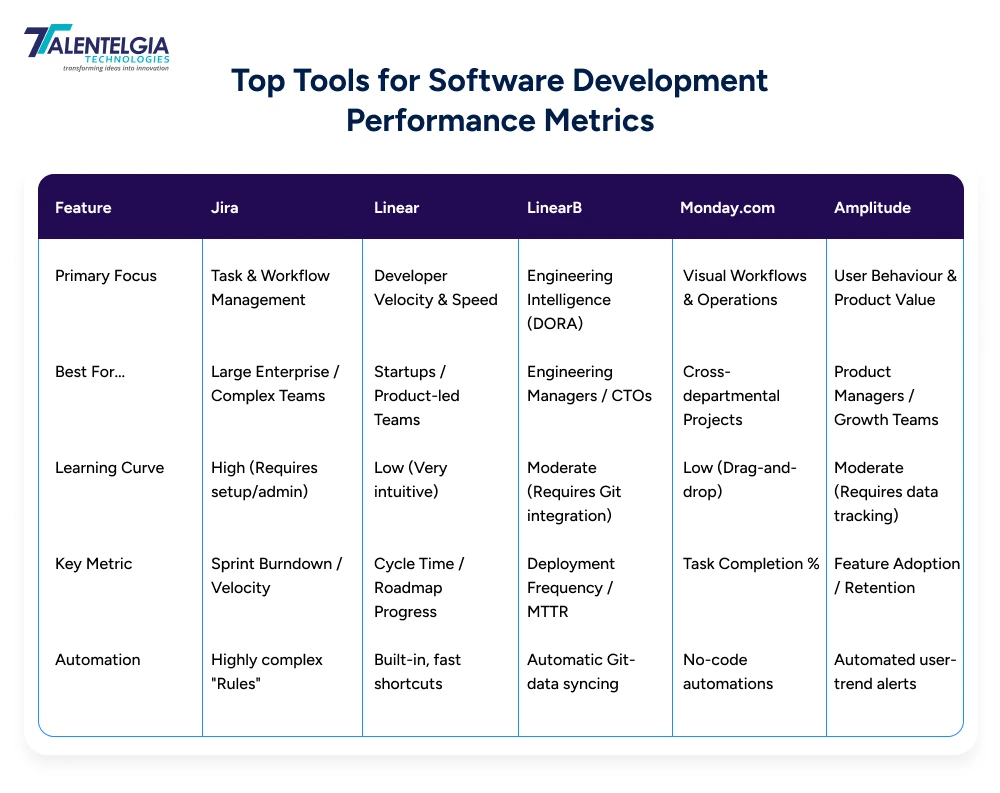
In 2026, manual spreadsheets will be replaced by automated platforms that pull data directly from your code repositories and task boards.
- Linear & Jira (Project Logistics): These are the foundations. They track the “What” and “When.” They are excellent for monitoring task completion, sprint cycles, and overall project timelines.
- LinearB & Jellyfish (Engineering Intelligence): These tools sit on top of your code (like GitHub) to measure “how” the team is working. They automatically calculate DORA metrics, cycle times, and even developer “burnout” levels by analyzing work patterns.
- Pendo & Amplitude (Value Tracking): Once the software is live, these tools measure if it’s actually successful with users. They track feature adoption, user retention, and where people are getting stuck, which directly feeds into your ROI calculations.
Final Thoughts
In the end, project success is measured by each of those factors that lead to the greater whole.
You should know that this cannot, at least not well, be done all in one report — rather, you’ll need to drill down on a single objective for the time being to understand its true effect — and pinpoint specific tangible opportunities for improvement next serially.
Talentelgia’s software developers and engineers take a client-focused approach to projects. Or, they’re all about measuring the impact of their efforts and using insights to ensure lasting improvements.













 Sales Enquiries:
  Business queries:
  HR:
HR: 


