


 Healthcare Software Development Services
 Healthcare App Development Services
 Real Estate Web Development Services
 Real Estate App Development Company
 E-Commerce App Development Services
 E-Commerce Web Development Services
 Blockchain E-commerce Development Company
 Fintech Software Development
 Fintech App Development Services
 E-Learning App Development Services
 Restaurant App Development Company
 Mobile Game Development Company
 Travel App Development Company
 Automotive Web Design
 AI Traffic Management System
 AI Inventory Management Software
 Logistics App Development Services
 Machine Learning Development
 ChatGPT integration services
  AI Development Company
  AI Integration Services
  Natural Language Processing Company
 Mobile App Development
  IOS App Development
  Android App Development
  Cross-Platform App Development
  Augmented Reality (AR) App Development
  Virtual Reality (VR) App Development
  Web App Development
  SaaS App Development
 Custom Software Development Services
  Flutter
  React Native
  Swift (IOS)
  Kotlin (Android)
  Mean Stack Development
  AngularJS Development
  MongoDB Development
  Nodejs Development
  Database Development
 Ruby on Rails Development
 Expressjs Development
  Full Stack Development
  Web Development Services
  Laravel Development
  LAMP Development
  Custom PHP Development
  .Net Development
  User Experience Design Services
  User Interface Design Services
  Automated Testing
  Manual Testing
  Digital Marketing Services
 Ride-Sharing And Taxi Services
 Food Delivery Services
 Grocery Delivery Services
 Transportation And Logistics
 Car Wash App
 Home Services App
 ERP Development Services
 CMS Development Services
 LMS Development
 CRM Development
 DevOps Development Services
 AI Business Solutions
 AI Cloud Solutions
 AI Chatbot Development
 API Development
 Blockchain Product Development
 Cryptocurrency Wallet Development
 About Talentelgia
  Our Team
  Our Culture
 Healthcare App Development Services
 Real Estate Web Development Services
 E-Commerce App Development Services
 E-Commerce Web Development Services
 Blockchain E-commerce
Development Company
Blockchain E-commerce
Development Company Fintech App Development Services
 Blockchain Fintech
Development Company
Blockchain Fintech
Development Company E-Learning App Development Services
 Restaurant App Development Company
 Mobile Game Development Company
 Travel App Development Company
 AI Traffic Management System
 AI Inventory Management Software
 AI Development Company
 ChatGPT integration services
 AI Integration Services
 Machine Learning Development
 Machine learning consulting services
 Blockchain Development
 Blockchain Software Development
 Smart contract development company
 NFT marketplace development services
 Asset tokenization companies
 DeFi Wallet Development Company
 IOS App Development
 Android App Development
 Cross-Platform App Development
 Augmented Reality (AR) App
Development
Augmented Reality (AR) App
Development Virtual Reality (VR) App Development
 Web App Development
 Flutter
 React
Native
React
Native Swift
(IOS)
Swift
(IOS) Kotlin (Android)
 MEAN Stack Development
 AngularJS Development
 MongoDB Development
 Nodejs Development
 Database development services
 Expressjs Development
 Full Stack Development
 Web Development Services
 Laravel Development
 LAMP
Development
LAMP
Development Custom PHP Development
 User Experience Design Services
 User Interface Design Services
 Automated Testing
 Manual
Testing
Manual
Testing About Talentelgia
 Our Team
 Our Culture
Digital transformation is one of the most prevalent strategic initiatives across organizations today. Companies all around the world invest in tons of new platforms, automation tools, advanced analytics & cloud infrastructure to improve efficiency, customer experience, and drive growth. However, many digital transformation projects do not live up to expectations despite these investments. There’s over budget, schedules get drifted away from original plans, which are stretched to either side, and it gets tough for any organization to even realize the benefits that justified the investment in the first place.
The problem is rarely technology itself. Finally, most modern platforms are robust and flexible enough to support significant enhancement of overall business performance. Challenges arise more frequently in the way in which transformation initiatives are scoped, governed, and executed. Often, organizations fail to recognize the complexity of change, and they tend to be too tech-focused, ignoring critical aspects such as business processes and organizational alignment that should be there for success.
To ensure success, the first step is to understand why digital transformation projects fail.
What Is Digital Transformation and Why Is It Important?
At its core, Digital Transformation (DX) is the integration of digital technology into all areas of a business, fundamentally changing how you operate and deliver value to customers. It isn’t about buying excellent software or hiring a Chief Digital Officer. It’s rewiring your entire business, people, processes, and technology—to thrive in a digital-first world.
Here’s the raw truth: ignoring digital transformation isn’t just missing out on cool tech, it’s watching your business slowly choke.
Why It’s Non-Negotiable in 2026:
- Customer Expectations: In the age of instant gratification, if your interface isn’t seamless, your customer is one click away from a competitor.
- Operational Agility: Transformation allows you to pivot your business model in weeks, not years, using real-time data.
- Future-Proofing: With AI-driven competitors entering every niche, staying “analog” is a slow-motion exit strategy.
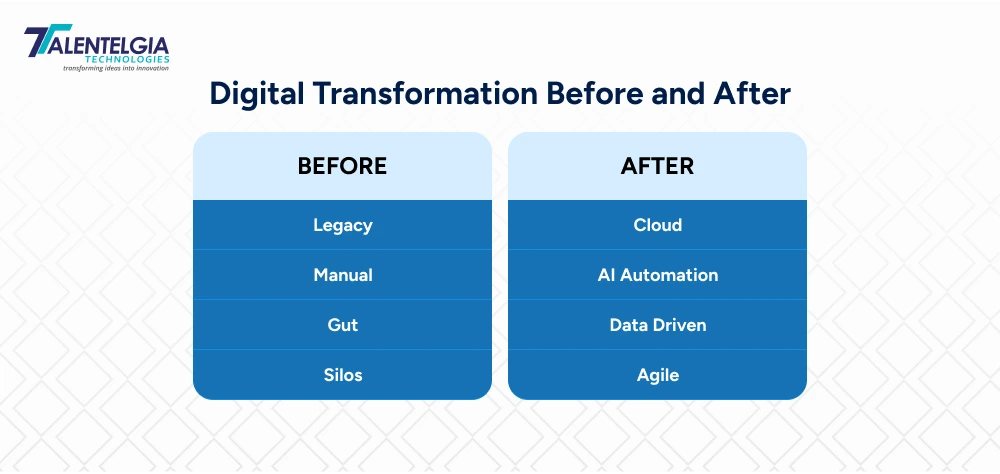
In a modern enterprise, these four points represent the “gravity” that holds a company back from true innovation. When digital transformation touches these areas, it seeks to flip them from liabilities into assets.
Here is how they function as the four interconnected pillars of transformation:
- From Legacy Systems to Modern Infrastructure
Legacy systems are often the biggest hurdle to transformation. They are old, “brittle” software and hardware that are difficult to update and even harder to integrate with modern AI.
- From Manual Tasks to Intelligent Automation
Manual, repetitive tasks are “innovation killers.” They drain your team’s time and are prone to human error. Transformation here focuses on identifying these bottlenecks and applying automation.
- From Gut Instinct to Data-Driven Decisions
In the past, business decisions were often made based on “experience” or “gut feeling.” In a digital enterprise, every decision is backed by real-time analytics.
- From Silos & Rigid Frameworks to Agile Ecosystems
Silos happen when departments (like Sales and IT) don’t talk to each other, and rigid frameworks happen when a company is too “locked-in” to its ways to pivot.
Most Common Reasons Why Digital Transformations Fail
Digital transformation in enterprise is an imperative, not a choice. Yet despite organizations sinking substantial investments into large-scale digital transformation (DX) initiatives, failure rates remain appallingly high. Research from McKinsey has found that 70% of digital transformations don’t reach their goals. Gartner statistics also find that 85% of digital strategies fail because they are poorly executed and not aligned within the organization.
But failure is not usually due to a single factor. In short, it takes place over three interrelated domains:
1. Strategic Failures
A transformation without a clear business strategy is just an expensive hobby. Strategic failures occur when leadership focuses on the “what” (the technology) rather than the “why” (the value).
- Unclear or Misaligned Business Goals: Starting with “We need AI” rather than “We need to reduce logistics costs by 15%.”
- Treated as a One-Time IT Initiative: Viewing transformation as a project with a “finish line” rather than a continuous evolution of the business model.
- Poor Tool & Platform Decisions: Choosing “shiny”, popular tools that don’t actually integrate with the company’s specific needs.
- No Clear Way to Measure ROI: Failing to define what success looks like beyond “going live,” leading to projects that are technically successful but financially useless.
How To Fix: Outcome-Based Roadmapping. Move away from a “Tech-First” approach. Define 3-5 high-impact business outcomes first, then work backward to find the technology that enables them. Establish a Steering Committee that tracks “Value Realization” monthly, not just project milestones.
2. Human Failures
As the saying goes, “Culture eats strategy for breakfast.” In 2026, the human element is the #1 reason transformations stall. If your people don’t buy in, the best code in the world won’t save you.
- Resistance to Change Across Teams: Employees often view new tools as a threat to their job security or a burden on their daily routine.
- Leadership (CXO) Knowledge Gaps: Executives who approve budgets but don’t understand the digital shift, leading to a lack of active sponsorship.
- Siloed Teams & Lack of Collaboration: When the “Digital Team” operates in a vacuum, their solutions rarely work for the “Sales” or “Operations” teams.
- Poor Communication & Change Fatigue: Bombarding staff with constant updates without explaining the “What’s in it for me?” factor.
How To Fix: The “People-First” Governance. Appoint “Digital Champions” within every department—not just IT—to lead the change locally. Incentivize adoption by tying employee bonuses to the successful use of new platforms. Finally, invest in Digital Adoption Platforms (DAP) that provide in-app, real-time training to reduce the learning curve.
3. Technical Failures
Even with a great strategy and a willing team, your transformation will collapse if the underlying technology is a mess of “digital duct tape.”
- Legacy System Limitations & Technical Debt: Trying to build a high-speed AI engine on a 20-year-old database foundation.
- Weak or Inconsistent Data Governance: If your data is messy, “hallucinating,” or unorganized, your AI and analytics will produce garbage insights.
- Disconnected Automation Efforts: Small pockets of automation that don’t talk to each other, creating new “digital silos.”
- Applying AI to Inefficient Processes: Automating a broken process just makes it fail faster.
- Expanding Scope Without Control: Allowing the project to grow (“Scope Creep”) until the original budget and timeline are irrelevant.
How The Fix: Foundational Modernization. Stop “overlaying” new tech on old debt. Use a Composable Architecture approach where you use APIs to bridge legacy systems while building a clean, modern data layer. Clean the data before you call the AI. Implement a strict “Change Control Board” to prevent any new features from being added without a clear ROI case.
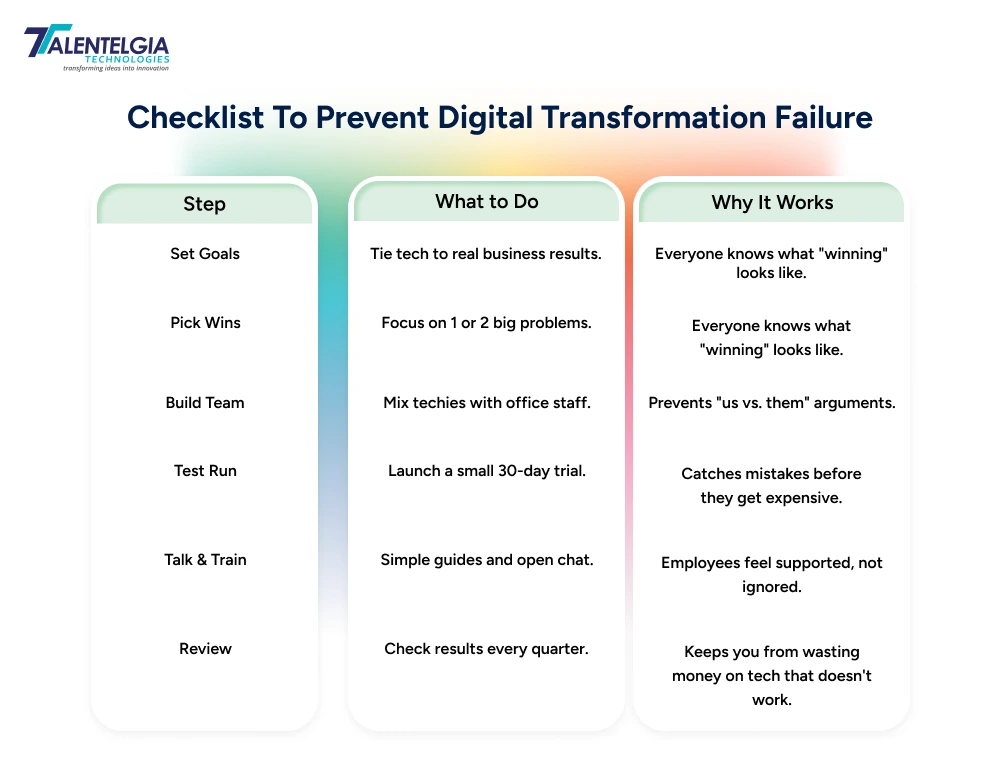
How To Prevent Digital Transformation Fail: 6-Step Success Framework
Usually, the structured approach is required for digital transformation to strike the right balance between speed, clarity and execution. The following framework should be useful for companies starting from scratch as well as those emerging from a stalled transformation:
1. Set Clear Business Goals
Don’t start by picking a trendy AI tool. Start by identifying a specific problem that is costing you money or frustrating your customers. In 2026, the focus has shifted from “experimentation” to Outcome-Based ROI.
- The Goal: Instead of saying “We need to go digital,” set a specific North Star, like “Reduce customer response time by 40%.“
- Strategy: Every dollar you spend must have a “Value Line” to your profit and loss statement. If a piece of software doesn’t clearly help you grow or save time, you don’t need it yet.
2. Pick 1 or 2 “Big Wins” to Start
Trying to change everything at once is the fastest way to overwhelm your team. Modern transformation strategy favours High-Value Use Cases—specific tasks that are high in manual effort but high in business impact.
- The Goal: Find the “low-hanging fruit.” For many in 2026, this means using Agentic AI to automate end-to-end workflows rather than just single tasks.
- Strategy: Pick just one or two specific areas (like billing or customer chat) and fix those first. Winning small battles early builds the momentum you need for the bigger ones later.
3. Get the Right People in the Room
Transformation isn’t just an “IT project“—it’s a company-wide shift. You need a mix of tech experts and the people who actually do the daily work.
- The Goal: Avoid “Digital Fragmentation” by creating cross-functional teams.
- Strategy: Make sure the people using the tools have a say in how they are built. When the “Frontline” staff and the “IT” staff work together, you prevent the friction that usually kills new projects.
4. Test Small Before You Go Big
In 2026, the best approach is “Fail Fast, Learn Faster.” Before rolling out a system to the whole company, try it with a small group first (a Pilot).
- The Goal: Use a test run to find bugs or confusing steps while the “price of failure” is still low.
- Strategy: Run a 30-day trial. Ask the test group for honest, brutal feedback. It is much cheaper to fix a mistake in a small test than to try to repair a global rollout.
5. Focus on Training and Talking
Software doesn’t change a company; people do. Change Fatigue is a real risk in 2026. If your staff feels the new tech is a threat or a burden, they will quietly ignore it.
- The Goal: Move from “Communication” to “Enablement.”
- Strategy: Don’t just send an email. Use Digital Adoption Platforms (tools that guide users inside the app) and hold peer-to-peer coaching sessions. When people see that the tech saves them 2 hours of boring work a day, they’ll become your biggest fans.
6. Check Your Progress Every 3 Months
A digital plan is never “finished.” Annual planning cycles are being replaced by Trigger-Based Decision Making—responding to real signals rather than a fixed calendar.
- The Goal: Turn your transformation into a habit of constant improvement.
- Strategy: Every quarter, look at the numbers. Is the tool actually saving money? Is the team happier? If yes, scale it. If not, pivot. Only 18% of leaders currently do this well, but those who do are 24% more likely to hit their targets.
Final Words
In summary, Digital transformation is not a single task that the IT department can accomplish within months. It’s a continual evolution that depends on having the right people in place on the right platform, and perhaps most importantly, the right change management approach.
When you have these in your arsenal, it enhances your success rate and brings more possibilities.
To learn more, you can contact our digital marketing expert at Talentelgia and start your digital marketing transformation.











 Sales Enquiries:
  Business queries:
  HR:
HR: 


