



 Healthcare Software Development Services
 Healthcare App Development Services
 Real Estate Web Development Services
 Real Estate App Development Company
 E-Commerce App Development Services
 E-Commerce Web Development Services
 Blockchain E-commerce Development Company
 Fintech Software Development
 Fintech App Development Services
 E-Learning App Development Services
 Restaurant App Development Company
 Mobile Game Development Company
 Travel App Development Company
 Automotive Web Design
 AI Traffic Management System
 AI Inventory Management Software
 Logistics App Development Services
 Machine Learning Development
 ChatGPT integration services
  AI Development Company
  AI Integration Services
  Natural Language Processing Company
 Mobile App Development
  IOS App Development
  Android App Development
  Cross-Platform App Development
  Augmented Reality (AR) App Development
  Virtual Reality (VR) App Development
  Web App Development
  SaaS App Development
 Custom Software Development Services
  Flutter
  React Native
  Swift (IOS)
  Kotlin (Android)
  Mean Stack Development
  AngularJS Development
  MongoDB Development
  Nodejs Development
  Database Development
 Ruby on Rails Development
 Expressjs Development
  Full Stack Development
  Web Development Services
  Laravel Development
  LAMP Development
  Custom PHP Development
  .Net Development
  User Experience Design Services
  User Interface Design Services
  Automated Testing
  Manual Testing
  Digital Marketing Services
 Ride-Sharing And Taxi Services
 Food Delivery Services
 Grocery Delivery Services
 Transportation And Logistics
 Car Wash App
 Home Services App
 ERP Development Services
 CMS Development Services
 LMS Development
 CRM Development
 DevOps Development Services
 AI Business Solutions
 AI Cloud Solutions
 AI Chatbot Development
 API Development
 Blockchain Product Development
 Cryptocurrency Wallet Development
 About Talentelgia
  Our Team
  Our Culture
 Healthcare App Development Services
 Real Estate Web Development Services
 E-Commerce App Development Services
 E-Commerce Web Development Services
 Blockchain E-commerce
Development Company
Blockchain E-commerce
Development Company Fintech App Development Services
 Blockchain Fintech
Development Company
Blockchain Fintech
Development Company E-Learning App Development Services
 Restaurant App Development Company
 Mobile Game Development Company
 Travel App Development Company
 AI Traffic Management System
 AI Inventory Management Software
 AI Development Company
 ChatGPT integration services
 AI Integration Services
 Machine Learning Development
 Machine learning consulting services
 Blockchain Development
 Blockchain Software Development
 Smart contract development company
 NFT marketplace development services
 Asset tokenization companies
 DeFi Wallet Development Company
 IOS App Development
 Android App Development
 Cross-Platform App Development
 Augmented Reality (AR) App
Development
Augmented Reality (AR) App
Development Virtual Reality (VR) App Development
 Web App Development
 Flutter
 React
Native
React
Native Swift
(IOS)
Swift
(IOS) Kotlin (Android)
 MEAN Stack Development
 AngularJS Development
 MongoDB Development
 Nodejs Development
 Database development services
 Expressjs Development
 Full Stack Development
 Web Development Services
 Laravel Development
 LAMP
Development
LAMP
Development Custom PHP Development
 User Experience Design Services
 User Interface Design Services
 Automated Testing
 Manual
Testing
Manual
Testing About Talentelgia
 Our Team
 Our Culture
The software development methodologies have changed drastically over the last few years due to the exponential advancement in technology. Many organizations have been using traditional methods like “Waterfall” for their structured and sequential approach towards project management for years. However, while they work well in certain cases, they’re still not enough to keep up with today’s software projects, which are constantly changing and full of unpredictable factors.
The aim of this article is to identify and describe the significant aspects of the differences between adaptive software development and other popular methods of software development. The following section will cover the key strengths of Adaptive Software Development (ASD) compared to other, more traditional software development methods.
Understanding Adaptive Software Development (ASD)
Created by project management pioneers Jim Highsmith and Sam Bayer in the late 1990s, Adaptive Software Development (ASD) is a philosophical and operational framework built directly on the principles of complex adaptive systems (like ecosystems or economies).
Unlike traditional methods that assume a project’s destination is perfectly predictable, ASD assumes that continuous change and uncertainty are the natural states of software engineering.
Instead of trying to control and suppress deviations from a fixed plan, ASD optimizes the development process to thrive on change. It shifts the organizational focus from rigid “command-and-control” management to a dynamic, collaborative environment where the software evolves through constant experimentation and rapid feedback loops.
Also Read: Software Development For Startups: A Complete Guide
The ASD Lifecycle: Breaking Down The Three Phases
ASD structures work around three repeating phases that form a continuous learning cycle. These phases are not sequential stages with hard boundaries; they are continuous, overlapping activities that repeat until the project mission is achieved. Each phase feeds into the next, creating a self-reinforcing loop of adaptation.
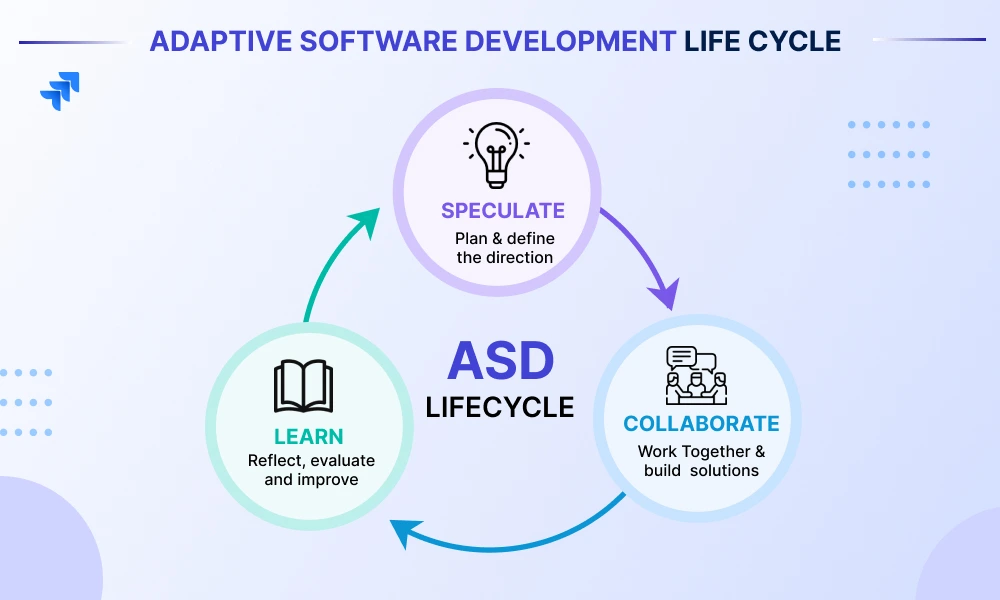
Phase #1: Speculate
Traditional planning assumes you know what to build. ASD’s Speculate phase explicitly acknowledges you don’t, and plans accordingly. Teams define the mission and core objectives while building in flexibility for everything else.
Process:
- Define the high-level project vision and mission
- Identify key feature sets and candidate components
- Estimate timeboxes (typically 1–4 weeks per iteration)
- Surface and document potential risks early
- Remain openly flexible about how objectives will be achieved
Phase #2: Collaborate
The Collaborate phase is where development actually happens, but unlike traditional execution phases, stakeholders remain actively engaged throughout, not just at requirements gathering and final delivery.
Process:
- Cross-functional teams design, build, test, and integrate
- Continuous stakeholder involvement and real-time feedback
- Developers, designers, testers, and business stakeholders work in parallel
- All expertise converges on one shared platform and goal
- Issues surfaced and were resolved immediately, not deferred
Phase #3: Learn
The Learn phase is ASD’s most distinctive contribution to software methodology. At the end of each iteration, the team formally evaluates both the process and the product, turning each cycle into a structured knowledge-generation event.
Process:
- Quality reviews against defined mission objectives
- Status reviews covering the schedule and technical health
- Retrospectives on team dynamics and collaboration effectiveness
- Customer focus groups for real-world feedback
- Insights directly inform the next Speculate phase
6 Key Principles That Define ASD
ASD is not just a process; it’s a philosophy about the nature of complex systems and how teams should respond to them. These six principles, rooted in Highsmith’s original work and validated by decades of real-world deployment, form the intellectual foundation of the methodology.
1. Mission-Focused Rather Than Plan-Focused
ASD replaces the rigid plan with a mission — a clear statement of what success looks like, without over-specifying how that success will be achieved. Teams align to outcomes, not to documentation. This seemingly small shift is what makes ASD resilient to change, while traditional plans are destroyed by it.
2. Feature-Based Delivery
Software is built and delivered in increments of working features, not in phases of design, then development, then testing in isolation. Each iteration delivers tangible software that users can interact with, generating real feedback rather than document-based assumptions about what users want.
3. Iterative Development with Timeboxing
Iterations are strictly timeboxed, one to four weeks, with a defined output expected from each. This discipline prevents the “scope creep” failure mode, where teams expand indefinitely without delivering. If a feature doesn’t fit in the timebox, it is deferred to the next cycle, not used to extend the current one.
4. Risk Tolerance, Not Risk Avoidance
Traditional methodologies treat uncertainty as something to be eliminated through planning. ASD treats uncertainty as an inherent property of complex systems, to be acknowledged, monitored, and managed rather than pretended away. Teams surface risks early, test assumptions quickly, and treat failed experiments as valuable data.
5. Continuous and Active Collaboration
Collaboration in ASD is not a kickoff meeting and a final review. It is a continuous practice, cross-functional teams working in shared spaces (physical or digital), with stakeholders engaged at every iteration. Knowledge is held collectively, not siloed in roles or departments.
6. Learning as a Core Deliverable
In most methodologies, learning is incidental; it happens if teams are lucky or disciplined. In ASD, learning is a designed, mandatory output of every cycle. The Learn phase exists to extract structured knowledge from each iteration: what worked, what didn’t, what the market revealed, and what the technology taught the team.
ASD vs. Traditional Software Development Methods
The software development process has been built around several traditional development methodologies, including the Agile and Waterfall models, for many years. Though these have been viable options for many years, they may not be as effectively suited to the rapidly changing needs of many contemporary projects. This section will review traditional development methodologies and discuss strengths/weaknesses, as well as reasons why adaptive software development is gaining more favour in the development community.
Waterfall Model (1970 – Present): Sequential
The Waterfall model is a sequential, phase-gated approach: Requirements → Design → Implementation → Testing → Deployment → Maintenance. Each phase must be completed before the next begins. It was borrowed from manufacturing and civil engineering industries, where changing a bridge design mid-construction is genuinely catastrophic.
Limitation:
Software isn’t a bridge. Requirements become outdated before development even begins. New technologies force changes to even the best designs. Waterfall treats each phase as a distinct, isolated event, meaning users don’t see working software until the project ends, at which point changes are prohibitively expensive. Waterfall projects report a 50% success rate vs. 70% for Agile projects, significantly surpassing the waterfall method.
Application: Still used in ~37% of projects, especially in regulated environments
Rapid Application Development (RAD, 1991 – Mid 1990s): Iterative
RAD was an early attempt to move beyond Waterfall’s rigidity by emphasizing rapid prototyping and user feedback. Developed by James Martin in 1991, it reduced development time through iterative delivery and active user participation. This was the direct predecessor to ASD, Highsmith and Bayer began their work on ASD while studying RAD’s successes and failures.
Limitation:
It was faster than Waterfall, but it still lacked a clear framework for handling genuine complexity and emergent change. It worked well with experienced teams and stable-enough requirements, but broke down in highly complex, highly uncertain environments, exactly the context ASD was designed for.
Application: Evolved into ASD and other Agile precursors
Spiral Model (Mid 1980s): Iterative Risk Driven
Introduced by Barry Boehm, the Spiral Model pushed the idea of iterative, risk-driven development, an important conceptual step forward. Each “spiral” involved planning, risk analysis, engineering, and evaluation. It was among the first models to make risk management an explicit, continuous part of the development lifecycle.
Limitation:
ASD took Boehm’s risk-awareness further. Where the Spiral Model was still relatively structured and documentation-heavy, ASD built risk tolerance into its culture rather than treating risk as a phase-by-phase checklist item. Highsmith wanted a lifecycle that was not just iterative but explicitly adaptive, learning as it goes rather than analyzing risk at pre-defined gate points.
Application: Influenced ASD’s risk-tolerance principle
Scrum (Early 1990s – Present): Structured Agile
Scrum originated in the early 1990s, influenced by Takeuchi and Nonaka’s 1986 Harvard Business Review paper on cross-functional teams. It crystallized Agile values into a practical framework with clear rules, artefacts (backlogs, burndown charts), and roles (Product Owner, Scrum Master, Development Team). 75% of Agile teams use Scrum as their primary framework as of 2025.
Limitation:
Scrum’s strength is its structure and clarity. Its limitation, relative to ASD, is that structure can become prescriptive in highly uncertain environments. ASD is more flexible about roles and less prescriptive about ceremonies — it sits between highly structured Scrum and completely flexible approaches. Teams today often blend both: ASD thinking for strategy and high-level direction, Scrum mechanics for day-to-day work organization.
Application: 58% of Agile teams use Scrum, often paired with ASD principles
Kanban (2000s – Present): Agile
Kanban is a visual, flow-based framework that emphasizes continuous delivery without fixed-length iterations. Teams use a visual board to manage work-in-progress, visualize flow, and optimize throughput. Unlike Scrum’s sprint structure and ASD’s timeboxed cycles, Kanban has no prescribed iteration length — work flows continuously as capacity permits.
Limitation:
Kanban excels at operational workflows and maintenance environments where work items arrive continuously and unpredictably. It complements ASD well in operational contexts, but lacks ASD’s structured learning mechanisms. Many teams combine Kanban’s visual workflow with ASD’s Speculate-Collaborate-Learn principles in what’s known as a “hybrid” approach.
Application: Best suited for continuous flow work; often combined with ASD or Scrum
Comparing ASD vs. Scrum vs. Agile vs. Waterfall: Full Breakdown
How does ASD compare to the methodologies it helped create, and the ones it was built to replace? This table brings every major dimension into one view:
| Dimension | Waterfall | Scrum | Agile (Broad) | ASD ✦ |
|---|---|---|---|---|
| Change Handling | Resists; costly to change | Accommodates within sprints | Welcomes change | Embraces change as a core value |
| Planning Approach | Exhaustive upfront plan | Sprint-by-sprint backlog planning | Iterative and adaptive | Mission-driven speculation, not fixed plans |
| Structure / Ceremonies | Very rigid; phase gates | Highly structured (daily standup, sprint review, retro) | Principles-based; varies by framework | Flexible; no prescribed ceremonies |
| Roles | Defined, siloed roles | Product Owner, Scrum Master, Dev Team | Varies by framework | Self-organizing; no rigid role definitions |
| Customer Involvement | Front (requirements) and back (delivery) only | Product Owner represents customer continuously | Continuous collaboration valued | Continuous, mandatory stakeholder engagement |
| Delivery Cadence | Single delivery at project end | Working software every 2–4 week sprint | Frequent incremental delivery | Feature-based delivery each 1–6 week iteration |
| Risk Management | Risk identified upfront; hard to pivot | Managed sprint-by-sprint | Risk surfaced through iteration | Explicit risk tolerance; uncertainty is assumed |
| Learning Mechanism | Post-mortems (if conducted) | Sprint retrospectives | Varies | Mandatory Learn phase every cycle |
| Best For | Stable requirements, regulated environments | Clear product roadmaps, stable teams | Most software projects | High complexity, high uncertainty, innovation projects |
| Project Success Rate | 49% (vs 64% Agile) | ~75% with mature implementation | 64% success rate | 67% higher than traditional approaches |
Benefits of Adaptive Software Development (ASD)
The business case for ASD is compelling — not in theory, but in measured outcomes from organizations that have implemented it. These benefits are why the majority of organizations now use some form of Agile practice, and why ASD specifically is growing in relevance as AI accelerates development cycles.
Higher Project Success Rates
Organisations implementing adaptive methodologies report 70% higher project success rates compared to traditional approaches, with significantly reduced time-to-market metrics. Agile projects broadly report 64% success vs. Waterfall’s 50%, with 42% achieving success without significant challenges vs. just 14% for Waterfall.
Faster Time To Market
ASD’s timeboxed iterations and feature-based delivery model mean working software reaches stakeholders every 1–6 weeks, not at the end of a 12-month project. This compresses feedback loops dramatically, allowing teams to validate product-market fit with real users rather than assumptions.
Built-In Change Resilience
Where traditional methodologies treat requirement changes as problems to be controlled (or billed for), ASD architecturally accommodates them. The Speculate phase explicitly acknowledges that the plan will change. This eliminates the structural tension between “what we planned” and “what the market actually needs.”
Higher Team Autonomy & Motivation
ASD fosters a collaborative and empowering work environment. Team members have greater autonomy and are actively involved in decision-making, leading to higher motivation and better performance. Teams shift from execution units following orders to self-organizing groups pursuing a shared mission.
Better Product Quality
The focus on iterative development and frequent communication leads to better software. Continuous testing, continuous integration, and regular stakeholder feedback catch defects earlier in the cycle, when they are cheap to fix, rather than discovering fundamental flaws in a final quality review.
Continuous Organizational Learning
Perhaps ASD’s most enduring contribution: the mandatory Learn phase transforms each iteration into a structured knowledge-generation event. Teams don’t just deliver software; they become smarter about their domain, their process, and their users with every cycle. This compounds into genuine organizational capability over time.
Real-World Examples of Adaptive Software Development
Adaptive Software Development is most useful when teams cannot afford to wait for perfect requirements before building. It works best in products that must evolve continuously based on user behavior, market shifts, and fast-changing business priorities rather than following a rigid fixed plan. Here are some adaptive software development examples:
Spotify (Music Streaming)
Spotify’s engineering challenge is delivering personalized music experiences for hundreds of millions of users while rapidly adapting to new artists, trends, audience shifts, and platform changes simultaneously. Fixed requirements are literally impossible; the right playlist for a user in 2024 is different from the right playlist in 2026, and the algorithm must evolve in real time.
Spotify pioneered the “Squad” model, small, autonomous, cross-functional teams that embody ASD’s Collaborate principle at scale. Each squad has a defined mission, operates independently, and feeds learnings back into a shared organizational intelligence.
Netflix (Entertainment)
Netflix’s transformation from DVD-by-mail to streaming to original content production is the canonical example of organizational adaptability at the highest level. At each transition, Netflix was making bets on uncertain futures; no rigid multi-year plan could have specified the exact path from DVD kiosks to a $32.8 billion content studio.
By continuously adapting strategies based on market feedback, data signals, and emerging technologies, Netflix executed transitions that rigid planning simply couldn’t have supported. The adaptive culture that powered these pivots is the same one ASD prescribes at the team level.
Healthcare AI Diagnostic Tool (Health Technology)
A healthcare technology company developing an AI-assisted diagnostic tool for radiologists adopted ASD because clinical requirements were impossible to specify upfront. What a radiologist needs from an AI assistant cannot be fully articulated in a requirements document; it emerges through interaction with working software in real clinical settings.
ASD’s iterative model allowed the team to deploy minimal prototypes, collect behavioral and qualitative data from radiologists, and refine the tool’s interface and AI model in continuous feedback loops. The final product was shaped by the users who would actually depend on it, not by a product manager’s pre-launch assumptions.
FinTech Consumer Leading Startup (Financial Technology)
A FinTech startup building a consumer lending platform faced the classic innovation challenge: they didn’t know which features would drive user adoption. Rather than committing to a full feature set based on guesswork, they used ASD to structure early development around speculative feature hypotheses. They deployed minimal prototypes with early adopters during the Collaborate phase, collected behavioral data, and used the Learn phase to radically reprioritize.
Within six months, they launched an MVP that real users had already validated, and the final feature set was 40% different from their original plan. Without ASD’s flexibility, that 40% difference would have been discovered after full development, at enormous cost.
How To Know When To Use ASD and When Not To?
ASD is a powerful methodology, but it is not universally applicable. Its greatest advantages emerge in specific contexts where uncertainty, complexity, and the need for innovation are highest. Forcing it into the wrong context produces friction rather than value.
✓ ASD Is the Right Choice When…
- Project requirements are unclear or highly likely to evolve
- You’re building a startup MVP and need to validate product-market fit rapidly
- Rapid market shifts demand flexibility in direction and scope
- Teams operate in innovative, experimental, or R&D domains
- Continuous stakeholder feedback is available and essential
- The organization genuinely values learning over pure predictability
- You’re integrating emerging technologies (AI, ML) with uncertain specifications
- A healthcare technology tool where clinical requirements cannot be specified upfront
- A FinTech product where you don’t yet know which features will drive adoption
✗ ASD Is Not the Right Choice When…
- Regulatory compliance demands rigid, auditable documentation at every step
- Budgets and timelines must be fixed upfront (e.g., public sector contracts)
- Stakeholder involvement is limited or unavailable throughout development
- Teams lack the autonomy, experience, or adaptive maturity ASD requires
- The project involves well-understood, stable requirements with no expected change
- Senior leadership is unwilling to tolerate emergent planning outcomes
- Safety-critical systems where uncertainty is genuinely unacceptable (aviation, nuclear)
Final Thoughts
Adaptive Software Development (ASD) provides standardized processes encouraging a partnership-based method for solving problems through development. It is like putting together a puzzle without knowing what the final product looks like; you must experiment and consult with your team to gain knowledge as you build. Understanding the advantages and disadvantages of using best practice examples is the key to unlocking the doors of successful software development for your organization.
So what? As fast-moving change continues to dominate our world today, organizations want to develop products that users want and are pleased with as quickly as possible. If you want adaptive software development services for your business, contact the Talentelgia team today!











 Sales Enquiries:
  Business queries:
  HR:
HR: 


