


 Healthcare App Development Services
 Real Estate Web Development Services
 E-Commerce App Development Services
 E-Commerce Web Development Services
 Blockchain E-commerce Development Company
 Fintech App Development Services
 Fintech Web Development
 Blockchain Fintech Development Company
 E-Learning App Development Services
 Restaurant App Development Company
 Mobile Game Development Company
 Travel App Development Company
 Automotive Web Design
 AI Traffic Management System
 AI Inventory Management Software
 Machine Learning Development
 ChatGPT integration services
  AI Development Company
  AI Integration Services
  Generative AI Development Services
  Natural Language Processing Company
 Mobile App Development
  IOS App Development
  Android App Development
  Cross-Platform App Development
  Augmented Reality (AR) App Development
  Virtual Reality (VR) App Development
  Web App Development
  SaaS App Development
 Flutter
  React Native
  Swift (IOS)
  Kotlin (Android)
  Mean Stack Development
  AngularJS Development
  MongoDB Development
  Nodejs Development
  Database Development
 Ruby on Rails Development
 Expressjs Development
  Full Stack Development
  Web Development Services
  Laravel Development
  LAMP Development
  Custom PHP Development
  .Net Development
  User Experience Design Services
  User Interface Design Services
  Automated Testing
  Manual Testing
  Digital Marketing Services
 Ride-Sharing And Taxi Services
 Food Delivery Services
 Grocery Delivery Services
 Transportation And Logistics
 Car Wash App
 Home Services App
 ERP Development Services
 CMS Development Services
 LMS Development
 CRM Development
 DevOps Development Services
 AI Business Solutions
 AI Cloud Solutions
 AI Chatbot Development
 API Development
 Blockchain Product Development
 Cryptocurrency Wallet Development
 About Talentelgia
  Our Team
  Our Culture
 Healthcare App Development Services
 Real Estate Web Development Services
 E-Commerce App Development Services
 E-Commerce Web Development Services
 Blockchain E-commerce
Development Company
Blockchain E-commerce
Development Company Fintech App Development Services
 Finance Web Development
 Blockchain Fintech
Development Company
Blockchain Fintech
Development Company E-Learning App Development Services
 Restaurant App Development Company
 Mobile Game Development Company
 Travel App Development Company
 Automotive Web Design
 AI Traffic Management System
 AI Inventory Management Software
 AI Development Company
 ChatGPT integration services
 AI Integration Services
 Machine Learning Development
 Machine learning consulting services
 Blockchain Development
 Blockchain Software Development
 Smart contract development company
 NFT marketplace development services
 Asset tokenization companies
 DeFi Wallet Development Company
 IOS App Development
 Android App Development
 Cross-Platform App Development
 Augmented Reality (AR) App
Development
Augmented Reality (AR) App
Development Virtual Reality (VR) App Development
 Web App Development
 Flutter
 React
Native
React
Native Swift
(IOS)
Swift
(IOS) Kotlin (Android)
 MEAN Stack Development
 AngularJS Development
 MongoDB Development
 Nodejs Development
 Database development services
 Expressjs Development
 Full Stack Development
 Web Development Services
 Laravel Development
 LAMP
Development
LAMP
Development Custom PHP Development
 User Experience Design Services
 User Interface Design Services
 Automated Testing
 Manual
Testing
Manual
Testing About Talentelgia
 Our Team
 Our Culture

Stripe didn’t cold-call engineers. Twilio didn’t run banner ads. Vercel didn’t hire a sales army to chase down developers. And somehow, all three built products that developers genuinely swear by.
That’s developer marketing done the right way.
Here’s the thing nobody tells you upfront:
Developers are definitely the hardest group to target when it comes to marketing your product or service. Not only do they tend to avoid advertisements, but they bypass your landing page and move straight to your documentation to judge whether what you have is worth their time. And if it doesn’t? They’ll write a Reddit thread about it before you’ve even sent a follow-up email.
But flip that dynamic, and you’ve got something most marketing channels can’t touch. A developer who trusts your product doesn’t just use it; they advocate for it, integrate it, and bring it into every company they work at for the next decade.
This blog provides an overview of the processes needed to foster this kind of trust, including position, content strategy, DevRel, channels, and more.
What Is Developer Marketing?
Developer marketing is the practice of building genuine relationships with developers and not just selling to them. Instead of pushing messages at an audience, it creates ecosystems where developers discover your product, adopt it naturally, and eventually advocate for it within their teams and networks.
It’s generally based on:
- Peer validation – participating in developer communities as a useful, credible voice rather than a brand broadcasting into the void
- Real problem-solving – providing documentation, tools, and resources that genuinely improve how developers build and ship
- Advocacy creation – empowering developers who already love your product to champion it across their professional networks
Dev marketing also operates on a completely different content diet. Forget glossy campaigns. What moves developers is sharp documentation, working code samples, honest tutorials, and technical blog posts that respect their intelligence.
What Developer Marketing Isn’t
This is where most companies quietly set themselves up to fail.
- Developer marketing is not B2B marketing with technical language swapped in.
- It’s not a campaign adapted for an engineering audience.
- It’s not a universal framework you can lift from another vertical and apply here.
- And it is absolutely not traditional marketing, at least not in any sense that actually works on this audience.
Understanding the Developer Mindset
Developers are a hard audience to fool, and that distinction changes everything about how you market to them.
They are trained to break systems, question assumptions, and find the edge case nobody accounted for. That instinct doesn’t switch off when they’re evaluating a new tool.
As someone said, developers are trained to reverse-engineer systems. They apply that same instinct to your marketing automation, spot the manipulation mechanics underneath, and bail.
What kills credibility instantly:
- Buzzwords without benchmarks – “game-changing” means nothing without latency data or uptime stats
- Tutorials that don’t work outside a demo environment
- Gated documentation – if you’re hiding your docs behind a signup form, developers assume the product is either broken or complicated
- Cold outreach with zero technical context – a LinkedIn message asking for “15 minutes” gets ignored every time
What actually builds trust:
Developers evaluate brands in a specific sequence: code first, documentation second, community presence third, brand last. Skip that order, and you’ve already lost them.
What moves the needle is technical accuracy, transparency about limitations, and peer validation. A single honest Reddit thread recommending your API carries more weight than a six-figure ad campaign. A tutorial that solves a real production problem builds more trust than a year of content marketing.
Developer Marketing vs DevRel: What’s the Difference?
These two terms share goals, overlap in practice, and often sit in the same org chart, but they are fundamentally different disciplines with different mechanics, different audiences, and different definitions of success.
Here’s how to actually tell them apart.
Developer Marketing
Marketing to developers is the strategic function of driving awareness, adoption, and growth of a product among developers. It operates through content, campaigns, SEO, events, and positioning. It has discrete, measurable goals: signups, activation rates, pipeline, and revenue.
Traditional B2C marketing runs on repetition and persuasion – get the message in front of someone enough times, and they convert. That model fails spectacularly with developers. They block ads, ignore drip sequences, and distrust anything that feels like a pitch.
Dev marketing works by being genuinely useful before being promotional. Technical blog posts, working code samples, honest documentation, and tutorials that solve real problems, that’s the content stack. The goal is education first, conversion second.
Two broad models exist here:
- Developer-first (B2D) – companies like Twilio and Stripe, whose entire product is built for developers. Every marketing decision centers on developer adoption.
- Developer-plus – companies like Apple, Slack, or Microsoft that have a primary B2B or B2C model but maintain a developer layer.
Developer Relations (DevRel)
Where marketing broadcasts to developers, DevRel goes into the communities where developers already live and works alongside them. Developer advocates are almost always developers themselves: they write code, give conference talks, contribute to open source, run workshops, and engage on GitHub, Discord, and Stack Overflow as peers, not brand representatives.
DevRel runs on four pillars:
- Advocacy – acting as a liaison between developers and the company, representing developer needs internally while representing the company externally
- Community management – building and nurturing developer communities through events, forums, contribution sprints, and ongoing engagement
- Education – producing technical documentation, tutorials, SDKs, and resources that help developers get real value from a product, whether it’s an API, platform, or custom software development solution.
- Developer success – ensuring developers have open support channels as they move from trial to full-scale production use
Developer Marketing in Action: Real-World Case Studies
1. Twilio – Activation Before Sales
Twilio’s entire early growth engine ran on one principle: get developers to a working result before they had time to second-guess the product. Their documentation was built around dead-simple, copy-paste code samples that let any developer send a text message in under 60 seconds, often without reading past the second paragraph.
That immediate win, “I built this,” did what no salesperson could. Twilio grew from 900,000 developers in 2016 to 2 million in 2017 to 10 million by 2020, a trajectory driven by activation, not advertising. As founder Jeff Lawson put it, “Twilio made new things possible,” and that utility, demonstrated through working code, was the entire developer marketing strategy.
2. Vercel – Documentation as a Distribution Channel
Vercel turned its documentation into a growth engine. Next.js treats SEO as a critical priority, bringing together tools and recommendations that make it easy for developers to implement good patterns, with analytics built directly into the framework. Their “Next.js Learn” interactive tutorial functions as a flagship product experience, not a support resource, and it consistently outranks competitors’ homepages for framework-related searches.
The result: developers don’t find Vercel through ads. They find Vercel while trying to solve a problem, land on documentation that actually teaches them something, and convert on technical merit alone. When your docs outperform competitors’ landing pages in search, distribution takes care of itself.
How to Build a Developer Marketing Strategy
Before you write a single blog post or spin up a Discord server, three things need to be locked in:
- who you’re targeting
- how you’re positioned
- and how developers will actually find and adopt your product.
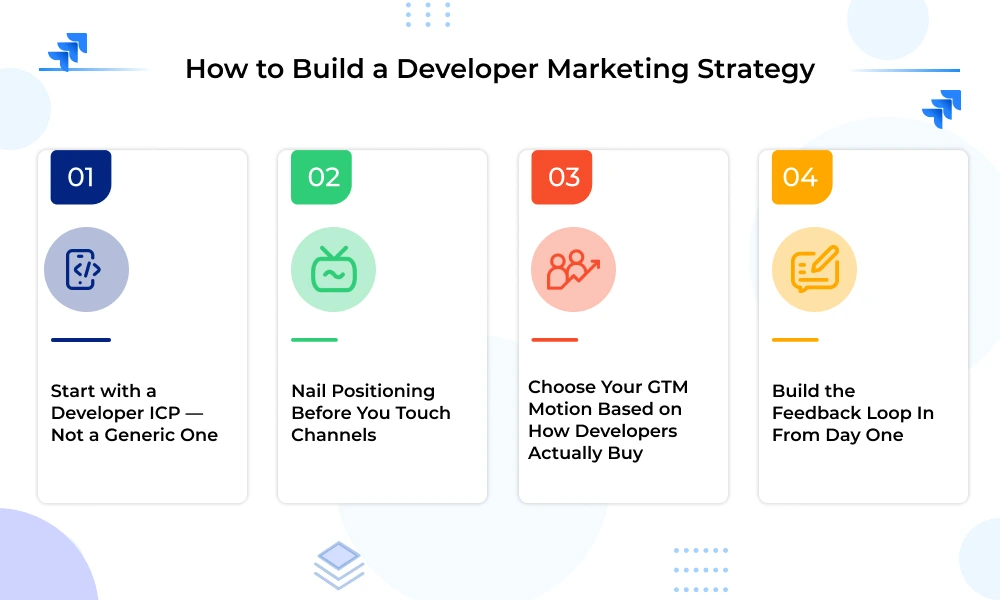
Start with a Developer ICP — Not a Generic One
Developers evaluate tools differently from traditional buyers. They prioritize functionality, integration, and hands-on testing over flashy marketing or ROI metrics. Your ICP needs to reflect that. Go beyond job titles and firmographics. Map:
- Tech stack — what languages, frameworks, and tools they already use
- Experience level — junior, mid-level, senior, or principal engineers all evaluate tools differently
- Learning habits — do they read docs, watch tutorials, or ask on Discord first?
- Community signals — where they spend time: GitHub, Stack Overflow, Reddit, or niche Slack groups
Also Read: Tech Stack For Web Development In 2025
Nail Positioning Before You Touch Channels
Strong positioning answers one question clearly: why should a developer choose your product over the alternatives? It needs three supports:
- Emotional appeal (pathos) — what pain does it relieve? What does building with it actually feel like?
- Logical appeal (logos) — what technical differentiators matter? Latency? API design? Integration depth?
- Credibility appeal (ethos) — why can developers trust this won’t break in production?
Choose Your GTM Motion Based on How Developers Actually Buy
Not every product needs the same motion. Product-led growth works for simpler products where individual users can experience value through a free trial or freemium tier. It reduces CAC because the product does the selling. Sales-led growth works when buying involves multiple stakeholders, and ACV exceeds $25K. Most developer tools in 2026 run a hybrid: PLG drives individual adoption, and usage signals trigger sales engagement for accounts showing expansion behavior.
Build the Feedback Loop In From Day One
Strategy doesn’t end at launch. The loop that separates good developer marketing programs from great ones looks like this:
- DevRel captures pain points from the community
- Product prioritizes them on the roadmap
- Marketing updates positioning to reflect what’s actually resonating
- Documentation absorbs edge cases and real-world friction points
Attribution is notoriously difficult. A developer might discover your product at a conference, evaluate it through documentation months later, and convert after a peer recommendation on Reddit. Multi-touch attribution models are essential; some activities, like community building, will never be perfectly measurable. Accept that. The compounding effect still shows up in your numbers.
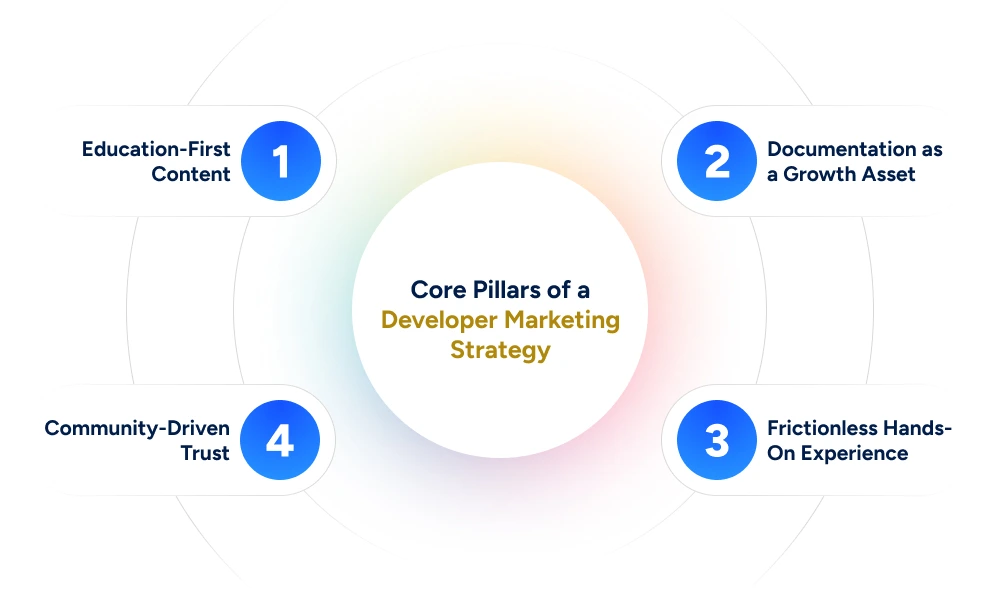
Core Pillars of a Developer Marketing Strategy
A developer marketing strategy doesn’t run on one lever. It runs on five, and they compound when they work together.
1. Education-First Content
Developers find you through content and decide whether to trust you through content. The most effective technical topics address real-world problems, sourced from Stack Overflow threads, GitHub Issues, and Reddit discussions where developers document their actual frustrations. What this looks like in practice: technical blogs that go beyond surface-level takes, step-by-step tutorials that work outside a demo environment, integration guides, and comparison pages that respect the reader’s intelligence.
2. Documentation as a Growth Asset
Documentation is often the first and most critical piece of content a prospective user engages with. Poor documentation is a deal-breaker. Excellent documentation is your best salesperson. This means getting-started guides that actually work, API references with runnable code samples, and troubleshooting content that covers edge cases, not just the happy path.
3. Frictionless Hands-On Experience
The faster a developer reaches a working result, the higher the likelihood of adoption. Every developer tool needs an instant-try path: a sandbox, in-browser REPL, CLI scaffold, or a Postman collection. Whatever removes the barrier between curiosity and first value. Faster time-to-value directly correlates with higher activation and better retention.
4. Community-Driven Trust
Stack Overflow alone sees 82% of developers visiting at least a few times per month, with 25% visiting daily, arriving with specific problems, high intent, and zero patience for promotional noise. Developers trust peers, not brands. Showing up on GitHub, Discord, Reddit, and Slack as a useful voice, not a brand account, is how community trust gets built. You don’t need ten thousand lurkers. Twenty people who actively share fixes and link your docs are worth more.
Wrapping Up
Developer marketing is one of the few disciplines where the usual shortcuts actively work against you. No amount of ad spend replaces a tutorial that actually works. No campaign outlasts a community that genuinely helps people. And no messaging framework compensates for documentation that breaks at step three.
What this guide covers: mindset, content, DevRel, PLG, channels, case studies, isn’t a checklist. It’s a system. Each piece feeds the next. Trust earns adoption. Adoption builds community. Community creates advocacy. Advocacy closes deals your sales team never had to touch.
Developers are not a hard audience. They’re just an honest one.












 Write us on:
  Business queries:
  HR:
HR: 


