



 Healthcare Software Development Services
 Healthcare App Development Services

 Real Estate Web Development Services
 Real Estate App Development Company

 E-Commerce App Development Services
 E-Commerce Web Development Services
 Blockchain E-commerce Development Company

 Fintech Software Development
 Fintech App Development Services
 E-Learning App Development Services

 Restaurant App Development Company

 Mobile Game Development Company

 Travel App Development Company

 Automotive Web Design

 AI Traffic Management System

 AI Inventory Management Software

 Logistics App Development Services
 Machine Learning Development
 ChatGPT integration services
 AI Development Company
 AI Integration Services
 Natural Language Processing Company
 Mobile App Development
 IOS App Development
 Android App Development
 Cross-Platform App Development
 Augmented Reality (AR) App Development
 Virtual Reality (VR) App Development
 Web App Development
 SaaS App Development
 Custom Software Development Services
 Flutter
 React Native
 Swift (IOS)
 Kotlin (Android)
 Mean Stack Development
 AngularJS Development
 MongoDB Development
 Nodejs Development
 Database Development
 Ruby on Rails Development
 Expressjs Development
 Full Stack Development
 Web Development Services
 Laravel Development
 LAMP Development
 Custom PHP Development
 .Net Development
 User Experience Design Services
 User Interface Design Services
 Automated Testing
 Manual Testing
 Digital Marketing Services

 Ride-Sharing And Taxi Services
 Food Delivery Services
 Grocery Delivery Services
 Transportation And Logistics
 Car Wash App
 Home Services App
 ERP Development Services
 CMS Development Services
 LMS Development
 CRM Development
 DevOps Development Services
 AI Business Solutions
 AI Cloud Solutions
 AI Chatbot Development
 API Development
 Blockchain Product Development
 Cryptocurrency Wallet Development
 About Talentelgia
 Our Team
 Our Culture

 Healthcare App Development Services
 Real Estate Web Development Services
 E-Commerce App Development Services
 E-Commerce Web Development Services
 Blockchain E-commerce
Development Company
 Fintech App Development Services
 Blockchain Fintech
Development Company
 E-Learning App Development Services
 Restaurant App Development Company
 Mobile Game Development Company
 Travel App Development Company
 AI Traffic Management System
 AI Inventory Management Software
 AI Development Company
 ChatGPT integration services
 AI Integration Services
 Machine Learning Development
 Machine learning consulting services
 Blockchain Development
 Blockchain Software Development
 Smart contract development company
 NFT marketplace development services
 Asset tokenization companies
 DeFi Wallet Development Company
 IOS App Development
 Android App Development
 Cross-Platform App Development
 Augmented Reality (AR) App
Development
 Virtual Reality (VR) App Development
 Web App Development
 Flutter
 React
Native
 Swift
(IOS)
 Kotlin (Android)
 MEAN Stack Development
 AngularJS Development
 MongoDB Development
 Nodejs Development
 Database development services
 Expressjs Development
 Full Stack Development
 Web Development Services
 Laravel Development
 LAMP
Development
 Custom PHP Development
 User Experience Design Services
 User Interface Design Services
 Automated Testing
 Manual
Testing
 About Talentelgia
 Our Team
 Our Culture

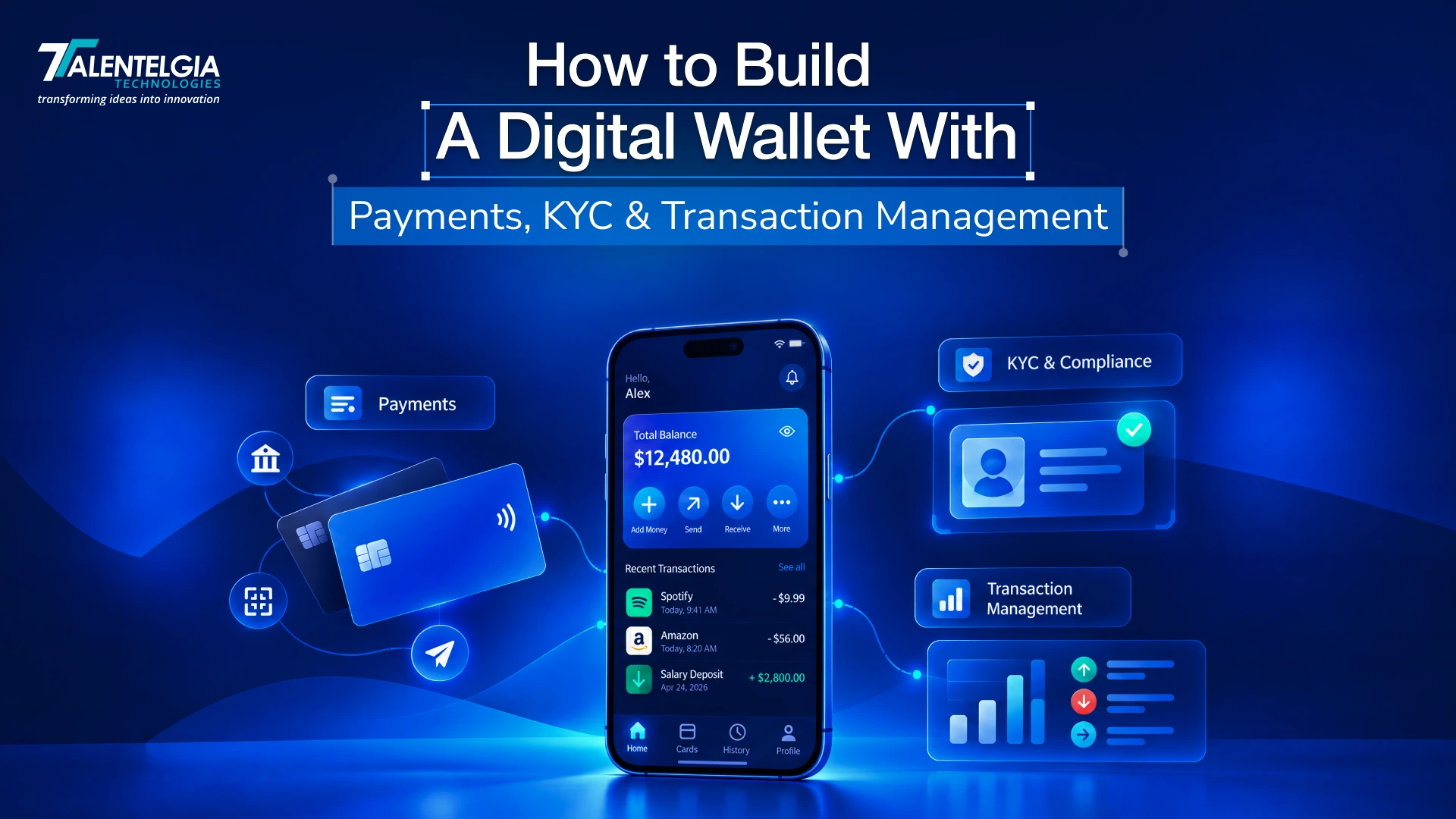
Building a digital wallet with payments, KYC, and transaction management starts with designing the financial infrastructure behind the app, not just its screens. The wallet needs a secure way to onboard and verify users, connect with the right payment rails, process transactions, maintain accurate balances, and record every movement of funds through a reliable ledger. These pieces must work together from the beginning because a failure in one layer can affect the others.
The scale of the opportunity is already visible in how people pay. Digital wallets accounted for $13.9 trillion in global transaction value in 2023, representing half of all e-commerce spend and 30% of point-of-sale spend worldwide, according to Worldpay’s Global Payments Report. That volume is exactly why the engineering behind a wallet matters as much as its interface.
For businesses planning a wallet product, the better question is not simply what features to include. It is how payments, KYC, and transaction management should work together without compromising financial accuracy, security, or compliance.
What a Digital Wallet Needs to Be Before You Build It
A digital wallet stores payment credentials or stored value and lets a user initiate transactions. It can be sending, receiving, paying, or holding funds without a physical card or cash. What varies enormously, and what determines your technical approach, is the money-movement model behind it.
Define the Wallet Type and Money-Movement Model
Before any architecture discussion, decide what kind of wallet you’re building. This is also one of the first decisions a fintech app development company should make because the wallet’s regulatory classification can influence its payment model, KYC requirements, data architecture, and operating responsibilities.
- Closed-loop wallet – value usable only within one merchant or ecosystem (a retailer’s stored-value account, for instance).
- Semi-closed wallet – usable across a network of affiliated merchants but not for cash withdrawal.
- Open wallet – linked to a bank account or card, usable broadly, often permitting withdrawal.
- Pass-through wallet – no stored value at all; it orchestrates payments from a linked bank account or card in real time.
Determine the Regulatory Requirements Before Development
Regulatory scope depends entirely on where you operate and what the wallet does.
- In India, wallets holding stored value fall under the RBI’s Master Directions on Prepaid Payment Instruments (PPIs). It classifies issuers into “Small PPIs” and “Full-KYC PPIs,” each with different transaction limits and cash-withdrawal rights.
- In the EU and UK, e-money and payment-initiation activity typically falls under PSD2 and equivalent e-money regulations.
- In the US, money transmission is regulated state by state, with added federal AML obligations.
None of these frameworks are interchangeable, and a wallet built for one market can’t simply relaunch in another without a fresh compliance review. Deciding this upfront is what separates teams that ship on schedule from teams that rebuild onboarding twice.
Why Payments, KYC & Transaction Management Are the Three Pillars You Can’t Get Wrong
A wallet succeeds only when three systems work together.
- Payments determine how money enters, leaves, and moves through the product. This includes cards, bank transfers, real-time payment systems, QR payments, merchant payments, and wallet-to-wallet transfers.
- KYC and identity determine who can use the wallet, what verification is required, and which actions that user is allowed to perform. Identity therefore becomes part of the product’s authorization model, not merely an onboarding screen.
- Transaction management determines whether every movement of value can be recorded, reconciled, traced, reversed when necessary, and explained to both users and operations teams.
Treating these as separate features creates avoidable risk. A payment can succeed at the provider while the wallet fails to update correctly. A user can pass initial verification but later require additional due diligence. A balance can appear correct while the underlying transaction records cannot explain how it was calculated.
That is why digital wallet app development should be approached as financial-system engineering rather than ordinary mobile application development.
Also Read: Digital Wallet App Development: A Complete Guide for 2025
Building the Payments Layer
The payment layer determines how the wallet interacts with external payment infrastructure. Its design should begin with the actual money flows the product needs to support, not with a list of popular payment APIs.
Payment Rails and Methods to Support
Decide which rails the wallet needs before writing integration code, since each brings its own settlement timing, fee structure, and failure behavior:
- Card networks – for adding and paying with debit/credit cards.
- Bank transfers (ACH, IMPS, SEPA, or equivalent) – for funding and withdrawal.
- Real-time payment rails – such as UPI in India, which processed a record 24.51 billion transactions in August 2026 per National Payments Corporation of India (NPCI) data, showing how dominant real-time rails have become where they exist.
- QR-based payments – for merchant checkout, especially where QR is the default in-store method.
- Wallet-to-wallet transfers – peer-to-peer movement within your closed system, architecturally simpler since it never leaves your ledger.
| The right combination depends on the target market and business model. For example, a wallet intended for Indian consumers may need UPI-related flows, while a European product may need different bank-payment and authentication arrangements. A global product may need multiple payment providers because no single provider offers identical coverage across countries.Stripe’s current payment documentation illustrates this fragmentation. Its platform supports categories including cards, bank transfers, bank debits, real-time payments, vouchers, and wallets, while availability varies by country, product, and connected-account configuration. |
Payment Orchestration and Processor Integration
A wallet should not necessarily embed every provider’s business logic directly into the core application.
A better approach is to create an abstraction layer that can manage provider-specific integrations while exposing a consistent internal payment model. That layer can handle:
- Payment initiation
- Provider selection
- Authorization responses
- Webhooks
- Retries
- Idempotency
- Status synchronization
- Refunds
- Payouts
- Provider failures
- Settlement references
This becomes particularly important when the product uses multiple processors or payment rails.
Payment orchestration can also support routing decisions. A transaction might be sent through a particular provider based on geography, currency, payment method, availability, or commercial rules. The orchestration layer should therefore remain separate from the wallet’s core ledger.
Platforms such as Stripe Connect demonstrate how modern payment infrastructure can manage payments and payouts between multiple parties while exposing APIs and account capabilities for platform developers.
The providers named in architecture discussions should also be chosen carefully. Stripe, Adyen, Marqeta, and similar platforms do not all serve the same function. Some specialize in acquiring and payment processing, some in issuing and card infrastructure, and others in broader financial infrastructure. The correct integration depends on the wallet’s actual money flows.
Security at the Payment Layer
Payment security should be designed into the integration rather than added after launch.
Tokenization can reduce direct exposure to sensitive payment credentials, but it does not automatically remove every compliance obligation. PCI Security Standards Council guidance distinguishes payment tokens from the underlying cardholder data and explains that PCI DSS applicability depends on how payment data and tokens are implemented. The payment layer should also enforce strong authentication where required, secure API communication, access controls, rate limiting, fraud controls, and careful handling of provider credentials and webhook events.
The European Banking Authority and European Central Bank reported that payment fraud across the European Economic Area reached €4.2 billion in 2024, up from €3.5 billion in 2023. Their 2025 report also found that strong customer authentication remained effective against several fraud types while fraudsters increasingly adapted their methods.
The implication is straightforward: authentication alone is not a complete fraud strategy. Wallets need layered controls around identity, transaction context, device signals, velocity, risk scoring, and monitoring.
Building the KYC & Identity Verification Layer
KYC should be designed as part of the wallet’s operating model, not as a form users complete before reaching the “real” product.
What KYC Actually Requires
The exact requirements depend on jurisdiction, product classification, risk profile, and regulated entity. A typical digital onboarding flow may involve:
- Identity information
- Government-issued identity documents
- Selfie or biometric verification
- Address information
- Document authenticity checks
- Sanctions or PEP screening where applicable
- Risk assessment
- Manual review for exceptions
- Ongoing monitoring or reverification where required
FATF guidance recommends a risk-based approach to using digital identity for customer due diligence. It emphasizes assessing the reliability and independence of a digital identity system rather than assuming that any particular technology automatically satisfies CDD requirements.
India provides a useful example of how digital identity can become part of regulated onboarding. RBI permits Video-based Customer Identification Process under specified conditions and requires appropriate records and safeguards. Its KYC framework has also continued to evolve, including amendments issued in 2025.
KYC Vendors and Automated Verification
Most organizations do not need to build document recognition, biometric matching, sanctions screening, and identity-data infrastructure from scratch.
Specialized providers can expose these capabilities through APIs or orchestration layers. Examples include Sumsub and Entrust’s identity-verification platform, which incorporates the technology acquired through Onfido. Entrust completed its acquisition of Onfido in April 2024.
The decision should not be based simply on which provider has the largest feature list. Evaluate:
- Supported countries and documents
- Verification methods
- API quality
- SDK availability
- Manual review workflows
- Fraud signals
- Data residency
- Regulatory fit
- Failure handling
- Auditability
- Vendor lock-in
The KYC provider should fit the wallet’s target markets and risk model.
Design KYC as a Permission Engine, not a Bolt-on
The strongest wallet architectures treat identity status as an input into authorization.
For example:
Identity status → risk assessment → account status → transaction permissions → limits → monitoring
A user may be permitted to create an account but not immediately access every financial function. A higher-risk transaction may trigger additional authentication or review. A regulatory event may require account restrictions or updated verification.
This approach also prevents a common architecture problem: building KYC separately and then trying to retrofit its results into transaction logic.
KYC should therefore expose structured states and decisions that the wallet can consume. The exact rules should remain configurable because regulatory requirements and business policies can change.
Building the Transaction Management Layer
Transaction management is where a wallet becomes a financial system rather than a collection of payment screens.
Ledger Design: Why a Wallet Needs More than a Transactions Table
A transaction history table tells you that something happened. A ledger should explain how value moved. A robust wallet ledger typically records accounts, debits, credits, transaction references, timestamps, and state changes in a way that supports auditability and reconciliation.
Modern Treasury’s digital-wallet documentation illustrates this ledger-centric approach by modeling wallet accounts and posting ledger transactions in response to user actions, rather than treating the wallet as a single mutable balance.
Real-time Balances and Asynchronous Settlement
The balance shown to a user may not always correspond to a payment that has fully settled externally.
Payment systems can return states such as:
initiated → authorized → processing → completed
or:
initiated → failed
A reversal can occur after an earlier authorization. A bank transfer may remain pending while the external rail processes it. A provider webhook may arrive after the user has closed the application. The wallet therefore needs explicit transaction states and rules for when funds become available.
Idempotency is equally important. If the same request or webhook is delivered twice, the wallet should not credit the user twice. Retry logic must be designed alongside transaction identifiers and provider references.
Reconciliation Across Settlement Windows
Reconciliation compares what your internal system says happened with what external systems report.
That can involve:
Wallet ledger ↔ payment processor ↔ bank/payment rail ↔ settlement records
Differences need to be identifiable and actionable.
A useful reconciliation system should help operations teams determine whether a discrepancy is caused by a delayed settlement, failed webhook, duplicate event, refund, chargeback, provider error, or internal processing problem.
This is also where transaction management becomes an operational discipline. A wallet may work perfectly in a demo while becoming difficult to operate once thousands of asynchronous events, refunds, disputes, and settlement records accumulate.
User Visibility versus Operational Visibility
The user needs a simple transaction history with:
- Amount
- Date and time
- Recipient or merchant
- Payment method
- Status
- Reference
- Receipt or confirmation
The operations team needs much more.
Internal tooling should support:
- Full transaction traces
- Provider references
- Audit trails
- Failed transactions
- Reversals
- Refunds
- Disputes
- Manual review
- Reconciliation exceptions
- User/account history
Keeping these two views separate improves usability without sacrificing operational depth.
Wallet Architecture: How the Three Layers Connect
Payments, KYC, and transaction management should not become three disconnected modules.
The ledger sits at the centre of financial state.
The KYC service provides identity and risk information. The payment engine manages external money movement. The ledger records the financial effect. Notifications communicate relevant state changes to users. The operations layer exposes the information required for reconciliation, disputes, monitoring, and support.
This separation allows each domain to evolve without turning the wallet into a tightly coupled application.
| For example, changing a payment provider should not require rewriting the ledger. Adding another KYC provider should not require redesigning the mobile interface. Introducing a new payment method should not change the fundamental accounting model. That separation is one of the most important architectural principles in digital wallet app development. |
Tech Stack for Payments, KYC & Transaction Management
There is no universally correct fintech stack. The technology should follow the product’s transaction model, integration requirements, security posture, and expected scale.
Frontend
Native Android/iOS development or cross-platform frameworks can support the customer-facing wallet. The decision should consider device security, biometric authentication, performance, release cadence, and access to platform capabilities.
Backend
A modular backend should isolate identity, wallet accounts, payment orchestration, ledger operations, notifications, and administrative functions. A modular monolith can be appropriate for an early product; services can be separated where domain boundaries and operational needs justify them.
Payment infrastructure
Use established payment processors, banking APIs, payment gateways, or payment orchestration platforms where they provide regulated or specialized infrastructure that would be impractical to reproduce internally.
KYC infrastructure
Use identity-verification APIs and SDKs where appropriate. Build an internal decision layer around them so business and regulatory rules are not permanently embedded inside one vendor.
Cloud and data infrastructure
Cloud infrastructure can support availability, monitoring, scaling, backups, disaster recovery, and secure secret management. The specific provider matters less than how the environment is configured and governed.
The technology stack should therefore be evaluated as part of fintech app development, not as a generic list of programming languages.
Compliance You Can’t Retrofit Later
Compliance cuts across all three pillars, which is why it can’t be a final checklist before launch. The need for stronger controls is clear: payment fraud across the European Economic Area reached €4.2 billion in 2024, up 17% from the previous year, even as strong customer authentication continued to reduce certain types of fraud.
The core frameworks a wallet typically needs to account for:
- PCI DSS – mandatory for any entity storing, processing, or transmitting cardholder data, currently version 4.0.1, fully required since March 31, 2025.
- KYC/AML obligations – rooted in FATF’s Recommendation 10 globally, implemented locally through frameworks like RBI’s PPI Directions in India, FinCEN’s CIP/CDD rules in the US, or the EU’s AML Regulation.
- Data protection law – GDPR and equivalent regional frameworks govern how identity and transaction data can be stored and retained, with direct implications for how long KYC documents can be kept and where they’re hosted.
- Payment services regulation – PSD2 in the EU introduced strong customer authentication for electronic payments, a pattern several other jurisdictions have since mirrored.
Cost & Timeline to Build a Digital Wallet
Digital wallet development cost breaks into three fairly consistent tiers across 2026 industry estimates, once crypto-specific wallets (a different cost curve entirely) are excluded:
| Tier | Cost | Timeline | What’s included |
|---|---|---|---|
| Closed-loop MVP | $15,000–$40,000 | 8–14 weeks | Registration, basic KYC, single-currency balance tracking, P2P transfer |
| Semi-closed / mid-complexity | $40,000–$110,000 | 4–7 months | Multi-currency, bank-account linking, QR/NFC payments, biometric auth, broader merchant network |
| Open-loop / enterprise wallet | $80,000–$300,000+ | 6–12 months | Card issuance via a BaaS provider, AI-driven fraud detection, white-label capability, multi-region compliance |
For heavily regulated, bank-grade builds with full multi-rail orchestration, production-grade reconciliation, and compliance tooling built for scale, cost can move into six or seven figures with a 12–24 month timeline, since audits, licensing, and regulatory sign-off extend the schedule more than the engineering itself does.
Three factors move a project between tiers more than anything else:
- whether you’re issuing cards (adds a BaaS provider relationship and $2,000–$15,000+ in recurring monthly fees) or working purely through bank rails;
- how many regions and compliance regimes you’re launching into simultaneously;
- whether KYC/AML is being built as an integrated permission engine from day one or retrofitted later.
Choosing between a white-label and custom wallet app development also shifts the numbers: white-label platforms can launch in 4–8 weeks at $15,000–$40,000, trading long-term flexibility for speed. A custom build costs more upfront but avoids the constraints of someone else’s architecture as you scale. It is worth the tradeoff once the wallet is core to the business rather than a supporting feature.
Common Mistakes Companies Make Building Payments, KYC & Transaction Management In-House
Teams building their first wallet, especially outside core fintech, tend to repeat the same mistakes. Most are avoidable with the right sequencing and architecture during custom fintech app development, not simply by increasing the budget.
Treating Wallet Development as a Frontend Problem with Payment API Calls Bolted On.
Why it happens: The UI is the visible part, so it gets scoped first, and the ledger gets treated as “just a database.”
Fix: Scope the ledger and permission engine before the UI. The frontend should be the last layer designed, not the first, since it consumes the other two.
Launching without ledger-centric reconciliation, discovering balance mismatches only after users report them.
Why it matters: A 2023 Bank of England review found that IT and operational failures, not fraud or credit losses, were the leading source of operational risk events at major financial institutions. Unreconciled balances are exactly this kind of failure: invisible until they surface as a support ticket or an audit finding.
Fix: Build reconciliation against processor and bank settlement records as a scheduled, automated job from week one, not a manual finance-team task added post-launch.
Hardcoding a single acquirer or bank partner with no failover plan for downtime.
Why it matters: Payments infrastructure outages aren’t rare. Every major processor has had one. And a wallet with no second route simply stops working for every user during that window.
Fix: Build the orchestration layer to support a second processor from the start, even if you only activate it later. Retrofitting failover after a live outage means rebuilding under pressure.
Adding KYC as a post-launch feature instead of a permission engine built into the architecture from the start.
Why it matters: FATF’s Recommendation 10 requires ongoing due diligence, not a one-time check. This means KYC status has to gate permissions continuously, not just at signup. Bolting this on later means retrofitting permission checks into every code path that touches money movement.
Fix: Design KYC tier as a field the payment engine checks on every transaction, from day one, exactly as covered in Section 4.
Underestimating the operational back office like support tooling, dispute handling, audit trails, until ticket volume spikes.
Why it happens: Back-office tooling has no user-facing payoff, so it’s the first thing cut under deadline pressure.
Fix: Budget and build dispute-handling and audit-trail tooling as part of the MVP scope, not a fast-follow. Support volume arrives the moment real users start transacting, not after a “phase 2.”
Assuming PCI DSS alone covers fraud risk.
Why it matters: PCI DSS, as defined by the PCI Security Standards Council, governs the protection of cardholder data, including encryption, tokenization, and access control. It does not include transaction-pattern monitoring or behavioral fraud detection; those are a separate system entirely.
Fix: Budget for a dedicated transaction-monitoring or fraud-detection layer alongside PCI DSS compliance, rather than treating it as something PCI DSS already covers. A provider of fintech app development services can help define how these security, monitoring, and transaction controls fit into the wider wallet architecture instead of treating them as separate compliance additions.
Proven Experience With Payment Platforms
Our fintech app development agency has applied this approach while developing Dinar Pay, a digital wallet platform combining the Physical Dinar Bank Payment Gateway with Virtual Dinar Wallet Cards through a mobile platform.
- The build reflects the same architectural priorities covered throughout this guide:
Native mobile clients (Kotlin for Android, Swift for iOS) built on top of a Node.js backend, with Firebase handling real-time data sync and SQLite managing local device storage for offline-tolerant access. - UI/UX was designed in Adobe XD before development began, keeping the interface work downstream of the underlying data and transaction model rather than driving it.
The platform brought together:
- Secure financial transactions and payment workflows
- Multi-currency support for broader accessibility
- QR-based payment initiation
- Financial management within a unified interface
- Security measures for sensitive financial information
This experience reflects the kind of cross-functional engineering required when building payment and wallet products, where integrations, financial workflows, security, and user experience must work as one system.
Build Your Fintech Product With the Right Foundation
Whether you are developing a digital wallet, payment platform, or broader financial application, our fintech app developers can help define the architecture, integrations, and technology approach around your product requirements.
Have a fintech product in mind? Let’s discuss what it takes to build it.
Frequently Asked Questions (FAQs)
A basic MVP costs $15,000–$40,000. A mid-complexity wallet with multi-currency support, bank linking, and KYC/AML runs $40,000–$110,000. A full enterprise wallet with card issuance and multi-region compliance costs $80,000–$300,000+, based on 2026 industry cost data. Heavily regulated, bank-grade builds can move into six or seven figures.
A basic MVP takes 8–14 weeks to build. A mid-complexity wallet with KYC, bank linking, and multi-currency support takes 4–7 months. A full enterprise-grade wallet with card issuance and multi-region compliance takes 6–12 months, and heavily regulated builds can stretch to 12–24 months with audits and licensing.
To create your own digital wallet, start by defining its features, target users, payment methods, and regulatory requirements. Choose a suitable technology stack, integrate payment gateways and KYC verification, and build a secure transaction management system with a reliable ledger. Implement authentication, fraud monitoring, and compliance controls, then test the wallet thoroughly before launch. Working with a fintech app development company can help ensure the wallet is secure, scalable, and aligned with your business requirements.
A digital wallet may require KYC and AML controls depending on its business model, regulated activities, jurisdiction, and role in the payment flow. Requirements are not identical worldwide. Product teams should establish the applicable regulatory obligations before development because identity verification, transaction monitoring, account restrictions, recordkeeping, and reporting can influence the architecture.
A secure wallet combines authenticated access, backend authorization, protected data storage, encrypted communication, transaction controls, fraud monitoring, and an auditable ledger. The system should also handle duplicate requests, retries, failed payments, reversals, and asynchronous provider events safely. Security must cover both the mobile application and the financial infrastructure behind it.
Yes. A wallet can integrate multiple payment providers through an abstraction or orchestration layer that standardizes payment initiation, status handling, webhooks, refunds, and provider references. This architecture can make geographic expansion and provider substitution easier, but each integration still requires country, currency, payment-method, compliance, and settlement validation.
White-label wallets launch faster and cost less upfront but limit flexibility as you scale or need non-standard features. Custom fintech app development costs more initially but gives full control over architecture, integrations, and compliance posture. The right choice depends on your timeline, how differentiated the product needs to be, and your long-term product roadmap.
A PCI DSS-compliant wallet protects cardholder data through controls such as tokenization, encryption, restricted access, and audit logging. Administrative access should also use multi-factor authentication. These requirements are covered under PCI DSS v4.0.1, which became fully mandatory in March 2025.
Yes. Talentelgia provides custom fintech mobile app development services for businesses that need wallet functionality designed around specific payment flows, integrations, user journeys, and business requirements. The architecture can be structured around the product’s required ledger, KYC, payment, security, and operational capabilities.
Yes. A wallet can be connected with existing payment gateways, processors, banking APIs, KYC providers, and other financial infrastructure through APIs. Talentelgia can structure these integrations around the wallet’s core payment and transaction architecture so external providers remain manageable as the product evolves.












 Sales Enquiries:
 Business queries:
 HR:


