


 Healthcare Software Development Services
 Healthcare App Development Services
 Real Estate Web Development Services
 Real Estate App Development Company
 E-Commerce App Development Services
 E-Commerce Web Development Services
 Blockchain E-commerce Development Company
 Fintech Software Development
 Fintech App Development Services
 E-Learning App Development Services
 Restaurant App Development Company
 Mobile Game Development Company
 Travel App Development Company
 Automotive Web Design
 AI Traffic Management System
 AI Inventory Management Software
 Logistics App Development Services
 Machine Learning Development
 ChatGPT integration services
  AI Development Company
  AI Integration Services
  Natural Language Processing Company
 Mobile App Development
  IOS App Development
  Android App Development
  Cross-Platform App Development
  Augmented Reality (AR) App Development
  Virtual Reality (VR) App Development
  Web App Development
  SaaS App Development
 Custom Software Development Services
  Flutter
  React Native
  Swift (IOS)
  Kotlin (Android)
  Mean Stack Development
  AngularJS Development
  MongoDB Development
  Nodejs Development
  Database Development
 Ruby on Rails Development
 Expressjs Development
  Full Stack Development
  Web Development Services
  Laravel Development
  LAMP Development
  Custom PHP Development
  .Net Development
  User Experience Design Services
  User Interface Design Services
  Automated Testing
  Manual Testing
  Digital Marketing Services
 Ride-Sharing And Taxi Services
 Food Delivery Services
 Grocery Delivery Services
 Transportation And Logistics
 Car Wash App
 Home Services App
 ERP Development Services
 CMS Development Services
 LMS Development
 CRM Development
 DevOps Development Services
 AI Business Solutions
 AI Cloud Solutions
 AI Chatbot Development
 API Development
 Blockchain Product Development
 Cryptocurrency Wallet Development
 About Talentelgia
  Our Team
  Our Culture
 Healthcare App Development Services
 Real Estate Web Development Services
 E-Commerce App Development Services
 E-Commerce Web Development Services
 Blockchain E-commerce
Development Company
Blockchain E-commerce
Development Company Fintech App Development Services
 Blockchain Fintech
Development Company
Blockchain Fintech
Development Company E-Learning App Development Services
 Restaurant App Development Company
 Mobile Game Development Company
 Travel App Development Company
 AI Traffic Management System
 AI Inventory Management Software
 AI Development Company
 ChatGPT integration services
 AI Integration Services
 Machine Learning Development
 Machine learning consulting services
 Blockchain Development
 Blockchain Software Development
 Smart contract development company
 NFT marketplace development services
 Asset tokenization companies
 DeFi Wallet Development Company
 IOS App Development
 Android App Development
 Cross-Platform App Development
 Augmented Reality (AR) App
Development
Augmented Reality (AR) App
Development Virtual Reality (VR) App Development
 Web App Development
 Flutter
 React
Native
React
Native Swift
(IOS)
Swift
(IOS) Kotlin (Android)
 MEAN Stack Development
 AngularJS Development
 MongoDB Development
 Nodejs Development
 Database development services
 Expressjs Development
 Full Stack Development
 Web Development Services
 Laravel Development
 LAMP
Development
LAMP
Development Custom PHP Development
 User Experience Design Services
 User Interface Design Services
 Automated Testing
 Manual
Testing
Manual
Testing About Talentelgia
 Our Team
 Our Culture
The European Securities and Markets Authority (ESMA) is the EU’s (European Union’s) securities and markets regulator, headquartered in Paris. For fintech software engineers, ESMA is not an irrelevant body that imposes compliance obligations. ESMA is the actual regulator that establishes the technical standards for DORA ICT risks, MiCA crypto-resilience, and MiFID II algorithmic trading. Most compliance content treats these as self-contained laws, skipping over the regulator that actually wrote their operative detail.
That gap matters. ESMA speaks through several instrument types: RTS, ITS, Guidelines, and Q&As, each carrying different legal weight. This piece maps ESMA’s actual regulatory output to what your engineering team needs to build.
What ESMA Actually Is (and What It Outputs)
ESMA is an independent authority of the EU, created in 2011 and headquartered in Paris. It serves the role of safeguarding financial stability and investor protection in EU securities and markets. It does not take the place of any national regulators. It works together with National Competent Authorities (NCAs) like the BaFin of Germany, the AMF of France, and the CSSF of Luxembourg.
For engineering teams, what matters is the type of document ESMA issues, because each carries different legal weight:
1. Regulatory Technical Standards (RTS)
Detailed technical rules drafted by ESMA, which become binding EU law once endorsed by the European Commission. These are the closest thing to a build spec: MiFID II’s RTS 6 on algorithmic trading systems is a direct example.
2. Implementing Technical Standards (ITS)
Similar legal force to RTS, but focused on standardizing formats and procedures (reporting templates, registers) rather than substantive requirements.
3. Guidelines
NCAs and firms are expected to comply, or publicly justify why they haven’t (“comply or explain”). Not directly binding law, but non-compliance carries real supervisory friction.
4. Opinions
Issued in specific supervisory contexts. A clear example: in 2019, ESMA issued opinions on national product intervention measures proposed by the FCA (UK), AMF (France), and Finansinspektionen (Sweden) on CFD trading restrictions, confirming the measures were justified and proportionate under MiFIR Article 42. Under Article 43(3), any NCA that acts contrary to an ESMA opinion must publicly explain why – showing how opinions shape enforcement even without being law themselves.
5. Q&As
Informal interpretive guidance, updated on a rolling basis. No formal legal status, but treated as the de facto reference point during supervisory reviews.
The practical takeaway for a dev team: if a requirement traces back to an RTS or ITS, it’s a hard build constraint. If it traces back to a Guideline or Q&A, it’s a strong design signal you build around, but with more interpretive latitude. Knowing which is which changes how a compliance requirement gets prioritized on a sprint board.
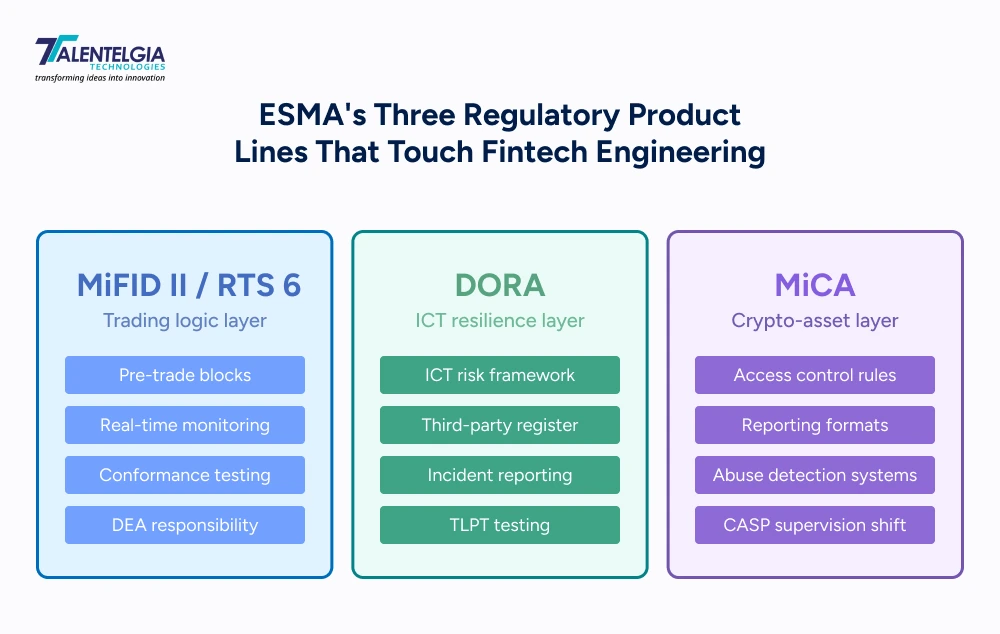
ESMA’s Three Regulatory Product Lines That Touch Fintech Engineering
ESMA’s regulatory reach into fintech engineering runs through three distinct workstreams, each governing a different layer of the stack: trading logic, infrastructure resilience, and crypto-asset systems.
1. MiFID II / RTS 6 – Algorithmic Trading Systems and Controls
Enforced since January 2018, RTS 6 is ESMA’s oldest and most granular technical standard for fintech. Article 4(1)(39) of MiFID II defines algorithmic trading broadly: any case where a computer algorithm determines an order’s timing, price, or quantity, even with a human approving each order before submission.
Build requirements dev teams must address:
(a) Pre-trade Controls (Article 15)
Mandatory hard blocks rejecting orders outside price, value, volume, or message-rate limits; traders cannot override without documented risk/compliance review. Limits must apply to both parent orders and sliced child orders, not child orders alone.
(b) Real-time Monitoring (Article 16)
A “two lines of defence” model: the trader plus an independent risk function empowered to challenge them directly, with alerts feeding pre-defined remedial actions up to kill-switch activation.
(c) Testing (Articles 5–7, 10)
Conformance and stress testing before deployment and after any material change; systems must withstand twice the highest message/trade volume of the prior six months.
(d) DEA (Article 17(5), 20)
Providers remain fully responsible for clients’ RTS 6 compliance, running independent controls regardless of client-side controls.
(e) Outsourcing (Article 4)
Using third-party systems never transfers regulatory responsibility (per ESMA Q&A 34).
(f) AI-driven Logic
Article 2 requires compliance staff to understand how algorithms operate, meaning AI decision logic must stay explainable; AI-based algo trading currently sits outside the EU AI Act’s high-risk category, but that’s under annual review.
2. DORA – ESMA’s Co-Authored ICT Resilience Framework
DORA applies to 21 financial entity types EU-wide; 12 fall under ESMA’s specific remit. ESMA acts jointly with EBA and EIOPA as one of three European Supervisory Authorities (ESAs) overseeing the framework.
Build requirements:
(a) ICT Risk Management Framework
Documented governance covering identification, protection, detection, response, and recovery of ICT risk, extending to third-party ICT services.
(b) Third-party Risk Management
A maintained register of all ICT third-party contracts, with mandatory contractual provisions: service descriptions, data locations, audit rights, termination/exit rights.
(c) Incident Classification and Reporting
Incidents classified by clients affected, duration, data loss, and economic impact; major incidents reported to national competent authorities via standardized templates.
(d) Resilience Testing
Annual-to-triennial threat-led penetration testing (TLPT) for critical systems.
(e) Oversight of Critical Third-Party Providers (CTPPs)
ESAs directly designate and oversee CTPPs. Microsoft Ireland Operations Limited was designated a CTPP on November 18, 2025 – a concrete precedent for what “critical” infrastructure dependency looks like under DORA.
3. MiCA – ESMA as Lead Technical Standard-Setter for Crypto-Asset ICT Resilience
MiCA became fully applicable on December 30, 2024. ESMA is the named source for the technical standards governing CASP, ART, and EMT ICT resilience under Article 35.
Build requirements:
(a) System Maintenance and Security Access Protocols
ESMA’s own Guidelines (currently in force) require offerors and CASPs to document system maintenance procedures and access-control protocols to “Union standards.”
(b) Reporting and Format Standards
ESMA-issued RTS/ITS govern authorisation applications, notification templates, and standardized reporting formats for ART/EMT issuers.
(c) Market Abuse Detection Systems
RTS on arrangements and systems for preventing, detecting, and reporting suspected market abuse, including cross-border coordination procedures between competent authorities.
(d) Supervisory Direction Shift
A June 2026 draft legislative proposal (Master Regulation) would transfer direct supervision of all CASPs to ESMA, centralizing what’s currently split across national competent authorities – a significant architectural shift for any CASP’s compliance-reporting integration.
How Dev Teams Should Actually Monitor ESMA Output
Most of ESMA’s regulatory output doesn’t arrive as a single dramatic announcement. It accumulates: a Q&A gets revised, a Guideline gets a compliance table update, a consultation paper quietly reshapes what a future RTS will require. For an engineering team, the risk isn’t ignorance of MiFID II or DORA as concepts; it’s missing the incremental update that changes what “compliant” means for a system already in production.
A few concrete ways to track this, rather than relying on secondhand summaries:
(a) ESMA’s Own Q&A Tool
Hosted directly on ESMA’s website, this is where informal interpretive guidance gets published and revised on a rolling basis. Since Q&As carry no formal legal status but function as the de facto reference point during supervisory reviews, a silent revision here can quietly redefine what a reviewer expects to see, even though no new law was passed.
(b) The Interactive Single Rulebook (ISRB)
ISRB is ESMA’s own documentation tool, not a third-party product, that maps a given Level 1 text (like MiFID II or MiCA) to every associated RTS, ITS, Guideline, Opinion, and Q&A tagged against it. For a dev team trying to figure out whether a requirement is a hard build constraint or a softer design signal, this is the fastest way to see the full instrument chain behind a single article.
(c) Joint Q&As from the ESAs
There is also a separate process where ESMA, EBA, and EIOPA answer questions jointly (relevant for DORA in particular, since it spans all three), tracked in a separate Joint Q&A Register rather than ESMA’s standalone tool.
(d) Consultation Papers
These show what’s coming before it’s binding. A consultation paper today is a strong signal of what an RTS will require in 12–18 months; teams that wait for the final endorsed standard are often building against yesterday’s draft.
The practical fix isn’t necessarily a dedicated compliance hire. It’s assigning ownership: someone on the team (often whoever already owns the DORA incident register or the RTS 6 kill-switch logic) checks the relevant Q&A and ISRB pages on a set cadence, the same way a team might track a dependency’s changelog. Treat regulatory drift the same way you’d treat an upstream API’s breaking changes – silent until it isn’t.
Also Read: How to Create a Fintech App?
Build Fintech Software With Compliance in Mind
ESMA compliance cannot be treated as a checklist added after development. It has to shape how your fintech platform handles trading controls, risk management, reporting, security, third-party dependencies, and regulatory change from the start.
At Talentelgia Technologies, our fintech app development services consider these requirements at the architecture and engineering level. From algorithmic trading systems and compliance workflows to resilient APIs, secure infrastructure, and regulatory reporting, we help financial businesses build technology designed for both performance and regulatory expectations.
Building a fintech product for the EU market? Let’s build it with compliance in mind from day one.











 Sales Enquiries:
  Business queries:
  HR:
HR: 


