



 Healthcare Software Development Services
 Healthcare App Development Services
 Real Estate Web Development Services
 Real Estate App Development Company
 E-Commerce App Development Services
 E-Commerce Web Development Services
 Blockchain E-commerce Development Company
 Fintech Software Development
 Fintech App Development Services
 E-Learning App Development Services
 Restaurant App Development Company
 Mobile Game Development Company
 Travel App Development Company
 Automotive Web Design
 AI Traffic Management System
 AI Inventory Management Software
 Logistics App Development Services
 Machine Learning Development
 ChatGPT integration services
  AI Development Company
  AI Integration Services
  Natural Language Processing Company
 Mobile App Development
  IOS App Development
  Android App Development
  Cross-Platform App Development
  Augmented Reality (AR) App Development
  Virtual Reality (VR) App Development
  Web App Development
  SaaS App Development
 Custom Software Development Services
  Flutter
  React Native
  Swift (IOS)
  Kotlin (Android)
  Mean Stack Development
  AngularJS Development
  MongoDB Development
  Nodejs Development
  Database Development
 Ruby on Rails Development
 Expressjs Development
  Full Stack Development
  Web Development Services
  Laravel Development
  LAMP Development
  Custom PHP Development
  .Net Development
  User Experience Design Services
  User Interface Design Services
  Automated Testing
  Manual Testing
  Digital Marketing Services
 Ride-Sharing And Taxi Services
 Food Delivery Services
 Grocery Delivery Services
 Transportation And Logistics
 Car Wash App
 Home Services App
 ERP Development Services
 CMS Development Services
 LMS Development
 CRM Development
 DevOps Development Services
 AI Business Solutions
 AI Cloud Solutions
 AI Chatbot Development
 API Development
 Blockchain Product Development
 Cryptocurrency Wallet Development
 About Talentelgia
  Our Team
  Our Culture
 Healthcare App Development Services
 Real Estate Web Development Services
 E-Commerce App Development Services
 E-Commerce Web Development Services
 Blockchain E-commerce
Development Company
Blockchain E-commerce
Development Company Fintech App Development Services
 Blockchain Fintech
Development Company
Blockchain Fintech
Development Company E-Learning App Development Services
 Restaurant App Development Company
 Mobile Game Development Company
 Travel App Development Company
 AI Traffic Management System
 AI Inventory Management Software
 AI Development Company
 ChatGPT integration services
 AI Integration Services
 Machine Learning Development
 Machine learning consulting services
 Blockchain Development
 Blockchain Software Development
 Smart contract development company
 NFT marketplace development services
 Asset tokenization companies
 DeFi Wallet Development Company
 IOS App Development
 Android App Development
 Cross-Platform App Development
 Augmented Reality (AR) App
Development
Augmented Reality (AR) App
Development Virtual Reality (VR) App Development
 Web App Development
 Flutter
 React
Native
React
Native Swift
(IOS)
Swift
(IOS) Kotlin (Android)
 MEAN Stack Development
 AngularJS Development
 MongoDB Development
 Nodejs Development
 Database development services
 Expressjs Development
 Full Stack Development
 Web Development Services
 Laravel Development
 LAMP
Development
LAMP
Development Custom PHP Development
 User Experience Design Services
 User Interface Design Services
 Automated Testing
 Manual
Testing
Manual
Testing About Talentelgia
 Our Team
 Our Culture
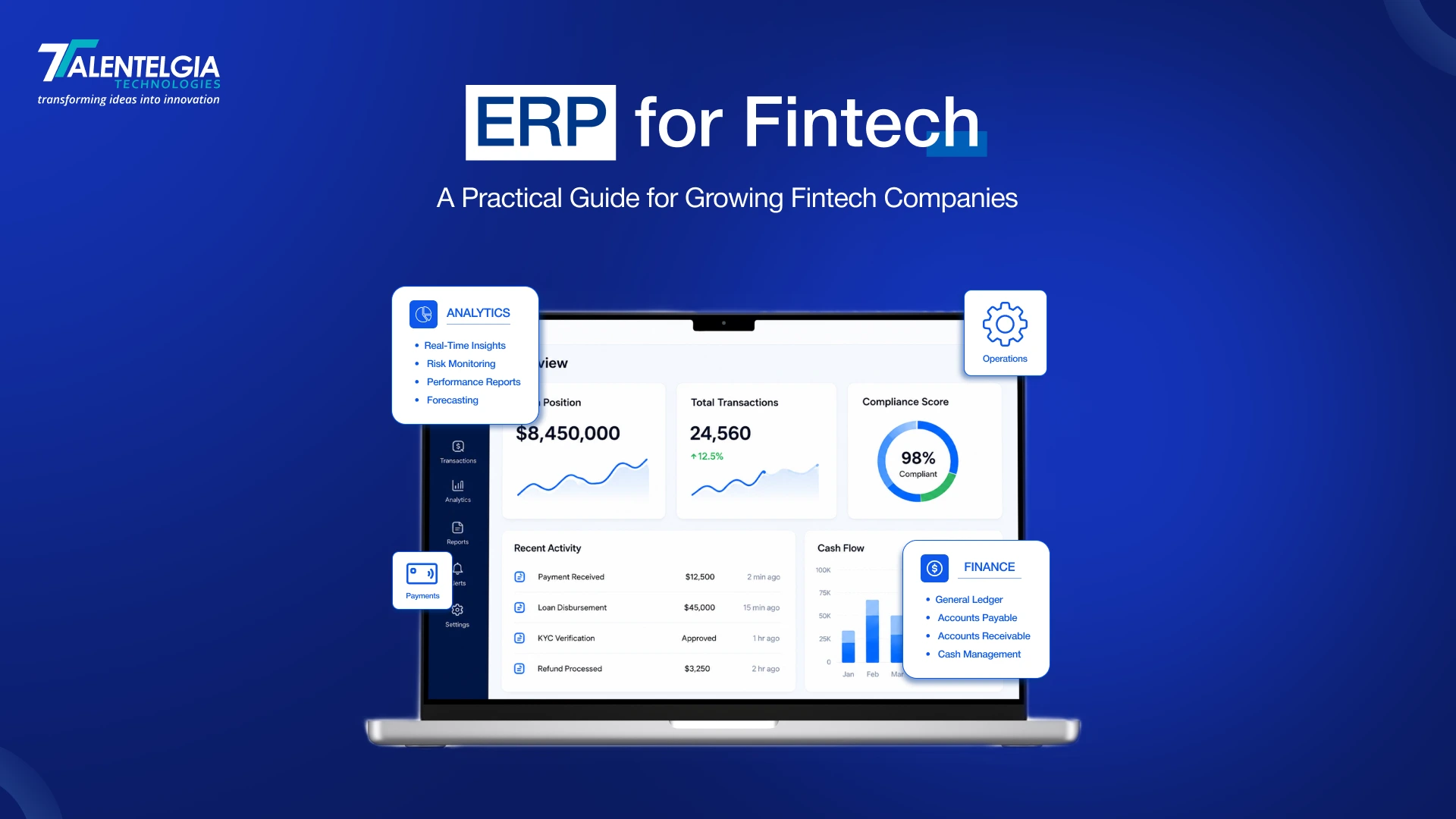
Most fintech companies don’t wake up one day and decide they need an ERP. They back into it. A payments startup adds a lending product. A neobank expands into a second country. A B2B platform onboards its five-hundredth client. Somewhere in that growth, the finance team is reconciling three spreadsheets, compliance is chasing data across four platforms, and nobody has one place to get a straight answer on cash position.
That’s usually the moment ERP for fintech stops being a nice-to-have and starts being the thing standing between orderly growth and operational chaos. Transactions need to trace back cleanly, audits need to hold up without a scramble, and someone should know the real cash position today, not whatever the last spreadsheet said. Instead, a lot of fintechs are running all of this through accounting software, a CRM, and manual reconciliation stitched together after the fact, with someone copying numbers from one system into another by hand.
This guide breaks down what that actually looks like, and what’s worth fixing first.
Do Fintech Companies Actually Need an ERP?
Short answer: not on day one, but sooner than most founders expect.
Most companies start fine with a spreadsheet and basic accounting software. It’s usually when things start growing: a second product, a second market, a customer list that’s gotten too long to track by hand. And that is when the cracks show up. Reconciliation used to take an hour on a Tuesday. Now it’s basically someone’s whole job. And once that happens, running on disconnected systems stops being an inconvenience and starts being an actual liability.
Recent research from InterSystems bears this out: 81% of fintechs worldwide name data issues as their single biggest technical challenge, and around 40% say they can’t properly connect their own applications, data, and legacy systems to begin with. That’s not a small-company problem, either; the same research found it gets worse, not better, as a fintech matures and scales.
So the honest answer is: a fintech needs an ERP the moment reconciling data across tools starts eating more hours than it should, or the moment a regulator’s question takes longer to answer than it should. For most companies, that’s earlier than they’d like to admit.
What Does ERP for Fintech Actually Do?
An ERP brings finance, compliance, operations, and customer data into a single connected system rather than scattered tools. For a fintech, that has a few very specific effects on how the business actually runs day-to-day.
It Removes Manual Reconciliation Between Payments, Accounting, And Compliance
A payments platform, a lending system, and an accounting tool don’t talk to each other by default. Someone ends up copying transaction data between them by hand. An ERP connects that data automatically, so a loan repayment or a customer transaction updates the books and the compliance record at the same time, without a person in the middle.
It Gives Real-Time Visibility Into Cash Position And Risk, Not Last Week’s Numbers
Fintechs deal in decisions that move fast, like approving credit, managing liquidity, flagging suspicious activity. An ERP means the finance team is looking at what’s happening right now, not reconstructing it from four different exports at the end of the week.
It Builds An Audit Trail Into The Transaction Itself
Every payment, loan disbursement, or account change gets logged automatically as it happens. When a regulator or auditor asks for a transaction history, it already exists. Nobody has to piece it together after the fact.
It Handles Multi-Currency And Multi-Entity Complexity That Spreadsheets Can’t
Fintechs expanding across borders deal with different currencies, tax rules, and reporting standards in parallel. An ERP manages that natively instead of requiring a separate workaround for every new market.
It Shortens Financial Close From Weeks To Days
Without automation, closing the books can stretch to three or four weeks of manual matching and cross-checking. With data flowing automatically between systems, that cycle shrinks, so leadership gets accurate numbers fast enough to actually act on them, instead of reacting to a picture that’s already a month old.
Also Read: Top ERP Trends
Cloud vs. Custom ERP for Fintech
The choice between an off-the-shelf platform (NetSuite, SAP, Microsoft Dynamics) and a custom-built ERP usually comes down to cost and timing, not just total cost.
Off-the-shelf ERP:
- SaaS licensing typically runs $15,000-$60,000/year depending on user count
- Live in weeks, not months
- Works well while workflows are still fairly standard: one currency, one jurisdiction, no unusual compliance logic
Custom-built ERP:
- For fintech specifically, development costs cluster around $90,000-$300,000+, with the higher end reserved for deep compliance or multi-entity logic built in
- Ongoing cost is typically maintenance and hosting, often 15-20% of the original build cost annually
- No per-user licensing, so cost doesn’t climb with headcount
Here’s where it flips:
- Off-the-shelf pricing is per-user, so costs rise linearly as the team grows, and fintech-specific workarounds: reconciliation logic tied to a payment rail, jurisdiction-specific reporting, pile up as extra integration costs on top of the license.
Custom systems don’t carry that recurring per-user tax. Past a certain scale and complexity threshold, the total cost of ownership over three to five years tends to favor the custom build, even if the upfront number looks worse.
The practical read: off-the-shelf makes sense while compliance and workflow needs are still generic. Custom becomes the better economics once complexity makes “generic” an expensive assumption to keep making.
Common Challenges While Integrating an ERP
Compliance Surface Area Grows with Every Connection
Each system an ERP connects to, be it a payment gateway, a KYC provider, or a legacy accounting tool, brings its own obligations:
- GDPR requires data portability and deletion capability
- SOC 2 auditors expect detailed logs of every API call
- Financial regulators often mandate data residency controls, where the data physically sits matters as much as how it moves
A fintech connecting five systems isn’t managing one compliance checklist. It’s managing five.
Legacy Systems weren’t Built to Share Data
Banking infrastructure and older financial tools frequently predate modern API standards, so bridging them into an ERP usually means custom adapters or middleware, not a clean plug-in.
Security Exposure Multiplies with Integration Count
Every new connection is a new potential entry point, and financial data is a high-value target. Encryption, authentication, and access controls need to be core requirements at every integration point, not an afterthought.
Scope Creep is Common and Expensive
Teams often request broad system access “to be safe” and end up using a fraction of it. Skipping a defined minimum viable scope upfront tends to balloon cost and timeline as unused complexity gets built and maintained anyway.
The pattern across all of these: integration difficulty scales with how many systems are connected and how sensitive the data is, not with the ERP software itself.
Read More: Business Intelligence In ERP- A Comprehensive Overview
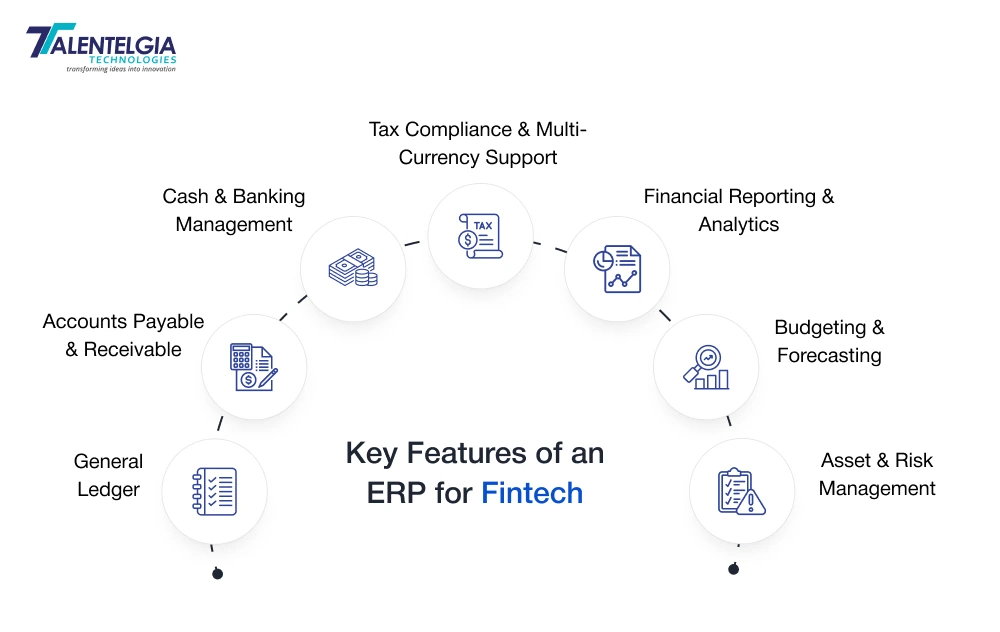
Key Features of an ERP for Fintech
Not every module a generic ERP vendor lists is actually relevant to a fintech. Appointment scheduling, fleet management, recruitment tools- all these show up in vertical-agnostic ERP feature lists, but they’re built for retail or logistics businesses, not financial platforms. Here’s what actually matters for fintech:
General Ledger
The foundation of the whole system, the chart of accounts that generates income statements, balance sheets, and trial balances. Every transaction across the ERP eventually flows into the ledger, which is why its structure needs to reflect how the fintech actually organizes its business, not a generic template.
Accounts Payable & Receivable
Tracks vendor obligations and customer payments in one place, and flags aging invoices or overdue payments automatically. For a lending platform or payments company, this is what prevents credit risk from going unnoticed until it’s already a problem.
Cash & Banking Management
Covers bank account setup, cash flow tracking, and reconciliation against bank statements. For fintechs operating across borders, this extends to managing foreign accounts and exporting payment files, cutting down on manual transfer errors.
Tax Compliance & Multi-Currency Support
Handles currency conversion, exchange rate tracking, and multi-jurisdictional tax reporting automatically. This matters the moment a fintech does business in more than one country. Manual currency math doesn’t scale, and errors compound quickly. Business Central, for example, automates exchange rate updates and multi-jurisdiction tax logic as part of its core finance module.
Financial Reporting & Analytics
Generates the reports stakeholders and regulators actually ask for, like P&L, balance sheet, aging reports, tax reports, without a manual month-end scramble to assemble them.
Budgeting & Forecasting
Let’s finance teams set targets across departments (sales, compliance, R&D) and track actuals against them throughout the year, rather than finding out at year-end that projections were off.
Asset & Risk Management
Tracks depreciation and asset value for tax purposes, and gives finance teams visibility into how equipment or infrastructure investments are performing financially over time.
Beyond these core modules, fintech-specific ERPs typically add payment reconciliation and KYC/AML compliance tracking as near-mandatory extensions, features generic ERP vendors don’t build in by default, which is often where custom development becomes worth considering.
How to Implement ERP in Fintech: A Step-by-Step Process
Fintech-specific ERP rollouts typically run 3-18 months, with cloud-first platforms landing on the faster end and full custom or on-premise builds stretching longer. It is largely because fintechs need to budget extra time for regulatory reporting requirements that a generic retail or manufacturing rollout never has to touch.
1. Define Clear Financial Goals
Before evaluating any system, pin down exactly what’s broken. Is it slow reconciliation, weak compliance reporting, or no multi-currency support? The answer shapes which modules and vendors are even worth considering.
2. Bring in an Implementation Partner Early
Given the compliance stakes and technical complexity in fintech, most companies loop in an ERP integration partner like Talentelgia Technologies at this stage, not after the system is already half-configured. In-house teams rarely have deep exposure to financial-sector regulatory requirements, and getting that expertise involved before customization begins prevents costly rework later.
3. Choose the Right ERP Finance Module
Not every platform fits every fintech. The right choice supports the company’s compliance obligations out of the box rather than requiring workarounds from day one.
4. Customize for Actual Finance Workflows
This includes:
- Setting up the chart of accounts, business units, and cost centers
- Configuring core modules (billing, budgeting, forecasting) to match real operations
- Mapping existing processes like tax handling and expense approvals into the system
- Defining role-based access so sensitive financial data stays restricted appropriately
- Connecting the ERP to existing tools (accounting platforms, CRMs) to eliminate data silos
5. Plan Data Migration Carefully
This is where implementations most often go wrong. It means identifying where financial data currently lives, cleaning and deduplicating it, running trial migrations before the real one, and having a rollback plan if something breaks mid-transfer.
6. Test the System Before Go-live
Data migrating cleanly doesn’t mean the system works. Run the new ERP against real transaction scenarios, compliance reporting requirements, and edge cases (multi-currency postings, audit trails, approval chains) before anyone depends on it. Skipping this step is how compliance gaps surface after launch instead of before.
7. Train the Finance Team
The best-configured ERP fails if finance staff default back to old spreadsheets and workarounds. Role-based access and new approval workflows only work if people know how to use them; training needs to happen before go-live, not as a follow-up.
8. Monitor and Maintain Post-launch
Implementation doesn’t end at go-live. Ongoing performance monitoring and updates are what sustain the system’s value over years, not just the first quarter.
How to Choose the Right ERP for Fintech
Choosing an ERP is less about comparing feature lists and more about matching the system to what a fintech specifically needs to prove: compliance, auditability, and scale, not just what it needs to run day to day.
Define Requirements Before Taking Any Demos
Document entities, currencies, transaction volumes, and specific compliance obligations (KYC/AML, PCI DSS, regional data residency rules) before talking to a single vendor. Walking into a demo without this list means evaluating flashy features instead of actual fit.
Match the ERP Tier to the Growth Stage
Enterprise-grade ERPs (SAP, Oracle) bring capability a 20-person fintech doesn’t need yet, and the cost reflects that. Buying too far ahead of scale burns cash on unused capacity; buying too small forces a painful re-platform mid-growth. The right tier is the one that fits the company 18-24 months out, not just today.
Test Compliance and Integration Live, Not on Slides
A vendor should be able to demonstrate, in the room, how their system handles revenue recognition standards relevant to fintech, like ASC 606, and show a working integration with an actual payment or ledger platform. If they can only show slides, that’s a signal the capability isn’t as mature as the pitch suggests.
Weigh Total Cost of Ownership, Not License Price
The subscription fee is often the smallest number in the whole project. Implementation, data migration, and integration work routinely cost more than the software itself over the first year, so comparing vendors on sticker price alone hides the real cost difference.
Prioritize Fintech-Specific Vendor Experience
A vendor who’s mostly worked with retail or manufacturing clients can still sell a functioning ERP. But they won’t know why payment reconciliation needs to work a certain way, or what KYC/AML reporting actually requires, until they hit it mid-project. Ask directly which fintech clients they’ve implemented for, and ask for a live example, not a case study PDF.
Involve Compliance and Finance Stakeholders From Day One
IT usually leads ERP purchases, with compliance looped in after the contract’s signed. That order causes problems. Compliance officers know which regulatory reports the system needs to produce and which data fields actually get checked. Bringing them in during evaluation, not after, means the ERP gets built around real audit needs instead of retrofitted for them.
Cost of ERP Implementation for Fintech
There’s no single number here. Cost depends heavily on company size, deployment type, and how much regulatory complexity the system needs to handle. But two consistent patterns show up across sources.
- For small to mid-sized fintechs on standard cloud platforms, implementation typically runs $40,000-$200,000, climbing to $200,000-$500,000 for larger organizations needing deeper customization. This range fits companies using mainstream platforms like NetSuite or Sage Intacct without heavy compliance-specific build-out.
- For fintech and payments companies specifically, though, costs tend to run higher, often $100,000 to several million dollars in the first year. The gap comes down to regulatory complexity: fintech ERP deployments frequently need extensions for compliance frameworks like Basel III, SOX, or IFRS 9 that generic finance ERP setups don’t require, and those extensions aren’t cheap to build or validate.
Cost breakdown by component:
| Cost Driver | Typical Range |
|---|---|
| Customization & integration | $20,000 – $200,000+ |
| Data migration | $10,000 – $100,000 |
| Staff training | $5,000 – $50,000 |
| Consulting & support | $150 – $400/hour |
| Ongoing maintenance | 15–22% of implementation cost, annually |
A few things worth flagging before budgeting: implementation services alone typically add 1-2x the software license cost on top of the subscription itself, and that’s before customization. Annual maintenance for on-premise systems tends to sit at the higher end (18-22%) compared to cloud deployments. And the consulting hourly range is wide enough, from $150 to $400, that getting multiple quotes matters more than trusting a single vendor’s estimate.
The honest takeaway: a lean cloud-based fintech ERP can go live for well under $200,000, but any real compliance depth pushes that number up fast, often by an order of magnitude.
Wrapping Up
Nobody sets out to build an ERP. It just becomes necessary, usually around the time someone on the finance team is spending more hours reconciling numbers than actually managing them, or a compliance report takes longer to pull together than it should.
Getting ahead of that point is easier and cheaper than fixing it after the fact.
If your team is starting to feel that pressure, Talentelgia’s ERP development services team builds fintech-specific ERP systems built around real compliance and scale needs, not generic templates. Worth a conversation before things get harder than they need to.
Frequently Asked Questions (FAQs)
Can a fintech ERP support multiple companies and currencies?
Yes. Most fintech-focused ERP systems support multi-entity structures and multi-currency transactions natively, with separate entity records and consolidated reporting across branches, subsidiaries, or business units.
Should fintechs choose cloud or on-premise ERP?
Cloud is the more common choice for fintechs today, mainly for lower upfront cost and faster deployment. On-premise still gets chosen in cases with strict data residency or security requirements, but it demands more upfront investment and in-house IT support.
What’s the difference between fintech ERP and core banking software?
Core banking software runs the actual banking operations like accounts, transactions, and loan servicing. ERP manages the business behind that: finance, accounting, compliance reporting, HR, and vendor management. Many fintechs run both side by side rather than one replacing the other.
Can an ERP migrate data from spreadsheets or existing software?
Yes, though it requires cleanup first. ERP vendors typically migrate approved, validated data — customers, vendors, invoices, account balances- once it's been mapped and deduplicated, rather than a straight copy-paste from spreadsheets.













 Sales Enquiries:
  Business queries:
  HR:
HR: 


