



 Healthcare Software Development Services
 Healthcare App Development Services
 Real Estate Web Development Services
 Real Estate App Development Company
 E-Commerce App Development Services
 E-Commerce Web Development Services
 Blockchain E-commerce Development Company
 Fintech Software Development
 Fintech App Development Services
 E-Learning App Development Services
 Restaurant App Development Company
 Mobile Game Development Company
 Travel App Development Company
 Automotive Web Design
 AI Traffic Management System
 AI Inventory Management Software
 Logistics App Development Services
 Machine Learning Development
 ChatGPT integration services
  AI Development Company
  AI Integration Services
  Natural Language Processing Company
 Mobile App Development
  IOS App Development
  Android App Development
  Cross-Platform App Development
  Augmented Reality (AR) App Development
  Virtual Reality (VR) App Development
  Web App Development
  SaaS App Development
 Custom Software Development Services
  Flutter
  React Native
  Swift (IOS)
  Kotlin (Android)
  Mean Stack Development
  AngularJS Development
  MongoDB Development
  Nodejs Development
  Database Development
 Ruby on Rails Development
 Expressjs Development
  Full Stack Development
  Web Development Services
  Laravel Development
  LAMP Development
  Custom PHP Development
  .Net Development
  User Experience Design Services
  User Interface Design Services
  Automated Testing
  Manual Testing
  Digital Marketing Services
 Ride-Sharing And Taxi Services
 Food Delivery Services
 Grocery Delivery Services
 Transportation And Logistics
 Car Wash App
 Home Services App
 ERP Development Services
 CMS Development Services
 LMS Development
 CRM Development
 DevOps Development Services
 AI Business Solutions
 AI Cloud Solutions
 AI Chatbot Development
 API Development
 Blockchain Product Development
 Cryptocurrency Wallet Development
 About Talentelgia
  Our Team
  Our Culture
 Healthcare App Development Services
 Real Estate Web Development Services
 E-Commerce App Development Services
 E-Commerce Web Development Services
 Blockchain E-commerce
Development Company
Blockchain E-commerce
Development Company Fintech App Development Services
 Blockchain Fintech
Development Company
Blockchain Fintech
Development Company E-Learning App Development Services
 Restaurant App Development Company
 Mobile Game Development Company
 Travel App Development Company
 AI Traffic Management System
 AI Inventory Management Software
 AI Development Company
 ChatGPT integration services
 AI Integration Services
 Machine Learning Development
 Machine learning consulting services
 Blockchain Development
 Blockchain Software Development
 Smart contract development company
 NFT marketplace development services
 Asset tokenization companies
 DeFi Wallet Development Company
 IOS App Development
 Android App Development
 Cross-Platform App Development
 Augmented Reality (AR) App
Development
Augmented Reality (AR) App
Development Virtual Reality (VR) App Development
 Web App Development
 Flutter
 React
Native
React
Native Swift
(IOS)
Swift
(IOS) Kotlin (Android)
 MEAN Stack Development
 AngularJS Development
 MongoDB Development
 Nodejs Development
 Database development services
 Expressjs Development
 Full Stack Development
 Web Development Services
 Laravel Development
 LAMP
Development
LAMP
Development Custom PHP Development
 User Experience Design Services
 User Interface Design Services
 Automated Testing
 Manual
Testing
Manual
Testing About Talentelgia
 Our Team
 Our Culture
Fintech compliance is basically the rulebook that keeps a financial app from becoming a liability to its users, to the banks it works with, and to itself. It’s what stands between “we built a cool payment app” and “we built a payment app regulators actually trust with people’s money.”
So what does that rulebook actually involve? A few non-negotiables:
- First, you need to know who your users really are before you let them move money. This is KYC, or Know Your Customer, and skipping it is how platforms end up laundering money without even realizing it
- Right alongside that sits AML, or Anti-Money Laundering. It’s basically keeping a constant eye on transactions so nothing suspicious slides through unnoticed
- Then there’s the data side of things: encrypting what you store, and making sure it stays exactly where local law says it should stay
- You also need the actual paperwork, including licenses and approvals for every market you operate in, not a workaround or a gray-area shortcut
- And finally, being straight with users. Clear fees, honest lending terms, no fine print designed to confuse people
None of this is optional once real money is involved. It’s the baseline, not the ambition.
How Fintech Compliance Differs from Traditional Finance
Banks built their compliance programs over decades. It was slow, deliberate, one product line at a time. Fintechs don’t have that luxury. Most start with little to no compliance team, then bolt on controls while shipping new features every week. That gap between speed and structure is where most fintech compliance problems actually start.
A few things make fintech compliance a different game entirely:
- Release speed: Banks review major changes for months. Fintechs push updates weekly, often through third-party APIs for payments, identity checks, or data, and each new integration opens up a fresh compliance exposure.
- Product sprawl: One banking app usually means one rulebook. One fintech app can blend crypto wallets, lending, and payments, and each feature can trigger a different regulator entirely.
- Regulatory scrutiny of code, not just paperwork: Regulators today don’t just read policy documents. They want proof that the actual product, be it the code, the logs, or the permissions, enforces the rules it claims to follow.
There’s also a trust gap fintechs have to close that banks never had to think about: banks inherited decades of institutional credibility, while fintechs have to earn it through provable compliance, transaction by transaction, market by market.
Also Read: How to Create a Fintech App?
Key Areas of Fintech Compliance
Zoom in on any fintech compliance program, and you’ll find it really comes down to four working parts.
Identity and Money Movement
Before anyone gets access to a fintech product, the company needs to know exactly who they’re dealing with. That’s the identity-verification piece. But knowing who someone is isn’t enough on its own; you also need eyes on how money moves once they’re in, catching unusual transfers or patterns before they turn into something worse. Together, these two form the backbone most regulators check first.
What Happens to User Data Once You Have It
Every fintech app is sitting on a pile of sensitive information like IDs, account numbers, spending habits. Where that data lives, who can access it, and how fast a company can respond if something goes wrong isn’t optional anymore; it’s usually spelled out by law, and it varies depending on which country a user is in.
Keeping Transactions Clean in Real Time
This is less about checking a user once and more about continuously watching for fraud, meeting card-network security standards, and filing the right reports the moment something looks off, rather than during a quarterly review.
Being Straight with the People using the Product
Clear pricing. Credit decisions that can actually be explained if someone asks why they were denied. No fine print doing the heavy lifting. Regulators increasingly test this by looking at outcomes across different user groups, not just the terms and conditions page.
Miss any one of these, and the other three don’t hold up either. They’re built to work as a set.
Who Regulates Fintech Companies?
Fintech regulation isn’t handled by one body anywhere in the world. It’s always a patchwork of agencies, each covering a different slice of the business. Here’s a closer look at who’s actually in charge, region by region.
United States
- Consumer Financial Protection Bureau (CFPB) enforces consumer protection and fair lending laws. Its posture has shifted toward deregulation and rule streamlining since 2025, though it’s still actively rulemaking. It finalized a major update to fair lending enforcement under Regulation B in April 2026.
- Office of the Comptroller of the Currency (OCC) charters and supervises national banks, and has been notably active in approving digital-asset-focused bank charters through 2025 and 2026.
- Federal Deposit Insurance Corporation (FDIC) insures deposits and examines financial institutions, including fintechs partnering with banks, for safety and soundness.
- Securities and Exchange Commission (SEC) regulates securities trading, robo-advisory platforms, and increasingly, tokenized securities.
- Financial Crimes Enforcement Network (FinCEN) oversees AML and counter-terrorism financing compliance across the board.
- Federal Trade Commission (FTC) steps in on deceptive or unfair business practices, separate from CFPB’s more finance-specific mandate.
United Kingdom
- Financial Conduct Authority (FCA): Authorizes and supervises firms conducting regulated financial activities, and is actively expanding its scope over cryptoasset businesses in 2026.
- Prudential Regulation Authority (PRA): Part of the Bank of England, focused on the safety and soundness of banks, insurers, and larger financial institutions.
Both bodies work alongside the UK’s new Financial Services and Markets Bill (introduced May 2026), which is reshaping parts of the regulatory framework, including how appointed representatives and financial promotions are handled.
Europe
- European Central Bank (ECB): Supervises significant banks directly and oversees financial stability across the eurozone.
- European Banking Authority (EBA): Sets consistent prudential standards and stress-tests the EU banking sector.
- European Securities and Markets Authority (ESMA): Regulates securities markets and works to protect investors across member states.
Canada
- Office of the Superintendent of Financial Institutions (OSFI): Supervises federally regulated banks and pension plans.
- FINTRAC: Canada’s financial intelligence unit, focused on detecting and preventing money laundering and terrorist financing.
- Financial Consumer Agency of Canada (FCAC): Protects consumers and monitors compliance with financial conduct codes.
Asia-Pacific
- Monetary Authority of Singapore (MAS): Runs Singapore’s FinTech Regulatory Sandbox and oversees digital banks and payment institutions.
- Reserve Bank of India (RBI): Regulates digital payments, wallets, and peer-to-peer lending platforms operating in India.
- Japan Financial Services Agency (JFSA): Oversees financial institution compliance and AML enforcement in Japan.
- Australian Securities and Investments Commission (ASIC) and AUSTRAC: Handle consumer protection and anti-money laundering enforcement respectively in Australia.
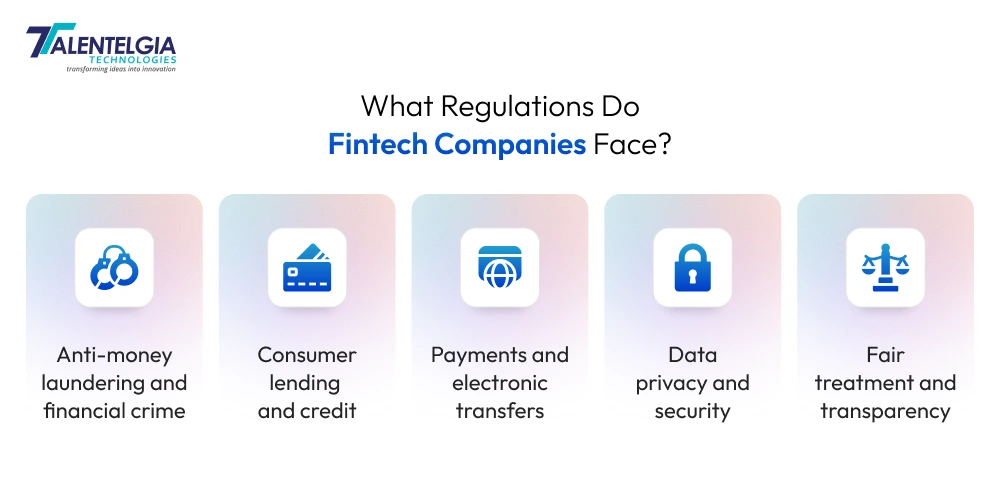
What Regulations Do Fintech Companies Face?
Knowing who regulates fintech is one thing. Knowing exactly which laws apply is a different challenge entirely, because the answer depends on what a company actually builds. A lending app and a crypto wallet answer to almost entirely different rulebooks, even though both call themselves “fintech.”
That said, a handful of regulations show up again and again, regardless of the specific product:
Anti-money Laundering and Financial Crime
- Bank Secrecy Act (BSA): Requires companies to help detect and report money laundering, largely through transaction monitoring and recordkeeping.
- USA PATRIOT Act: Expanded the BSA after 9/11, adding stronger requirements around terrorism financing monitoring.
- OFAC sanctions: Enforced by the Treasury Department, these prohibit doing business with sanctioned countries, entities, or individuals.
Consumer Lending and Credit
- Truth in Lending Act (TILA): Requires lenders to disclose loan costs and terms clearly, before a customer borrows a cent.
- Equal Credit Opportunity Act (ECOA): Bans discrimination in lending decisions based on race, gender, age, or similar factors.
- Fair Credit Reporting Act (FCRA): Governs how consumer credit information is collected, shared, and corrected.
Payments and Electronic Transfers
- If you’re moving money electronically via ATM withdrawals, debit swipes, direct deposits, the Electronic Fund Transfer Act (Reg E) is what governs it in the U.S. It’s the rule that decides how much a customer has to disclose upfront, who’s on the hook when something goes wrong, and what the dispute process looks like when a transfer gets contested.
- Then there’s PCI DSS, which technically isn’t a law at all. It’s an industry security standard. But don’t let that fool you into thinking it’s optional. Touch card payments in any way, and you’re expected to meet it, full stop.
- And if you’re operating in the EU, PSD2 adds another layer: strong customer authentication on payments, meaning a password alone usually won’t cut it anymore.
Data Privacy and Security
- GDPR (EU): Sets strict rules on how personal data is collected, stored, and used, and applies to any company handling EU residents’ data, regardless of where that company is based.
- CCPA (California): The U.S.’s closest equivalent, giving consumers rights over their personal data and how businesses use it.
- Gramm-Leach-Bliley Act (GLBA): Requires U.S. financial companies to explain their data-sharing practices and protect customer information.
Fair Treatment and Transparency
- UDAP/UDAAP: Prohibits unfair, deceptive, or abusive acts. This is one of the laws that regulators will most likely cite whenever a fintech’s marketing or product design tricks consumers.
- Truth in Savings Act (TISA): Requires clear disclosure of account terms, fees, and interest rates.
| Here’s the part that trips a lot of fintechs up: not every one of these laws applies to every fintech. * A company that never extends credit doesn’t need to worry about ECOA. * A company with no EU users can mostly set GDPR aside. The real starting point isn’t memorizing this list but mapping which of these actually apply to your specific product, then building controls around that exact footprint. Getting this mapping wrong in either direction is costly: overbuild compliance for laws that don’t apply, and you waste money and slow down launches; underbuild for ones that do, and you’re looking at fines, forced product changes, or in serious cases, a shutdown. That mapping exercise is usually where fintechs bring in outside help from a bank partner’s compliance team, a banking-as-a-service provider, or specialized compliance vendors, since getting it wrong the first time is far more expensive than getting advice early. |
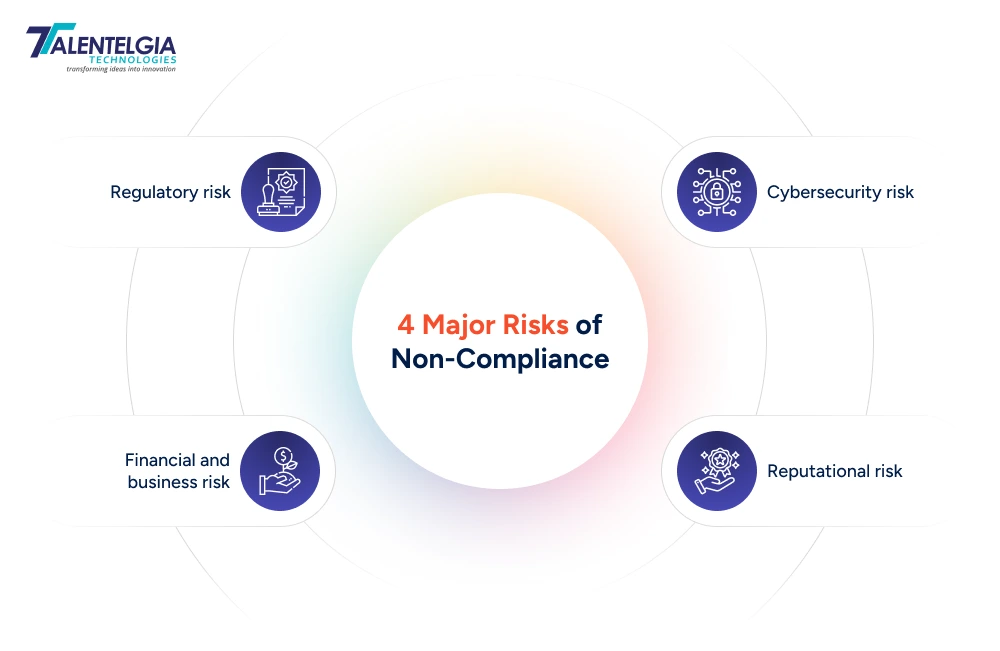
4 Major Risks of Non-Compliance
Ask any compliance officer at a fintech what keeps them awake, and it usually comes down to one of four things: getting on the wrong side of a regulator, getting hacked, running the business itself into the ground, or losing the trust that got customers there in the first place.
Regulatory Risk
This is the risk of getting fined, restricted, or shut down for failing to follow financial law, and it’s genuinely a bigger headache for fintechs than for traditional banks. Regulation itself has been inconsistent: U.S. federal regulators were slow to get involved with fintech early on, then became aggressive once crypto blurred the line between currency and security. On top of that, states have gone their own way, and global rules diverge even further.
States like New York and California have introduced their own fintech-specific rules layered on top of federal ones, so a nationwide fintech can end up juggling different requirements state by state
Cybersecurity Risk
Fintechs are an obvious target. They sit on exactly the kind of data criminals want, and many are young companies without the security maturity of an established bank. This risk has also gotten harder to manage as fintechs lean more on outside infrastructure like cloud providers, third-party APIs, and open-source code, each one a door someone else could walk through.
- Revolut found this out in September 2022, when hackers didn’t even need to break anything technical; a simple social engineering trick got them access to the personal data of roughly 50,000 customers, including names, addresses, and partial payment card details.
- Third-party exposure: a vulnerability in a vendor’s system can just as easily become a vulnerability in yours.
- Attacker sophistication is falling, not rising: malware-as-a-service tools mean even unskilled attackers can now launch damaging attacks.
Financial and Business Risk
The same speed that makes fintech exciting is also what makes it risky. Moving fast works fine for a social app; it’s a lot less forgiving when you’re processing real transactions or extending credit.
- Operational risk – the everyday cost of moving quickly with financial infrastructure, where small mistakes can have outsized consequences.
- Technology risk – AI and machine learning models can quietly bake in bias from the data they’re trained on, sometimes without anyone noticing until a regulator or lawsuit points it out.
- Consumer risk – fintech’s whole pitch is reaching people traditional finance overlooked, which also means reaching people who may not fully understand the product they’re using.
- Investor risk – fintech runs largely on venture capital, and that funding tap can tighten fast during a downturn, leaving companies short on runway right when they need it most.
Reputational Risk
Financial regulation exists, at its core, to protect confidence in the system, so when that confidence breaks, fintechs feel it fastest.
- A serious breach or funding collapse sends customers running to competitors and makes bank partners reconsider the relationship.
- Reputational damage isn’t always self-inflicted; when one crypto exchange collapses, suspicion spreads to every other company building in that space, fair or not.
- Strong compliance programs don’t just prevent fines. They’re often what keeps a company’s reputation intact when something does go wrong elsewhere in the industry.
How to Build a Fintech Compliance Program / Checklist
- Map what actually applies to you – Not every fintech needs every regulation. Identify your specific use case first: lending, payments, crypto before building controls for laws that don’t touch your business.
- Understand your risk profile – Work out where your biggest exposure sits (fraud, data, lending practices) and build controls around that, not a generic template.
- Bring your bank partner in early – If you work with a bank or BaaS provider, get their compliance team involved from day one, not after a feature ships.
- Choose the right vendors for the job – Identity verification, transaction monitoring, and sanctions screening are usually handled by different specialized tools, not one all-in-one platform.
- Decide how much to outsource – Smaller fintechs often lean on specialized partners; larger ones eventually build compliance in-house as they scale.
- Keep your team involved, always – Compliance can be supported by outside partners, but it can never be fully outsourced; ownership has to stay in-house.
Also Read: Fintech Mobile App Features
Wrapping Up
Fintech compliance is a living part of how a fintech operates, right alongside the product itself. The rules will keep shifting, regulators will keep sharpening their focus on tech-driven finance, and the fintechs that treat compliance as an afterthought will keep paying for it, one fine at a time.
At Talentelgia Technologies, we’ve helped fintech businesses build secure, compliant, and scalable software from the ground up because we know compliance works best when it’s baked into the architecture, not bolted on later. If you are looking for a tech partner offering excellent fintech app development services, who understands this from day one, let’s talk.











 Sales Enquiries:
  Business queries:
  HR:
HR: 


