



 Healthcare Software Development Services
 Healthcare App Development Services
 Real Estate Web Development Services
 Real Estate App Development Company
 E-Commerce App Development Services
 E-Commerce Web Development Services
 Blockchain E-commerce Development Company
 Fintech Software Development
 Fintech App Development Services
 E-Learning App Development Services
 Restaurant App Development Company
 Mobile Game Development Company
 Travel App Development Company
 Automotive Web Design
 AI Traffic Management System
 AI Inventory Management Software
 Logistics App Development Services
 Machine Learning Development
 ChatGPT integration services
  AI Development Company
  AI Integration Services
  Natural Language Processing Company
 Mobile App Development
  IOS App Development
  Android App Development
  Cross-Platform App Development
  Augmented Reality (AR) App Development
  Virtual Reality (VR) App Development
  Web App Development
  SaaS App Development
 Custom Software Development Services
  Flutter
  React Native
  Swift (IOS)
  Kotlin (Android)
  Mean Stack Development
  AngularJS Development
  MongoDB Development
  Nodejs Development
  Database Development
 Ruby on Rails Development
 Expressjs Development
  Full Stack Development
  Web Development Services
  Laravel Development
  LAMP Development
  Custom PHP Development
  .Net Development
  User Experience Design Services
  User Interface Design Services
  Automated Testing
  Manual Testing
  Digital Marketing Services
 Ride-Sharing And Taxi Services
 Food Delivery Services
 Grocery Delivery Services
 Transportation And Logistics
 Car Wash App
 Home Services App
 ERP Development Services
 CMS Development Services
 LMS Development
 CRM Development
 DevOps Development Services
 AI Business Solutions
 AI Cloud Solutions
 AI Chatbot Development
 API Development
 Blockchain Product Development
 Cryptocurrency Wallet Development
 About Talentelgia
  Our Team
  Our Culture
 Healthcare App Development Services
 Real Estate Web Development Services
 E-Commerce App Development Services
 E-Commerce Web Development Services
 Blockchain E-commerce
Development Company
Blockchain E-commerce
Development Company Fintech App Development Services
 Blockchain Fintech
Development Company
Blockchain Fintech
Development Company E-Learning App Development Services
 Restaurant App Development Company
 Mobile Game Development Company
 Travel App Development Company
 AI Traffic Management System
 AI Inventory Management Software
 AI Development Company
 ChatGPT integration services
 AI Integration Services
 Machine Learning Development
 Machine learning consulting services
 Blockchain Development
 Blockchain Software Development
 Smart contract development company
 NFT marketplace development services
 Asset tokenization companies
 DeFi Wallet Development Company
 IOS App Development
 Android App Development
 Cross-Platform App Development
 Augmented Reality (AR) App
Development
Augmented Reality (AR) App
Development Virtual Reality (VR) App Development
 Web App Development
 Flutter
 React
Native
React
Native Swift
(IOS)
Swift
(IOS) Kotlin (Android)
 MEAN Stack Development
 AngularJS Development
 MongoDB Development
 Nodejs Development
 Database development services
 Expressjs Development
 Full Stack Development
 Web Development Services
 Laravel Development
 LAMP
Development
LAMP
Development Custom PHP Development
 User Experience Design Services
 User Interface Design Services
 Automated Testing
 Manual
Testing
Manual
Testing About Talentelgia
 Our Team
 Our Culture
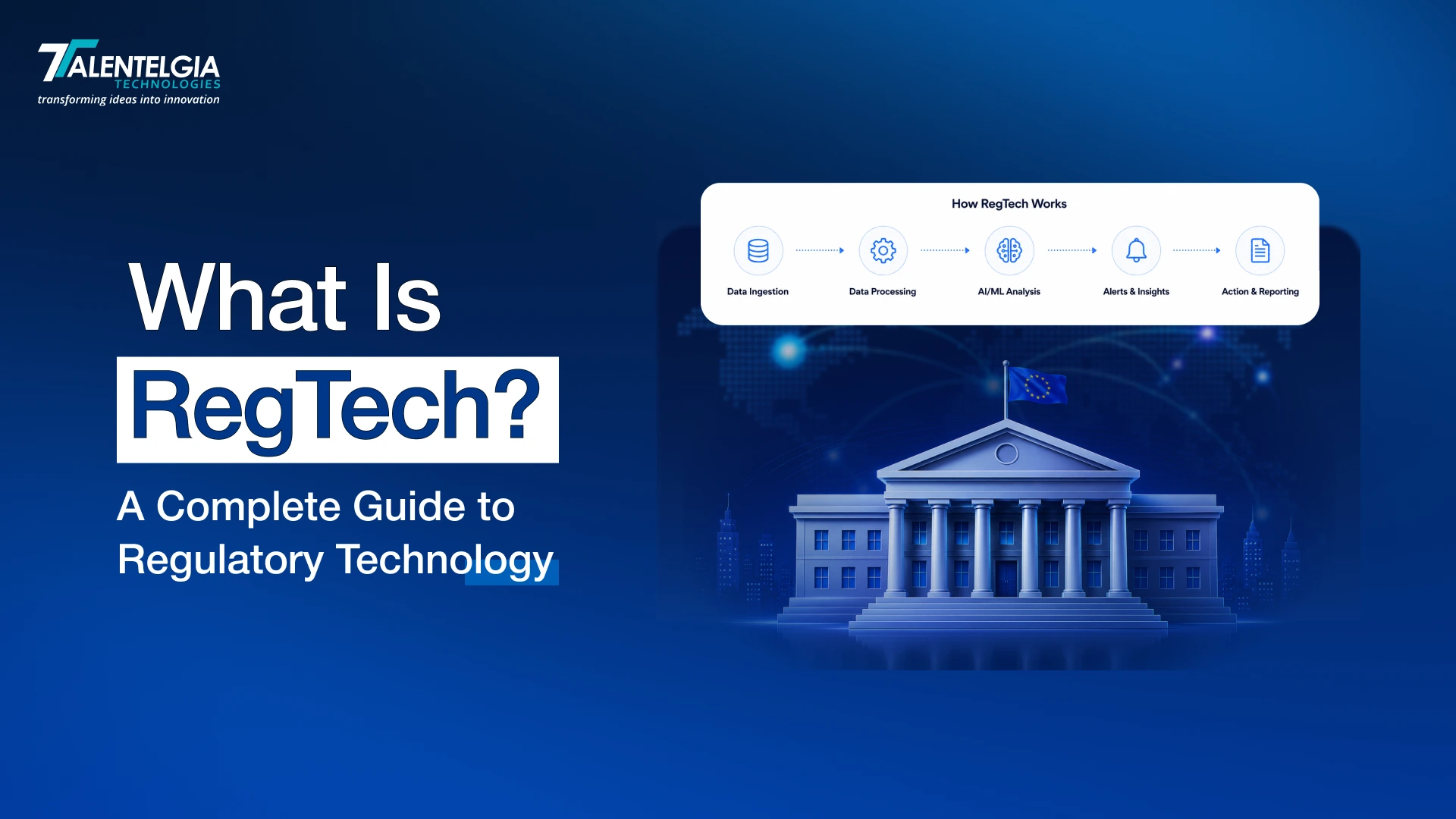
RegTech is short for regulatory technology. Simple as that: software that automates the compliance tasks that banks and fintechs would once have outsourced to whole teams of people manually cross-referencing spreadsheets. It flags suspicious transactions the moment they happen, verifies who a customer actually is in seconds, and spits out audit-ready reports nobody had to build by hand.
It’s become one of the fastest-growing categories in financial technology, and for good reason. As real-time payments and cross-border transactions have exploded, manual compliance simply can’t keep up anymore.
This guide breaks it down properly. You’ll learn exactly what RegTech does, the technologies powering it, the different types available, where it’s used across industries, and how it actually differs from FinTech – everything you need to understand where compliance technology is headed.
What Does RegTech Do?
RegTech exists to solve one specific problem: financial institutions are drowning in regulatory obligations, and doing them by hand doesn’t scale. Banks paid $19.3 billion in compliance penalties in 2024 alone, the highest figure on record, according to McKinsey. That number is the entire reason RegTech exists.
At its core, RegTech automates the compliance work that used to eat up entire departments. That means:
- Verifying identities – running KYC checks in seconds instead of days, cross-referencing documents, biometrics, and databases automatically
- Monitoring transactions in real time – scanning payments as they happen to catch money laundering, fraud, or sanctions violations before they clear
- Screening against watchlists – checking every customer and transaction against global sanctions lists and politically exposed person (PEP) databases continuously, not on a periodic review cycle
- Tracking regulatory changes – flagging when a new rule affects existing workflows, so compliance teams aren’t relying on manual research to stay current
- Generating audit-ready reports – pulling data from multiple systems into a single trail regulators can review without a scramble
The underlying shift is from periodic to continuous. Traditional compliance ran on scheduled reviews, quarterly audits, manual sample checks. RegTech replaces that with systems that never stop watching, because modern transaction volume and speed made scheduled reviews obsolete the moment real-time payments became standard.
The payoff isn’t just fewer fines. Institutions running RegTech well see faster onboarding, fewer false-positive fraud alerts pulling analysts off real threats, and audit trails that exist automatically instead of getting built retroactively when a regulator asks.
The Technologies Behind RegTech & How It Works
RegTech isn’t one technology. It’s several working together, each handling a different piece of the compliance problem.
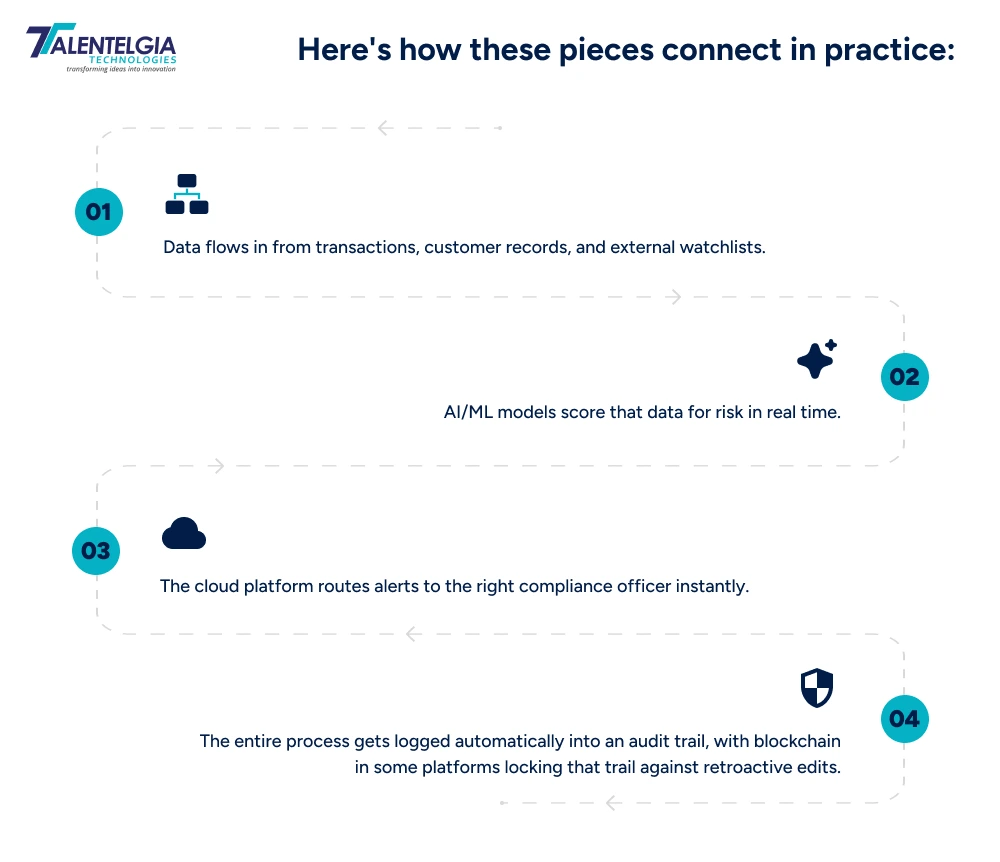
Artificial intelligence and machine learning do the heavy lifting. AI models learn what normal transaction behavior looks like for a given customer or account, then flag deviations that a fixed rule engine would miss entirely. This is what separates modern RegTech from older rule-based compliance software: a rules engine catches transactions above a set threshold; an ML model catches a transaction that’s unremarkable in size but wildly out of character for that specific customer. It’s also how false positives get reduced; instead of flagging every transaction that technically matches a risk criterion, the model learns which patterns are actually suspicious.
Big data and analytics feed those models. Compliance decisions run on volume, years of transaction history, sanctions lists updated by the day, and regulatory filings across jurisdictions. RegTech platforms aggregate this data from multiple internal systems and external feeds into one queryable environment, which is what makes real-time monitoring possible in the first place. Without that consolidation layer, a bank’s transaction data, KYC records, and watchlist feeds would sit in separate systems that don’t talk to each other.
Cloud computing is the delivery layer. Most RegTech runs as SaaS, which matters because regulatory requirements change constantly. A cloud-based platform can push a rule update across every client instantly, rather than requiring each institution to manually patch on-premise software. It’s also what makes RegTech affordable for smaller fintechs that can’t run their own compliance infrastructure.
Blockchain shows up in a narrower but growing set of use cases, mainly identity verification and audit trails, where an immutable record of who checked what, and when, gives regulators a tamper-proof history to review.
Also Read: AI vs Machine Learning vs Deep Learning
How Does RegTech Work?
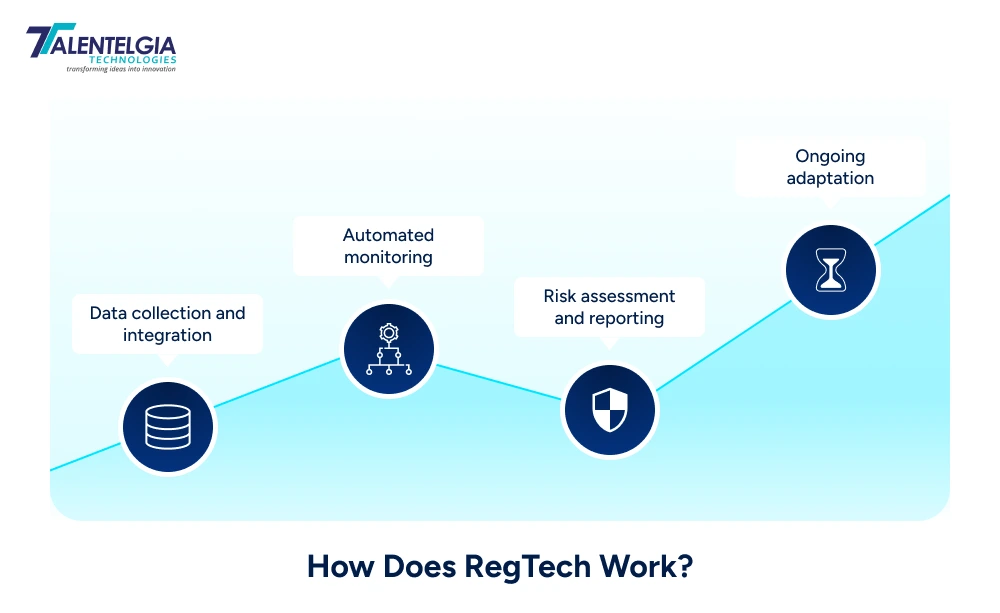
RegTech doesn’t follow one universal script; workflows shift by industry and regulation, but most platforms run through the same four stages underneath.
1. Data collection and integration – The system pulls information from internal business applications, external regulatory feeds, and third-party sources, both structured data (transaction logs, customer records) and unstructured data (emails, documents, communications), into a single unified view. This is usually the hardest part in practice: legacy systems that don’t talk to each other slow integration down considerably.
2. Automated monitoring – Once the data’s flowing, the system reviews transactions, communications, and operational activity against defined regulatory thresholds in real time, flagging irregularities as they happen rather than in a scheduled batch review. The tradeoff here is tuning: too sensitive, and compliance teams drown in false positives; too loose, and real risks slip through.
3. Risk assessment and reporting – Flagged data gets analyzed to score actual non-compliance exposure, then compiled into audit-ready reports. Output quality here depends entirely on input quality; a well-configured system with poor data still produces unreliable reports.
4. Ongoing adaptation – Regulations change constantly, so RegTech platforms update their rule sets to reflect new requirements, but that update rarely happens without friction. Staff retraining, workflow reconfiguration, and automation adjustments usually follow every meaningful regulatory shift.
The result, when it works: a bank goes from manually chasing compliance gaps to a live system that catches, scores, and reports issues continuously. One US bank cited by McKinsey ran a legacy solution that covered less than 75% of its regulatory obligations before switching to an automated RegTech platform; after implementation, compliance climbed above 95%.
RegTech vs. Traditional Compliance Approaches
Traditional compliance runs on a model built for a slower era: spreadsheets, periodic audits, and reviews conducted after a problem has already surfaced. That model breaks down fast once transaction volume and regulatory complexity scale past what a manual team can track.
| Dimension | Traditional Compliance | RegTech |
|---|---|---|
| Timing | Reactive, audits after the fact | Proactive, continuous, real-time monitoring |
| Data sources | Fragmented, siloed systems | Aggregated into a unified view |
| Error rate | High, manual entry, human oversight gaps | Lower, automated extraction and validation |
| Reporting speed | Weeks, often dependent on external legal support | Near-instant, auto-generated and audit-ready |
| Scalability | Breaks down as vendor/transaction volume grows | Scales with API-driven, cloud-based infrastructure |
| Cost profile | High labor cost, hidden penalty risk | Upfront platform investment, lower ongoing labor cost |
The gap shows up starkly in fraud detection specifically. One Latin American bank’s legacy monitoring system caught less than half of the fraud attempts it faced. After switching to a behavioral-biometrics RegTech platform, detection rates climbed past 90% and false positives dropped by 66%, the same data, processed by a system built to catch patterns a manual review would miss entirely.
Integration With Third-Party Risk Management Frameworks
Vendor risk doesn’t stay contained to one system, and neither should the compliance tooling meant to catch it. RegTech’s real value in third-party risk management (TPRM) comes from aligning vendor oversight with recognized frameworks like NIST, ISO 27001, SOC 2, and GDPR, instead of running a separate, manual checklist for each one.
Practically, this integration does three things:
- Automates evidence collection and control mapping – instead of a compliance analyst manually gathering vendor certifications and cross-referencing them against each framework, the platform does the mapping and flags gaps automatically
- Centralizes documentation into one hub – compliance records, risk scores, and audit trails for every vendor relationship live in a single system rather than scattered across departments, which is what actually gives real-time visibility across an entire vendor network
- Opens shared portals with vendors – suppliers submit compliance data and certifications directly into the platform, cutting the manual back-and-forth that used to stretch vendor verification out over weeks
The practical payoff is consistency. A vendor assessed against GDPR requirements in January and reassessed in June gets evaluated the same way both times, by the same automated logic, something a rotating team of human reviewers can’t reliably guarantee at scale.
Also Read: How to Create a Fintech App?
Challenges & Best Practices for RegTech Adoption
RegTech adoption isn’t friction-free, and pretending otherwise sets up a rollout for disappointment.
The Real Challenges
- Legacy system integration – most financial institutions run on infrastructure that predates API-first design, and connecting new RegTech tools to that stack takes real engineering time, not a plug-and-play install
- Data privacy exposure – cloud-based platforms handling sensitive compliance data raise legitimate questions about storage, access, and cross-border data sharing, especially with global vendor networks
- Vendor and staff training – a platform is only as good as the people using it; both internal compliance teams and external vendors need onboarding before the tool delivers value
- Incumbent bias – McKinsey notes that risk-averse financial institutions often favor established providers over newer RegTech entrants by default, which means newer, sometimes better-fit vendors have to work harder to prove themselves
- Regulatory volatility – a RegTech solution built around a specific regulation can lose relevance fast if that regulation gets rolled back or restructured.
What Actually Works
- Start with high-risk vendors first – proving value on the relationships carrying the most exposure builds internal buy-in faster than a broad, unfocused rollout
- Choose scalable, API-friendly platforms – tools that integrate with existing systems instead of requiring a rip-and-replace approach
- Tie adoption to the broader compliance strategy – RegTech implemented in isolation from an institution’s actual risk priorities tends to underperform, regardless of how good the underlying technology is
RegTech Use Cases
RegTech isn’t theoretical — it’s running underneath specific, high-volume compliance tasks right now across financial institutions.
- Transaction monitoring – screening payments and transfers in real time against regulatory thresholds, flagging anomalies for review before they clear rather than after
- Identity verification and KYC – cross-checking customer identity documents, biometrics, and databases automatically during onboarding, reducing both fraud risk and onboarding time
- AML compliance and sanctions screening – continuously checking transactions and customers against global sanctions and PEP lists to prevent high-profile compliance failures and systemic oversight gaps.
- Regulatory reporting – auto-generating and formatting filings according to regulator-specific requirements (structured formats like XBRL are common here), cutting both manual effort and submission errors
- Third-party risk assessment – evaluating vendor and partner compliance exposure continuously instead of during an annual review cycle
- Audit preparation – centralizing documentation and compliance history so audits pull from an existing, organized trail instead of a last-minute scramble
McKinsey estimates roughly 1,000 firms now offer some form of RegTech service, spanning four broad categories: financial risk and capital management, governance/risk/compliance, cyber and IT security, and financial crime. Growth isn’t slowing either. McKinsey projects the RegTech segment could grow up to 14% annually through 2028, driven largely by financial crime and cybersecurity-focused solutions outpacing more generalized platforms.
Benefits of RegTech
RegTech consistently cuts costs, time, and error rate versus manual compliance. Here’s where that shows up.
Lower compliance costs – Automating what used to require entire teams of manual reviewers cuts labor costs directly. Deloitte’s research on regulatory automation found the FDA’s drug application intake process cut processing time by 93% and eliminated over 5,200 hours of manual labor after switching to automated review. A Government example, not finance, but it shows the scale of what automation can strip out of a compliance workflow built on manual review.
Faster processing, fewer bottlenecks – Reports that used to take days to compile, pulling data from five different systems, formatting it to a regulator’s spec, getting sign-off, now generate in minutes. That speed compounds: faster onboarding means faster revenue, faster fraud flags mean less exposure window, faster regulatory filings mean less risk of missing a deadline.
Fewer errors, more accuracy – Manual compliance work is repetitive, and repetitive work is where humans make mistakes, be it a mistyped field, a missed cross-reference, or a report filed against the wrong template. Automated systems apply the same logic every time, which doesn’t eliminate errors but removes the fatigue-driven inconsistency that manual review introduces at scale.
Real-time risk visibility – Traditional compliance finds problems after they’ve already happened, during a quarterly review, an annual audit, or a regulator’s inquiry. RegTech flags issues as they occur, which is the entire reason continuous monitoring has become the baseline expectation rather than a competitive edge.
Built-in scalability – A compliance team sized for last year’s transaction volume doesn’t automatically scale to this year’s growth, but a RegTech platform does, without a proportional headcount increase. That matters most for institutions expanding into new jurisdictions, where the alternative is hiring a specialized compliance function for every new regulatory regime.
Wrapping Up
RegTech isn’t hype. It’s what lets compliance stop chasing problems after they happen and start catching them as they occur. Every piece in this guide points to the same shift: banks used to review compliance once a quarter. Now they can’t afford to blink. AI flags the risk, cloud platforms push the fix instantly, and reports write themselves instead of piling up on someone’s desk.
If you’re building financial technology and want compliance baked into your product from day one rather than bolted on after a regulator asks questions, that’s exactly the kind of work Talentelgia Technologies does. We build fintech software with compliance architecture in mind from the ground up, so when your product scales, your compliance doesn’t have to scramble to catch up. If that’s the kind of tech partner you’re looking for, let’s talk.












 Sales Enquiries:
  Business queries:
  HR:
HR: 


