


 Healthcare Software Development Services
 Healthcare App Development Services
 Real Estate Web Development Services
 Real Estate App Development Company
 E-Commerce App Development Services
 E-Commerce Web Development Services
 Blockchain E-commerce Development Company
 Fintech Software Development
 Fintech App Development Services
 E-Learning App Development Services
 Restaurant App Development Company
 Mobile Game Development Company
 Travel App Development Company
 Automotive Web Design
 AI Traffic Management System
 AI Inventory Management Software
 Logistics App Development Services
 Machine Learning Development
 ChatGPT integration services
  AI Development Company
  AI Integration Services
  Natural Language Processing Company
 Mobile App Development
  IOS App Development
  Android App Development
  Cross-Platform App Development
  Augmented Reality (AR) App Development
  Virtual Reality (VR) App Development
  Web App Development
  SaaS App Development
 Custom Software Development Services
  Flutter
  React Native
  Swift (IOS)
  Kotlin (Android)
  Mean Stack Development
  AngularJS Development
  MongoDB Development
  Nodejs Development
  Database Development
 Ruby on Rails Development
 Expressjs Development
  Full Stack Development
  Web Development Services
  Laravel Development
  LAMP Development
  Custom PHP Development
  .Net Development
  User Experience Design Services
  User Interface Design Services
  Automated Testing
  Manual Testing
  Digital Marketing Services
 Ride-Sharing And Taxi Services
 Food Delivery Services
 Grocery Delivery Services
 Transportation And Logistics
 Car Wash App
 Home Services App
 ERP Development Services
 CMS Development Services
 LMS Development
 CRM Development
 DevOps Development Services
 AI Business Solutions
 AI Cloud Solutions
 AI Chatbot Development
 API Development
 Blockchain Product Development
 Cryptocurrency Wallet Development
 About Talentelgia
  Our Team
  Our Culture
 Healthcare App Development Services
 Real Estate Web Development Services
 E-Commerce App Development Services
 E-Commerce Web Development Services
 Blockchain E-commerce
Development Company
Blockchain E-commerce
Development Company Fintech App Development Services
 Blockchain Fintech
Development Company
Blockchain Fintech
Development Company E-Learning App Development Services
 Restaurant App Development Company
 Mobile Game Development Company
 Travel App Development Company
 AI Traffic Management System
 AI Inventory Management Software
 AI Development Company
 ChatGPT integration services
 AI Integration Services
 Machine Learning Development
 Machine learning consulting services
 Blockchain Development
 Blockchain Software Development
 Smart contract development company
 NFT marketplace development services
 Asset tokenization companies
 DeFi Wallet Development Company
 IOS App Development
 Android App Development
 Cross-Platform App Development
 Augmented Reality (AR) App
Development
Augmented Reality (AR) App
Development Virtual Reality (VR) App Development
 Web App Development
 Flutter
 React
Native
React
Native Swift
(IOS)
Swift
(IOS) Kotlin (Android)
 MEAN Stack Development
 AngularJS Development
 MongoDB Development
 Nodejs Development
 Database development services
 Expressjs Development
 Full Stack Development
 Web Development Services
 Laravel Development
 LAMP
Development
LAMP
Development Custom PHP Development
 User Experience Design Services
 User Interface Design Services
 Automated Testing
 Manual
Testing
Manual
Testing About Talentelgia
 Our Team
 Our Culture
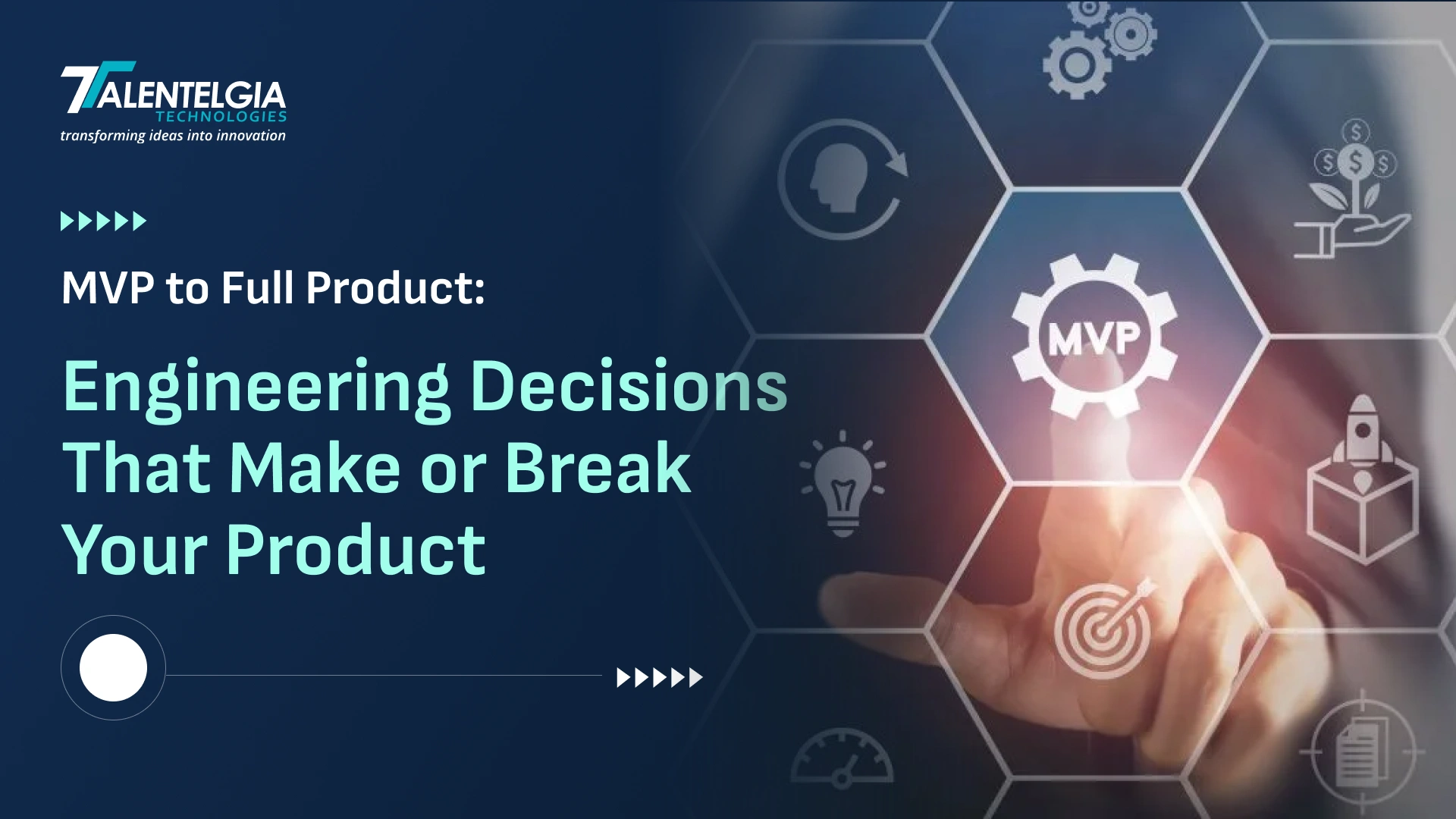
Every great product starts with a bold idea and a tight deadline. You move fast, make a few compromises, and get your MVP out into the world. In the beginning, users come in slowly.
Then, almost overnight, hundreds and thousands of people start using your product. Everyone thought this would be an easy undertaking, but suddenly everything breaks—servers crash, features slow down, users complain. This is the moment when products either live or die!
Turning an MVP into a full product is not just about adding more features. It is about making the right choices early on, even when you are moving quickly and working with limited time. Many teams only realize this when the pressure builds, but by then, it can be harder to fix what was rushed.
The difference between a product that grows smoothly and one that struggles often comes down to a few key decisions made much earlier in the journey.
So, if you are ready to convert your MVP to a full product, here is what actually matters.
1. Architecture: Monolithic vs. Microservices
One of the most common mistakes early-stage teams make is over-engineering from day one. Microservices are powerful, but they come with significant operational overhead: service discovery, distributed tracing, inter-service communication, and complex deployments.
For most MVPs, a well-structured monolithic is the right starting point. It is faster to build, easier to debug, and simpler to deploy. The key is to keep it modular internally, with clean boundaries between domains, so that when the time comes to extract services, the seams are already there.
The thumb rule: migrate to microservices when a specific component has a bottleneck that cannot be solved within the monolithic, not because it feels like the right thing to do. Read more about monolithic vs microservices.
2. Database Design: The Decisions That Haunt You Later
Database choices may not seem urgent in the early days, but they can create serious problems as your product grows. Many teams rush through this part during the MVP stage, only to face major rework later when things get bigger and harder to change.
When you are moving from MVP to full product, your data model needs serious attention. A few things that make a real difference:
- Pick the database based on your needs: A relational database is not always the best option, and neither is NoSQL. Think about how your data will actually be used before deciding.
- Focus on how data will be read: Storing data is important, but how often and how quickly you need to fetch it matters even more.
- Plan for changes from the start: As your product grows, your database will need updates. If you do not plan for this early, making changes later can be slow and risky.
Once your system has a large amount of data, changing the structure becomes difficult and expensive. Taking a bit more care in the beginning can save months of effort down the line.
3. API Design: Build Contracts That Last
APIs help different parts of your product work together, such as the frontend, mobile apps, and external services. Sometimes, they even connect directly with customers. If you make changes without enough care, you can easily break things and cause major issues.
Take time early on to set up strong API practices. Start versioning right away, even if you only have one version. Use clear and consistent names, and make sure your documentation is complete. Good APIs attract other developers, but confusing or poorly documented ones are usually ignored.
As your product grows, the API becomes a key part of your system. Focus on its quality from the beginning to avoid problems later on.
4. Observability: You Cannot Fix What You Cannot See
A lot of teams put all their energy into building features and shipping quickly. At this point, things like logs, monitoring, and alerts often get overlooked. Everything seems fine until something breaks in production and you have no idea what happened.
That’s when you realize you’re just guessing instead of actually knowing what’s wrong.
This is why observability is important. It lets you see what’s happening in your system, so you’re not left in the dark when problems show up.
At the very least, you should have a few basics covered:
- Logs that are easy to understand
- Monitoring to help you catch slowdowns early
- Alerts that quickly reach the right person
If you wait to add these things until your system is bigger, it gets messy and takes a lot more time. Setting them up early is much easier and saves you a lot of stress down the road.
5. The Build vs. Buy Decision: Be Honest About Your Core Competency
There is a certain satisfaction in building everything on your own. Most engineers feel it. But when your product starts growing, this mindset can slowly take up too much time and energy, and progress begins to slow down.
Things like authentication, payments, email delivery, or analytics are already handled well by existing tools and services. Many companies specialize in just these areas. Using their solutions is not about taking shortcuts, it is about using your time wisely.
Focus on building the parts that make your product unique. For everything else, rely on trusted tools or open-source options.
The more clearly you draw this line, the faster your team can move. And speed matters a lot when you are turning an MVP into a full product and trying to keep up with the market.
Also Read: MVP Development Cost
The Bottom Line
Turning an MVP into a full product is more than a technical task. It is also a strategic process. The choices you make early on can help your growth or hold it back later.

Teams that make this transition well are not always the ones with the most skilled engineers. Instead, they make thoughtful decisions early and review them honestly as their product grows.

At Talentelgia, we have worked with startups and growing companies at every stage, from the first line of code to systems that serve millions. If you are moving from MVP to a full product, we are here to help you succeed.










 Sales Enquiries:
  Business queries:
  HR:
HR: 


