



 Healthcare Software Development Services
 Healthcare App Development Services
 Real Estate Web Development Services
 Real Estate App Development Company
 E-Commerce App Development Services
 E-Commerce Web Development Services
 Blockchain E-commerce Development Company
 Fintech Software Development
 Fintech App Development Services
 E-Learning App Development Services
 Restaurant App Development Company
 Mobile Game Development Company
 Travel App Development Company
 Automotive Web Design
 AI Traffic Management System
 AI Inventory Management Software
 Logistics App Development Services
 Machine Learning Development
 ChatGPT integration services
  AI Development Company
  AI Integration Services
  Natural Language Processing Company
 Mobile App Development
  IOS App Development
  Android App Development
  Cross-Platform App Development
  Augmented Reality (AR) App Development
  Virtual Reality (VR) App Development
  Web App Development
  SaaS App Development
 Custom Software Development Services
  Flutter
  React Native
  Swift (IOS)
  Kotlin (Android)
  Mean Stack Development
  AngularJS Development
  MongoDB Development
  Nodejs Development
  Database Development
 Ruby on Rails Development
 Expressjs Development
  Full Stack Development
  Web Development Services
  Laravel Development
  LAMP Development
  Custom PHP Development
  .Net Development
  User Experience Design Services
  User Interface Design Services
  Automated Testing
  Manual Testing
  Digital Marketing Services
 Ride-Sharing And Taxi Services
 Food Delivery Services
 Grocery Delivery Services
 Transportation And Logistics
 Car Wash App
 Home Services App
 ERP Development Services
 CMS Development Services
 LMS Development
 CRM Development
 DevOps Development Services
 AI Business Solutions
 AI Cloud Solutions
 AI Chatbot Development
 API Development
 Blockchain Product Development
 Cryptocurrency Wallet Development
 About Talentelgia
  Our Team
  Our Culture
 Healthcare App Development Services
 Real Estate Web Development Services
 E-Commerce App Development Services
 E-Commerce Web Development Services
 Blockchain E-commerce
Development Company
Blockchain E-commerce
Development Company Fintech App Development Services
 Blockchain Fintech
Development Company
Blockchain Fintech
Development Company E-Learning App Development Services
 Restaurant App Development Company
 Mobile Game Development Company
 Travel App Development Company
 AI Traffic Management System
 AI Inventory Management Software
 AI Development Company
 ChatGPT integration services
 AI Integration Services
 Machine Learning Development
 Machine learning consulting services
 Blockchain Development
 Blockchain Software Development
 Smart contract development company
 NFT marketplace development services
 Asset tokenization companies
 DeFi Wallet Development Company
 IOS App Development
 Android App Development
 Cross-Platform App Development
 Augmented Reality (AR) App
Development
Augmented Reality (AR) App
Development Virtual Reality (VR) App Development
 Web App Development
 Flutter
 React
Native
React
Native Swift
(IOS)
Swift
(IOS) Kotlin (Android)
 MEAN Stack Development
 AngularJS Development
 MongoDB Development
 Nodejs Development
 Database development services
 Expressjs Development
 Full Stack Development
 Web Development Services
 Laravel Development
 LAMP
Development
LAMP
Development Custom PHP Development
 User Experience Design Services
 User Interface Design Services
 Automated Testing
 Manual
Testing
Manual
Testing About Talentelgia
 Our Team
 Our Culture
Everyone has seen the headlines: “Built my SaaS in a weekend using AI.” And honestly? Some of them are true.
But here’s what the headline doesn’t tell you. That weekend project either cost $60,000 to fix three months later, or it never scaled past 50 users.
The AI development boom has created a genuine paradox. Building has never been faster. Budgets are still blowing up. And the gap between “it works” and “it works at scale” has never been more expensive to cross.
In 2026, the real question isn’t whether AI can help you build a SaaS product. It absolutely can. The question is: what does it actually cost, and what are the decisions in the first few weeks that determine whether you spend $30,000 or $300,000?
This guide cuts through the noise. No recycled estimates. No vague ranges padded with disclaimers. Just a straight breakdown of how much does it cost to build a SaaS product using AI tools and how to make sure every rupee or dollar you spend is working for you.
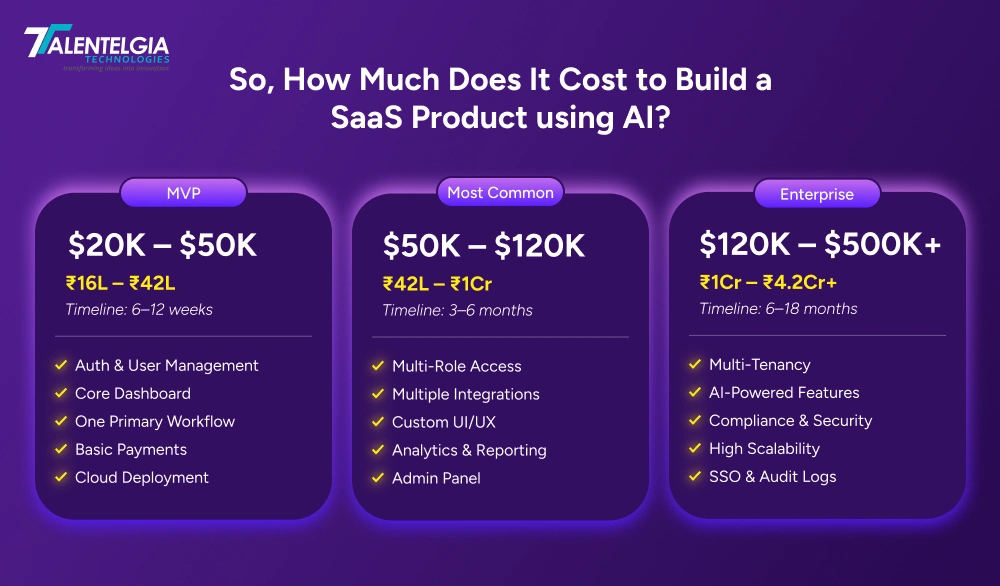
SaaS development costs using AI vary primarily by product stage and complexity. An MVP typically costs $20k–$50k, focusing on core features to validate demand. Mid-level SaaS products range from $50k–$120k, adding scalability, integrations, and a polished user experience for paying customers. Enterprise SaaS builds start at $120k and can exceed $500k, driven by requirements like security, compliance, analytics, and high reliability. AI tools have accelerated development, but costs still scale with what you’re building, not just how fast you build it. Architecture decisions, feature depth, and long-term maintainability are still the primary cost drivers.
How Founders Actually Build SaaS in 2026?
The tooling landscape has split into three distinct paths, and the one you choose shapes everything from your timeline to your total spend.
AI-powered builders like Cursor and similar platforms can take you from description to deployable product in hours. Genuinely. The cost to get started is almost nothing.
Traditional development agencies provide structure, experience (to some degree), and a team. But that means they will work for 12–16 weeks at the very least, and budgets starting at $35k and climbing quickly
Bubble or Webflow and other no-code platforms are somewhere in the middle. They have a low upfront cost but a steep learning curve and a ceiling that every scaling product hits eventually
None of these paths is universally right. What matters is matching the path to your stage because a founder validating an idea has completely different needs than one scaling a proven product.
The cost difference between choosing right and choosing wrong? Easily $50,000. Yes!
Factors that Impact the Cost of an AI-Powered SaaS Product?
Several clear factors affect the SaaS development cost while using AI. Let’s talk about a few of them in detail: -.
Product Complexity
This is the biggest one. And no, we aren’t talking about the features. Complexity here means how your system is built, how data flows, how users interact, and how the product behaves when there is enough load. A lean MVP with one focused use case might ship in 6–8 weeks. And if we add multi-tenancy, custom permissions, real-time data, and audit logging, it’s going to be a completely different project, often 3x the cost before a single advanced feature is added.
| Complexity Level | What It Means | Approximate Cost |
|---|---|---|
| Micro SaaS | Single use case, minimal infra | $3000 – $5,000+ |
| Basic | Standard features, limited scale | $5000 – $8,000+ |
| Medium | Multi-tenant, several integrations | $10,000 – $25,000+ |
| Complex | Enterprise-grade, high availability | $25,000 – $50,000+ |
Budget Impact – This single factor sets the base for your entire budget.
Feature Scope
Core features are predictable to build. Cost starts climbing the moment you go beyond the basics and include real-time data, third-party integrations, custom reporting, and AI workflows. Each of these compound development time in ways that aren’t obvious upfront. The smarter move is to scope your MVP around only the features your first users actually need. Everything else is phase two.
If you’re building an MVP specifically to validate the idea before committing to the full build, the numbers look like this:
| MVP Complexity | Approximate Cost |
|---|---|
| Simple SaaS MVP | $8,000 – $10,000 |
| Medium complexity MVP | $10,000 – $25,000+ |
| Complex MVP | $25,000 – $50,000+ |
Budget Impact – Data preparation and advanced features alone can consume 30–40% of your total development budget.
UI/UX Design
Most founders treat design as an afterthought. It isn’t. Design scope increases with the number of screens, level of custom interaction design, and how much of the interface needs to be built from scratch versus adapted from a component library.
| Design Complexity | Approximate Cost |
|---|---|
| Simple (basic UI, minimal custom elements) | $2,000 – $3,000 |
| Medium (advanced UI, more screens) | $3,000 – $5,000 |
| Complex (fully custom, per-screen design) | $5,000 – $10,000 |
Budget Impact – Design typically accounts for 10–15% of total development cost on a standard build.
Team Structure and Location
Three models, each with real tradeoffs.
- In-house gives you full control but comes with a 3–6 month hiring lag.
- Freelancers can be cost-effective for isolated tasks, but coordinating a full SaaS build across distributed freelancers adds overhead most founders underestimate.
- Agencies eliminate the hiring lag and give you an immediately functional cross-functional team.
Rates vary significantly by region. Location matters too, not because of quality, but because of labour costs:
| Region | Hourly Rate |
|---|---|
| Asia / Africa | $20 – $45 |
| Central / North Europe | $50 – $70 |
| Western Europe | $75 – $150 |
| North America | $100 – $200 |
Budget Impact – Labour is usually 50–70% of the total project cost, and the biggest lever you have to control it is where your team is based.
Quality Assurance and Testing
Bugs in production can erode trust and create an expensive support load that compounds over time. QA is something you can’t miss. It’s a cost you either pay upfront in testing or pay later in fixes, refunds, and churn.
| QA Type | Approximate Cost |
|---|---|
| Manual QA testing | $2,000 – $3,000 |
| Automated test suite | $1,000 – $2,000 |
| Security penetration testing | $1,000 – $2,000 |
| Performance and load testing | $2,000 – $3,000 |
| Deployment and DevOps setup | $1,000 – $2,000 |
Budget Impact – Budget 15–20% of your total development cost for QA, cutting it routinely costs 3–5x more in post-launch fixes.
| Component | Cost range |
|---|---|
| UI/UX design | $3,000 – $15,000 |
| Frontend development | $10,000 – $40,000 |
| Backend development | $15,000 – $60,000 |
| APIs & integrations | $5,000 – $20,000 |
| Testing & QA | $5,000 – $15,000 |
| Deployment & infrastructure | $3,000 – $10,000 |
| Total | $41,000 – $160,000 |
How Much Does it Cost to Build a SaaS Product Using AI Tools
Tier 1: MVP
Cost: $20,000 – $50,000 (₹16L – ₹42L) Timeline: 6–12 weeks
This is where every SaaS product should start. And not because it comes under the cheapest options. But because it answers the only question that actually matters early on – will people use this?
A well-scoped MVP includes user authentication, a core dashboard, one primary workflow, basic payments, and enough stability to onboard real users. That’s it.
Who this is for: First-time founders validating a market, early-stage startups pre-funding, or businesses testing a new product line before committing to a full build.
Tier 2: Mid-Level SaaS
Cost: $50,000 – $120,000 (₹42L – ₹1Cr) Timeline: 3–6 months
This is where most serious SaaS products actually live. You’ve moved past validation. Now it is time to build something users will pay for, return to, and recommend.
The mid level SAAS product demands multiple user roles, a polished UI, payment integrations, an admin panel, reporting dashboards, and 2–3 third-party integrations.
Who this is for: Founders who are seeing early traction on their product and want to make it more professional. It also works well for businesses that are launching a SaaS with a customer base that has already been identified, especially those operating under an on demand business model.
Tier 3: Enterprise SaaS
Cost: $120,000 – $500,000+ (₹1Cr – ₹4.2Cr+) Timeline: 6–18 months
Enterprise is a different category of build entirely. There is an entirely different set of requirements for this tier based on reliability, security, and scale.
It includes SSO, audit logging, advanced analytics, compliance infrastructure, custom onboarding, and AI-powered features. All decisions at this level are time or money based. This is why teams with experience and good architecture are important.
Who this is for: Companies with proven demand, enterprise customers already in conversation, or products operating in regulated industries like fintech or healthcare.
The Hidden Costs No One Talks About
The build budget is the number everybody plans for. What quietly derails most SaaS products is everything that comes after, and a few things hiding inside the build itself.
- Technical debt from AI-generated code – Fast code isn’t always clean code. Without proper review, you end up with duplicate logic and inconsistent patterns that get harder to untangle every week. What saves time in month one compounds into expensive rework by month six.
- No architecture, just code – AI writes functions. It doesn’t design systems. Without deliberate architecture planning upfront, you get a product that works at 100 users and breaks at 1,000, requiring costly rebuilds mid-growth.
- More testing than you budgeted for – AI-generated code looks correct. It often isn’t, especially at edge cases. Budget testing at 20–25% of total development cost from the start, not as a final afterthought.
- Security and compliance – It is an expensive surprise. GDPR violations can cost up to €20 million, or 4% of global annual turnover, whichever is higher. Under the EU AI Act, non-compliance with prohibited AI practices carries fines up to €35 million or 7% of worldwide annual turnover. Building compliance from day one costs a fraction of retrofitting it after a breach.
- Tool costs that quietly compound – Subscriptions, API usage, infrastructure, these are individually small but collectively significant. These stack up faster than most founders expect and directly eat into margins if not accounted for early.
AI vs Traditional Development: What Changes?
AI hasn’t replaced development. It has just redistributed where the effort goes. And the data tells a more complicated story than most people expect.
The gains are real, but small. AI already excels at handling the most basic tasks, such as boilerplate code, documentation, and repetitive debugging. And it is actually faster for these tasks. What it stumbles at is anything requiring judgment: system architecture, security decisions, business logic, or scalability planning. That will continue to require the services of seasoned human beings, and it always will.
The challenge is that speed has an illusion of progress. It makes writing code faster, but it doesn’t necessarily mean production-ready. AI-assisted pull requests were found to have about 1.7 times as many issues, according to independent code analysis. So, faster output often means more review time, not less. And the teams that are actually receiving great value from AI are those that are not leveraging many tools. They are the ones who treat AI-generated code like they would compare with a junior developer, a good starting point, always reviewed, and never shipped on faith alone.
How to Control Costs When Building SaaS with AI
Controlling SaaS development costs is all about spending at the right stage on the right things.
Invest in discovery before a line of code is written
A week spent on proper architecture and requirements definition prevents months of rework. Most budget overruns are born in week one, not week ten.
Build for your current stage, not your future ambitions
Every feature you build now is a feature you have to test, maintain, and support. Defer what isn’t essential to launch. The features users actually need will reveal themselves after launch, not before.
Use pre-built where it makes sense
Authentication, payments, notifications – these features don’t need custom builds. Integrating proven tools like Stripe or Auth0 saves weeks of development time and reduces long-term maintenance burden significantly.
Treat your tech stack as a hiring decision
Niche frameworks might seem appealing technically. But a smaller developer pool means higher rates and longer timelines every time you need to hire, fix, or scale.
Plan maintenance into the budget from day one
A product without a maintenance budget doesn’t stay a product for long. Build that 15–25% annual cost into your financial model before you write the first check.
Conclusion
AI tools have made building SaaS products faster than ever. But they haven’t made it “cheap” in the way many people expect. Instead, they’ve shifted the cost from writing code to:

Reviewing it
Testing it
Maintaining it

The teams that succeed in 2026 are the ones that know how to build SaaS with AI wisely, with strong engineering practices. Because in the end:
AI helps you build faster.

But only good decisions help you build something that lasts.










 Sales Enquiries:
  Business queries:
  HR:
HR: 


