



 Healthcare App Development Services
 Real Estate Web Development Services
 E-Commerce App Development Services
 E-Commerce Web Development Services
 Blockchain E-commerce Development Company
 Fintech App Development Services
 Fintech Web Development
 Blockchain Fintech Development Company
 E-Learning App Development Services
 Restaurant App Development Company
 Mobile Game Development Company
 Travel App Development Company
 Automotive Web Design
 AI Traffic Management System
 AI Inventory Management Software
 Machine Learning Development
 ChatGPT integration services
  AI Development Company
  AI Integration Services
  Generative AI Development Services
  Natural Language Processing Company
 Mobile App Development
  IOS App Development
  Android App Development
  Cross-Platform App Development
  Augmented Reality (AR) App Development
  Virtual Reality (VR) App Development
  Web App Development
  SaaS App Development
 Flutter
  React Native
  Swift (IOS)
  Kotlin (Android)
  Mean Stack Development
  AngularJS Development
  MongoDB Development
  Nodejs Development
  Database Development
 Ruby on Rails Development
 Expressjs Development
  Full Stack Development
  Web Development Services
  Laravel Development
  LAMP Development
  Custom PHP Development
  .Net Development
  User Experience Design Services
  User Interface Design Services
  Automated Testing
  Manual Testing
  Digital Marketing Services
 Ride-Sharing And Taxi Services
 Food Delivery Services
 Grocery Delivery Services
 Transportation And Logistics
 Car Wash App
 Home Services App
 ERP Development Services
 CMS Development Services
 LMS Development
 CRM Development
 DevOps Development Services
 AI Business Solutions
 AI Cloud Solutions
 AI Chatbot Development
 API Development
 Blockchain Product Development
 Cryptocurrency Wallet Development
 About Talentelgia
  Our Team
  Our Culture
 Healthcare App Development Services
 Real Estate Web Development Services
 E-Commerce App Development Services
 E-Commerce Web Development Services
 Blockchain E-commerce
Development Company
Blockchain E-commerce
Development Company Fintech App Development Services
 Finance Web Development
 Blockchain Fintech
Development Company
Blockchain Fintech
Development Company E-Learning App Development Services
 Restaurant App Development Company
 Mobile Game Development Company
 Travel App Development Company
 Automotive Web Design
 AI Traffic Management System
 AI Inventory Management Software
 AI Development Company
 ChatGPT integration services
 AI Integration Services
 Machine Learning Development
 Machine learning consulting services
 Blockchain Development
 Blockchain Software Development
 Smart contract development company
 NFT marketplace development services
 Asset tokenization companies
 DeFi Wallet Development Company
 IOS App Development
 Android App Development
 Cross-Platform App Development
 Augmented Reality (AR) App
Development
Augmented Reality (AR) App
Development Virtual Reality (VR) App Development
 Web App Development
 Flutter
 React
Native
React
Native Swift
(IOS)
Swift
(IOS) Kotlin (Android)
 MEAN Stack Development
 AngularJS Development
 MongoDB Development
 Nodejs Development
 Database development services
 Expressjs Development
 Full Stack Development
 Web Development Services
 Laravel Development
 LAMP
Development
LAMP
Development Custom PHP Development
 User Experience Design Services
 User Interface Design Services
 Automated Testing
 Manual
Testing
Manual
Testing About Talentelgia
 Our Team
 Our Culture
With the rapid advancements in the digital space, software engineers and developers are always coming up with innovative ways to optimize their apps and improve end-user experience. One of the most popular approach that has become widely popular is “Serverless Architechture.” Serverless abstracts server provisioning, scaling and management — enabling more time for developers to focus on building applications; while providing operational efficiencies as well as cost-savings.
The arrival of serverless computing came with a very attractive pitch: no server to manage, automatic scaling, and “pay-for-everything-you-use” pricing. This model seemed like a breath of fresh air for everyone who is trying to get their startup on track, and SaaS teams running fast. This was made possible by services like Google Cloud Cloud Functions, Amazon Web Services, and Microsoft Azure Functions as they enabled developing code without requiring provisioning infrastructure. Thus, engineers can focus on logic instead of servers.
But before you jump to conclusions about this architectural paradigm, it is important to know the tradeoffs and costs of a serverless architecture so that you can tell if this is suitable to your use case and budgetary constraints.
Understanding The Serverless Architecture Model: Key Components, Cost Savings & Benefits
Have you ever wondered how Netflix serves millions of streams without crashing or how Figma can support bunch of designers working on creatives and other designing stuff at the same time? And that secret — is serverless architecture! Most traditional server-based computing does not work for Mobile apps or Websites where you have hundreds of triggers and interaction based functionality. It is also not very scalable, can be difficult to maintain, and may not be well suited for applications that have high traffic and are dynamic.
However, Serverless doesn’t always mean cheaper. For these sorts of scenarios, serverless is quite cost-effective and has a lower operational burden. In others, it silently becomes one of the most expensive architectural decisions you made in your cloud environment. In a nutshell, we will go through the pros and cons of serverless architecture and any prospective recommendation for your clients to use it or not!
What Exactly Is Server Architecture?
The term “Serverless” is often misunderstood. Servers still exist in high-security data centers; the difference lies in ownership and abstraction. In a traditional setup, you rent a “room” (a server) and pay for it whether you are sleeping in it or not. In Serverless, you pay for the “service”—the provider spins up the resources the exact millisecond they are needed and dissolves them the moment the task is complete.
Serverless Architecture means the cloud provider (like AWS, Azure, or Google) manages the server allocation, scaling, and maintenance entirely. Developers simply upload “functions” of code that execute in response to events.
The Core Components
- FaaS (Function as a Service): The logic of your app is broken into small, independent functions (e.g., AWS Lambda).
- BaaS (Backend as a Service): Third-party services handle complex tasks like databases (Firebase) or authentication (Auth0).
- Event-Driven Triggers: The architecture waits for an action—a user clicking a button or an image being uploaded—before consuming any compute power.
Evolution of Computing Models: Monolith to Serverless Timeline
Serverless architecture didn’t appear overnight, it’s the latest chapter in computing’s relentless quest for speed, scale, and simplicity. Here’s how we got here, from 90s server farms to 2026’s function-first world:
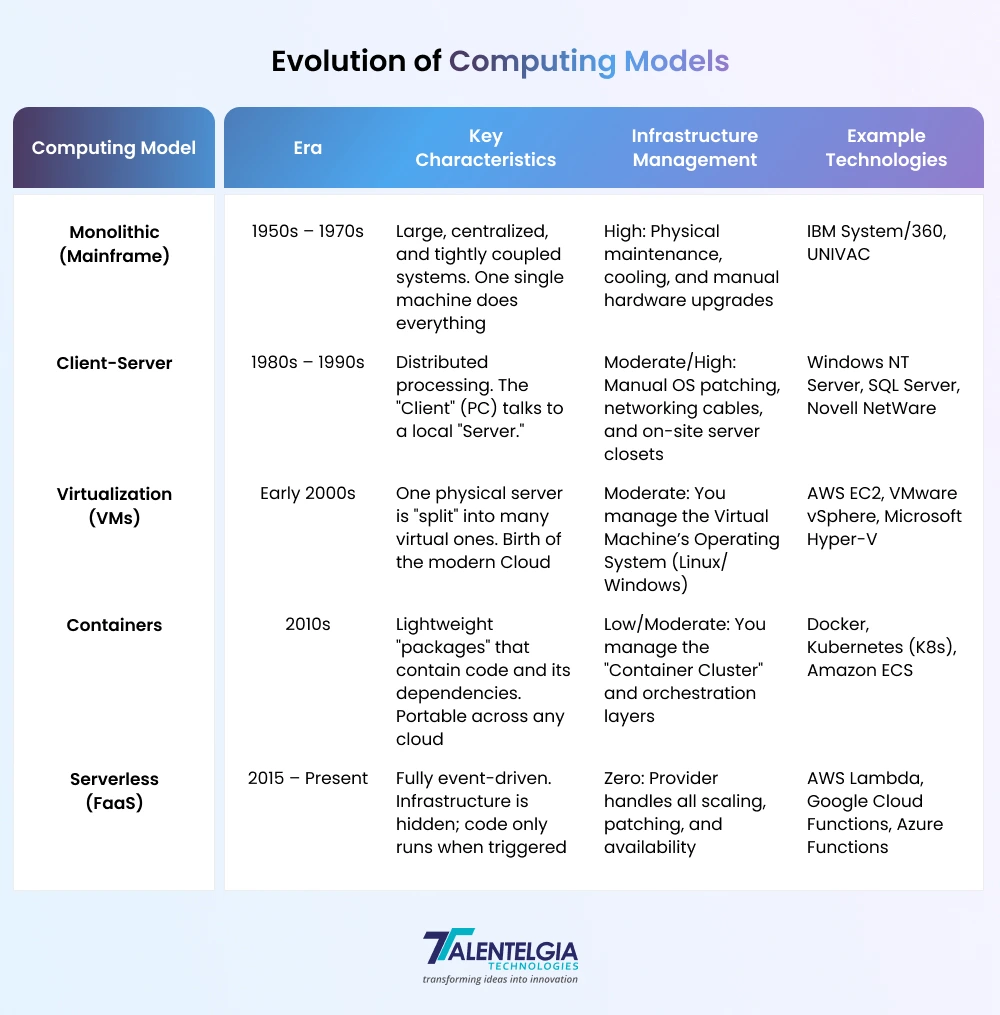
1. The Monolithic Era (1950s – 1970s)
In this period, the “Mainframe” was king. Organizations like IBM dominated with massive machines that filled entire rooms.
The Model: A single, unified codebase (monolith) where all logic—database, user interface, and processing—was tightly coupled and ran on one physical system.
2. Client-Server & PC Era (1980s – 1990s)
With the rise of personal computers and Local Area Networks (LANs), the model shifted from one central brain to a “split” system.
The Model: Applications were divided into two parts: the Client (your desktop PC) handled the user interface, while the Server (a dedicated machine in the office closet) managed the database and heavy calculations.
3. The Virtualization Era (Early 2000s)
This is the era that birthed the “Modern Cloud.” Companies like VMware revolutionized how we use hardware by allowing one physical server to host dozens of “Virtual Machines” (VMs).
The Model: Infrastructure-as-a-Service (IaaS). Instead of buying a server, you rented a “slice” of one in a data center (e.g., the launch of AWS EC2 in 2006).
4. The Container & Microservices Era (2010s)
As applications grew, they became too heavy for VMs. Developers started “packaging” their code into lightweight Containers (like Docker) that could run anywhere.
The Model: Platform-as-a-Service (PaaS). Monoliths were broken into tiny, independent pieces called “Microservices.” If the “Payment Service” crashed, the “Search Service” kept working.
5. The Serverless Era (2015 – 2026+)
This is the current “peak” of abstraction. The infrastructure is now completely invisible to the user.
The Model: Function-as-a-Service (FaaS). You don’t manage servers, operating systems, or even container clusters. You simply upload your “Function” (e.g., AWS Lambda, Google Cloud Functions).
Understanding The Serverless Cost Models In 2026: An Overview
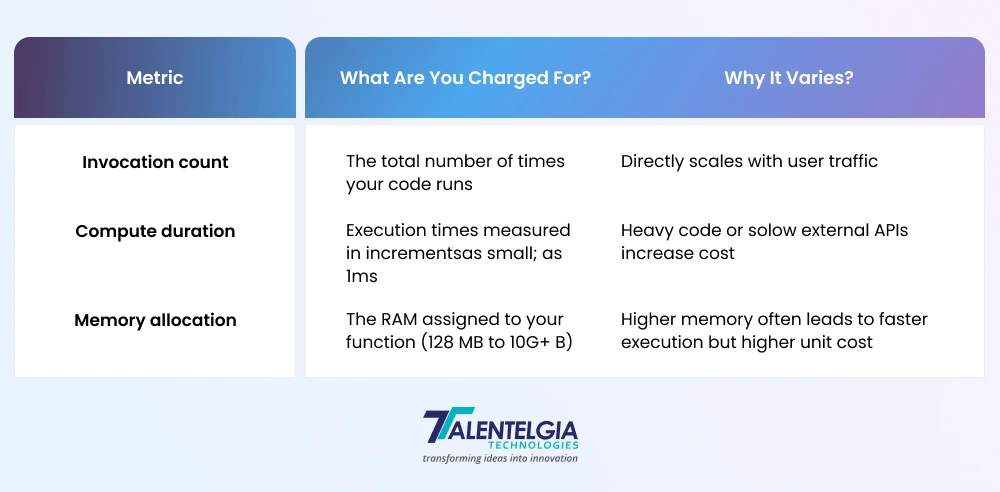
To evaluate the financial impact, one must understand that serverless shifts the billing unit from time-provisioned to value-consumed. Most major providers calculate your monthly bill based on three primary metrics:
Serverless vs. Traditional Cloud: A Direct Comparison
Understanding whether you will save money with serverless or not depends on the usage patterns and requirements of your application. Using serverless architecture in certain scenarios may save you cash, but it may not be the best choice for every use case.
With traditional provisioned infrastructure, it generally incurs some initial upfront costs even before you have any traffic on your application. So that means you will have a lot more capacity then what you may need to run. As your application grows and you need to scale, the same cycle is repeated over time — when in fact you just end up scaling yourself up to a much larger server than expected.
In comparison serverless eliminates having to pay for capacity upfront and the danger of over-provisioning your workload requirements by scaling as flown automatically, plus only paying for what you use. Choosing between a dedicated Virtual Machine (VM) and Serverless isn’t just about the price tag; it’s about the Break-Even Point.
When Serverless Wins (Cost Savings)
For applications with irregular, “spiky,” or low traffic, serverless is almost always cheaper. If your website only gets 1,000 visitors a day spread out over 24 hours, a traditional server sits idle 98% of the time. Serverless eliminates that waste, potentially reducing infrastructure costs by 60-90% for new products or internal tools.
When Traditional Wins (Predictable Budgets)
As traffic becomes heavy and constant, the “convenience fee” of serverless adds up. High-volume APIs that process millions of requests per hour can actually be 2-3 times more expensive in a serverless environment compared to a well-optimized, reserved instance server.
| PRO TIP: Total Cost of Ownership (TCO) While the cloud bill might be higher in some serverless scenarios, businesses often save significantly on DevOps Headcount. A serverless architecture allows you to operate with fewer specialized system administrators, shifting that salary budget back into product development. |
The “Hidden Cost” Structure of Going Serverless: Is It Always Cheaper?
While the “Pay-as-you-go” promise of serverless is the headline, the financial reality in 2026 is that it often trades predictable infrastructure costs for complex operational expenses. According to recent architectural audits from sources like Cloud Zero and The New Stack, many enterprises are discovering that serverless is only “cheaper” if the application is architected perfectly for it.
1. The “Cold Start” Performance Tax
When a serverless function has been idle, the provider spins down the resources to save money. When the next request comes in, the provider must “provision” a new environment, leading to a delay known as a Cold Start. To avoid this lag for customer-facing apps, businesses use features like AWS Provisioned Concurrency. This keeps functions “warm” and ready—but you are charged for that readiness 24/7.
2. The API Gateway & Networking Premium
Serverless functions don’t exist in a vacuum; they need a “doorway” to the internet. API Gateways (like AWS API Gateway or Azure API Management) often charge per million requests. In high-traffic scenarios, the cost of the Gateway can actually be 3x to 5x higher than the cost of the actual code execution. Moving data out of a function and across different “Availability Zones” (inter-region data transfer) is a notorious silent killer of serverless budgets that is often excluded from initial estimates.
3. Observability and Monitoring Overheads
Because serverless is “distributed” (broken into hundreds of tiny pieces), you cannot use traditional monitoring tools. You must invest in specialized observability platforms like Datadog, New Relic, or Lumigo to see what is happening. These tools often charge based on the volume of “traces” or logs. As your app scales, your monitoring bill can grow faster than your computer bill, sometimes accounting for 15-20% of your total cloud spend.
4. The High-Volume “Tipping Point”
Serverless is optimized for “spiky” traffic. However, every cloud model has a break-even point where it becomes more expensive than its predecessor. If your CPU usage is consistently high (e.g., above 60-70% most of the day), the unit cost of serverless execution is significantly higher than renting a Reserved Instance (a server you commit to for 1-3 years). For steady-state workloads, serverless can be up to 2x more expensive than a well-tuned containerized environment (Kubernetes).
5. Developer & Debugging Latency
Success in serverless requires a different mindset. Debugging a distributed serverless app takes longer than debugging a monolith. If your developers spend 30% more time hunting down a bug across 50 different functions, that is a massive “human capital” cost that doesn’t appear on your AWS bill but shows up in your payroll.
Top Benefits of Serverless Architecture
Beyond just the line items on a bill, serverless provides a strategic leap in how a business operates. According to recent whitepapers from AWS, Cloudflare, and Vercel, the primary drivers for serverless adoption today are speed-to-market and operational simplicity.
1. Extreme Scalability (Horizontal & Instant)
In a traditional model, scaling requires “Auto-scaling groups” that can take minutes to spin up new servers. Serverless scales per request.
- The Benefit: Your application can go from 0 to 100,000 users in seconds without any manual intervention. The infrastructure expands and contracts like an accordion based on real-time demand.
- Use Case: Viral Marketing & Flash Sales. If your brand is featured on a major news outlet or runs a “Limited Drop” sale, serverless ensures your site doesn’t crash when traffic spikes 1,000% in one minute.
2. Reduced “Time-to-Market” (Agility)
Serverless removes the “Infrastructure Bottleneck.” Developers don’t have to wait for IT to provision servers or configure load balancers.
- The Benefit: You can move from an idea to a live, production-ready feature in hours. This allows for rapid experimentation and “failing fast” without a massive upfront investment.
- Use Case: MVP Development & Startups. For a new product where you need to test features quickly with real users, serverless allows your team to focus 100% on product logic rather than server maintenance.
3. Zero Operational Overhead
The “Serverless” promise means the cloud provider handles the “undifferentiated heavy lifting”—patching operating systems, managing hardware failures, and updating runtimes.
- The Benefit: You save on DevOps salary costs. Instead of hiring a team to keep the servers running, you can hire more developers to build features that generate revenue.
- Use Case: Lean Enterprise Teams. A small team at a large corporation can manage a global-scale application without needing a dedicated 24/7 operations department.
4. Cost Efficiency for “Spiky” or Low Traffic
Because you only pay for execution time, you aren’t paying for “Idling” resources.
- The Benefit: If your code isn’t running, your bill is literally $0.00. This is the ultimate “Pay-as-you-grow” model.
- Use Case: Internal Business Tools. Apps used only during business hours (like an employee portal or a report generator) cost nothing overnight or on weekends.
Final Thoughts: Should Your Business Go Serverless?
The value proposition of serverless architecture is strong for agencies looking for the right solution to scale and reduce time, resource, and development cost. It allows teams to innovate rather than manage infrastructure and is ideal for event-driven applications, API-based services or those with varying traffic patterns.

Nonetheless due to cold start latency, vendor lock-in, and execution time limits they should be evaluated carefully. Agencies with a wide range of client needs should evaluate how they adopt it. Serverless is a powerful thing, but it is not truly a silver bullet – knowing when and where to use Serverless will allow you to gain all the benefits while limiting the risks.

So, will serverless be the right option for your next client project? Think about its advantages, weigh out its disadvantages, and relate it to your project’s vision in the long run. Getting it right today can lay the groundwork for more effective, scalable web development tomorrow. Contact Talentelgia to know more.












 Sales Enquiries:
  Business queries:
  HR:
HR: 


