


 Healthcare Software Development Services
 Healthcare App Development Services
 Real Estate Web Development Services
 Real Estate App Development Company
 E-Commerce App Development Services
 E-Commerce Web Development Services
 Blockchain E-commerce Development Company
 Fintech Software Development
 Fintech App Development Services
 E-Learning App Development Services
 Restaurant App Development Company
 Mobile Game Development Company
 Travel App Development Company
 Automotive Web Design
 AI Traffic Management System
 AI Inventory Management Software
 Logistics App Development Services
 Machine Learning Development
 ChatGPT integration services
  AI Development Company
  AI Integration Services
  Natural Language Processing Company
 Mobile App Development
  IOS App Development
  Android App Development
  Cross-Platform App Development
  Augmented Reality (AR) App Development
  Virtual Reality (VR) App Development
  Web App Development
  SaaS App Development
 Custom Software Development Services
  Flutter
  React Native
  Swift (IOS)
  Kotlin (Android)
  Mean Stack Development
  AngularJS Development
  MongoDB Development
  Nodejs Development
  Database Development
 Ruby on Rails Development
 Expressjs Development
  Full Stack Development
  Web Development Services
  Laravel Development
  LAMP Development
  Custom PHP Development
  .Net Development
  User Experience Design Services
  User Interface Design Services
  Automated Testing
  Manual Testing
  Digital Marketing Services
 Ride-Sharing And Taxi Services
 Food Delivery Services
 Grocery Delivery Services
 Transportation And Logistics
 Car Wash App
 Home Services App
 ERP Development Services
 CMS Development Services
 LMS Development
 CRM Development
 DevOps Development Services
 AI Business Solutions
 AI Cloud Solutions
 AI Chatbot Development
 API Development
 Blockchain Product Development
 Cryptocurrency Wallet Development
 About Talentelgia
  Our Team
  Our Culture
 Healthcare App Development Services
 Real Estate Web Development Services
 E-Commerce App Development Services
 E-Commerce Web Development Services
 Blockchain E-commerce
Development Company
Blockchain E-commerce
Development Company Fintech App Development Services
 Blockchain Fintech
Development Company
Blockchain Fintech
Development Company E-Learning App Development Services
 Restaurant App Development Company
 Mobile Game Development Company
 Travel App Development Company
 AI Traffic Management System
 AI Inventory Management Software
 AI Development Company
 ChatGPT integration services
 AI Integration Services
 Machine Learning Development
 Machine learning consulting services
 Blockchain Development
 Blockchain Software Development
 Smart contract development company
 NFT marketplace development services
 Asset tokenization companies
 DeFi Wallet Development Company
 IOS App Development
 Android App Development
 Cross-Platform App Development
 Augmented Reality (AR) App
Development
Augmented Reality (AR) App
Development Virtual Reality (VR) App Development
 Web App Development
 Flutter
 React
Native
React
Native Swift
(IOS)
Swift
(IOS) Kotlin (Android)
 MEAN Stack Development
 AngularJS Development
 MongoDB Development
 Nodejs Development
 Database development services
 Expressjs Development
 Full Stack Development
 Web Development Services
 Laravel Development
 LAMP
Development
LAMP
Development Custom PHP Development
 User Experience Design Services
 User Interface Design Services
 Automated Testing
 Manual
Testing
Manual
Testing About Talentelgia
 Our Team
 Our Culture
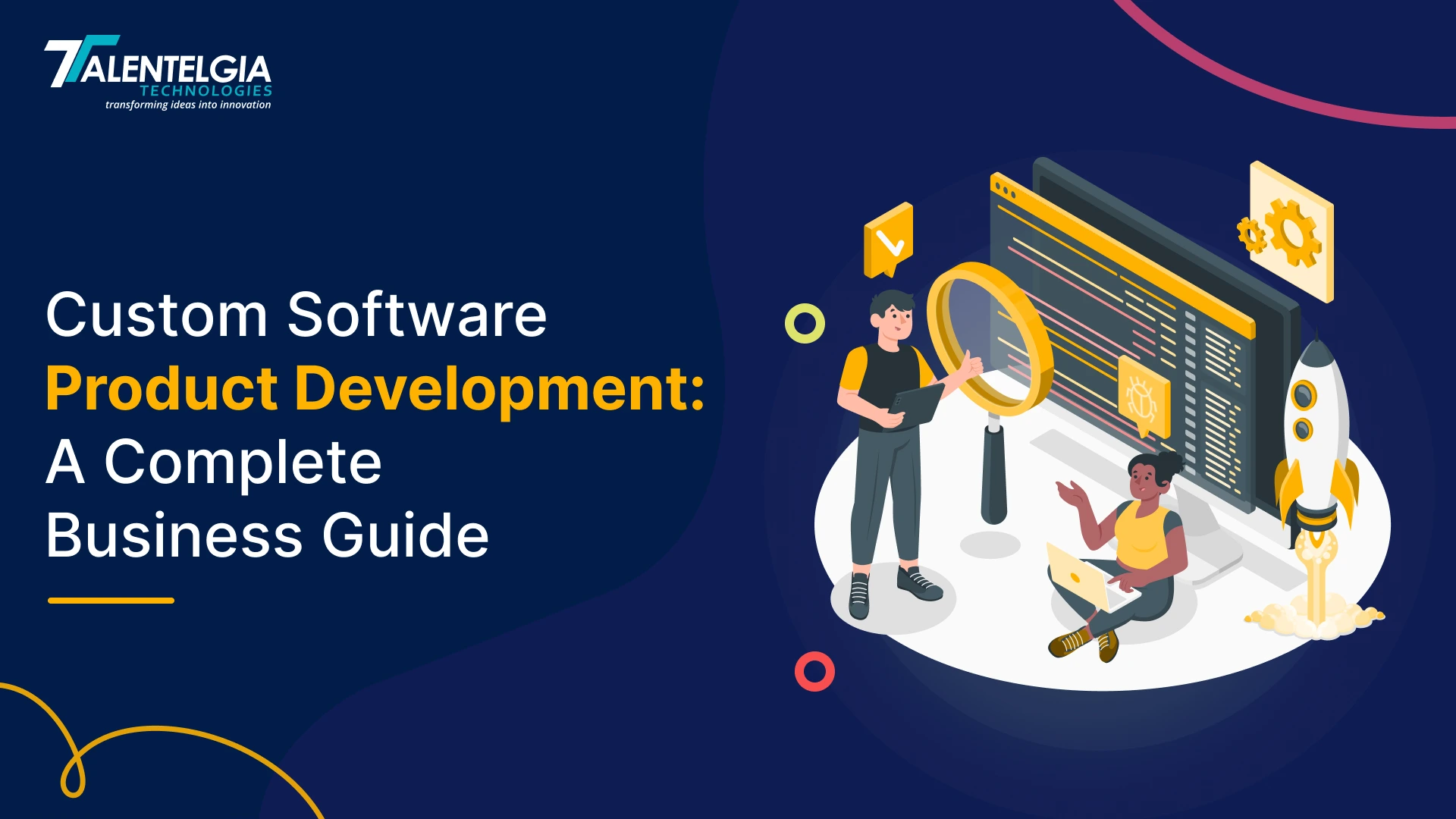
In the current digital landscape, with technology advancing exponentially in many industries, building a software application is equally a business decision and not merely a technical decision. A promising idea could lose its momentum if the method used to develop an application is not aligned with the application’s level of complexity. As per the Boston Consulting Group report, 70% of IT projects are unable to meet their goals, exceed intended budgets, and miss deadlines, which is an astounding number! Therefore, there must be a problem with how the software development process is approached.
As a result, founders, product managers, and executives searching for successful custom software product development services can feel as if they’re wandering in a maze when they’re trying to figure out a method to carry out the development process; to create a proprietary system that will solve their specific business challenges, whereas off-the-shelf software is inflexible and does not adequately solve their problems.
So, how do you avoid another cautionary tale within this industry? This software development guide will help to ensure that you get off to a good start and will assist you in deciding whether to purchase or develop your software.
Understanding Custom Software Product Development: Types, Benefits & How It Works
Software has become a major part of how we do business. In a few cases, like when you’re starting up or running a small business, there are pre-built or open-source tools available that you can use to run your operations. However, custom-made software apps become critical when you want to expand and grow your business.
Although off-the-shelf solutions appear to be the easiest way to manage tasks in your business, they often fail to meet the unique requirements of each industry or business type. This is why businesses are turning to custom software product development services. Businesses from various sectors – including eCommerce, big data, fintech, logistics, and healthcare – have found considerable value in building customized applications for their organizations.
Mordor Intelligence statistics show that the global software development market was valued at $570 billion in 2025, which is estimated to reach $1.04 trillion by 2030, with a CAGR of 13% during the forecast period (2025 – 2030). These figures highlight the massive demand for custom solutions, and to accurately address this, we will take a look at the meaning of custom software and compare it with out-of-the-box software products, along with information associated with a custom software product development company.
What Is Custom Software Development?
Custom software product development is the design, build, and ongoing improvement of software tailored to one organization’s workflows, data, and users — rather than adopting a prebuilt product intended for broad use. In 2026, “custom” may be an internal operations tool, a customer portal, an API layer, a mobile application, a workflow automation engine, or a full enterprise platform, each built from the ground up around what your operations actually do, including edge cases, exceptions, and proprietary processes that define your business.
This is distinct from Commercial Off-The-Shelf (COTS) software, products built for mass-market use with standardized features, sold to thousands of businesses simultaneously. COTS forces your business to adapt to the software. Custom software adapts to your business.
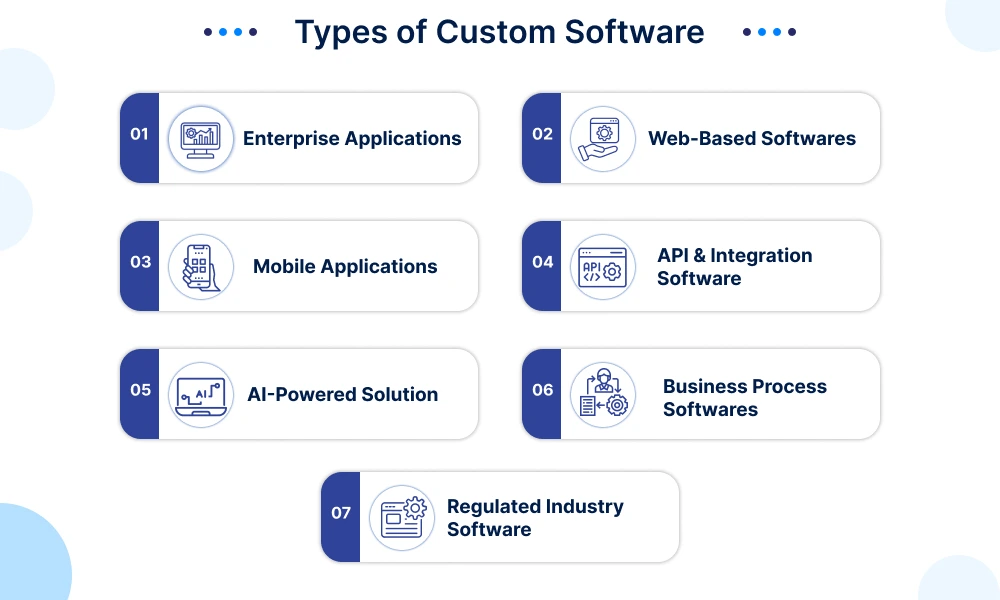
Architectural Types of Custom Software Products
Custom software development encompasses many categories of solutions. Understanding the types helps businesses identify which category addresses their specific challenge, and what expertise the development team must have.
1. Enterprise Applications
ERP systems, CRM platforms, project management tools, and supply chain management systems are designed for specific organizational structures. Streamlines operations, automates workflows, and improves productivity across departments — built around how your organization actually works, not how the vendor assumes you work.
2. Web-Based Softwares
Progressive web applications, SaaS platforms, customer portals, and cloud-native systems accessible through browsers. Leverage responsive design principles and modern frameworks for optimal user experiences across devices. Increasingly built with cloud-native architectures for elasticity and global reach.
3. Mobile Applications
iOS and Android native apps, cross-platform solutions (React Native, Flutter), and mobile-first enterprise tools. Custom mobile app development enables businesses to deliver branded, integrated experiences, from customer-facing e-commerce apps to internal field service tools — without adapting to app store template limitations.
4. API & Integration Software
Custom API development, middleware, and integration platforms that make existing systems communicate. In a world where businesses average 897 apps but only 29% are integrated, custom integration architecture is often the highest-ROI investment, eliminating the manual data transfer and synchronization errors that cost teams hundreds of hours monthly.
5. AI-Powered Solution
Custom ML models, AI chatbots, predictive analytics engines, fraud detection systems, document processing tools, and intelligent automation platforms. Built specifically on your data, for your domain, delivering measurably higher accuracy than generic AI products trained on industry-average datasets.
6. Business Process Softwares
Workflow automation systems, digital forms, approval engines, compliance tools, and operational dashboards that encode your exact business logic. When your processes have many exceptions, approvals, or handoffs, off-the-shelf tools add complexity instead of removing it; custom process software standardizes execution while preserving edge cases.
7. Regulated Industry Software
HIPAA-compliant healthcare platforms, GDPR-ready data systems, fintech regulatory compliance tools, and audit-trail management systems. In regulated industries, off-the-shelf tools often fail to provide the granular control, auditability, and documentation that regulators require; custom development is often not a preference but a compliance necessity.
Custom Software vs. Off-the-Shelf Products Full Comparison
Off-the-Shelf software products are pre-packaged, out-of-the-box software solutions that solve a specific task. It has a predefined set of features with limited customized options. An out-of-the-box solution will provide you with some level of capability to provide a solution to your need; however, this type of solution will provide you with limited customisation capabilities so that you can align the solution to your business processes. This is fine for many use cases where you have a common requirement; however, if your business has a unique requirement, you will likely run into issues due to limited features and scalability.
- Faster deployment — available immediately
- Lower upfront investment ($1K–$100K vs $100K–$400K+)
- Community support, proven market validation
- Automatic updates managed by the vendor
- Lower initial risk — functionality is pre-tested
- Good for standard, commodity business functions
- ROI of 74% over 5 years (McKinsey) — lower, but faster to realize
- SaaS vendors raise prices 5–15% annually — costs grow with headcount
Custom software is developed specifically to meet your unique business requirements and provides you with full control over how your software operates. By ensuring that your business processes align with the functionality provided by technology, a custom software solution will give you a competitive advantage. While these types of solutions require significant investment in the initial development stage, in the long run, the return on investment is determined through increased productivity, flexibility, and alignment with your business goals, typically exceeding the original investment.
- Built precisely for your workflows — no compromises
- Eliminates 85–90% of off-shelf features you never use
- Scales on your terms, not a vendor’s pricing tiers
- No vendor lock-in; you own the software and code
- Integrates natively with your existing systems
- Competitive differentiation — competitors can’t replicate your tool
- ROI of 162% over 5 years (McKinsey)
- Predictable long-term costs; no surprise price increases
This is the decision every growing business faces. And it’s rarely as simple as “build vs. buy.” Understanding the true tradeoffs, including the hidden costs that make off-the-shelf software far more expensive than its sticker price, is the most important analysis you can do before committing either way.
| Dimension | Custom Software | Off-the-Shelf |
|---|---|---|
| Initial Investment | $30K–$750K+ depending on complexity | $1K–$100K upfront; low barrier to entry |
| 5-Year Total Cost | Often lower at scale; no per-seat increases | Often 2–4× higher when licensing + customization + migration costs accumulate |
| Fit to Business | Exact fit — built for your workflows, data model, and edge cases | 80–90% fit; remaining gap filled by workarounds or costly customization |
| Scalability | Scales to your architecture and growth plan | Per-seat pricing punishes growth; vendor tier limits can block features |
| Integration | Built-in native integration with your stack | Integration costs $20K–$100K per system; 71% of apps are still siloed |
| Security & Compliance | Role-based permissions, audit logs, SBOM visibility — fully controlled | Shared security model; compliance gaps possible; vendor controls data |
| Time to Deploy | 3–18 months, depending on complexity | Days to weeks; immediate access to features |
| Competitive Advantage | Proprietary operational logic — competitors cannot replicate it | Same tool available to every competitor; no differentiation |
| Vendor Dependency | None — you own the code and IP | High — vendor roadmap, pricing, and discontinuation risk |
| ROI (5-Year) | 162% average (McKinsey) | 74% average (McKinsey) |
The 7-Phase Custom Software Development Process
Custom software development services transform business challenges into tailored digital solutions through a structured yet adaptable lifecycle. Modern product development follows a highly strategic, iterative process, so understanding these phases helps businesses set realistic expectations, make better decisions at each milestone, and avoid the scope and budget overruns that often affect poorly managed projects.
1. Discovery & Requirement Analysis
The most critical and most underinvested phase. Development teams collaborate with key stakeholders, managers, end users, and IT professionals to understand the business problem before proposing any technical solution. Discovery focuses equally on business clarity and technical feasibility, not just requirements gathering.
A thorough discovery phase lays the foundation for the project: validated business requirements, a technical feasibility assessment, architecture options, team composition, effort estimates, and cost projections. Organizations that prepare properly in discovery save time, money, and avoid the most common sources of mid-project disputes. Unclear scope is the single biggest cost multiplier; poor requirements management causes project failures.
2. Design Architecture
UX/UI designers and software architects translate requirements into wireframes and system blueprints. This phase defines the technology stack, data models, APIs, and security frameworks to support scalability. Designers create wireframes, mockups, and prototypes to visualize how the software will look and function before any code is written.
Modern development teams increasingly adopt DesignOps principles and AI-assisted prototyping tools like Figma and Uizard to accelerate iteration. A custom, interactive, and accessible interface can increase project costs compared to template-based designs, but dramatically improves adoption rates in production. Architecture decisions made here determine technical debt levels for years; front-loaded investment here pays compound returns.
3. Development & Implementation
The core build phase where engineers implement the designed system. Development uses iterative sprints, typically 2-week cycles, translating agreed scope into concrete tasks for design, engineering, and QA. Sprint planning ensures the entire team starts from the same assumptions and connects day-to-day work to the overall product structure.
Teams using mature CI/CD (Continuous Integration/Continuous Delivery) practices deploy 200 times more frequently than traditional approaches while maintaining higher quality. This is the phase where AI coding tools (GitHub Copilot, Cursor) are having the most transformative impact, with some teams reporting a reduction in development time compared to internal benchmarks.
4. Testing & Quality Assurance
Testing takes approximately 30% of the total project time and is non-negotiable. Comprehensive QA covers functional testing (does it work as specified?), performance testing (does it handle load?), security testing (is it resistant to common attack vectors?), integration testing (do components communicate correctly?), and user acceptance testing (does it satisfy the business requirement?)
Data shows that detailed integration testing can cut post-deployment issues by up to 60%. Quality gates throughout development ensure smooth component interaction — the cost of fixing a defect in production is 10–100× higher than fixing it in testing. Testing also provides continuous feedback to design and development, enabling course corrections before they become expensive.
5. Deployment & Integration
Deployment planning often starts early in the project lifecycle, particularly for regulated or business-critical systems. This phase covers infrastructure setup (cloud provisioning, server configuration), data migration from legacy systems, integration with existing tools, user training, and the actual go-live release, typically staged to minimize business disruption.
Each external system integration — a third-party API, a payment gateway, a legacy enterprise tool- adds dependency risk and synchronization complexity. Custom CRM development typically costs between $25,000 & $30,000. A poorly planned deployment that disrupts live operations can cost far more than the integration savings.
6. Support & Maintenance
Software is never truly “done.” Post-launch maintenance covers bug fixes, performance optimization, security patches, operating system compatibility updates, and user-reported issue resolution. A common budget rule: ongoing annual maintenance typically costs 15–25% of the initial development budget per year.
This is where custom software’s advantage over off-the-shelf becomes most concrete: you control the maintenance roadmap. There are no forced upgrades that break your integrations, no vendor decisions that remove features your team relies on, and no SLA limitations that leave critical bugs unpatched for weeks.
7. Evolution & Scaling
The final and most valuable phase — and the one most often ignored in initial planning conversations. Custom software should not be a static artifact. It should evolve with your business, incorporating new features, adapting to new market requirements, integrating with new tools, and scaling its infrastructure as user volume grows.
Organizations that treat custom software as a long-term platform, building new capabilities on a stable, owned foundation, realize the compounding competitive advantage that justifies the initial investment. Unlike COTS, where a vendor’s product roadmap determines your feature timeline, custom software evolves on your strategic schedule.
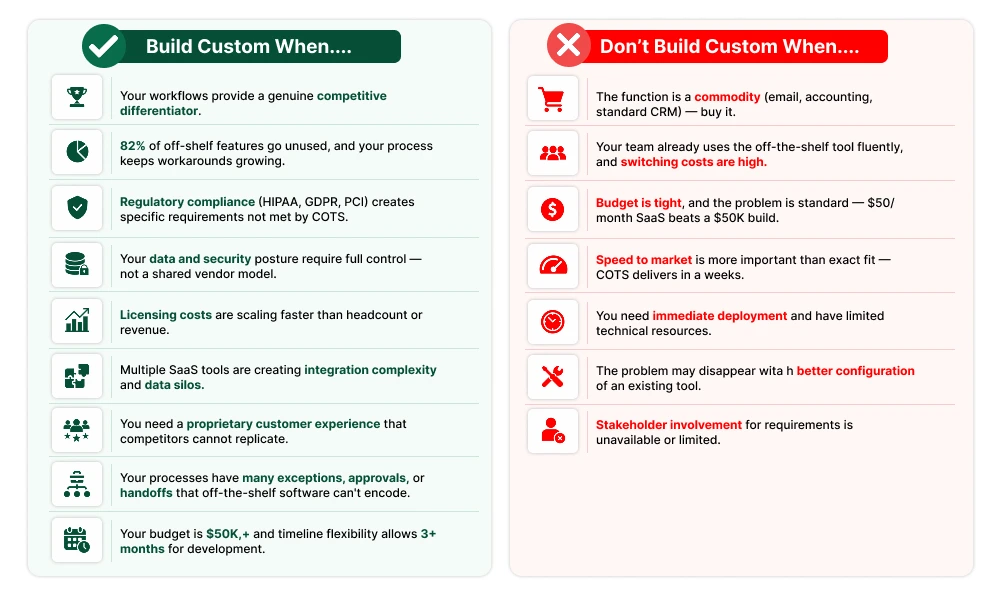
How To Know When To Build Custom Software & When Not To?
Custom is most successful when it solves a durable business problem — something that won’t disappear with better training or a different configuration. The short answer: choose custom when your workflows give a competitive edge that off-the-shelf tools can’t support. Choose off-the-shelf when a proven platform already solves your problem, and speed matters more than differentiation.
Final Thoughts
There is a trend among both new/established companies of all sizes that use a variety of platforms or services for creating tailor-made applications through a custom software development company.
A custom software development app increases your overall return on investment, offers greater opportunities for personalisation, and provides increased security and improved integration possibilities with other businesses in today’s business marketplace.
Talentelgia is a highly established software & App development company of customised projects and has been using multiple types of technology to create customised apps for many years. If you would like more information regarding any of our previous development projects and the availability of potential collaboration with your company for similar projects, please contact us!










 Sales Enquiries:
  Business queries:
  HR:
HR: 


