


 Healthcare Software Development Services
 Healthcare App Development Services
 Real Estate Web Development Services
 Real Estate App Development Company
 E-Commerce App Development Services
 E-Commerce Web Development Services
 Blockchain E-commerce Development Company
 Fintech Software Development
 Fintech App Development Services
 E-Learning App Development Services
 Restaurant App Development Company
 Mobile Game Development Company
 Travel App Development Company
 Automotive Web Design
 AI Traffic Management System
 AI Inventory Management Software
 Logistics App Development Services
 Machine Learning Development
 ChatGPT integration services
  AI Development Company
  AI Integration Services
  Natural Language Processing Company
 Mobile App Development
  IOS App Development
  Android App Development
  Cross-Platform App Development
  Augmented Reality (AR) App Development
  Virtual Reality (VR) App Development
  Web App Development
  SaaS App Development
 Custom Software Development Services
  Flutter
  React Native
  Swift (IOS)
  Kotlin (Android)
  Mean Stack Development
  AngularJS Development
  MongoDB Development
  Nodejs Development
  Database Development
 Ruby on Rails Development
 Expressjs Development
  Full Stack Development
  Web Development Services
  Laravel Development
  LAMP Development
  Custom PHP Development
  .Net Development
  User Experience Design Services
  User Interface Design Services
  Automated Testing
  Manual Testing
  Digital Marketing Services
 Ride-Sharing And Taxi Services
 Food Delivery Services
 Grocery Delivery Services
 Transportation And Logistics
 Car Wash App
 Home Services App
 ERP Development Services
 CMS Development Services
 LMS Development
 CRM Development
 DevOps Development Services
 AI Business Solutions
 AI Cloud Solutions
 AI Chatbot Development
 API Development
 Blockchain Product Development
 Cryptocurrency Wallet Development
 About Talentelgia
  Our Team
  Our Culture
 Healthcare App Development Services
 Real Estate Web Development Services
 E-Commerce App Development Services
 E-Commerce Web Development Services
 Blockchain E-commerce
Development Company
Blockchain E-commerce
Development Company Fintech App Development Services
 Blockchain Fintech
Development Company
Blockchain Fintech
Development Company E-Learning App Development Services
 Restaurant App Development Company
 Mobile Game Development Company
 Travel App Development Company
 AI Traffic Management System
 AI Inventory Management Software
 AI Development Company
 ChatGPT integration services
 AI Integration Services
 Machine Learning Development
 Machine learning consulting services
 Blockchain Development
 Blockchain Software Development
 Smart contract development company
 NFT marketplace development services
 Asset tokenization companies
 DeFi Wallet Development Company
 IOS App Development
 Android App Development
 Cross-Platform App Development
 Augmented Reality (AR) App
Development
Augmented Reality (AR) App
Development Virtual Reality (VR) App Development
 Web App Development
 Flutter
 React
Native
React
Native Swift
(IOS)
Swift
(IOS) Kotlin (Android)
 MEAN Stack Development
 AngularJS Development
 MongoDB Development
 Nodejs Development
 Database development services
 Expressjs Development
 Full Stack Development
 Web Development Services
 Laravel Development
 LAMP
Development
LAMP
Development Custom PHP Development
 User Experience Design Services
 User Interface Design Services
 Automated Testing
 Manual
Testing
Manual
Testing About Talentelgia
 Our Team
 Our Culture
In the last 10 years, there has been a switch in how companies access and utilize software in their work ecosystem, and the driving force behind this transformation has been SaaS. From startups to large enterprises, businesses across different sectors are moving away from bulky on-premise systems and expensive licensing models and opting for flexible, subscription-based SaaS applications, which can grow with them.
From CRM to project collaboration, accounting, marketing automation, to even advanced AI tools – SaaS has created a new way for businesses to operate, develop new products/services, and compete. But what does it take to build a SaaS application? This guide provides concrete information about the things involved in developing a SaaS application, such as: fundamentals, the overall development cycle, design & development considerations, key elements that drive development costs, and the most important SaaS separates “successful” SaaS products from average products.
So, if you’re a business trying to develop or create a cloud-based solution, or a non-technical person trying to understand how modern software is created, we will give you all the information you need in a very logical way and will help you prepare for your success.
Understanding SaaS Development: Full Overview
Most people are still unfamiliar with the term “SaaS”; nonetheless, each day, millions of people around the globe utilize SaaS applications. People who surf the internet frequently come across these types of software, and we also find ourselves using SaaS applications in many facets of life. Examples include entertainment programs such as Netflix, YouTube Music, Google Drive, and Spotify; eCommerce-related apps such as online grocery shopping, banking applications for daily transactions; and business-related applications, such as customer relationship management systems (CRMs) and analytics systems, for tracking and analyzing customer interactions.
SaaS is referred to as “Software-as-a-Service” and generally refers to cloud-based software that is accessed via web-based applications or browser interfaces by users. In the past, if you needed to install software onto your device, you would do so locally. Nowadays, instead of locally installing the software on your physical device and running it from there, the software itself is hosted in the cloud and runs on servers, some of which may be located anywhere in the world.
According to Market.us statistics, the global SaaS market was valued at $328.46 billion in 2024, which is estimated to reach $1,486.89 billion by 2034 with a CAGR of 16.3% during the forecast period (2025 – 2034). These numbers are an example of why Artificial Intelligence (Gen AI / Agentic AI) solutions in enterprise SaaS providers continue to accelerate with the growth of many leading SaaS automation platforms including Zapier, Asana, Salesforce, and HubSpot.
What Is Custom SaaS Development?
Custom SaaS (Software-as-a-Service) Development is the process of architecting, engineering, and deploying a cloud-hosted software application tailored to a specific organization’s unique operational logic or market niche.
Unlike traditional custom software built for a single local machine or isolated server, a custom SaaS product is engineered natively for the cloud. It features a multi-tenant architecture, allows secure access from any device worldwide, and automates scaling dynamically.
Essentially, you are building a proprietary cloud application that can serve as either:
- A Centralized Internal Operating System: Unifying your entire cross-border workforce onto a single, automated ledger.
- A Commercial, Monetized Platform: Solving a unique market problem and licensing it out to other businesses via tiered subscription seats.
Why Do Custom SaaS Applications Matter In 2026?
Businesses usually turn to custom SaaS when standard software starts creating operational drag. That drag might come from limited customization, pricing tiers that punish growth, poor integration options, compliance constraints, or the need to deliver a more differentiated user experience.
Custom SaaS is especially attractive when software is becoming part of the company’s value proposition rather than just an internal support tool. In these situations, the business often needs ownership, flexibility, and a roadmap it can control directly.
Custom SaaS vs. Off-the-Shelf Software: Owning vs Buying
This is the heart of the decision. Off-the-shelf software is prebuilt and rented under subscription, while custom SaaS is purpose-built around your requirements and usually shaped for long-term control and growth. To see how something is different from off-the-shelf software, we can look at a comparison of them. Here is the full picture
| Custom SaaS | Off-The-Shelf Software |
|---|---|
| Built exactly for your workflows and user needs | Faster deployment — days to weeks, not months |
| You own the code, IP, and product roadmap | Lower upfront cost; predictable monthly fees |
| No per-seat pricing — scales without punishing growth | Proven, tested, with community and support |
| Full control over data, security, and compliance | Automatic updates managed by the vendor |
| Native integration with your existing systems | No engineering team required to get started |
| Competitive moat — competitors can’t replicate your tool | Best practices baked in for standard business functions |
| Can be sold as a product to your own customers | Ideal for commodity workflows (email, HR, basic CRM) |
| No vendor dependency or sunset risk | SaaS vendors raise prices 5–15% annually at renewal |
Which One Should You Choose – and Why?
The right answer depends on seven variables: process differentiation, data sovereignty requirements, integration complexity, scalability profile, vendor dependency tolerance, time-to-value requirements, and internal technical capability. In 2026, mid-market leaders with differentiated operations, regulated data environments, or 3× growth trajectories most commonly find that custom development delivers superior 5-year ROI.
| ✓ Build Custom SaaS When… | ✗ Stick with Off-the-Shelf SaaS When… |
|---|---|
| Your workflow is genuinely differentiated — the way you operate is how you win | The function is a commodity — email, HR, standard accounting, basic CRM |
| You’ve identified a market gap no existing SaaS adequately serves | You need to deploy in days, not months; speed is the only priority |
| Regulatory compliance (HIPAA, GDPR, PCI-DSS) demands full data control | Your team already uses the tool well, and switching costs outweigh customization friction |
| You’re planning 3× headcount growth where per-seat pricing becomes punishing | Budget is constrained, and the existing SaaS tool covers 90%+ of your needs |
| You want to sell the software itself as a revenue-generating product | Technical resources to build and maintain custom software are unavailable |
| Integration between 5+ systems is creating operational overhead and data silos | Requirements are unclear or likely to change fundamentally within six months |
| Vendor lock-in is a strategic or security risk you can no longer tolerate | Stakeholder availability for requirements and feedback is limited |
| AI-native features need to be built on your proprietary data — not a generic model | |
| Budget allows $50K+ and timeline flexibility includes 3–12 months of development |
How To Get Started with Custom SaaS Development: Step-by-Step Process
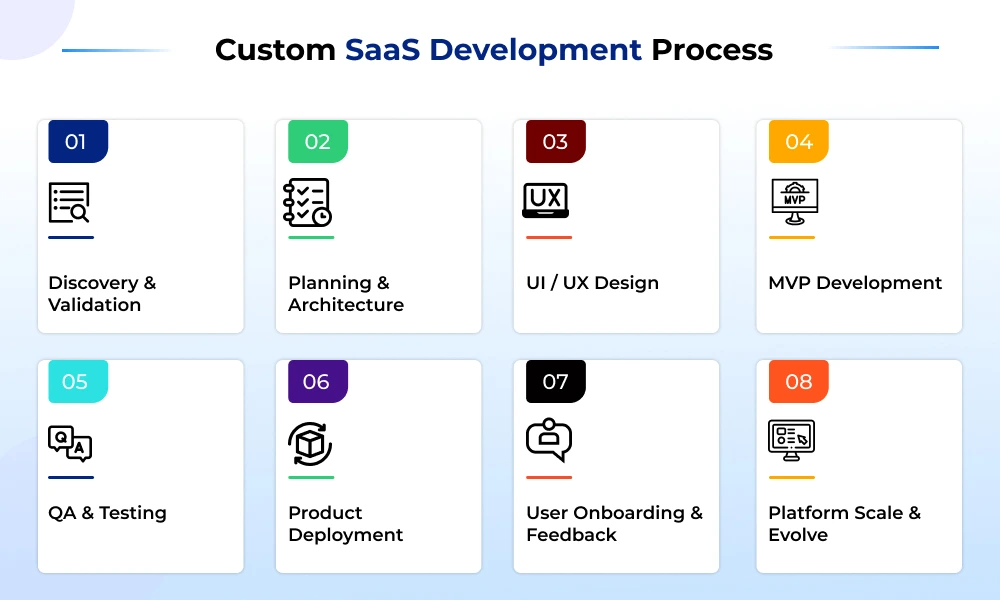
A successful SaaS lifecycle is iterative rather than linear — teams cycle between development, testing, feedback, and scaling continuously. The 8 phases below represent the structure of that cycle, from idea validation to production scaling.
1. Discovery & Validation: Market Research & Business Model Definition
The journey starts with the discovery phase. You need to define your business model, identify your target audience, and outline key value propositions. This foundation guides every technical decision that follows. Teams that spend 2–3 weeks in thorough discovery ship on time. Teams that skip discovery spend those weeks in mid-build rework, which takes 3–4× longer and costs significantly more.
- ICP Definition
- Market Gap Analysis
- Competitive Audit
- Core Value Prop
- Revenue Model
2. Planning & Architecture: Requirements, Architecture Design & Tech Stack Selection
Architecture is not a detail you revisit at scale; it is the decision that determines whether scale is even possible. 72% of SaaS startups cite architecture as their top technical debt driver. During this phase, teams detail project requirements and work closely with software experts to define the right system architecture, choose the technology stack, and establish project timelines and milestones.
The most consequential decisions here: monolith vs. microservices (start monolith for 99% of early-stage products; simpler to build, easier to manage), single-tenant vs. multi-tenant architecture (multi-tenant is the right default for 90% of SaaS products), and tech stack selection (mismatched stacks lead to technical debt, development slowdowns, and expensive refactoring).
3. UX / UI Design: User Experience Design & Subscription Infrastructure
Subscription planning is crucial: it defines how users will access and pay for the service; billing infrastructure, subscription tiers, trial flows, and onboarding experiences. Users in 2026 have zero patience for apps that feel unfinished; the bar for quality UX is high even at MVP. Custom design adds 15–25% to project cost vs. template-based design, but dramatically improves adoption.
Component libraries (shadcn/ui, Tailwind) significantly reduce UX cost without sacrificing quality. Billing systems (Stripe) should be integrated at design time, not retrofitted; retrofitting metering into a SaaS architecture not designed for it costs $25,000–$60,000 post-launch.
4. Core Development – MVP Build: Backend, Frontend & Integrations
The core build phase where backend API, business logic, data layer, and frontend interface come together. Teams using CI/CD practices deploy 200× more frequently than traditional approaches while maintaining higher quality. AI coding assistants now reduce boilerplate work by 30–55% for experienced developers — compressing what a 12-week build in 2023 was to 7–8 weeks in 2026. However, AI doesn’t replace senior engineering judgment on architecture, security, and performance.
An MVP is not a prototype. It is the smallest version of your product that delivers real value to real users, can be deployed in production, and has enough reliability that customers won’t churn on day one. For SaaS specifically: user authentication, core feature set, payment integration, and baseline reliability are non-negotiable MVP requirements
5. Quality Assurance: Testing, Security & Performance Validation
SaaS security in 2026 follows a Security First mindset: externalize authentication (Clerk, Auth0, Kinde; building your own login is a security risk you shouldn’t take), implement zero-trust architecture (every request validated, even internal), and pursue SOC2 compliance from day one (platforms like Vanta or Drata automate evidence-gathering). As your development team scales, security becomes your biggest liability.
OWASP GenAI Security Project highlights that teams using LLMs in their product or delivery process must handle prompt injection, insecure AI output, sensitive data leakage, and supply-chain risks. Data shows detailed integration testing cuts post-deployment issues by up to 60%
- Functional Testing
- Security Audit
- Load Testing
- Penetration Testing
- SOC2 Framework
6. Deployment: Cloud Deployment, Monitoring & Go-Live
The Serverless First movement is now the default in 2026. Using platforms like Vercel, Netlify, or AWS Lambda, teams deploy code that scales automatically from one user to one million. Edge Functions take this further by running code at the CDN level; physically closer to users; reducing latency to single-digit milliseconds. AWS leads cloud market share at roughly a third, followed by Azure and GCP.
Monitoring and observability from day one is non-negotiable. Allocating resources for observability (real-time monitoring, logging, analytics) from launch day is critical — organizations that skip it accelerate technical debt remediation costs. Infrastructure costs at MVP scale: $100–$500/month; at 10,000+ users expect $200–$2,000/month.
7. Growth: User Onboarding, Feedback Loops & Iteration
Building a SaaS product isn’t a one-and-done project. The real work begins at launch — gathering user feedback, measuring activation metrics, identifying friction points in onboarding, and iterating based on real behavior data rather than assumptions. The most important metric in the first 90 days post-launch is not revenue: it is the percentage of users who complete their first core action (the “aha moment”) within their first session.
PostHog (analytics), Intercom (user communication), and Hotjar (session recording) form the standard 2026 feedback infrastructure. Organizations that define feedback loops at architecture time — building event tracking into the data model — get qualitative and quantitative signal significantly faster than those who bolt analytics on later.
8. Scale & Evolve: Scaling Architecture, Feature Expansion & Platform Evolution
As you scale from your first 10 users to your first 10,000, architecture decisions made at MVP stage either compound into advantages or accumulate as technical debt. Read replicas before CQRS: before any exotic architectural pattern, add a PostgreSQL read replica — this single change can handle 10× read traffic with minimal code changes. Multi-cloud adoption reduces vendor lock-in and improves uptime; many businesses now adopt multi-cloud to improve resilience.
Almost 100% of SaaS companies founded in 2025 treated AI as the product’s core capability. If your roadmap includes AI-powered features; automated triage, document understanding, workflow automation; early answers to AI integration questions (hosted LLMs vs. self-hosted, RAG architecture, data sovereignty) determine whether AI is designed in cheaply or bolted on expensively.
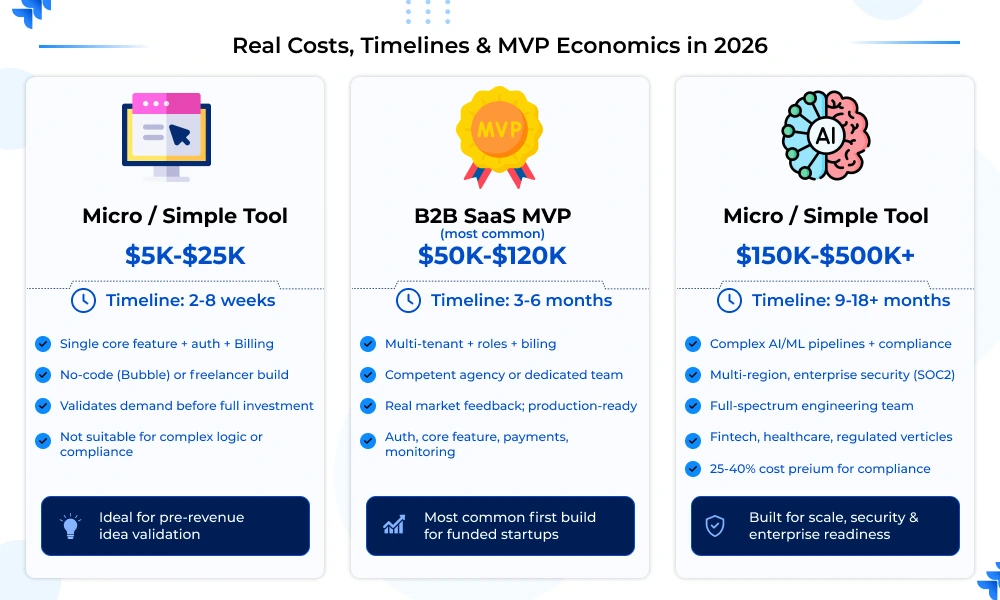
Real Costs, Timelines & MVP Economics in 2026
SaaS development in 2026 costs anywhere from $10,000 for a micro-tool to over $500,000 for an enterprise platform. AI-assisted development has meaningfully reduced certain types of work: boilerplate code, authentication flows, and standard CRUD operations are scaffolded significantly faster than three years ago. At Talentelgia, AI tooling reduces development time by roughly 20–35% on standard features. However, AI doesn’t replace senior engineering judgment. Founders who believe they can build production-ready SaaS entirely with AI tools are consistently disappointed.
Micro / Simple Tool
$5K–$25K
Timeline: 2–8 weeks
- Single core feature + auth + billing
- No-code (Bubble) or freelancer build
- Validates demand before full investment
- Not suitable for complex logic or compliance
- Ideal for pre-revenue idea validation
B2B SaaS MVP (most common)
$50K–$120K
Timeline: 3–6 months
- Multi-tenant + roles + billing
- Competent agency or dedicated team
- Real market feedback; production-ready
- Auth, core feature, payments, monitoring
- Most common first build for funded startups
Enterprise / AI Platform
$150K–$500K+
Timeline: 9–18+ months
- Complex AI/ML pipelines + compliance
- Multi-region, enterprise security (SOC2)
- Full-spectrum engineering team
- Fintech, healthcare, regulated verticals
- 25–40% cost premium for compliance
Final Thoughts
When you’re trying to figure out whether to use SaaS applications or develop a custom software solution, there is no single right answer. Both options come with their own set of advantages and disadvantages. A SaaS product may be the fastest way to get started and begin achieving your goals for some companies; others, however, may prefer the flexibility and control that developing a custom application will give them as they continue to grow.
Ultimately, determining whether you will utilize a SaaS application, develop a custom software solution, or both will be dictated by your goals for the company, your budget, and your plan for the future. There are many situations where combining both types of solutions can provide you with the benefits you want. The focus should always be on the product-based delivery model, as that model will help deliver value for your business over the long term.











 Sales Enquiries:
  Business queries:
  HR:
HR: 


