



 Healthcare Software Development Services
 Healthcare App Development Services

 Real Estate Web Development Services
 Real Estate App Development Company

 E-Commerce App Development Services
 E-Commerce Web Development Services
 Blockchain E-commerce Development Company

 Fintech Software Development
 Fintech App Development Services
 E-Learning App Development Services

 Restaurant App Development Company

 Mobile Game Development Company

 Travel App Development Company

 Automotive Web Design

 AI Traffic Management System

 AI Inventory Management Software

 Logistics App Development Services
 Machine Learning Development
 ChatGPT integration services
 AI Development Company
 AI Integration Services
 Natural Language Processing Company
 Mobile App Development
 IOS App Development
 Android App Development
 Cross-Platform App Development
 Augmented Reality (AR) App Development
 Virtual Reality (VR) App Development
 Web App Development
 SaaS App Development
 Custom Software Development Services
 Flutter
 React Native
 Swift (IOS)
 Kotlin (Android)
 Mean Stack Development
 AngularJS Development
 MongoDB Development
 Nodejs Development
 Database Development
 Ruby on Rails Development
 Expressjs Development
 Full Stack Development
 Web Development Services
 Laravel Development
 LAMP Development
 Custom PHP Development
 .Net Development
 User Experience Design Services
 User Interface Design Services
 Automated Testing
 Manual Testing
 Digital Marketing Services

 Ride-Sharing And Taxi Services
 Food Delivery Services
 Grocery Delivery Services
 Transportation And Logistics
 Car Wash App
 Home Services App
 ERP Development Services
 CMS Development Services
 LMS Development
 CRM Development
 DevOps Development Services
 AI Business Solutions
 AI Cloud Solutions
 AI Chatbot Development
 API Development
 Blockchain Product Development
 Cryptocurrency Wallet Development
 About Talentelgia
 Our Team
 Our Culture

 Healthcare App Development Services
 Real Estate Web Development Services
 E-Commerce App Development Services
 E-Commerce Web Development Services
 Blockchain E-commerce
Development Company
 Fintech App Development Services
 Blockchain Fintech
Development Company
 E-Learning App Development Services
 Restaurant App Development Company
 Mobile Game Development Company
 Travel App Development Company
 AI Traffic Management System
 AI Inventory Management Software
 AI Development Company
 ChatGPT integration services
 AI Integration Services
 Machine Learning Development
 Machine learning consulting services
 Blockchain Development
 Blockchain Software Development
 Smart contract development company
 NFT marketplace development services
 Asset tokenization companies
 DeFi Wallet Development Company
 IOS App Development
 Android App Development
 Cross-Platform App Development
 Augmented Reality (AR) App
Development
 Virtual Reality (VR) App Development
 Web App Development
 Flutter
 React
Native
 Swift
(IOS)
 Kotlin (Android)
 MEAN Stack Development
 AngularJS Development
 MongoDB Development
 Nodejs Development
 Database development services
 Expressjs Development
 Full Stack Development
 Web Development Services
 Laravel Development
 LAMP
Development
 Custom PHP Development
 User Experience Design Services
 User Interface Design Services
 Automated Testing
 Manual
Testing
 About Talentelgia
 Our Team
 Our Culture

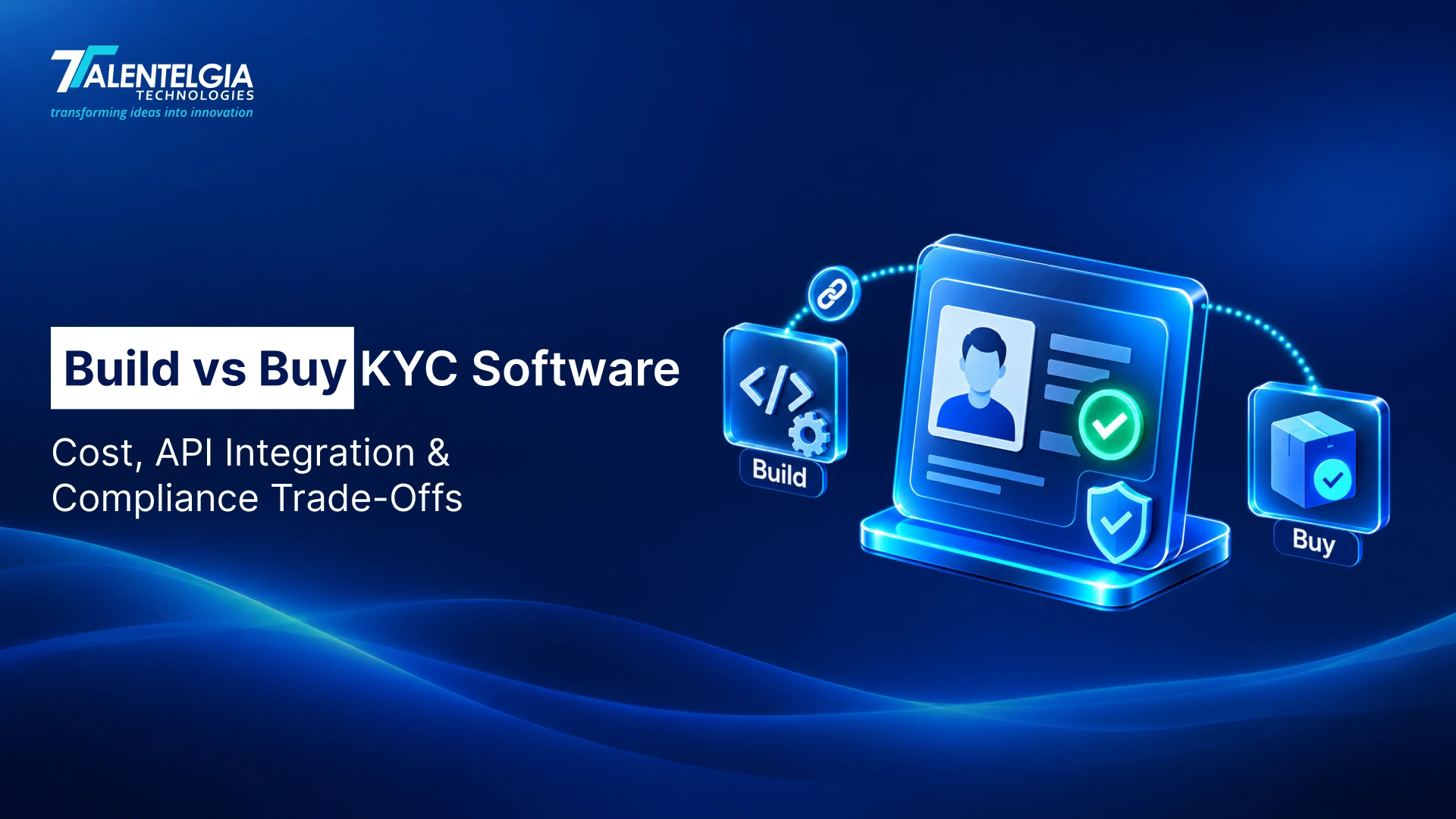
Choosing whether to build or buy KYC software comes down to how much control your fintech business needs, what it can afford to maintain, and how quickly it must launch. Developing a solution in-house gives your team control over workflows and architecture, but also makes you responsible for ongoing engineering, data integrations, security, and maintenance. A third-party platform provides existing verification capabilities, although pricing, coverage, and customization depend on the provider.
A third option is to combine both approaches: use specialist services for identity verification and screening while developing your own onboarding experience, internal workflows, and decision logic.
The right choice requires more than comparing development costs with a vendor’s advertised price. You must evaluate total ownership costs, API reliability, data handling, operational responsibilities, and the effort required to change providers later.
Build vs Buy KYC Software: Key Differences
Building KYC Software In-House
In-house KYC software development gives your team control over the application, business rules, data flows, and integration architecture. This can be useful when standard platforms cannot support specialized onboarding requirements.
However, your organization must also maintain the underlying technology, integrate reliable identity-data sources, test security controls, and update the system as requirements change. Building the interface alone is not equivalent to building a complete verification and compliance capability.
Buying a Ready-Made KYC Platform
A third-party platform provides existing verification services through a dashboard, API, or both. Your team can configure supported workflows instead of developing every component from scratch.
The trade-offs include recurring fees, dependence on the provider’s coverage and availability, and possible limitations on customization or data portability.
Choosing a Hybrid Approach
A hybrid model separates specialist capabilities from the parts of the product that differentiate your business. You might purchase document verification and sanctions screening while building your own onboarding interface, customer journey, internal risk rules, and case-management integrations.
| Decision factor | Build in-house | Buy a platform | Hybrid approach |
|---|---|---|---|
| Initial investment | Generally higher engineering commitment | Vendor setup and integration costs | Investment focused on selected custom components |
| Ongoing costs | Maintenance, staffing, infrastructure, and data | Subscriptions, checks, and internal support | Vendor charges plus custom-system maintenance |
| Time to implementation | Depends on scope and team capacity | Depends on provider coverage and integration | Depends on the number of components built |
| Customization | High, within internal resources | Limited to supported configuration and APIs | Custom control over selected workflows |
| Integration | Designed around internal systems | Depends on API capabilities | Internal orchestration across purchased services |
| Maintenance | Primarily your responsibility | Shared across vendor services and internal integration | Split between vendor-managed and custom components |
| Compliance oversight | Internal governance remains essential | Vendor due diligence and internal oversight remain essential | Internal governance across both components |
| Vendor dependency | Depends on external data providers and infrastructure | Higher for purchased capabilities | Reduced through clear component boundaries and exit planning |
KYC Software Development Cost vs. Buying: Total Cost of Ownership
The cheapest initial option may not be the least expensive over time. Compare the full cost of delivering equivalent capabilities rather than measuring development expenditure against a vendor’s per-check fee.
The Cost of Building KYC Software
An in-house solution requires more than application development. Its total cost can include:
- People: Engineering, product management, quality assurance, security, and compliance expertise.
- Verification infrastructure: External identity databases, document checks, biometric verification, and screening services where required.
- Technology: Hosting, storage, monitoring, encryption, and disaster recovery.
- Ongoing operations: Security testing, software updates, incident response, and regulatory changes.
- Exceptions: Manual reviews, failed checks, disputed results, and customer support.
A custom interface connected to third-party verification APIs is not the same investment as developing your own identity-verification engine and data sources. Define exactly what the team will build before estimating the budget.
The Cost of Buying KYC Software
KYC software pricing varies according to verification type, volume, and included features. A review of three publicly listed identity-verification plans found an average advertised rate of approximately $1.22 per verification, based on entry-level prices ranging from $0.80 to $1.50. This is a small sample rather than a market-wide average, and the plans are not directly equivalent. Monthly minimums, AML screening, ongoing monitoring, integration, and manual reviews can increase the total cost. Businesses should use these figures as an initial benchmark and request quotes based on their actual requirements.
Additional expenses may include internal integration work, manual case handling, extra checks, support arrangements, and migration when changing providers.
How to Compare Three-Year KYC Costs
Use the same assumptions for both options.
| Cost category | Build | Buy |
|---|---|---|
| Initial delivery | Design, engineering, testing | Setup and integration |
| Verification | Data providers and infrastructure | Subscription and per-check fees |
| Operations | Internal staffing and maintenance | Internal support and vendor management |
| Exceptions | Review workflows and case handling | Manual reviews and add-on services |
| Change and exit | Enhancements and replacement components | Contract termination, data export, and migration |
Calculate each category annually, account for expected usage changes, and total the results over three years. Keep one-time costs separate from recurring charges. Where reliable estimates are unavailable, show the assumptions and gaps rather than presenting an unsupported total.
When In-House Development May Be Cost-Effective
Building a fintech compliance software becomes more defensible when the company needs capabilities that existing platforms cannot provide, has a team equipped to maintain them, and can justify the long-term investment. High verification volume alone does not prove that building is cheaper; external data, staffing, and ongoing maintenance can remain substantial.
Considering a custom KYC workflow? Talk to our fintech software development company to discuss your technical requirements, integration scope, and cost drivers.
KYC API Integration: Custom Development vs. Third-Party Platforms
A KYC API connects your application to a verification provider. It can let your product submit applicant information, initiate checks, and receive results without building every verification capability itself.
What Integrating a KYC API Involves
A typical integration includes:
- Authentication: Secure API credentials and sign requests where required.
- Applicant creation: Send the necessary customer information or create a verification session.
- Verification: Collect documents or other evidence through the provider’s supported workflow.
- Result handling: Retrieve status updates and map the provider’s responses to internal application states.
- Decision workflow: Route approved, rejected, incomplete, or review-required applications appropriately.
Provider documentation should clearly explain API authentication, sandbox and production environments, and webhooks for receiving verification-status updates. These capabilities help developers test integrations safely, process verification results, and troubleshoot issues before and after deployment.
Integration Flexibility and Vendor Lock-In
A purchased API can reduce the need to implement specialized verification capabilities, but it introduces dependencies on the provider’s response formats, supported countries, available checks, and product roadmap.
Reduce switching costs by:
- Mapping vendor-specific responses to your own internal status model.
- Keeping business rules separate from provider-specific code.
- Documenting data fields, error responses, and integration dependencies.
- Confirming whether verification records and audit evidence can be exported.
- Reviewing contract terms before relying on a provider for a critical workflow.
Reliability and Ongoing Maintenance
A successful test request does not establish production readiness. Build safeguards around the entire integration.
- Timeouts and retries: Retry transient failures without creating duplicate verification requests.
- Idempotency: Ensure repeated requests or events do not trigger duplicate actions.
- Webhooks: Validate signatures, reject unauthorized events, and handle duplicate or delayed deliveries.
- Rate limits: Respect provider limits and handle throttling without losing application state.
- Monitoring: Track failures, latency, incomplete checks, and discrepancies between provider and internal statuses.
- Version changes: Test API updates and unexpected response fields before deploying changes.
OWASP’s API security guidance highlights risks including broken authentication, authorization failures, and unsafe consumption of external APIs. These risks apply to integrations regardless of whether the KYC engine is purchased or built internally.
Compliance, Security, and Data Ownership Trade-Offs
Technology supports a KYC program; it does not independently establish that the program meets every applicable obligation.
Who Owns KYC and AML Compliance?
A provider may perform identity checks or supply screening results, but outsourcing those activities does not automatically remove the customer’s responsibilities. The regulated business must determine which requirements apply, define its controls, and oversee relevant third-party arrangements.
The Financial Action Task Force (FATF) explains that customer due diligence should follow a risk-based approach, including consideration of the reliability of digital identity systems. The required measures depend on the risks and applicable framework.
Before selecting a solution, clarify:
- Which checks the provider performs and which remain internal.
- How risk ratings, escalations, and enhanced due diligence are handled.
- Who reviews exceptions and makes final decisions.
- How policies, evidence, and approvals are recorded.
Data Privacy, Security, and Audit Trails
Both custom and purchased solutions need clear controls for sensitive identity information. Assess the complete data lifecycle, including collection, transmission, storage, access, retention, and deletion.
Ask vendors about encryption, role-based access, audit logs, data-processing locations, subprocessors, breach notification, and export options. For an internal build, establish these controls as engineering requirements rather than treating them as post-launch additions.
Screening, Monitoring, and Regulatory Updates
Do not assume that every platform includes sanctions screening, politically exposed person (PEP) checks, adverse-media screening, ongoing monitoring, or business verification. Confirm the coverage, update frequency, geographic availability, and configuration of each required service.
Requirements also vary by jurisdiction and business type. For example, the European Banking Authority’s outsourcing framework addresses due diligence, oversight, contractual arrangements, and exit considerations for institutions within its scope. It should not be treated as a universal rule for every fintech worldwide.
Vendor Risk and Operational Resilience
Evaluate how the provider handles outages, security incidents, service changes, and subcontractor dependencies. Confirm service commitments, escalation channels, audit rights where applicable, and a workable exit plan.
The key question is not simply whether the vendor has security documentation. It is whether your organization can continue meeting its own obligations when the service fails, changes, or becomes unsuitable.
When to Build, Buy, or Choose Hybrid KYC Software
The decision should reflect your product requirements, internal capabilities, and the extent to which verification technology differentiates your business.
When Building Makes Sense
Consider an in-house solution when:
- Your onboarding logic is highly specialized.
- Existing platforms cannot meet essential data or workflow requirements.
- You have the engineering and operational capacity to maintain the system.
- Greater control justifies the ongoing cost and delivery effort.
Be precise about what “build” means. Developing an internal case-management layer is a different undertaking from creating document verification, biometric checks, and global identity-data coverage.
When Buying Makes Sense
A third-party platform is often suitable when its capabilities match your requirements and speed of delivery matters. It can also reduce the burden of maintaining specialized verification components internally.
Buying is less attractive when essential checks are unavailable in your markets, pricing becomes unsuitable at forecast volumes, or contractual and technical constraints prevent necessary control.
When a Hybrid Model Is the Better Fit
Hybrid architecture can preserve product flexibility without requiring every verification capability to be developed internally. The business purchases selected services while owning its customer experience, orchestration, internal policies, and decision workflows.
Use this decision guide:
- Build: Your requirements are distinctive, and ownership is worth the lifecycle investment.
- Buy: Existing capabilities meet your needs with acceptable costs and contractual terms.
- Hybrid: You need proprietary workflows but do not need to own every underlying verification service.
Need a tailored implementation approach? Explore Talentelgia’s fintech software development services for support with custom financial workflows, application engineering, and API integration.
How to Evaluate a KYC Software Provider
Evaluate providers against documented requirements rather than relying on feature lists or demonstrations.
Verification Coverage and Compliance Fit
- Does the service support your target countries, customer types, and required checks?
- Can you configure risk-based workflows and human review?
- What evidence supports its claims about data coverage and updates?
API Quality, Documentation, and Reliability
- Are authentication, webhooks, errors, rate limits, and versioning documented?
- Are sandbox access and production-readiness requirements clear?
- What service availability commitments and incident procedures apply?
Pricing, Scalability, and Support
- What is included in the quoted price?
- Are there minimum commitments, volume tiers, or extra charges?
- How are unsuccessful checks, repeat attempts, and manual reviews billed?
- What support and escalation options are available?
Security, Auditability, and Data Portability
- Can your team review relevant security and assurance documentation?
- Are data retention, deletion, and export terms explicit?
- Can you retrieve the evidence needed for internal reviews or regulatory requests?
- What happens to your data and workflows if the contract ends?
Request written answers, test representative workflows, and have engineering, compliance, security, and finance stakeholders review the same proposal. A vendor that meets functional requirements but fails data portability or contractual checks may still be unsuitable.
Also Read: How to Build a Digital Wallet App With Payments, KYC & Transaction Management
Conclusion: Choosing the Right KYC Software Approach
Choose the model that meets your verification requirements without creating unnecessary engineering or operational burden. Compare the full cost of ownership, test API reliability, verify data and screening coverage, and establish clear responsibility for compliance controls. For many businesses, a hybrid architecture is worth evaluating alongside a full build or a ready-made platform.
If you are planning a new KYC workflow or extending an existing fintech product, contact our fintech software development agency to discuss your requirements and explore a suitable development and integration approach.
Frequently Asked Questions (FAQs)
Buying KYC software can reduce initial development costs by providing existing verification capabilities, while building requires investment in engineering, infrastructure, data sources, and ongoing maintenance. However, vendor fees can increase with verification volume and additional services. The more cost-effective option depends on your required features, expected usage, internal resources, and long-term operating costs. Compare both approaches over the same period using equivalent capabilities.
Integrating a Know Your Customer (KYC) API typically takes 1 to 3 weeks for a standard backend and SDK deployment. However, the timeline depends on your application architecture, verification requirements, and testing needs. Integrations involving multiple providers, custom workflows, legacy systems, or complex compliance checks may take longer. Allow additional time for security testing, error handling, and production validation before launch.
Yes. A hybrid approach allows a business to integrate third-party APIs for identity verification, document checks, or screening while developing its own onboarding interface, internal workflows, and decision logic. This can reduce the need to build specialized capabilities from scratch while preserving control over the customer experience. Successful implementation requires clear API boundaries, reliable error handling, consistent data models, and a plan for switching providers if necessary.
Businesses should evaluate more than the initial development budget or adve rtised verification fee. Relevant expenses include subscriptions, per-check charges, external data access, integration, infrastructure, maintenance, manual reviews, and security updates. Contract minimums and migration costs can also affect long-term spending. Comparing these expenses over a consistent period helps decision-makers estimate the total cost of ownership and identify costs that might otherwise be overlooked.
Look for verification capabilities that match your customer types, operating markets, and regulatory requirements. Depending on your needs, these may include document verification, identity checks, sanctions and politically exposed person screening, case management, audit trails, and ongoing monitoring. Evaluate API documentation, security controls, reporting, scalability, and data portability as well. Confirm which features are included in the quoted price rather than assuming every capability comes standard.
Not necessarily. KYC software can support identity verification and customer due diligence, while AML compliance may also require sanctions screening, transaction monitoring, risk assessments, suspicious activity escalation, and ongoing customer reviews. The required controls depend on the business model and applicable jurisdiction. Before selecting a platform, map your compliance obligations to its actual capabilities and identify which processes must remain under internal management.











 Sales Enquiries:
 Business queries:
 HR:


