



 Healthcare Software Development Services
 Healthcare App Development Services

 Real Estate Web Development Services
 Real Estate App Development Company

 E-Commerce App Development Services
 E-Commerce Web Development Services
 Blockchain E-commerce Development Company

 Fintech Software Development
 Fintech App Development Services
 E-Learning App Development Services

 Restaurant App Development Company

 Mobile Game Development Company

 Travel App Development Company

 Automotive Web Design

 AI Traffic Management System

 AI Inventory Management Software

 Logistics App Development Services
 Machine Learning Development
 ChatGPT integration services
 AI Development Company
 AI Integration Services
 Natural Language Processing Company
 Mobile App Development
 IOS App Development
 Android App Development
 Cross-Platform App Development
 Augmented Reality (AR) App Development
 Virtual Reality (VR) App Development
 Web App Development
 SaaS App Development
 Custom Software Development Services
 Flutter
 React Native
 Swift (IOS)
 Kotlin (Android)
 Mean Stack Development
 AngularJS Development
 MongoDB Development
 Nodejs Development
 Database Development
 Ruby on Rails Development
 Expressjs Development
 Full Stack Development
 Web Development Services
 Laravel Development
 LAMP Development
 Custom PHP Development
 .Net Development
 User Experience Design Services
 User Interface Design Services
 Automated Testing
 Manual Testing
 Digital Marketing Services

 Ride-Sharing And Taxi Services
 Food Delivery Services
 Grocery Delivery Services
 Transportation And Logistics
 Car Wash App
 Home Services App
 ERP Development Services
 CMS Development Services
 LMS Development
 CRM Development
 DevOps Development Services
 AI Business Solutions
 AI Cloud Solutions
 AI Chatbot Development
 API Development
 Blockchain Product Development
 Cryptocurrency Wallet Development
 About Talentelgia
 Our Team
 Our Culture

 Healthcare App Development Services
 Real Estate Web Development Services
 E-Commerce App Development Services
 E-Commerce Web Development Services
 Blockchain E-commerce
Development Company
 Fintech App Development Services
 Blockchain Fintech
Development Company
 E-Learning App Development Services
 Restaurant App Development Company
 Mobile Game Development Company
 Travel App Development Company
 AI Traffic Management System
 AI Inventory Management Software
 AI Development Company
 ChatGPT integration services
 AI Integration Services
 Machine Learning Development
 Machine learning consulting services
 Blockchain Development
 Blockchain Software Development
 Smart contract development company
 NFT marketplace development services
 Asset tokenization companies
 DeFi Wallet Development Company
 IOS App Development
 Android App Development
 Cross-Platform App Development
 Augmented Reality (AR) App
Development
 Virtual Reality (VR) App Development
 Web App Development
 Flutter
 React
Native
 Swift
(IOS)
 Kotlin (Android)
 MEAN Stack Development
 AngularJS Development
 MongoDB Development
 Nodejs Development
 Database development services
 Expressjs Development
 Full Stack Development
 Web Development Services
 Laravel Development
 LAMP
Development
 Custom PHP Development
 User Experience Design Services
 User Interface Design Services
 Automated Testing
 Manual
Testing
 About Talentelgia
 Our Team
 Our Culture

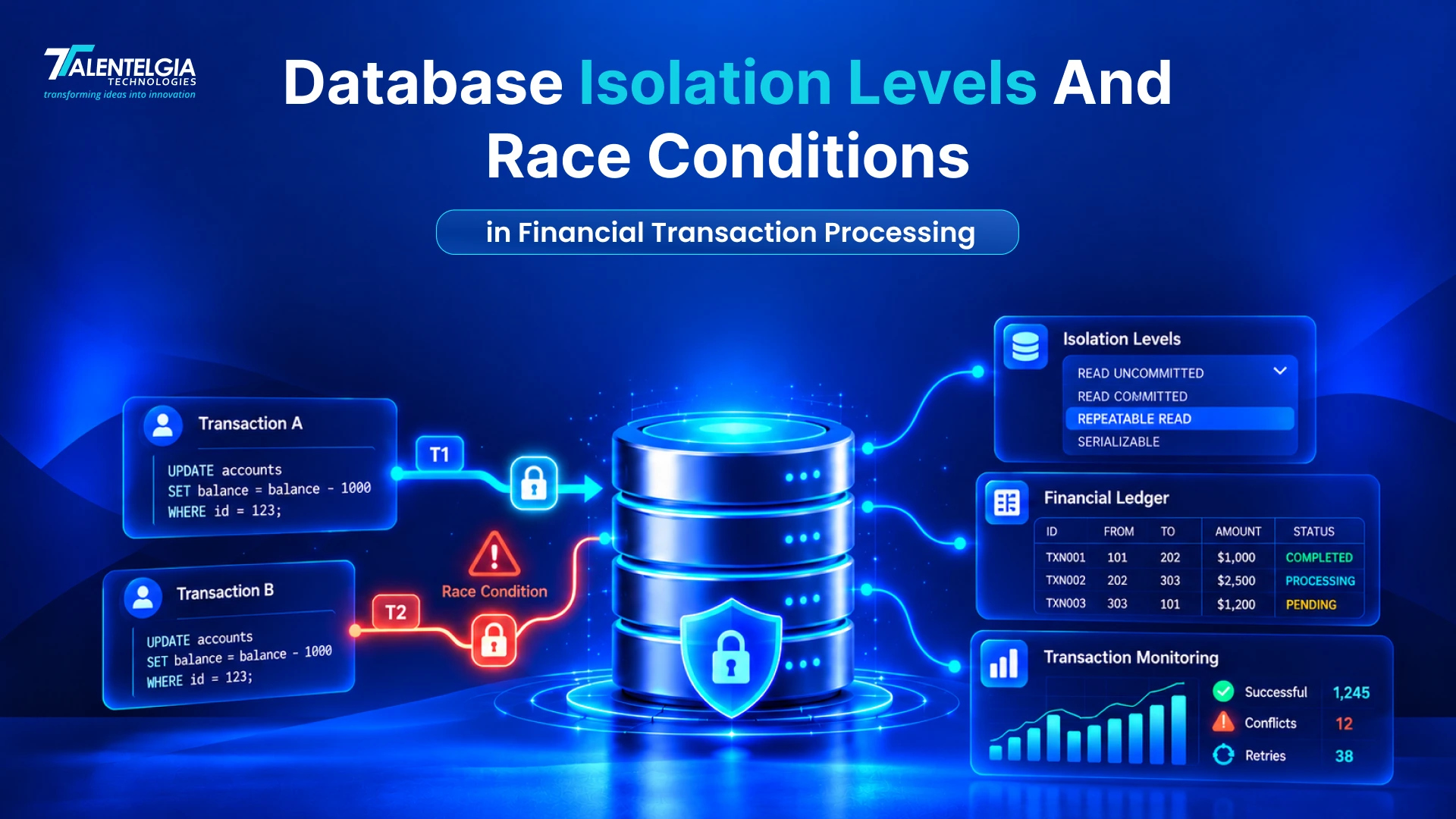
When I was building a trading platform, one of the most important technical challenges was ensuring that financial transactions remained accurate while multiple operations were being processed simultaneously. In a trading environment, users may place orders, modify existing positions, close trades, and check their available balances at the same time. Behind the scenes, the system must process these operations without allowing one transaction to interfere with another in a way that produces incorrect financial data.
Imagine a trader who has $1,000 in available funds and places two orders almost simultaneously. Each order requires $700 to execute. If both requests read the same initial balance before either transaction updates it, the system could incorrectly approve both orders, potentially committing more funds than the trader has available.
This is not simply an application logic problem. It is a concurrency problem that involves database transactions, isolation levels, and race conditions.
While developing financial and trading applications, I learned that maintaining accurate balances and consistent transaction records requires more than writing correct SQL queries. It also requires understanding how databases behave when multiple transactions compete for the same data. This is particularly important when building systems where financial data consistency directly affects transaction accuracy and account integrity.
In this article, I will explain database isolation levels and race conditions using practical examples from a trading platform, along with the approaches developers can use to build reliable financial transaction systems.
1. Understanding Transactions in a Trading Platform
A trading platform involves several connected operations that must work together to maintain accurate financial records.
For example, when a trader places an order, the system may need to:
- Validate the user’s account and trading permissions.
- Check the available balance or margin.
- Validate the requested order quantity and price.
- Reserve the required funds or margin.
- Create the order record.
- Update the order status as execution progresses.
- Record the corresponding financial transactions.
- Update the user’s positions and portfolio information.
Not every order immediately results in a completed trade. An order may remain pending, be partially filled, be rejected, or be cancelled. Therefore, the system must distinguish between order placement, fund reservation, execution, settlement, and final account reconciliation.
For example, if a trader places an order worth $400, the platform might reserve the required amount before execution. If the order is subsequently cancelled, the reserved amount must be released correctly.
If two operations attempt to reserve the same funds simultaneously, the platform needs appropriate concurrency controls to ensure that the available balance remains valid.
This is where database transactions become essential.
A database transaction groups related operations into a single logical unit. If an operation fails, the database can roll back the changes made within that transaction.
However, atomicity alone is not enough. When multiple transactions execute concurrently, the database must also control how they read and modify shared data.
That is the purpose of transaction isolation.
These considerations are central to fintech application development, where transaction workflows often involve balances, payments, account records, and other interconnected financial data. Developers must ensure that related operations succeed or fail together wherever the business rules require it. Without appropriate transaction boundaries and concurrency controls, even a small timing issue can create discrepancies between what the application displays and what the database actually records.
2. Why Database Isolation Matters in Trading Applications
Consider a trading platform where multiple orders can be submitted from different browser sessions, mobile devices, or automated trading strategies.
Even if the application validates every order correctly, two requests can arrive within milliseconds of each other. Both may read the same account balance before either request has completed its update.
Without appropriate concurrency protection, both requests may proceed using outdated information.
Database isolation levels define how concurrent transactions interact and what data they are allowed to observe. They help determine whether a transaction can read uncommitted changes, whether repeated reads remain consistent, and how conflicting operations are handled.
The four standard SQL isolation levels are Read Uncommitted, Read Committed, Repeatable Read, and Serializable.
Understanding database isolation levels in fintech applications helps developers determine which concurrency problems a database can prevent and where additional safeguards are necessary. The appropriate choice depends on the operation being performed, the data involved, and the business rules that must remain valid. For example, displaying a historical transaction may have different consistency requirements from reserving funds for a new order. Selecting an isolation level should therefore be based on the application’s actual correctness requirements rather than assuming that the strongest setting is always the best option.
Read Uncommitted
Read Uncommitted is the weakest standard isolation level. It may allow one transaction to read changes made by another transaction before those changes are committed.
Consider a scenario where an order-processing transaction temporarily deducts funds from a trader’s account but later fails and rolls back.
If another transaction reads that temporary balance under an isolation level that permits dirty reads, it may calculate available funds using a value that never becomes permanent.
For a trading platform, this can lead to incorrect decisions about order eligibility, available margin, or portfolio exposure.
Most financial applications should avoid relying on uncommitted data for decisions that affect financial transactions.
The exact behaviour depends on the database engine; some databases do not permit dirty reads even when Read Uncommitted is requested.
Read Committed
Read Committed ensures that a transaction read committed data. However, another transaction may commit changes between two queries executed by the first transaction.
Imagine that the platform reads a trader’s available balance as $1,000. Before the next query, another order reserves $300. A subsequent read may return $700.
This behaviour is known as a non-repeatable read.
Read Committed is suitable for many application operations, but it does not automatically make a sequence of reading, validating, and updating a balance safe.
For example, if two order requests independently read $1,000 and each tries to reserve $700, both may pass the initial application-level validation. A separate concurrency control is needed to ensure that the combined reservations cannot exceed the available funds.
Repeatable Read
Repeatable Read provides stronger guarantees for data read within a transaction, although the precise implementation differs between databases.
In PostgreSQL, Repeatable Read uses a consistent snapshot of the database for the transaction. This prevents non-repeatable reads and prevents phantom reads under PostgreSQL’s implementation, but certain serialization anomalies can still occur.
Consider a platform that applies a trading limit based on multiple account records or open positions. Two concurrent transactions might examine different records, each conclude that a limit has not been exceeded, and then make changes that collectively violate the intended business rule.
The important lesson is that consistent reads do not automatically protect every business rule involving multiple records.
When developing trading applications, database concurrency control must be designed around the specific business rules being protected, such as sufficient available margin, maximum open exposure, or permitted order quantity. Choosing an appropriate isolation level is essential, but complex rules involving multiple records may also require additional safeguards.
Serializable
Serializable is the strongest standard SQL isolation level. It aims to make concurrent transactions behave as though they were executed in some serial order, which can be particularly useful in financial transaction processing when multiple operations compete to modify shared data.
Suppose two order requests compete for the same available funds. If allowing both to complete would violate a financial constraint, Serializable isolation must prevent the database from committing an outcome that could not occur under a valid serial ordering.
Depending on the database engine and transaction design, this can involve locks, conflict detection, or transaction aborts.
A transaction may therefore fail with a serialization error and need to be retried.
Serializable is especially useful for complex business rules involving several records, but it can increase contention and retry rates. For simpler operations, atomic SQL statements or targeted row-level locking may provide the required protection more efficiently.
3. A Real-World Race Condition: Two Orders Using the Same Balance
One of the most useful ways to understand race conditions is to examine a scenario that can occur in a trading application.
Suppose a trader has $1,000 available and submits two orders from separate sessions. Each order requires $700 in available funds.
The application follows this logic:
- Read the trader’s available balance.
- Check whether the balance covers the order.
- Calculate the remaining balance.
- Update the account.
- Create the order record.
Now consider what happens when both requests execute at the same time.
Transaction A reads the balance as $1,000.
Transaction B also reads the balance as $1,000.
Both transactions conclude that the trader has sufficient funds. Each calculates a remaining balance of $300.
If both updates are implemented as unconditional writes based on the original balance, one update may overwrite the other. The account could show $300 remaining even though two orders have been accepted.
This is a lost-update problem.
If the platform instead deducts $700 separately from the same initial balance without ensuring that the combined deductions are valid, the result could be an invalid negative balance or excessive reservations, depending on the implementation.
The underlying problem is that the balance validation and update were not coordinated safely.
The solution is not simply to add more validation in the frontend. Both requests can be individually valid while being collectively invalid.
The database must enforce the relevant financial invariant.
4. Preventing Race Conditions in Trading Transactions
Preventing race conditions requires choosing database operations that remain safe under concurrent execution. In fintech software development, the challenge is to preserve financial rules even when multiple requests attempt to modify the same account, reserve funds, or create orders simultaneously.
Atomic balance updates
One effective approach is to combine the balance check and deduction into a single conditional SQL statement.
For example, in PostgreSQL:
UPDATE trading_accounts
SET available_balance = available_balance – 700
WHERE account_id = 123
AND available_balance >= 700
RETURNING available_balance;
The application checks whether the statement returns a row. If it does, the deduction succeeded. If no row is returned, the account did not satisfy the balance condition.
This approach avoids the unsafe pattern of reading a balance into application memory, calculating a new balance, and later writing that value back unconditionally.
The database evaluates the condition and performs the update as one statement, coordinating concurrent updates to the same row.
However, this example represents a simplified balance reservation. A production trading platform must also account for pending orders, fees, margin requirements, order rejection, partial fills, cancellation, and other relevant financial rules.
Row-level locking
Another useful approach is pessimistic locking.
In PostgreSQL, a transaction can use SELECT … FOR UPDATE to lock an account row before checking and modifying its balance.
For example:
BEGIN;
SELECT available_balance
FROM trading_accounts
WHERE account_id = 123
FOR UPDATE;
— Validate funds and reserve the required amount.
— Create the order and reservation records.
COMMIT;
The omitted business logic must run inside the same transaction. The account should be updated only after the validation succeeds, and every required database change should be committed together.
When another transaction attempts to lock the same account row, it must wait for the conflicting transaction to finish or encounter other database-specific behavior.
This approach is useful when order validation involves several related operations that cannot be expressed safely as a single conditional update.
For operations involving multiple accounts, developers should also use a consistent lock order to reduce the risk of deadlocks.
Database constraints
Database constraints provide another layer of protection.
For example, a non-negative balance constraint can prevent the account’s stored balance from falling below zero:
ALTER TABLE trading_accounts
ADD CONSTRAINT balance_nonnegative
CHECK (available_balance >= 0);
Unique constraints can also prevent duplicate order identifiers or duplicate transaction references.
However, a non-negative balance constraint does not automatically protect against every business-level problem. A platform might have a positive cash balance but still exceed its margin limit or maximum permitted exposure.
Such rules may require atomic updates, locking, Serializable transactions, or a different data model.
Idempotent order processing
Trading applications also need to handle duplicate requests.
A trader may submit an order, experience a network timeout, and retry the request because the client does not know whether the original submission succeeded.
Without appropriate protection, the platform might create two orders.
An idempotency key or unique client order identifier can help the server recognize repeated submissions of the same logical request.
The database should enforce uniqueness, and the order-processing workflow should safely handle simultaneous requests using the same identifier.
Idempotency is not a substitute for balance validation or transaction isolation, but it prevents retries from creating duplicate financial effects.
5. Keeping Orders, Balances, and Portfolio Data Consistent
A trading platform does not manage balances in isolation. Order records, financial transactions, positions, and portfolio summaries must also remain consistent.
Consider an order that is accepted and reserves funds. If the order record is created but the reservation fails, the system could display an order that was never properly funded.
Similarly, if a trade executes but the corresponding position update fails, the portfolio may not reflect the actual execution.
Where these operations are managed by the same database, a transaction can ensure that the required changes are committed together.
A simplified workflow might be:
- Begin a database transaction.
- Validate the account and order parameters.
- Reserve the required funds or margin.
- Create the order and its reservation records.
- Record the appropriate financial event.
- Commit the transaction.
The exact sequence depends on the platform’s order lifecycle and execution model.
A particularly important distinction is that accepting an order is not the same as executing a trade. The platform should model these states explicitly rather than treating order submission as proof that a trade has completed.
External exchange APIs, broker systems, and market-data services introduce another challenge: a database transaction cannot roll back an external trade that has already executed.
For those workflows, durable order states, idempotent requests, execution reports, reconciliation, and recovery processes are essential. A transactional outbox can also help ensure that committed database changes are reliably published to downstream services.
6. Choosing the Right Isolation Level for Trading Workloads
Different parts of a trading platform have different consistency requirements.
| Trading operation | Possible approach | Primary concern |
|---|---|---|
| Available-balance deduction | Atomic conditional update | Prevent overspending |
| Order placement and fund reservation | Transaction with row-level locking or equivalent concurrency control | Keep the order and reservation consistent |
| Complex margin or exposure checks | Serializable isolation or carefully designed locking | Protect multi-record business rules |
| Duplicate order submissions | Unique client order ID and idempotent processing | Prevent duplicate orders |
| Portfolio dashboard | Consistent snapshot where required | Avoid presenting an inconsistent view |
| Trade execution and settlement | Durable state transitions, transaction records, and reconciliation | Recover safely from partial failures |
These approaches are not mutually exclusive. A production platform may combine Read Committed isolation, atomic SQL statements, targeted locks, unique constraints, and idempotency to achieve the required correctness without imposing the cost of Serializable isolation on every operation.
The important consideration is to understand what must remain true when concurrent operations execute.
For example, if a trader must never reserve more than the permitted available funds, that invariant should be enforced by the transaction design and database operations—not merely by a preliminary application-level check.
7. Performance, Scalability, and Concurrency Testing
Financial systems must handle both correctness and performance. A solution that prevents race conditions but creates excessive lock contention can become a bottleneck as order volume increases.
For a fintech development agency building transaction-heavy applications, these requirements should be considered during architecture and database design, rather than addressed only after performance issues emerge.
To address this challenge, developers should keep transactions short and avoid making external network calls while holding database locks.
Applications should also handle deadlocks and serialization failures through bounded retries, with appropriate backoff where useful. The entire logical transaction must be retried safely, and external financial effects must not be duplicated.
Concurrency testing is equally important. A trading platform should be tested with simultaneous requests for the same account, competing order reservations, duplicate order submissions, cancellation and execution races, and interrupted transactions.
Tests should verify the final state of the database, including balances, orders, reservations, and transaction records—not just whether each API returned a successful response.
Monitoring lock waits, transaction latency, database conflicts, rejected orders, and reconciliation discrepancies can help identify problems before they affect a larger number of users.
Conclusion
Database isolation levels and race conditions are critical considerations when building financial systems that process multiple transactions simultaneously. A trading platform may validate every order correctly at the application level, yet still produce incorrect results if concurrent requests modify the same data without adequate protection.
Choosing the right isolation level is only part of the solution. Atomic SQL updates, row-level locking, database constraints, and idempotent processing each address different concurrency risks. The right combination depends on the business rules the application must enforce, the database engine being used, and the expected transaction workload.
Testing concurrent transactions, handling failed operations safely, and implementing reliable reconciliation mechanisms are equally important to maintaining accurate financial records as the system scales.
At Talentelgia Technologies, we approach fintech software development services with an understanding that reliability must be built into the underlying architecture, not added as an afterthought. By prioritising transaction integrity, financial data consistency, and robust database design, we help businesses build financial applications designed to handle complex workflows and demanding operational requirements.











 Sales Enquiries:
 Business queries:
 HR:


