



 Healthcare App Development Services
 Real Estate Web Development Services
 E-Commerce App Development Services
 E-Commerce Web Development Services
 Blockchain E-commerce Development Company
 Fintech App Development Services
 Fintech Web Development
 Blockchain Fintech Development Company
 E-Learning App Development Services
 Restaurant App Development Company
 Mobile Game Development Company
 Travel App Development Company
 Automotive Web Design
 AI Traffic Management System
 AI Inventory Management Software
 Machine Learning Development
 ChatGPT integration services
  AI Development Company
  AI Integration Services
  Generative AI Development Services
  Natural Language Processing Company
 Mobile App Development
  IOS App Development
  Android App Development
  Cross-Platform App Development
  Augmented Reality (AR) App Development
  Virtual Reality (VR) App Development
  Web App Development
  SaaS App Development
 Flutter
  React Native
  Swift (IOS)
  Kotlin (Android)
  Mean Stack Development
  AngularJS Development
  MongoDB Development
  Nodejs Development
  Database Development
 Ruby on Rails Development
 Expressjs Development
  Full Stack Development
  Web Development Services
  Laravel Development
  LAMP Development
  Custom PHP Development
  .Net Development
  User Experience Design Services
  User Interface Design Services
  Automated Testing
  Manual Testing
  Digital Marketing Services
 Ride-Sharing And Taxi Services
 Food Delivery Services
 Grocery Delivery Services
 Transportation And Logistics
 Car Wash App
 Home Services App
 ERP Development Services
 CMS Development Services
 LMS Development
 CRM Development
 DevOps Development Services
 AI Business Solutions
 AI Cloud Solutions
 AI Chatbot Development
 API Development
 Blockchain Product Development
 Cryptocurrency Wallet Development
 About Talentelgia
  Our Team
  Our Culture
 Healthcare App Development Services
 Real Estate Web Development Services
 E-Commerce App Development Services
 E-Commerce Web Development Services
 Blockchain E-commerce
Development Company
Blockchain E-commerce
Development Company Fintech App Development Services
 Finance Web Development
 Blockchain Fintech
Development Company
Blockchain Fintech
Development Company E-Learning App Development Services
 Restaurant App Development Company
 Mobile Game Development Company
 Travel App Development Company
 Automotive Web Design
 AI Traffic Management System
 AI Inventory Management Software
 AI Development Company
 ChatGPT integration services
 AI Integration Services
 Machine Learning Development
 Machine learning consulting services
 Blockchain Development
 Blockchain Software Development
 Smart contract development company
 NFT marketplace development services
 Asset tokenization companies
 DeFi Wallet Development Company
 IOS App Development
 Android App Development
 Cross-Platform App Development
 Augmented Reality (AR) App
Development
Augmented Reality (AR) App
Development Virtual Reality (VR) App Development
 Web App Development
 Flutter
 React
Native
React
Native Swift
(IOS)
Swift
(IOS) Kotlin (Android)
 MEAN Stack Development
 AngularJS Development
 MongoDB Development
 Nodejs Development
 Database development services
 Expressjs Development
 Full Stack Development
 Web Development Services
 Laravel Development
 LAMP
Development
LAMP
Development Custom PHP Development
 User Experience Design Services
 User Interface Design Services
 Automated Testing
 Manual
Testing
Manual
Testing About Talentelgia
 Our Team
 Our Culture
Did you know how much manufacturers lose every single year due to unplanned downtime? $1.4 trillion.
Is it from poor strategy? Or bad products? No. It is just from not knowing something was about to go wrong, until it already did.
Manufacturing has always been a difficult business. There are narrow margins, constant pressure to deliver, and equipment that can fail at any time. For the longest time, manufacturers managed all of it based on experience, intuition, and a lot of manual oversight. And honestly? That worked until operations got too big, too fast, and too complex for any team to keep up with manually.
That’s the world IoT was built for!!
Today, factories that have accepted connected technology are operating in a completely different way. They catch equipment issues before they become breakdowns. They know exactly what’s happening on every part of the floor. And that too in real time. They waste less, produce more, and make better decisions faster.
This blog is about how that’s actually happening. We will discuss the use cases driving real results and what the road ahead looks like for manufacturers willing to embrace it.
What is IoT in Manufacturing?
The Internet of Things (IoT), also known as Industrial IoT (IIoT) in manufacturing, is a concept based on interconnecting machines, sensors, and manufacturing equipment for sharing ongoing operational data. Machines do not operate individually but collectively as interconnected devices, giving feedback on their operation and issues.
In a typical manufacturing system, IoT connects various manufacturing layers, from individual machines to whole plant systems, using sensors and communication technologies.
The design of an IoT-driven manufacturing system includes the following elements:
- Sensors – Measure operational variable factors like temperature, vibrations, pressures, and speeds of machines
- Industrial Devices – Machinery like CNC machine tools, robots, conveyor belts, and inspection equipment
- Gateways – Allow secure transmission of machine operational data from shop floors to centralized platforms
- Cloud or Edge Computing Platforms – Stores and processes machine operational data
- Analytic Software – Transforms raw machine data into meaningful information.
What Makes IoT A Critical Part of Modern Manufacturing?
Let us discuss the core technological and operational shifts responsible for making IoT a long-term requirement in manufacturing: –
1. Real-Time Data Has Become the Backbone of Modern Productivity
In the past, manufacturing decision-making was highly dependent on reports, manual logs, and scheduled inspections. However, in modern settings that demand 24/7 operations and highly dynamic process variables, the old way does not cut it. Instead, IoT facilitates the constant transmission of machine data rather than fixed intervals.
This technology works by collecting data from sensors placed on machines, tooling systems, conveyor systems, environmental controls, and other systems. The following parameters may be gathered through high-frequency collection of IoT data:
- Temperature variations
- Vibration frequency patterns
- Motor current loads
- Machine cycle times
- Pressure levels
- Environmental humidity
This continuous data flow supports live operational awareness. It allows production teams to get a better understanding of what is happening on the floor than just waiting and relying on manual feedback. Such real-time intelligence is becoming a defining element in the future of IoT in manufacturing.
2. Integration of IT and OT Systems Is Reshaping Factory Architecture
Traditional manufacturing environments kept Information Technology (IT) and Operational Technology (OT) separated. IT systems focused on managed enterprise software like ERP platforms. OT systems, on the other hand, control machinery, PLCs, and industrial controllers.
IoT reduces this gap and connects the two technologies into a single system.
Modern manufacturing infrastructure now includes:
- Programmable Logic Controllers (PLCs) for managing equipment logic
- Supervisory Control and Data Acquisition (SCADA) systems to monitor plant activity
- Manufacturing Execution Systems (MES) for tracking production workflows
3. Production Systems Are Becoming Too Complex for Manual Oversight
Manufacturing plants today often run hundreds or thousands of interconnected machines. Many operations involve:
- Multi-stage production lines
- Automated robotics
- Computer-controlled machining
- Distributed production units
Manual supervision alone cannot track performance across such environments. IoT systems introduce centralized monitoring frameworks capable of managing large-scale industrial activity.
Connected infrastructure supports:
- Central dashboards displaying machine status
- Automated alerts triggered by abnormal readings
- System-wide synchronization across equipment
4. Edge and Cloud Computing Are Enabling Scalable Industrial Intelligence
IoT does more than collect data. It creates the infrastructure required to process that data at scale. Modern IoT environments use both edge computing and cloud computing to manage industrial workloads efficiently.
Edge computing supports:
- Local processing near machines
- Low-latency decision-making
- Immediate response to operational changes
Cloud computing supports:
- Long-term data storage
- Large-scale analytics
- Cross-factory performance comparisons
Together, these technologies allow manufacturing organizations to expand operations without losing control over performance data.
5. Standardization of Industrial Connectivity Is Driving Ecosystem Growth
Manufacturing equipment historically used proprietary communication systems. Many machines operate using different protocols, making integration difficult and expensive.
IoT adoption is accelerating the use of standardized industrial communication technologies:
- MQTT (Message Queuing Telemetry Transport)
- OPC UA (Open Platform Communications Unified Architecture)
- Industrial Ethernet networks
- Wireless sensor networks
These standardized protocols enable machines from different vendors to exchange data within shared environments.
6. Fully Connected Factory Ecosystems in Manufacturing
It is all about the connected infrastructure. IoT is like the digital backbone linking machines, production workflows, maintenance systems, and supply operations into a single ecosystem.
Connected factories operate with:
- Unified monitoring platforms
- Continuous production visibility
- Automated workflow coordination
- Centralized operational dashboards
Instead of isolated machines performing individual tasks, manufacturing systems now function as synchronized networks.
This ecosystem-driven approach supports:
- Faster operational adjustments
- Improved coordination between production stages
- Higher production consistency across shifts
Read More:- How To Develop an IoT Application? Features & Cost
Real-World IoT Use Cases in Manufacturing
The true value of IoT in manufacturing becomes clear when it is applied to real-world challenges on the factory floor.
Predictive Maintenance
Let’s take an example. An important machine on your production line stops working. Work stops. And when everything gets better, you’ve lost hours of output and thousands in revenue. The worst part? There were signs that something was wrong days earlier. Nobody caught them.
This is the reality of reactive maintenance. And it’s still how a lot of factories operate today. They either fix things after they break or service equipment on a fixed schedule, even if it doesn’t need it or not. Both approaches are wasteful, and neither of them actually prevents the main problem.
IoT brings a change to this approach. It uses connected sensors to track machine parameters like vibration, temperature, pressure, and runtime. These systems observe and analyze patterns and alert operators when early signs of failure appear so that the maintenance teams can act before any damage occurs.
Research consistently shows the strong business value of predictive maintenance. According to McKinsey & Company, it can:
- Reduce machine downtime by up to 50%
- Lower maintenance costs by 10–40%
- Extend equipment lifespan by 20–40%
Smart Inventory and Supply Chain Optimisation
Keeping track of inventory has always been a headache for manufacturers. Things get misplaced, stock runs out at the wrong time, or you end up ordering way more than you actually need. IoT helps fix that.
By attaching RFID tags and sensors to raw materials and finished goods, manufacturers always know what they have, where it is, and when it’s running low, without anyone having to manually count or check. Everything updates in real time.
This visibility extends beyond the warehouse, too. Manufacturers can follow materials as they move through production lines and across the supply chain. If something is delayed or going off track, they catch it early instead of finding out when it’s already caused a problem. In industries where a single late shipment can halt an entire production line, that kind of heads-up makes a real difference.
Real-Time Machine Monitoring and Production Visibility
Not too long ago, factory managers had to walk the floor or wait for shift reports to know how things were running. IoT changes that completely.
Sensors placed on machines continuously collect data like cycle times, temperature, output rates, and more. This information flows to a central dashboard where operators can see exactly what’s happening across the entire facility, at any moment. If a machine is underperforming or a line is slowing down, it shows up immediately.
What’s even better is how engineers don’t need to be physically present on the floor to act on it. They can monitor production remotely and make adjustments from wherever they are.
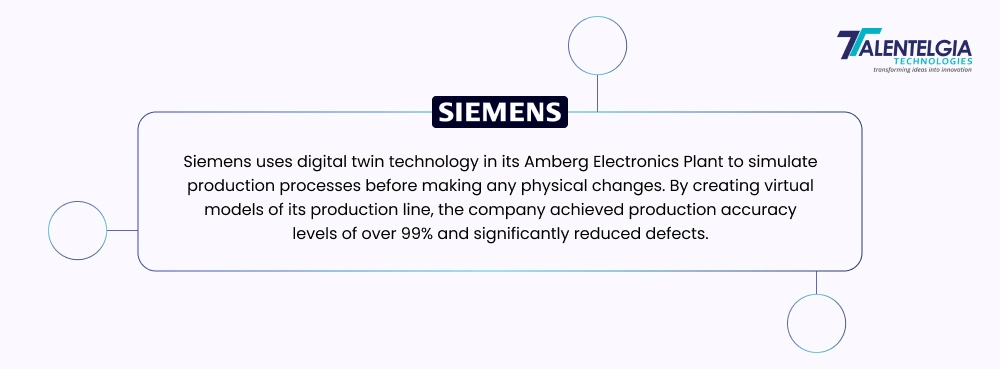
Digital Twins and Process Simulation
One of the most advanced IoT use cases is the development of digital twins – virtual models of physical machines or production systems. These models use real-time sensor data to simulate operations, test new configurations, and predict system behavior without interrupting ongoing production.
Manufacturers can now spot bottlenecks, try out different workflows, and work through potential problems. This technology is becoming increasingly important as factories grow more complex and require faster decision-making.
According to Gartner, 75% of organizations implementing IoT are expected to use digital twins by 2026, showing how rapidly this technology is becoming essential in smart manufacturing environments.
Emerging IoT Trends Shaping the Future of Manufacturing
Here are the foundational trends making the future of IoT in the manufacturing industry even brighter: –
AI-Native and Lights-Out Factories
Manufacturers are adopting autonomous production environments. Here, IoT devices stream machine data to edge AI systems. These systems adjust parameters, detect anomalies, and trigger maintenance actions with minimal human intervention.
5G Connectivity Enabling Real-Time Industrial Operations
The deployment of 5G is doing wonders for Industrial IoT. With 5G, data transfer becomes ultra-fast. It can connect up to 1 million devices per square kilometer. These capabilities support real-time robotics, automated guided vehicles (AGVs), and remote-controlled industrial systems. This is going to remarkably improve production speed and responsiveness.
Strengthened Cybersecurity for Connected Manufacturing
Manufacturing belongs to one of the industries that gets the most cyber attacks, accounting for up to 25% of all cyber attacks globally. This is the reason why techniques like network segmentation, real-time monitoring, and periodic security audits should be adopted to safeguard the OT systems and critical data from being exploited in cybersecurity.
Sustainability and Energy Optimization Using IIoT
Manufacturers are using IoT-based energy monitoring systems to reduce operational costs and meet their sustainability targets, and support ESG and regulatory compliance goals.
Augmented Reality (AR) Supporting Workforce Productivity
AR-enabled industrial tools provide technicians with ongoing visual instructions during maintenance and training. Companies implementing AR-assisted workflows, such as AR App Development, have reported productivity improvements.
Conclusion
It’s clear as crystal. Manufacturing businesses operating without IoT will find it extremely difficult to compete with those that have already adopted connected technologies. It is no longer something that they can simply overlook. Relying on disconnected systems and manual monitoring will increase the risk of downtime and inefficiencies.
So, it's not the time to think about whether manufacturers should adopt IoT or not, but how quickly they are going to integrate it into their systems for operational excellence. That's because the future of IoT in manufacturing is going to be all about factories that operate with greater visibility, stronger coordination, and more reliable performance across every stage of production.













 Sales Enquiries:
  Business queries:
  HR:
HR: 


