



 Healthcare App Development Services
 Real Estate Web Development Services
 E-Commerce App Development Services
 E-Commerce Web Development Services
 Blockchain E-commerce Development Company
 Fintech App Development Services
 Fintech Web Development
 Blockchain Fintech Development Company
 E-Learning App Development Services
 Restaurant App Development Company
 Mobile Game Development Company
 Travel App Development Company
 Automotive Web Design
 AI Traffic Management System
 AI Inventory Management Software
 AI Development Company
  ChatGPT integration services
  AI Integration Services
  Generative AI Development Services
  Natural Language Processing Company
 Machine Learning Development
  Machine learning consulting services
  Blockchain Development
  Blockchain Software Development
  Smart Contract Development Company
  NFT Marketplace Development Services
  Asset Tokenization Company
 DeFi Wallet Development Company
 Mobile App Development
  IOS App Development
  Android App Development
  Cross-Platform App Development
  Augmented Reality (AR) App Development
  Virtual Reality (VR) App Development
  Web App Development
  SaaS App Development
 Flutter
  React Native
  Swift (IOS)
  Kotlin (Android)
  Mean Stack Development
  AngularJS Development
  MongoDB Development
  Nodejs Development
  Database Development
 Ruby on Rails Development
 Expressjs Development
  Full Stack Development
  Web Development Services
  Laravel Development
  LAMP Development
  Custom PHP Development
  .Net Development
  User Experience Design Services
  User Interface Design Services
  Automated Testing
  Manual Testing
  Digital Marketing Services
 Ride-Sharing And Taxi Services
 Food Delivery Services
 Grocery Delivery Services
 Transportation And Logistics
 Car Wash App
 Home Services App
 ERP Development Services
 CMS Development Services
 LMS Development
 CRM Development
 DevOps Development Services
 AI Business Solutions
 AI Cloud Solutions
 AI Chatbot Development
 API Development
 Blockchain Product Development
 Cryptocurrency Wallet Development
 About Talentelgia
  Our Team
  Our Culture
 Healthcare App Development Services
 Real Estate Web Development Services
 E-Commerce App Development Services
 E-Commerce Web Development Services
 Blockchain E-commerce
Development Company
Blockchain E-commerce
Development Company Fintech App Development Services
 Finance Web Development
 Blockchain Fintech
Development Company
Blockchain Fintech
Development Company E-Learning App Development Services
 Restaurant App Development Company
 Mobile Game Development Company
 Travel App Development Company
 Automotive Web Design
 AI Traffic Management System
 AI Inventory Management Software
 AI Development Company
 ChatGPT integration services
 AI Integration Services
 Machine Learning Development
 Machine learning consulting services
 Blockchain Development
 Blockchain Software Development
 Smart contract development company
 NFT marketplace development services
 IOS App Development
 Android App Development
 Cross-Platform App Development
 Augmented Reality (AR) App
Development
Augmented Reality (AR) App
Development Virtual Reality (VR) App Development
 Web App Development
 Flutter
 React
Native
React
Native Swift
(IOS)
Swift
(IOS) Kotlin (Android)
 MEAN Stack Development
 AngularJS Development
 MongoDB Development
 Nodejs Development
 Database development services
 Ruby on Rails Development services
 Expressjs Development
 Full Stack Development
 Web Development Services
 Laravel Development
 LAMP
Development
LAMP
Development Custom PHP Development
 User Experience Design Services
 User Interface Design Services
 Automated Testing
 Manual
Testing
Manual
Testing About Talentelgia
 Our Team
 Our Culture
Customer support is an experience almost every user encounters at some point. You would have been there too. It could be for a billing issue, a delayed flight or package, or maybe a damaged product. And that moment, small it seems, is exactly where AI is being tested right now.
Companies are putting AI into every corner of their customer experience. And the numbers back the momentum: 98% of contact centers are using AI in some capacity. But here’s the uncomfortable truth sitting underneath all that investment: 9 out of 10 executives say customer loyalty has grown, while only 4 in 10 customers agree.
That gap is a reality check.
AI in customer experience isn’t good or bad. It’s how you use it. Some applications are genuinely changing the game. Others are just expensive ways to frustrate people faster. This blog breaks down exactly which is which, so you can cut through the noise and focus on what actually moves the needle.
Why AI in Customer Experience Is Exploding Right Now?
Here are the three very real reasons why businesses are bending towards AI Integration for customer service: –
Customer expectations have outpaced human capacity
70% of the executives find it increasingly difficult to cope with their customers’ rising expectations. This is because, at present, the expectations have surpassed their capacity to cope. The customers expect immediate responses, 24/7 availability, and personalized interactions all the time.
The cost pressure is real
Supporting customers at scale is expensive. AI chatbots alone are helping businesses reduce customer service costs by up to 30%. And that is a huge number to ignore, especially when margins are tight, and support volumes keep climbing.
Generative AI changed what’s actually possible
For years, CX automation meant clunky, frustrating bots. Generative AI for customer experience has changed that. 88% of organizations now report using AI in at least one business function, and customer service is consistently among the top three areas of deployment. The technology finally caught up with the ambition.
The result? Businesses are operationalizing AI, and that too, to a good extent!
What Actually Works: Proven AI Use Cases in Customer Experience
Not all AI in customer experience is created equal. Some applications have a clear, measurable impact. Others are still finding their footing. Here’s where businesses are genuinely seeing results.
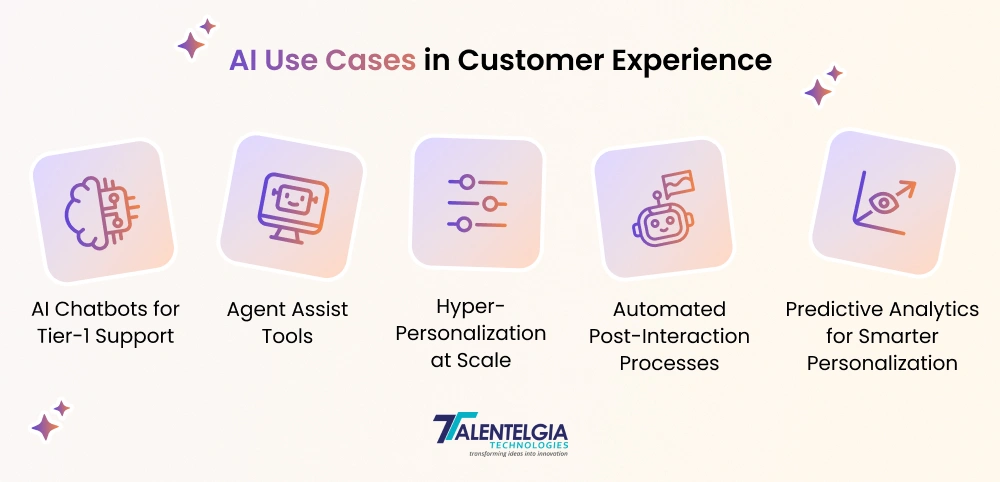
AI Chatbots for Tier-1 Support
This is the most battle-tested use case in AI customer experience, and it works. It is all because the job is simple and repetitive: answer the same questions faster, at any hour, without a queue.
Take Klarna, the fintech giant processing over 2 million transactions daily. They deployed an AI assistant to handle the flood of routine customer queries like refund requests, payment status, order tracking, and account updates.
The result: average resolution time dropped to around 2 minutes, with a 25% reduction in repeat contacts and roughly 1.3 million conversations handled by AI per month.
Agent Assist Tools
Agent assist tools are where AI is quietly delivering some of its biggest gains. It’s not replacing agents but is making them faster and sharper instead. AI can surface relevant knowledge in real time, auto-suggest replies, summarize tickets, and even flag the tone of a conversation before an agent responds.
The results are meaningful. According to BCG, early adopters report agents spending 80% less time typing during support interactions, with productivity gains of 10–20%. For a busy support team, that compounds fast.
Real-world applications include tools that auto-fill post-call notes, suggest responses while agents type, and pass full conversation context during escalations, so customers never have to repeat themselves.
Hyper-Personalization at Scale
AI can analyze thousands of behavioral signals simultaneously and tailor every interaction in real time. This is where AI for personalized customer experiences is creating value for companies.
Starbucks‘ “Deep Brew” engine factors in a customer’s purchase history, location, time of day, and even the weather to make proactive recommendations through the app. The result has been a 10% increase in revenue from loyalty members and a 12% rise in average order value.
Sephora works quite similarly. Their AI-powered skin scan and Virtual Artist tool deliver personalized product recommendations based on individual skin analysis. The outcome: a 31% average increase in sales conversion compared to rule-based recommendation methods.
You know what’s common here? Personalization that solves a real problem for the customer, not just personalization for its own sake.
Read More:- AI Consulting Services For Small Businesses
Automated Post-Interaction Processes
Post-interaction activities can consume a lot of time. It can include summarizing conversations, updating records, and sending follow-up messages. AI tools can now automate these tasks by generating summaries, tagging cases, and updating Customer Relationship Management (CRM) platforms automatically after each interaction.
It saves a significant portion of executives’ time (about 35% of their time) as there is no need to work on repetitive administrative tasks. This means that agents can now focus on active customer engagement rather than documentation. This improves productivity without requiring additional staffing. Automated follow-ups also ensure consistency, ensuring that customers receive confirmations, updates, and satisfaction surveys promptly. Over time, these efficiency gains accumulate, delivering meaningful improvements across the entire customer service workflow.
Predictive Analytics for Smarter Personalization
Instead of guessing what customers want, businesses take notes of the past behavior, purchase history, and browsing patterns to predict what a customer might need next. This helps companies send more relevant recommendations, reminders, and offers at the right time. Companies like Amazon and Netflix have started to use it as a part of their everyday customer experience.
However, strong results depend heavily on good data. Businesses that see success with predictive analytics invest time in organizing and maintaining accurate customer data, ensuring recommendations feel helpful rather than random.
What’s Just Hype: Overpromised AI Trends to Watch Out For
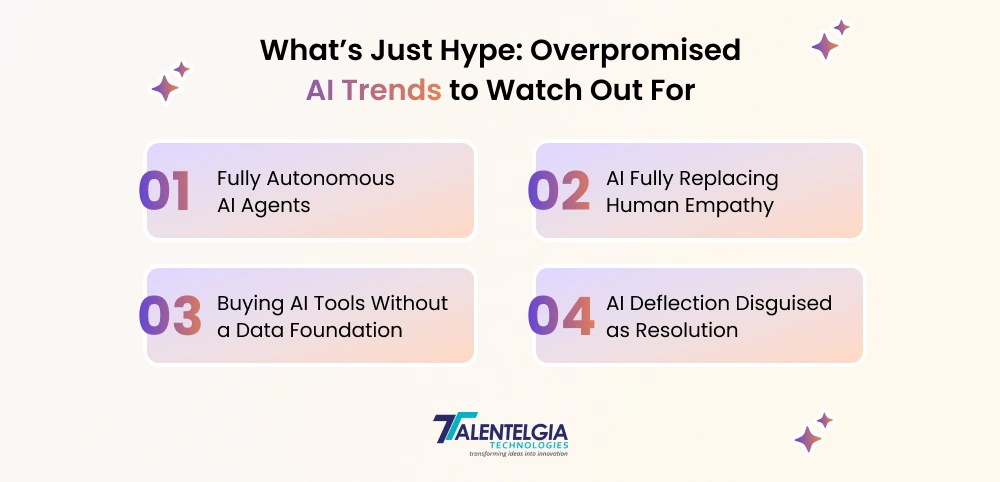
Fully Autonomous AI Agents
This is the biggest overpromise in CX right now. Vendors are selling the dream of AI agents that handle entire customer journeys end-to-end, no human needed, no supervision required. The reality on the ground tells a very different story.
According to an MIT report, 95% of enterprise-grade generative AI systems fail before they ever reach production. A separate Gartner analysis suggests 40% of agentic AI projects will be scrapped by 2027. The root causes are consistent: projects built around hype rather than real workflows, poor data foundations, and no governance structure to catch failures.
Most of what’s being called an “AI agent” in the market today is simply an LLM with basic tool-calling capabilities. It’s not a truly autonomous system. The genuinely autonomous, multi-step problem-solving agent that vendors are selling? We’re not there yet.
AI Fully Replacing Human Empathy
The idea that AI can replicate human empathy at scale is one of the most persistent myths in this space. And the customer data keeps disproving it.
80% of consumers still prefer a human agent for needs driven by empathy, things like dispute resolution, trust-building, or emotionally charged situations. That number hasn’t budged despite years of AI improvement. For high-stakes issues like fraud or sensitive complaints, 70% of customers specifically want a human agent.
Here is a real-world example for better clarity: –
Klarna (as discussed) is widely known for successfully deploying AI chatbots to handle routine support queries. But it eventually discovered the limits of automation when the technology was pushed too far. After the company started to expand AI into areas that demanded more judgment and careful handling, its customer satisfaction started to decline. That is when the company was forced to re-balance its strategy and bring human agents back into critical touchpoints. The technology itself worked, no doubt. But removing human support from emotionally complex situations can create friction that automation alone could not resolve.
Buying AI Tools Without a Data Foundation
This is probably the most widespread and expensive mistake businesses are making right now. Companies are purchasing AI platforms, deploying chatbots, and building automation workflows, all on top of messy, siloed, inconsistent data. And then wondering why nothing works.
According to MIT’s GenAI Divide report, U.S. businesses collectively invested between $35 and $40 billion into internal AI projects, and 95% saw zero return on investment or no measurable impact on profits. The leading reason wasn’t the technology. It was the foundation underneath it. AI simply works on whatever it is fed. It doesn’t fix what’s broken. For instance, if customer information exists in multiple systems with different versions of the same details, AI will provide conflicting answers and deliver confusing responses to customers.
Buying the tool before fixing the foundation is like installing a high-performance engine in a car with no wheels.
AI Deflection Disguised as Resolution
This one is subtle but damaging. Many companies deploy AI chatbots with a hidden goal, and it is not to solve the customer problems. It is to deflect them away from human agents to cut costs. Customers end up in loops, hitting dead ends, and repeating themselves, while the company’s dashboard shows “containment rate” going up and celebrates it as a win.
Nearly one in five consumers who used AI for customer service saw no benefit from the experience at all. That is a failure rate almost four times higher than Agentic AI use in other contexts. Measuring success by deflection instead of resolution is one of the most costly mistakes a CX team can make.
The human + AI balance – The Real Formula
Every business chasing full automation is chasing the wrong goal. Companies winning at customer service are the ones that treat AI as a support system and know exactly where they need AI and where they must rely on humans only.
AI can’t do it alone, and neither can humans.
50% of consumers say they would cancel a service entirely if they found it was solely AI-driven. And 42% say they’d pay more just to access a human agent. At the same time, human-only support doesn’t scale. Customers want instant answers at 2 am. They expect to never repeat themselves. That’s where AI for customer experience carries its weight.
The formula is knowing which one to deploy at which moment.
So what works?
The businesses getting this right operate on a simple but disciplined structure:
- Tier 1 – AI handles it fully: Routine, predictable queries. Order status, password resets, FAQs, and account questions. Fast, consistent, zero wait time.
- Tier 2 – AI assists, human decides: Moderate complexity. AI surfaces context and suggestions, but a human agent owns the conversation.
- Tier 3 – Human leads, AI supports: Complaints, disputes, emotional situations, high-value customers. A human takes the wheel, AI provides the background intelligence.
Organizations that adopt this kind of hybrid model see a 41% improvement in first-contact resolution while maintaining 89% customer satisfaction rates.
Wrapping Up
When it comes to customer experience, customers don’t care who is helping them, be it a human or an AI. What matters is if their problems are getting solved quickly without any inconvenience. That’s it.

All you need to do is start with a real problem, build on clean data, keep humans where they matter the most, and ensure that problems are actually getting solved and customers are satisfied. Remember, the motive is never to close the ticket. So, get that order right, and AI for customer experience becomes one of the most powerful tools you have.












 Write us on:
  Business queries:
  HR:
HR: 


