


 Healthcare Software Development Services
 Healthcare App Development Services
 Real Estate Web Development Services
 Real Estate App Development Company
 E-Commerce App Development Services
 E-Commerce Web Development Services
 Blockchain E-commerce Development Company
 Fintech Software Development
 Fintech App Development Services
 E-Learning App Development Services
 Restaurant App Development Company
 Mobile Game Development Company
 Travel App Development Company
 Automotive Web Design
 AI Traffic Management System
 AI Inventory Management Software
 Logistics App Development Services
 Machine Learning Development
 ChatGPT integration services
  AI Development Company
  AI Integration Services
  Natural Language Processing Company
 Mobile App Development
  IOS App Development
  Android App Development
  Cross-Platform App Development
  Augmented Reality (AR) App Development
  Virtual Reality (VR) App Development
  Web App Development
  SaaS App Development
 Custom Software Development Services
  Flutter
  React Native
  Swift (IOS)
  Kotlin (Android)
  Mean Stack Development
  AngularJS Development
  MongoDB Development
  Nodejs Development
  Database Development
 Ruby on Rails Development
 Expressjs Development
  Full Stack Development
  Web Development Services
  Laravel Development
  LAMP Development
  Custom PHP Development
  .Net Development
  User Experience Design Services
  User Interface Design Services
  Automated Testing
  Manual Testing
  Digital Marketing Services
 Ride-Sharing And Taxi Services
 Food Delivery Services
 Grocery Delivery Services
 Transportation And Logistics
 Car Wash App
 Home Services App
 ERP Development Services
 CMS Development Services
 LMS Development
 CRM Development
 DevOps Development Services
 AI Business Solutions
 AI Cloud Solutions
 AI Chatbot Development
 API Development
 Blockchain Product Development
 Cryptocurrency Wallet Development
 About Talentelgia
  Our Team
  Our Culture
 Healthcare App Development Services
 Real Estate Web Development Services
 E-Commerce App Development Services
 E-Commerce Web Development Services
 Blockchain E-commerce
Development Company
Blockchain E-commerce
Development Company Fintech App Development Services
 Blockchain Fintech
Development Company
Blockchain Fintech
Development Company E-Learning App Development Services
 Restaurant App Development Company
 Mobile Game Development Company
 Travel App Development Company
 AI Traffic Management System
 AI Inventory Management Software
 AI Development Company
 ChatGPT integration services
 AI Integration Services
 Machine Learning Development
 Machine learning consulting services
 Blockchain Development
 Blockchain Software Development
 Smart contract development company
 NFT marketplace development services
 Asset tokenization companies
 DeFi Wallet Development Company
 IOS App Development
 Android App Development
 Cross-Platform App Development
 Augmented Reality (AR) App
Development
Augmented Reality (AR) App
Development Virtual Reality (VR) App Development
 Web App Development
 Flutter
 React
Native
React
Native Swift
(IOS)
Swift
(IOS) Kotlin (Android)
 MEAN Stack Development
 AngularJS Development
 MongoDB Development
 Nodejs Development
 Database development services
 Expressjs Development
 Full Stack Development
 Web Development Services
 Laravel Development
 LAMP
Development
LAMP
Development Custom PHP Development
 User Experience Design Services
 User Interface Design Services
 Automated Testing
 Manual
Testing
Manual
Testing About Talentelgia
 Our Team
 Our Culture
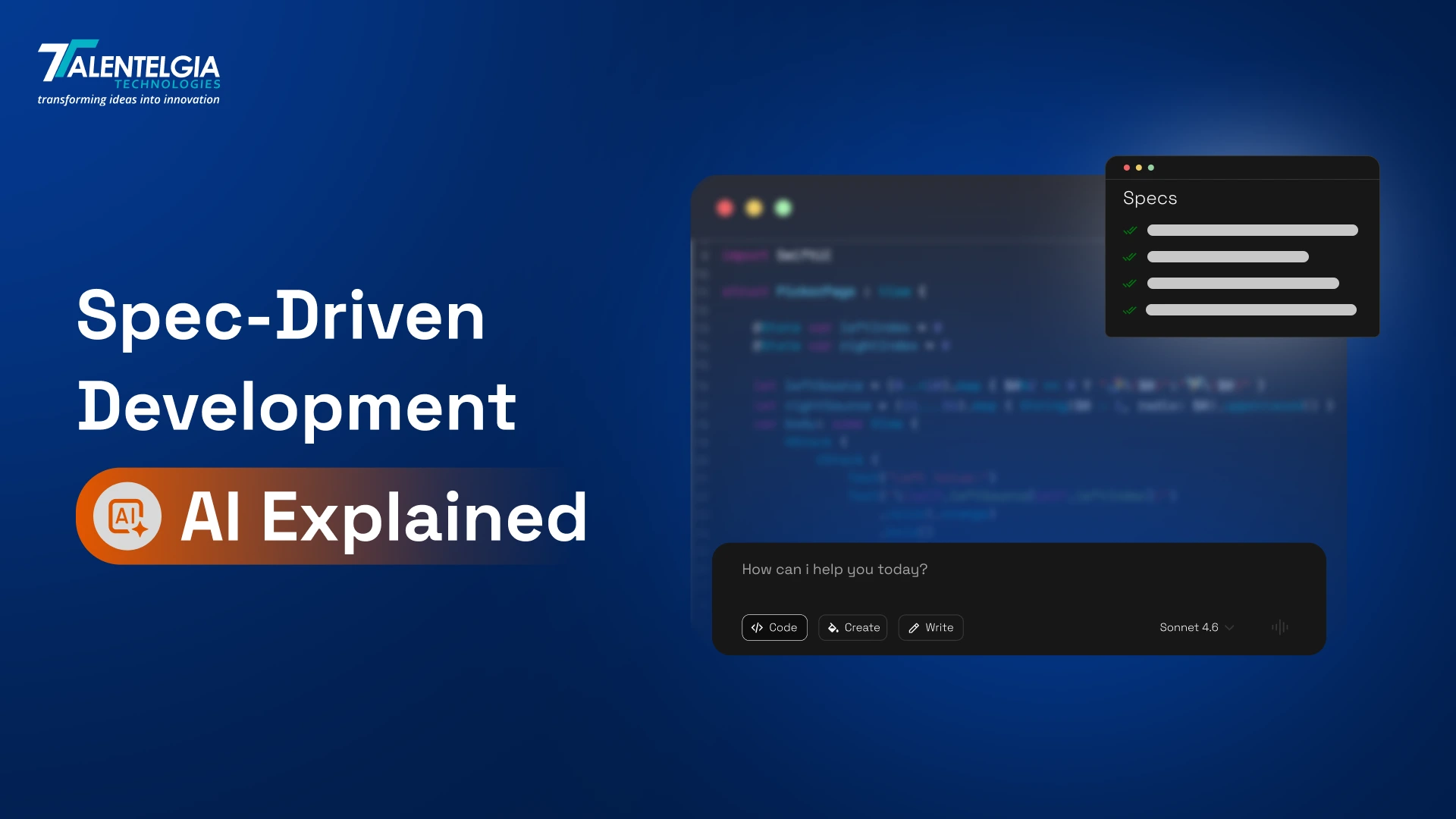
AI can now generate 1,000+ lines of code in seconds. That is not the problem.
The problem is that speed without direction is just a faster way to build the wrong thing. “Vibe coding”, describing a goal loosely and hoping the AI figures it out, produces code that looks right but breaks under real conditions. The bottleneck in software delivery has never been writing code. It has always been the clarity of what gets defined before a single line is written.
Spec-Driven Development (SDD) inverts this workflow: engineers write detailed technical specifications first, and AI agents generate the implementation from those specs. The spec is not a requirements document you write once and archive. It is the active source of truth from which code, tests, and architecture are derived and continuously validated against.
SDD is one of the most important engineering practices to emerge in 2026, and it is rapidly becoming the standard for teams building scalable generative AI development services without sacrificing system reliability.
This blog breaks down exactly what SDD is, how it works, and why it matters for anyone building production software with AI.
What Is Spec-Driven Development AI?
SDD is a structured development paradigm where a formal specification, not a prompt, not a ticket, is the primary artifact that drives AI agent behavior. Prompt engineering optimizes a single human-LLM interaction, particularly in modern ChatGPT integration services. Context engineering optimizes the entire agent-LLM environment. SDD lives at that second, deeper level.
The workflow follows four distinct phases:
- Specify – Define user journeys, goals, acceptance criteria, architectural constraints, and failure modes. This is the thinking work humans must own.
- Plan – The AI generates a structured implementation plan: an ordered list of tasks derived directly from the spec.
- Generate – AI agents execute against those tasks, using the spec as a continuous reference – not a one-time input.
Validate and iterate – Generated tests run against the spec’s definition of done. Mismatches loop back, not to the prompt, but to the spec itself.
Spec-Driven Development vs Vibe Coding
| Aspect | Vibe Coding | Spec-Driven Development (SDD) |
|---|---|---|
| Development Style | Conversational and iterative | Structured and specification-based |
| How Instructions Are Given | Short prompts and natural language requests | Detailed specs, rules, and requirements |
| AI’s Role | Interprets and guesses intent | Executes against clearly defined instructions |
| Primary Focus | Speed and experimentation | Reliability and consistency |
| Best Used For | Prototypes, UI work, boilerplate generation | Production systems, enterprise workflows, complex logic |
| Handling Business Logic | AI infers rules from prompts | Rules are explicitly defined upfront |
| Workflow | Prompt → Generate → Refine repeatedly | Specify → Plan → Generate → Validate |
| Consistency of Output | Can vary between prompts and sessions | More predictable and repeatable |
| Team Collaboration | Mostly individual and session-based | Shared, version-controlled specifications |
| Long-Term Maintainability | Harder to preserve architectural consistency | Specs maintain alignment across updates |
| Testing and Validation | Usually added after generation | Validation is built into the workflow |
| Scalability | Best for smaller or low-risk tasks | Better for large-scale and multi-service systems |
| Source of Truth | The active conversation or prompt | The specification document |
| Human Responsibility | Reviewing and correcting generated output | Defining clear intent and constraints upfront |
| Ideal Goal | Fast iteration and exploration | Controlled, production-grade development |
The spec persists. It can be reviewed before any code is generated, referenced during implementation, and checked against after.
Core SDD Patterns: Spec-First, Spec-Anchored, and Spec-as-Source
Not all teams adopt SDD the same way. There are three distinct levels, each representing a deeper commitment to the spec as the source of truth.
1. Spec-First: The spec is written before any code is touched. It defines the what and why of a feature: user journeys, acceptance criteria, constraints. It is then handed to the AI agent as its primary instruction set. Once the feature is built, the spec’s job is considered done. This is the entry point for most teams new to SDD and the minimum requirement to call a workflow spec-driven.
2. Spec-Anchored: The spec does not get archived after implementation. It stays live, version-controlled alongside the codebase, and continues to govern every future change to that feature. When the feature evolves, the spec is updated first, then the AI regenerates or modifies the code from it. This is where SDD starts delivering real long-term value: reduced drift, consistent behavior across updates, and a documented history of intent.
3. Spec-as-Source: The most advanced pattern. The spec is the only file a human ever edits. Code becomes a fully generated output, a byproduct of the spec, not something maintained directly. Tools like Tessl are building toward this model. It requires high confidence in generation quality and is currently practical only in well-defined domains, but it represents where the discipline is heading.
But What Is a Spec in AI Development?
A spec is not a requirements document. It is not a Confluence page. It is a structured, testable description of exactly how your system should behave. All of it is written precisely enough that an AI agent can act on it without guessing.
A well-formed SDD spec defines:
- What the system must do – and explicitly what it must not do
- Business rules and edge cases – the scenarios most vague prompts skip entirely
- Failure modes – how the system should behave when things go wrong
- Definition of Done (DoD) – a concrete, testable condition, not a feeling
The format is typically structured Markdown – machine-readable, version-controlled, and maintained alongside the codebase. It is precise enough that two different AI agents working from the same spec should produce functionally equivalent outputs.
That is the bar.
Why Does Spec-Driven Development Matter?
Code is no longer a scarce resource. Clarity is.
When AI accelerates code generation without improving specification quality, it amplifies existing dysfunction. That is faster production of the wrong thing, more misaligned pull requests, and higher rework rates discovered only during review. The problem was always ambiguity. AI just made it faster and more expensive.
Three specific forces make SDD matter right now:
- Security at scale – LLMs generate vulnerable code at rates between 9.8% and 42.1% across benchmarks. SDD embeds executable specifications as active validation gates against exactly these failures.
- Compliance pressure – The EU AI Act requires high-risk AI systems to maintain documented, traceable decision-making, with obligations taking effect August 2, 2026. Fines reach up to €15 million or 3% of global annual turnover. A well-maintained spec is now a legal requirement, not just good practice.
- Multi-service architecture – Only one in five companies has a mature governance model for autonomous AI agents, according to Deloitte’s State of AI 2026. Without structured specifications governing cross-service coordination, teams hit compounding integration failures as their architectures scale.
When to Use a Spec and When Not To
Spec overhead is a real cost. Writing a detailed spec for a two-line bug fix or a throwaway prototype is wasted effort. Use vibe coding and iterative prompting for exploration. Use spec-driven development for production. The decision comes down to one question: how expensive is it if the AI gets this wrong?
Write a spec when:
- The work spans multiple agent sessions or agent handoffs
- Multiple services, repositories, or teams are involved
- Misreading the intent means expensive rework
- Compliance or an audit trail is required
- The output involves component logic, end-to-end flows, or architectural decisions
Skip the spec when:
- The task is exploratory or experimental
- A single prompt can produce a reviewable output in under five minutes
- The output is a prototype that will be thrown away
- The change is mechanical, low-risk, and self-contained
Where SDD delivers the most value:
- Greenfield projects – Starting from zero is where vague AI output does the most damage. A spec written upfront ensures the AI builds what you actually intend, not a generic pattern-matched solution.
- Adding features to existing systems – In established codebases, simple prompting often produces code that technically works but does not fit, uses different state management from existing patterns, recreates functionality that already exists, or misses compliance requirements, which is why many enterprises now rely on AI development services for structured AI-driven software delivery. A spec front-loads that context before a single line is generated.
- Legacy modernization – When rebuilding older systems, the original intent is often undocumented. A spec captures the essential business logic, defines a fresh architecture, and lets the AI rebuild without inheriting the old technical debt.
Top Tools Used in Spec-Driven Development AI
Tools are split into two categories: living-spec platforms that keep documentation synchronized with code as agents work, and static-spec tools that structure requirements upfront but require manual reconciliation when implementation diverges. Here is how the leading options compare:
Intent
- Runs multiple specialized agents in parallel: Investigate, Implement, Verify, Critique, all from one shared spec
- The spec is living and bidirectional: when an agent changes an API mid-task, the spec updates automatically so other agents work from the correct contract
- Context Engine maintains semantic understanding across 400,000+ files, making it the only tool on this list built for large, multi-service architectures
- No manual reconciliation required, the biggest practical advantage over every static-spec alternative
- Best for: complex brownfield and multi-repo systems where spec drift is a recurring problem
Amazon Kiro
- Uses EARS (Easy Approach to Requirements Syntax) to generate unambiguous, testable acceptance criteria from a simple user prompt
- Produces three linked documents automatically: requirements.md, design.md, and tasks.md
- Agent Hooks trigger automated actions on file saves for example, updating test stubs whenever a component changes
- Limited to Claude models only, which restricts flexibility for teams already using other AI providers
- Best for: AWS-native teams building greenfield projects with defined specifications
GitHub Spec Kit
- Open-source, MIT-licensed, and agent-agnostic, works with Copilot, Claude Code, Gemini CLI, Cursor, and Windsurf without modification
- Organizes the workflow into four CLI-driven phases: Specify → Plan → Tasks → Implement
- Specs are version-controlled Markdown files, making them reviewable and collaborative through standard Git workflows
- Specs are static and do not update during implementation, so drift is a real risk on longer tasks
- Best for: open-source teams and developers who need a portable, vendor-neutral SDD starting point
OpenSpec
- Built specifically for brownfield codebases, every change is tagged as ADDED, MODIFIED, or REMOVED, making implicit assumptions explicit before code is generated
- Enforces a strict proposal → apply → archive state machine, so no code runs until a human approves the proposal
- Produces lightweight specs (~250 lines vs Spec Kit’s ~800), significantly reducing review overhead
- Specs do not self-update during implementation; drift must be managed manually
- Best for: teams in regulated environments or those with mandatory change approval processes
BMAD-METHOD
- Assigns named agent personas to each SDLC phase: Business Analyst, Architect, Developer, QA Engineer, and more, 21 specialized agents in total
- Each agent has strict access permissions and defined handoff protocols, preventing one agent from modifying artifacts owned by another
- Scale-adaptive: lightweight Quick Flow for bug fixes, full Enterprise Flow for platform-level development
- Coordination overhead is real when implementation surfaces design issues, routing feedback back through the correct agent manually breaks the flow
- Best for: large greenfield projects and enterprise teams that need rigorous documentation across every development phase
Cursor (.cursorrules)
- Project rules live in version-controlled .mdc files and act as persistent system prompts that guide every AI interaction in the repository
- Four activation modes: always-applied, auto-attached by file glob, agent-requested, or manually triggered
- Not a full SDD workflow, there is no spec lifecycle, no validation layer, and no structured phase progression
- Rule activation can be inconsistent if scoping and glob matching are not carefully configured
- Best for: individual developers who want lightweight, IDE-native AI behavior consistency without adopting a dedicated SDD tool
| Tool | Spec type | Best for | Multi-agent |
|---|---|---|---|
| Intent | Living | Complex multi-service codebases | Yes |
| Amazon Kiro | Static | AWS-native greenfield projects | No |
| GitHub Spec Kit | Static | Agent-agnostic, open-source teams | No |
| OpenSpec | Static | Brownfield, approval-gated changes | No |
| BMAD-METHOD | Static | Full SDLC, large enterprise teams | Yes |
| Cursor (.cursorrules) | Static | Individual devs, convention enforcement | No |
Challenges and Limitations of Spec-Driven Development
SDD is not a silver bullet. Every advantage it offers comes with a real cost that teams need to understand before adopting it.
- Spec maintenance is ongoing work – A spec written today becomes a liability tomorrow if nobody updates it when requirements shift. Most teams are good at writing specs. Very few are consistent at maintaining them. Stale specs can mislead humans and actively misdirect AI agents that execute against them without questioning accuracy.
- Code generation from spec to LLM is not deterministic – The same spec can produce different outputs across sessions, models, or even repeated runs. This makes upgrades and maintenance unpredictable and demands rigorous CI/CD practices to compensate.
- Upfront cost before visible return – Writing a solid spec takes time. The ROI timeline for SDD is typically three to six months before productivity gains show up, which makes it a hard sell in fast-moving teams under delivery pressure.
- Not suitable for all work – Exploratory research, rapid prototyping, and novel algorithm design do not benefit from rigid specs. Forcing SDD onto inherently experimental work slows it down without improving output quality.
Conclusion
Specs are the foundation that makes AI-generated code trustworthy. Every agent session, every code generation cycle, every validation check runs against one thing: what the spec says. That is what keeps the system honest. AI agents are only as good as the clarity of what you feed them. A precise spec eliminates guesswork, cuts rework cycles, and gives every agent working on your codebase the same unambiguous source of truth.
SDD is still evolving. The tooling is maturing, the standards are forming, and the best workflows are still being figured out. But the core principle is already proven: define intent precisely before writing a single line of code, and everything downstream gets better.













 Sales Enquiries:
  Business queries:
  HR:
HR: 


