


 Healthcare App Development Services
 Real Estate Web Development Services
 E-Commerce App Development Services
 E-Commerce Web Development Services
 Blockchain E-commerce Development Company
 Fintech App Development Services
 Fintech Web Development
 Blockchain Fintech Development Company
 E-Learning App Development Services
 Restaurant App Development Company
 Mobile Game Development Company
 Travel App Development Company
 Automotive Web Design
 AI Traffic Management System
 AI Inventory Management Software
 Machine Learning Development
 ChatGPT integration services
  AI Development Company
  AI Integration Services
  Generative AI Development Services
  Natural Language Processing Company
 Mobile App Development
  IOS App Development
  Android App Development
  Cross-Platform App Development
  Augmented Reality (AR) App Development
  Virtual Reality (VR) App Development
  Web App Development
  SaaS App Development
 Flutter
  React Native
  Swift (IOS)
  Kotlin (Android)
  Mean Stack Development
  AngularJS Development
  MongoDB Development
  Nodejs Development
  Database Development
 Ruby on Rails Development
 Expressjs Development
  Full Stack Development
  Web Development Services
  Laravel Development
  LAMP Development
  Custom PHP Development
  .Net Development
  User Experience Design Services
  User Interface Design Services
  Automated Testing
  Manual Testing
  Digital Marketing Services
 Ride-Sharing And Taxi Services
 Food Delivery Services
 Grocery Delivery Services
 Transportation And Logistics
 Car Wash App
 Home Services App
 ERP Development Services
 CMS Development Services
 LMS Development
 CRM Development
 DevOps Development Services
 AI Business Solutions
 AI Cloud Solutions
 AI Chatbot Development
 API Development
 Blockchain Product Development
 Cryptocurrency Wallet Development
 About Talentelgia
  Our Team
  Our Culture
 Healthcare App Development Services
 Real Estate Web Development Services
 E-Commerce App Development Services
 E-Commerce Web Development Services
 Blockchain E-commerce
Development Company
Blockchain E-commerce
Development Company Fintech App Development Services
 Finance Web Development
 Blockchain Fintech
Development Company
Blockchain Fintech
Development Company E-Learning App Development Services
 Restaurant App Development Company
 Mobile Game Development Company
 Travel App Development Company
 Automotive Web Design
 AI Traffic Management System
 AI Inventory Management Software
 AI Development Company
 ChatGPT integration services
 AI Integration Services
 Machine Learning Development
 Machine learning consulting services
 Blockchain Development
 Blockchain Software Development
 Smart contract development company
 NFT marketplace development services
 Asset tokenization companies
 DeFi Wallet Development Company
 IOS App Development
 Android App Development
 Cross-Platform App Development
 Augmented Reality (AR) App
Development
Augmented Reality (AR) App
Development Virtual Reality (VR) App Development
 Web App Development
 Flutter
 React
Native
React
Native Swift
(IOS)
Swift
(IOS) Kotlin (Android)
 MEAN Stack Development
 AngularJS Development
 MongoDB Development
 Nodejs Development
 Database development services
 Expressjs Development
 Full Stack Development
 Web Development Services
 Laravel Development
 LAMP
Development
LAMP
Development Custom PHP Development
 User Experience Design Services
 User Interface Design Services
 Automated Testing
 Manual
Testing
Manual
Testing About Talentelgia
 Our Team
 Our Culture
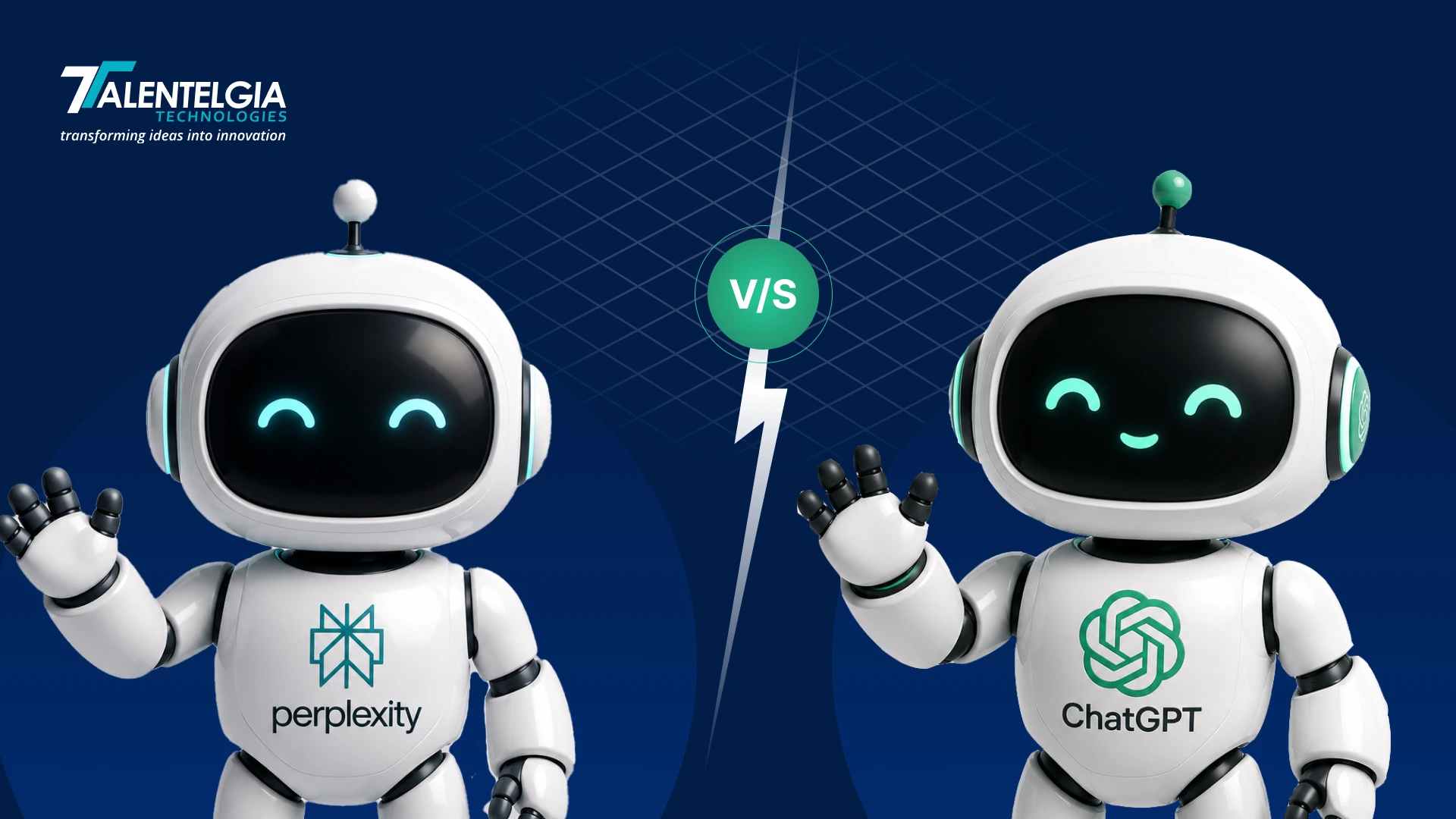
AI tools are now used widely, be it for research or content creation. Among the many options available, two tools that are the centre of every conversation are Perplexity AI and ChatGPT.
Both launched in late 2022, yet they took very different paths. ChatGPT became one of the fastest-growing apps in history, reaching 100 million users in just two months. Meanwhile, Perplexity quietly built its user base and processed 780 million queries by May 2025.
But they aren’t actually the same kind of tool.
- ChatGPT is an AI conversational assistant designed for content creation, coding, brainstorming, and multi-step reasoning.
- Perplexity describes itself as ‘an AI-first answer engine’ and positions itself as a citation-focused alternative to Google.
So, which one is better? The answer depends on your specific needs.
In this blog, we discuss everything in detail: features, pricing, use cases, and real-world performance, so you can stop guessing and start using the right tool for the right job.
Let’s get into it.
Quick Comparison (TLDR)
| Aspect | Perplexity AI | ChatGPT |
|---|---|---|
| Best For | Research, fact-checking, and real-time information | Content creation, coding, and multi-purpose AI tasks |
| Primary Function | AI-powered answer engine (search-first) | Conversational AI assistant (task-first) |
| Core Strength | Real-time web access with citations | Versatility across writing, coding, and problem-solving |
| Response Style | To the point, factual answers with sources | Detailed, conversational, and context-aware responses |
| Web Access | Built-in, real-time by default | Available, but not always default (depends on mode/plan) |
| Citations | Always included in responses | Limited/optional depending on tools used |
| Content Creation | Basic (informational writing) | Advanced (blogs, marketing, scripts, etc.) |
| Coding & Technical Tasks | Limited | Strong support (debugging, generation, explanation) |
| Accuracy Approach | Source-backed answers | AI-generated answers (may require verification) |
| Customization | Limited | High (custom GPTs, tools, workflows) |
| File Handling | Supported (plan-based) | Strong support (documents, data, analysis) |
| Image Capabilities | Available but limited | Advanced (generation + analysis) |
| Free Plan | Yes (with usage limits) | Yes (with usage limits) |
| Paid Plans | Starts ~ $20/month (Pro/Max tiers) | Starts ~ $20/month (Plus/Pro tiers) |
| Ease of Use | Very simple, search-like | Slight learning curve due to flexibility |
| Ideal Users | Students, researchers, analysts | Marketers, developers, businesses, creators |
Also Read: DeepSeek AI Cost Guide
What is Perplexity AI?
Perplexity AI is an AI-powered answer engine. It was founded in August 2022 by Aravind Srinivas, Denis Yarats, Johnny Ho, and Andy Konwinski. Its search engine was launched in December that same year.
The core idea of this AI tool is quite simple. Perplexity follows a search-first approach. It first makes sense of the intent from every query, reaps through the web in real-time, and pulls references from multiple authoritative sources such as news articles, papers research and websites. And then it gives you a direct answer, with citations included so that you can check everything yourself. This helps it provide up-to-date information rather than outdated responses.
The platform offers two core modes:
- Quick Search for fast, straightforward answers
- Pro Search for deeper research. It may ask follow-up questions to understand better what you need.
| Perplexity generated $200 million in revenue in 2025 and has 45 million active users. Currently, it is a favourite of students all over the world and well known among researchers, journalists – professionals who need verified answers very quickly. |
What is ChatGPT?
ChatGPT is a conversational AI assistant developed by OpenAI and launched in November 2022. It is designed to understand and generate human-like text across a wide range of tasks. It is also widely used in ChatGPT Integration Services. This AI tool is built on advanced large language models (LLM) and can handle a wide range of tasks, including
- answering questions
- writing content
- debugging code
- analyzing data
- solve complex problems
ChatGPT is a general-purpose AI. It can
- draft blog posts
- generate marketing copy
- summarize documents
- brainstorm ideas
- explain complex topics step by step
What makes it genuinely useful is how it keeps up with the user. The more you interact, the better it understands what you need. This makes every follow-up interaction more relevant and context-aware.
Additionally, it has multimodal functionalities that enable working with text, images, and files in the same workflow. This makes it just as effective when analysing text documents, interpreting images, and generating structured results.
It is used daily by businesses, developers, marketers, and students for a good reason. Its flexibility, creativity, and scalability make it one of the most versatile AI tools available today.
Perplexity AI vs ChatGPT: Key Differences
Product Philosophy & Execution Capabilities
ChatGPT is built as a broad AI operating environment rather than just a question-answering tool. According to the ChatGPT Capabilities Overview, the platform supports features such as:
- code execution
- data analysis
- image generation
- file uploads
- voice interaction
- Projects
- Canvas
- Scheduled tasks
- and custom GPTs.
Users can analyze spreadsheets, debug code, process PDFs, create presentations, generate dashboards, and build applications within the same ecosystem. The platform increasingly behaves like a complete AI productivity workspace.
Perplexity AI, on the other hand, was designed first as an AI-native search and research engine. Its core philosophy revolves around retrieving information quickly, grounding responses in live sources, and reducing hallucinations through citation-heavy answers. Even though Perplexity is expanding into Labs, APIs, and agentic tooling, its primary identity still centers around information discovery and web synthesis.
Source Transparency and Citations
One of Perplexity’s strongest differentiators is its emphasis on source transparency. The entire interface is built around citations, references, and web-grounded answers. Users are consistently shown where information came from, which sources were used, and how the answer was synthesized. This creates a stronger sense of verification and makes Perplexity especially valuable for researchers, journalists, analysts, students, and professionals working with factual or time-sensitive information.
ChatGPT can also browse the web and provide citations through Search and Deep Research features, but citations are not the centerpiece of the experience. The system is more focused on delivering polished reasoning, contextual synthesis, and collaborative interaction. The user experience prioritizes fluid conversation and execution rather than aggressively surfacing references at every step.
Memory and Personalization
ChatGPT has a much deeper personalization layer due to its memory capabilities. With memory enabled, it can remember user preferences, goals, projects, workflows, tone preferences, and contextual information across sessions. Features like Projects and persistent context turn the platform into an ongoing collaborative environment rather than a single-session chatbot. This creates stronger continuity for long-term projects and personalized workflows.
Perplexity currently feels more transactional in comparison. Conversations are generally optimized around immediate retrieval and short-term research tasks rather than persistent collaboration. While the platform can maintain conversational context within sessions, it does not yet operate with the same level of long-term memory integration or workflow continuity that ChatGPT offers.
Developer Ecosystem and Model Access
Perplexity has positioned itself as a more open orchestration layer for developers. Through the Perplexity Agent API, developers can access models from
- OpenAI
- Anthropic
- xAI
and other providers using a unified API structure. This makes Perplexity attractive for teams that want flexibility across different AI providers without managing multiple infrastructures separately. It functions partly as an interoperability layer within the AI ecosystem.
ChatGPT is more tightly integrated into OpenAI’s own ecosystem. Instead of prioritizing model plurality, it focuses on deeply integrated experiences built around OpenAI’s models, tools, and interfaces. This creates stronger optimization between features like memory, image generation, voice, code execution, and Projects, but with less emphasis on multi-provider abstraction.
Coding and Software Development
ChatGPT has become one of the strongest AI coding environments because it combines reasoning with execution. Users can write code, debug interactively, execute scripts, analyze outputs, modify files, generate applications, and collaborate across entire software projects. OpenAI’s broader ecosystem, including Codex and agentic coding systems, pushes ChatGPT closer to functioning as an autonomous software collaborator rather than simply a code suggestion tool.
Perplexity is stronger in coding research and technical discovery. It is excellent for finding documentation, comparing frameworks, exploring implementation examples, and surfacing technical discussions from across the web. The platform performs especially well when developers need external references or up-to-date information, but it is less execution-oriented than ChatGPT’s development environment.
Multimodal Capabilities
ChatGPT is significantly more advanced in multimodal integration. Users can combine text, voice, images, charts, spreadsheets, screenshots, PDFs, and generated visuals inside a unified workflow. The platform supports both image understanding and image generation through features described in Image Generation in ChatGPT. This allows users to move fluidly between formats without leaving the environment, making ChatGPT more versatile for creative, analytical, and collaborative tasks.
Perplexity supports some multimodal functionality, but its ecosystem is still primarily centered around text-based retrieval and synthesis. The experience is optimized for information access rather than multimodal workflow orchestration.
Available AI Models
ChatGPT: Gives you access to a powerful lineup within OpenAI’s model ecosystem:
- GPT-4o for real-time multimodal tasks
- GPT-4.1 for precise coding and technical work
- o3 for deep complex reasoning
- o3-pro for the highest level of analytical performance.
Each model is optimized for specific use cases, but all sit within OpenAI’s own family of models.
Perplexity AI: This is one of Perplexity’s biggest advantages. Rather than locking you into one model family, it brings together frontier models from across the AI industry
Claude 4.0 Sonnet and Opus from Anthropic
- Gemini 2.5 Pro from Google
- Grok-4 from xAI
- GPT-4.1 from OpenAI
- and its own Sonar and R1 models.
By default, Perplexity automatically selects the best model for your query type, but Pro users can manually switch at any time.
Perplexity AI vs ChatGPT: Pricing Comparison
Both tools follow a freemium model, free to start, paid plans to unlock the real power. Here is what you need to know before choosing a plan: –
ChatGPT Pricing Table
| Plan | Price | Key Features |
|---|---|---|
| Free | $0 / month | Limited access to GPT-5; limited messages, uploads, image generation, deep research, memory, and Codex access |
| Go | $8 / month | Everything in Free, plus more access to GPT-5.5 Instant, more messages, uploads, image creation, and longer memory |
| Plus | $20 / month | Everything in Go, plus advanced reasoning with GPT-5, expanded messaging/uploads, faster image creation, expanded deep research & agent mode, expanded memory & context, projects/tasks/custom GPTs, expanded Codex usage, early access to new features |
| Pro (Mid-Tier) | $100 / month | Everything in Plus, plus 5x usage, Pro reasoning with GPT-5.4 Pro, maximum Codex tasks, unlimited GPT-5.3 and file uploads, faster image creation, maximum deep research & agent mode, maximum memory & context, expanded projects/tasks/custom GPTs, research preview of new features |
| Pro (High-Tier) | $200 / month | Everything in Pro Mid-Tier, plus 20x usage, highest limits on all features, maximum performance and early access |
| Business Codex | Pay-as-you-go | AI-powered software engineering, automated code/security reviews, task automation, multi-agent workflows, secure dedicated workspace, SAML SSO & MFA, no training on your data, compliance support (GDPR, CCPA, CSA STAR, SOC 2 Type 2) |
| Business ChatGPT & Codex | $20 / user / month | Everything in ChatGPT Plus & Business Codex, unlimited core chat, 60+ app integrations (Slack, Google Drive, GitHub, etc.), business features (data analysis, canvas, shared projects, custom workspace GPTs), member/role/billing management, secure workspace |
| Enterprise | Custom Pricing | Expanded context windows, enterprise-level security & controls (SCIM, EKM, user analytics), advanced privacy, data residency, 24/7 priority support, SLAs, custom legal terms, AI advisors for eligible customers |
Perplexity AI Pricing Table
| Plan | Price | Key Features |
|---|---|---|
| Free (Standard) | $0 / month | Practically unlimited basic searches, very limited Pro searches (~5/day), basic file uploads, best model selected for your query, no access to advanced AI models, image generation, or premium support |
| Pro (Individual) | $20 / month or $200 / year (≈$16.67/month) | Unlimited Pro searches, 20 deep research queries/day, 50 Labs queries/month, 3 video generations/month, access to GPT, Claude, Gemini, file/photo uploads (50 files max 50 MB each), collaboration with up to 5 users, AI image generation, 10x citation density, $5/month API credits |
| Max (Individual) | $200 / month or $2,000 / year | Everything in Pro, plus unlimited Labs usage, Perplexity Computer (multi-agent AI system, 10,000 credits/month), Comet browser with context awareness, highest-tier model access (OpenAI o3-pro, Claude Opus 4), unlimited research queries, priority support |
| Education Pro | $10 / month (verification required via SheerID) | Everything in Pro plus extended access to Perplexity Academic features; free first 12 months in some promotions |
| Enterprise Pro | $40 / seat / month or $400 / year | Everything in Pro, plus unlimited Pro & concise queries, 500 research queries/day, 50 Labs queries/month, 5 video generations/month, collaboration with unlimited teammates, up to 15,000 file uploads, SSO/SCIM, role-based user management, audit logging, SOC 2 Type II compliance, no training on customer data, dedicated enterprise support |
| Enterprise Max | $325 / seat / month or $3,250 / year | Everything in Enterprise Pro, plus unlimited Labs & Research queries, highest-tier AI models (o3-pro, Claude Opus 4), enhanced video generation (15 high-quality videos/month), greater file upload limits (up to 5,000 files/Space, 10,000 files/user), Comet Max assistant, organization-wide data insights & logs, SOC 2 Type II compliance, priority support |
Which One Should You Choose
So, which one is the best AI right now? Which one should you choose? The choice between Perplexity and ChatGPT comes down to what you need most – verified information or creative intelligence?
- Choose Perplexity if your focus is research-heavy work
- Best for real-time, cited answers
- Ideal for students, analysts, journalists, and researchers
- Strong for fact-checking, academic search, and live data
- Helps access sources, reports, and updated information quickly
- Choose ChatGPT if your focus is on creation and problem-solving
- Best for writing, coding, brainstorming, and strategy
- Ideal for marketers, developers, writers, and business users
- Strong in generating content, refining ideas, and building workflows
- Supports tools like custom GPTs, Canvas, and coding assistance
Many modern AI Integration Services now combine tools like Perplexity and ChatGPT into unified workflows so teams can seamlessly switch between research and creation without losing context or efficiency.
Conclusion
Businesses and professionals integrating these two tools together would actually help them make better decisions, enhance creativity, and allow innovation across teams. So, don’t see them as individual teams, rather team players with a specific role, one for uncovering knowledge and the other for helping you apply it.










 Write us on:
  Business queries:
  HR:
HR: 


