


 Healthcare Software Development Services
 Healthcare App Development Services

 Real Estate Web Development Services
 Real Estate App Development Company

 E-Commerce App Development Services
 E-Commerce Web Development Services
 Blockchain E-commerce Development Company

 Fintech Software Development
 Fintech App Development Services
 E-Learning App Development Services

 Restaurant App Development Company

 Mobile Game Development Company

 Travel App Development Company

 Automotive Web Design

 AI Traffic Management System

 AI Inventory Management Software

 Logistics App Development Services
 Machine Learning Development
 ChatGPT integration services
 AI Development Company
 AI Integration Services
 Natural Language Processing Company
 Mobile App Development
 IOS App Development
 Android App Development
 Cross-Platform App Development
 Augmented Reality (AR) App Development
 Virtual Reality (VR) App Development
 Web App Development
 SaaS App Development
 Custom Software Development Services
 Flutter
 React Native
 Swift (IOS)
 Kotlin (Android)
 Mean Stack Development
 AngularJS Development
 MongoDB Development
 Nodejs Development
 Database Development
 Ruby on Rails Development
 Expressjs Development
 Full Stack Development
 Web Development Services
 Laravel Development
 LAMP Development
 Custom PHP Development
 .Net Development
 User Experience Design Services
 User Interface Design Services
 Automated Testing
 Manual Testing
 Digital Marketing Services

 Ride-Sharing And Taxi Services
 Food Delivery Services
 Grocery Delivery Services
 Transportation And Logistics
 Car Wash App
 Home Services App
 ERP Development Services
 CMS Development Services
 LMS Development
 CRM Development
 DevOps Development Services
 AI Business Solutions
 AI Cloud Solutions
 AI Chatbot Development
 API Development
 Blockchain Product Development
 Cryptocurrency Wallet Development
 About Talentelgia
 Our Team
 Our Culture

 Healthcare App Development Services
 Real Estate Web Development Services
 E-Commerce App Development Services
 E-Commerce Web Development Services
 Blockchain E-commerce
Development Company
 Fintech App Development Services
 Blockchain Fintech
Development Company
 E-Learning App Development Services
 Restaurant App Development Company
 Mobile Game Development Company
 Travel App Development Company
 AI Traffic Management System
 AI Inventory Management Software
 AI Development Company
 ChatGPT integration services
 AI Integration Services
 Machine Learning Development
 Machine learning consulting services
 Blockchain Development
 Blockchain Software Development
 Smart contract development company
 NFT marketplace development services
 Asset tokenization companies
 DeFi Wallet Development Company
 IOS App Development
 Android App Development
 Cross-Platform App Development
 Augmented Reality (AR) App
Development
 Virtual Reality (VR) App Development
 Web App Development
 Flutter
 React
Native
 Swift
(IOS)
 Kotlin (Android)
 MEAN Stack Development
 AngularJS Development
 MongoDB Development
 Nodejs Development
 Database development services
 Expressjs Development
 Full Stack Development
 Web Development Services
 Laravel Development
 LAMP
Development
 Custom PHP Development
 User Experience Design Services
 User Interface Design Services
 Automated Testing
 Manual
Testing
 About Talentelgia
 Our Team
 Our Culture

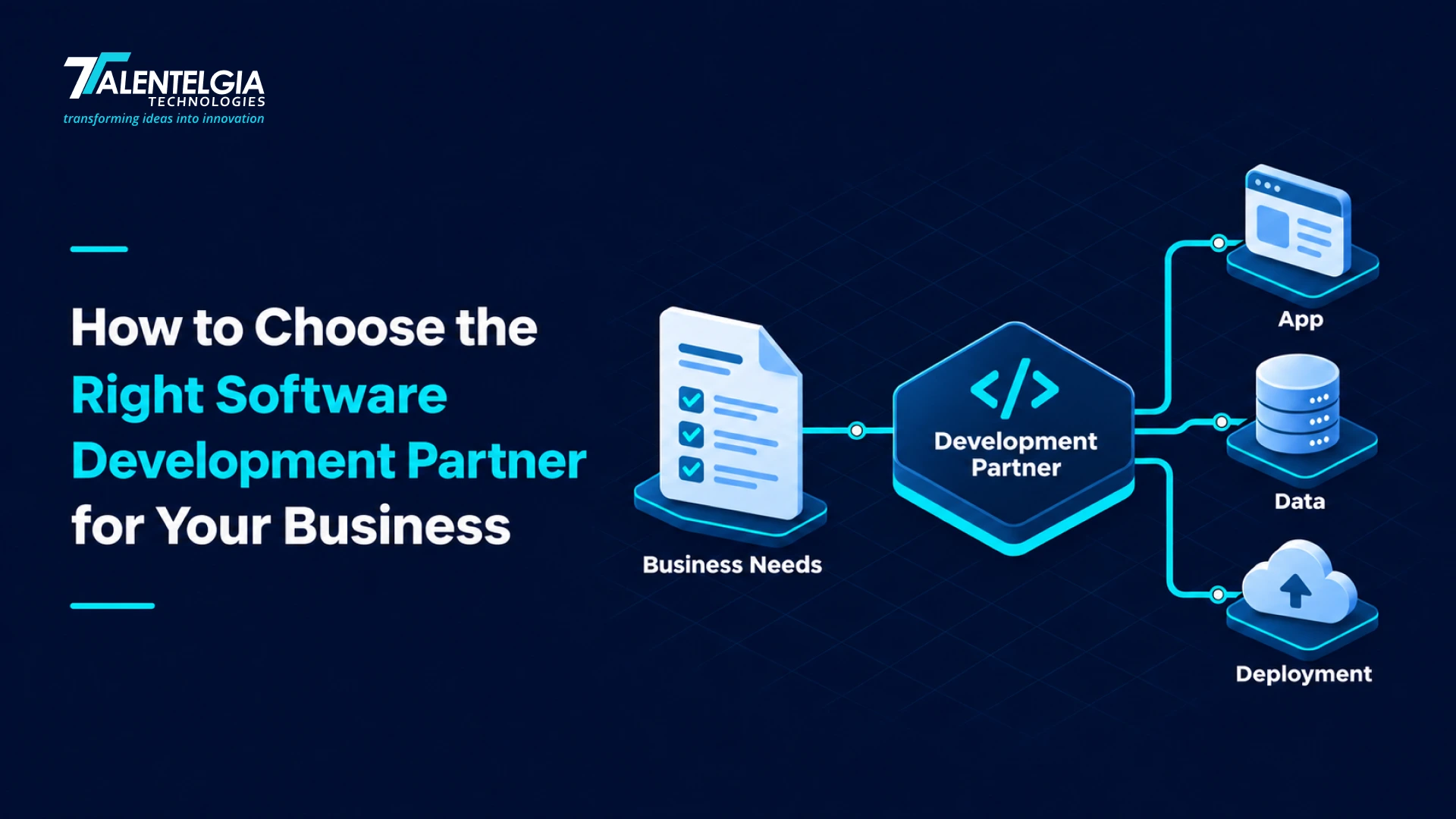
Choosing a software development partner is a significant decision for any business. Whether you want to build a new business application, modernize an existing platform, automate internal operations, or develop an enterprise-level solution, the company you work with will directly impact the project’s outcome.
There are many companies offering software development services, but finding one that understands your business requirements is not always easy. A development company may have an impressive portfolio and experience with multiple technologies, but can it understand your business processes, manage the project properly, and deliver software that works reliably over time?
That is what you need to find out before making a decision.
The right development partner should do more than write code. It should understand the problem you are trying to solve, recommend suitable technologies, identify potential challenges, and build software that supports your business goals.
For example, a growing company may need a customized CRM to manage customer relationships, while an enterprise organization may require a complex application that connects several departments and existing systems. Both projects require different technical capabilities, planning, and development approaches.
In this guide, we will explain how to choose a software development partner, what to look for when evaluating a custom software development agency, and which questions to ask before signing a development agreement.
Key Takeaways
- Define your business requirements and project objectives before approaching development companies.
- Evaluate the technical expertise, industry experience, and previous projects of each custom software development firm.
- Understand how the company manages project planning, communication, development, and quality assurance.
- Check whether security, scalability, and future maintenance are considered from the beginning.
- Compare proposals based on project scope, deliverables, ownership, and long-term support rather than price alone.
- Choose a development partner that understands your business goals and can provide suitable software development solutions as your requirements change.
Why Choosing the Right Software Development Partner Matters
Most businesses invest in software to solve a specific problem. It could be improving internal workflows, managing customer information, connecting different business systems, or making daily operations more efficient.
However, software that does not match your actual business requirements can create more problems than it solves.
Consider a manufacturing company that needs an application to manage inventory, production schedules, and purchase orders. If these processes operate through separate systems, employees may spend considerable time transferring information and correcting errors. A properly developed application with suitable integrations can help bring these activities together.
Similarly, a logistics company may need a platform that connects warehouse operations, order processing, shipment tracking, and customer information.
In both situations, a standard application may not provide all the features or flexibility required. This is where a reliable custom software development agency can help.
Instead of asking employees to adjust their workflows around generic software, a development partner can build a customized application around the organization’s actual processes.
The right partner can help your business:
- Automate repetitive tasks: Reduce manual work and improve the consistency of everyday operations.
- Improve operational efficiency: Connect different departments and simplify business workflows.
- Integrate existing systems: Connect ERP, CRM, accounting, inventory, and other applications.
- Support business growth: Develop software that can accommodate more users, transactions, and data.
- Improve customer experience: Build applications that make it easier for customers to access services and information.
- Address technical limitations: Modernize outdated applications and replace systems that no longer meet business requirements.
- Improve decision-making: Develop reporting and analytics features that provide useful business information.
These benefits depend on selecting a company with the right technical capabilities and a clear understanding of your business.
10 Important Factors to Consider When Choosing a Software Development Partner
1. Start by Defining Your Business Requirements
Before contacting a development company, take some time to understand what you actually want to build.
Many businesses approach software development companies with only a general idea of the application they need. They know they want to automate a process or build a new platform, but the exact requirements are not clearly defined.
This can lead to misunderstandings, additional development work, and changes in project scope.
Start by answering a few basic questions:
- What business problem do you want the software to solve?
- Who will use the application?
- Which features are essential?
- Does the software need to connect with existing systems?
- How many users will access it?
- What security and compliance requirements apply?
- What results do you expect after implementation?
For example, if you are planning an inventory management application, you may need stock tracking, purchase order management, warehouse visibility, reporting, and integration with your existing ERP system.
Write down your requirements and separate essential features from those that can be added later.
It is also helpful to involve the people who will actually use the application. Employees working in sales, finance, operations, or customer support may identify practical requirements that senior management might overlook.
A development partner should help refine these requirements. An experienced team will ask questions, identify missing details, and suggest practical ways to approach the project.
What to look for: A company that takes time to understand your business before recommending a technology stack or providing a project estimate.
2. Check Their Technical Expertise
Technical capabilities should be one of the first things you evaluate when choosing an IT software development company.
Different projects require different technologies. A web application, mobile application, enterprise platform, and cloud-based system may all require different development skills.
Depending on your requirements, look for experience in areas such as:
- Frontend development: React, Angular, Vue.js, HTML, CSS, and JavaScript.
- Backend development: Python, Java, .NET, Node.js, and PHP.
- Mobile application development: Native iOS, Android, and cross-platform development.
- Cloud development: AWS, Microsoft Azure, and Google Cloud.
- Database development: PostgreSQL, MySQL, MongoDB, and other database technologies.
- API development: REST APIs, GraphQL, and third-party system integrations.
- Enterprise development: Business applications, workflow automation, and enterprise platforms.
- Quality assurance: Automated testing, manual testing, performance testing, and security testing.
However, do not select a company simply because it mentions every popular technology.
What matters is whether its developers understand how to use the right technology for your particular requirements.
For example, a business application that handles sensitive customer information may require a different architecture and security approach from a simple internal dashboard.
Ask the company to explain its technology recommendations. It should be able to discuss the advantages, limitations, maintenance requirements, and scalability of the proposed solution.
You should also ask whether it has experience with modern development practices such as version control, code reviews, automated testing, CI/CD pipelines, and DevOps.
These practices help development teams manage code changes, identify problems, and maintain consistent software quality.
A good development team will focus on solving your business problem rather than recommending technology simply because it is popular.
3. Review Their Portfolio and Previous Projects
A company’s portfolio can tell you a lot about its development experience.
Before hiring a custom software development firm, look at the projects it has completed and check whether they are relevant to your requirements.
Pay attention to:
- The types of applications it has developed.
- The complexity of previous projects.
- Its experience with enterprise-level applications.
- The industries it has served.
- Its experience with integrations and automation.
- The technologies used in completed projects.
- Whether it has supported applications after deployment.
Do not just look at screenshots or design samples. Ask about the business problem behind each project, the technical challenges involved, and how the development team addressed them.
For example, if you need an enterprise application, experience building small websites or basic applications may not be enough. You should look for a company that understands complex workflows, system integrations, data management, and enterprise-level performance requirements.
Request case studies that explain the initial requirements, development approach, and actual results.
You can also ask whether the company can arrange a conversation with a previous client. A reference can provide useful information about communication, project management, delivery quality, and ongoing support.
Remember that a portfolio demonstrates previous work, but it does not automatically guarantee that a company can handle your project. Use it as a starting point for a deeper technical discussion.
4. Look for Industry-Specific Experience
Every industry has different business processes, and software should reflect those differences.
A development company working with manufacturing businesses may understand production workflows, inventory management, and ERP integrations. A company serving healthcare organizations may have experience with patient management, data protection, and healthcare application requirements.
This industry knowledge can save time during requirement gathering and development.
Here are some examples of industry-specific requirements:
| Industry | Common Software Requirements |
|---|---|
| Healthcare | Patient management, appointment scheduling, data security, and system integration |
| Manufacturing | Production planning, inventory control, ERP integration, and equipment monitoring |
| Financial Services | Transaction processing, reporting, access controls, and security |
| Logistics | Warehouse management, shipment tracking, fleet management, and order processing |
| E-commerce | Product management, payment integration, order tracking, and customer management |
| Education | Learning management systems, student portals, assessments, and reporting |
Ask potential partners:
- Have you worked with businesses in our industry?
- What types of business applications have you developed?
- Are you familiar with our operational processes?
- Have you handled similar technical challenges?
- Can you share relevant client examples?
A company does not necessarily need to work exclusively in your industry. However, it should be willing to understand your business and research the requirements before recommending a solution.
The goal is to work with a team that understands both software development and the business environment in which the application will be used.
5. Understand Their Software Development Process
A structured development process helps ensure that everyone understands what needs to be delivered and when.
Ask how the company manages a project from the initial discussion to the final launch.
A typical software development service process includes the following stages:
a. Requirement gathering
The team discusses your business objectives, application features, users, existing systems, and technical requirements.
b. Planning and estimation
The project scope, development priorities, resources, milestones, and estimated timeline are defined.
c. UI/UX design
Designers prepare wireframes, application layouts, prototypes, and user journeys to show how the software will work.
d. Software development
Developers build the application according to the approved requirements and technical architecture.
e. Quality assurance and testing
The QA team checks functionality, performance, usability, security, and compatibility to identify issues before release.
f. Deployment
The application is configured and released into the production environment.
g. Maintenance and support
The development team monitors the application, resolves issues, applies updates, and provides technical assistance.
Also, ask whether the company follows Agile, Scrum, Waterfall, or a combination of development methodologies.
Agile development can be useful when requirements may change as the product develops. It allows teams to work in smaller iterations, review progress, and incorporate feedback.
For example, a company developing a new SaaS product may begin with a minimum viable product (MVP), test it with a smaller group of users, and then add features based on actual feedback.
Regardless of the methodology, the development company should have a clear process for managing requirements, approving changes, tracking progress, and communicating delays.
6. Evaluate Communication and Project Management
Even a technically experienced development team can struggle if communication is poor.
You need to know who is managing your project, how often you will receive updates, and how the company handles questions or unexpected challenges.
Before choosing a development partner, find out:
- Will you have a dedicated project manager?
- Who will be your main point of contact?
- How frequently will progress updates be shared?
- Can you communicate directly with developers when required?
- How are delays and technical issues handled?
- What tools are used to track project progress?
- How are decisions and project approvals documented?
Pay attention to how the company communicates during your initial discussions.
Does the company respond clearly to your queries, communicate technical details in an understandable way, and take time to understand your requirements before recommending a solution?
These things matter because software development involves regular discussions and decisions.
For companies working with offshore development teams, communication and time-zone coordination deserve additional attention.
Agree on overlapping working hours, meeting schedules, reporting methods, and escalation procedures before development begins.
A dependable partner should keep you informed throughout the project rather than contacting you only when approvals or payments are required.
7. Check Their Security and Quality Assurance Practices
Security should never be treated as an afterthought, especially when software handles customer information, financial records, employee data, or confidential business information.
A security issue can affect customer trust, business operations, and regulatory obligations. For this reason, security considerations should be included during requirement gathering, architecture planning, development, and testing.
Ask the development company how it protects applications during development and after deployment.
Important areas to discuss include:
- Secure authentication and user authorization.
- Role-based access controls.
- Data encryption during transmission and storage.
- Secure API development.
- Database security.
- Vulnerability assessments.
- Secure coding practices.
- Regular security updates.
- Backup and recovery procedures.
- Logging and monitoring.
Depending on your business and target market, you may also need to consider GDPR, HIPAA, SOC 2, or other applicable requirements.
Do not assume that a development company is compliant simply because it mentions a particular standard. Ask what controls it implements and what responsibilities remain with your organization.
Quality assurance is equally important.
Ask whether the company performs:
- Functional testing.
- Integration testing.
- Regression testing.
- Performance and load testing.
- Security testing.
- User acceptance testing.
- Cross-browser and device compatibility testing.
A proper testing process should check how the application behaves under realistic conditions, not just whether its main features work during a demonstration.
You can also ask whether the development team follows recognized secure development guidance, such as the OWASP Application Security Verification Standard.
8. Make Sure the Software Can Scale With Your Business
Your software requirements today may not remain the same in the coming years.
As your company grows, you may need additional users, new features, more integrations, larger databases, and improved performance.
That is why scalability should be discussed before development begins.
Ask the development partner how it plans to accommodate:
- Increasing numbers of users.
- Higher transaction volumes.
- Growing business data.
- Additional departments and locations.
- New features and modules.
- Third-party integrations.
- Changing business processes.
- Expansion into new markets.
For example, a business may initially need a basic CRM application for its sales team. Later, it may want to add marketing automation, customer support, reporting, and integrations with other enterprise systems.
The software should be designed in a way that makes future improvements manageable.
Discuss the proposed architecture, database design, API structure, and cloud infrastructure with the development team.
You should also ask about performance monitoring, backup strategies, disaster recovery, and infrastructure management.
Scalability does not mean building the largest possible system from day one. It means making sensible technical decisions so the application can grow without requiring unnecessary redevelopment.
9. Compare Pricing, Contracts, and Project Ownership
Price is naturally an important part of the decision, but the cheapest proposal is not necessarily the right one.
Two development companies may provide very different estimates because their proposals include different services, resources, and deliverables.
Before comparing prices, check what is actually included.
Look for clarity on:
- Project scope and deliverables.
- Development milestones.
- Resource allocation.
- Payment schedules.
- Estimated timelines.
- Testing and deployment.
- Additional development requests.
- Maintenance and support.
- Intellectual property ownership.
- Third-party software licensing.
You should also understand the engagement model.
Fixed-price model: Suitable for projects with clearly defined requirements and scope. The expected deliverables and payment terms are agreed upon in advance.
Time-and-materials model: Suitable for projects where requirements may change during development. Payment is generally based on the time and resources used.
Dedicated development team: Suitable for businesses that need ongoing development resources or long-term technical support.
One point that should never be overlooked is source code ownership.
Make sure the agreement clearly explains who owns the source code, designs, documentation, and other project deliverables.
It should also cover access to repositories, third-party components, software licenses, confidentiality, and the process for transferring project assets if the engagement ends.
Your business should have the appropriate access and ownership rights to the software it has paid to develop.
10. Ask About Post-Launch Support
Software development does not stop when the application goes live.
Once employees or customers start using the application, you may need technical assistance, bug fixes, performance improvements, security updates, and additional features.
Before finalizing your decision, understand what kind of support the company provides after deployment.
Ask questions such as:
- Does the company provide ongoing maintenance?
- How are critical issues handled?
- What are the support hours?
- Are software updates included?
- Does it provide application monitoring?
- Can it support future development requirements?
- Will technical documentation be provided?
- What response and resolution times are covered by the support agreement?
Also, check whether the company offers a service-level agreement (SLA) that defines response and resolution expectations.
For businesses that depend on software for daily operations, reliable support is particularly important.
Choose a development partner that is prepared to support the application beyond its initial launch.
How to Compare Different Software Development Companies
Once you have shortlisted a few companies, compare them using the same evaluation criteria.
A structured comparison helps prevent decisions based only on sales presentations, brand reputation, or initial project estimates.
| Evaluation Criteria | What You Should Check |
|---|---|
| Business understanding | Does the company understand your objectives and requirements? |
| Technical expertise | Does it have the required development skills? |
| Portfolio | Has it completed projects with similar complexity? |
| Industry experience | Does it understand your business processes? |
| Development process | Does it follow a structured approach? |
| Communication | Are updates and responsibilities transparent? |
| Security | Does it follow appropriate security practices? |
| Quality assurance | Does it have a documented testing process? |
| Scalability | Can the application support future growth? |
| Pricing | Are costs and deliverables clearly explained? |
| Ownership | Are source code and intellectual property rights defined? |
| Support | Does it provide post-launch maintenance? |
You can score each company from 1 to 5 against these criteria:
- 1: Does not meet expectations.
- 2: Limited capabilities.
- 3: Meets basic requirements.
- 4: Strong capabilities.
- 5: Excellent fit for your project.
Not every criterion carries equal importance. For an enterprise application handling sensitive information, security and compliance may deserve more weight than design experience.
You can assign higher weights to the factors that matter most to your organization.
This makes the selection process more objective and helps your team explain why one company is a better fit than another.
Questions to Ask Before Hiring a Software Development Partner
Before signing an agreement, have a detailed discussion with the shortlisted companies.
Here are some questions worth asking.
About technical experience
- Have you developed applications similar to our requirements?
- Which technologies would you recommend for our project, and why?
- Can you share relevant case studies?
- Do you have experience with enterprise-level applications and integrations?
Project management
- How will you manage the project?
- Who will be responsible for communication?
- How frequently will we receive progress updates?
- How do you handle changes in project requirements?
Security and quality
- What security practices do you follow?
- How do you test applications before deployment?
- How do you manage data protection and access controls?
Ownership and support
- Who owns the source code and intellectual property?
- Will we receive complete technical documentation?
- What support is available after deployment?
- Can you manage future updates and improvements?
The answers will help you understand how the company works and whether its approach matches your expectations.
Pay attention not only to what the company promises but also to how clearly it explains its processes.
A capable development partner should be comfortable discussing risks, technical limitations, alternative approaches, and project dependencies.
Common Mistakes to Avoid When Choosing a Development Partner
A few mistakes can make software development more complicated and expensive than expected.
Here are some things to avoid:
1. Choosing based only on price
A low estimate may not cover important development, testing, deployment, or support activities. Compare the complete scope before making a decision.
2. Ignoring previous experience
A company may have an impressive technology list but limited experience with projects similar to yours. Review relevant case studies and technical capabilities.
3. Starting without clear requirements
Unclear project scope can lead to unnecessary changes, additional development work, and delays. Document your priorities before development begins.
4. Overlooking communication
Establish regular communication, reporting, and escalation expectations. This is particularly important when working with distributed or offshore teams.
5. Ignoring security
Make security part of the development process from the beginning. Do not wait until the application is ready for deployment.
6. Not discussing future maintenance
Understand who will support the application after launch and what services are included in the agreement.
7. Failing to clarify ownership
Define source code ownership, access rights, documentation, and intellectual property terms in writing.
8. Accepting unrealistic timelines
A development company should explain the resources, dependencies, and testing activities required to meet a deadline. Be cautious of commitments that are not supported by a realistic project plan.
Taking time to address these points before development begins can prevent many problems later.
What Makes a Software Development Company the Right Long-Term Partner?
The best custom software development company is not necessarily the one with the biggest team or the longest list of technologies.
It is the company that understands your business, has the right technical experience, communicates clearly, and takes responsibility for delivering a solution that meets your requirements.
A good development partner should be able to:
- Understand your business objectives.
- Recommend suitable technologies and architecture.
- Build customized applications around your requirements.
- Handle complex integrations and workflows.
- Maintain software quality and security.
- Support future improvements and business growth.
- Provide technical documentation and knowledge transfer.
- Offer reliable maintenance and technical assistance.
Whether you need enterprise software, a business application, a mobile platform, or a bespoke solution for a specific process, the development company should be able to explain how it will approach the project and what you can expect at each stage.
It should also be willing to discuss alternatives when your initial approach may not be the most practical one.
For example, building every feature at once may not be necessary. A phased development approach or an MVP may help your organization validate important requirements before committing to a larger implementation.
The relationship should be collaborative. Your internal team understands the business, while the development team brings technical knowledge and implementation experience. Both should work together to achieve the expected results.
Final Thoughts
Choosing the right software development partner takes time, but it is worth getting the decision right.
Start by understanding your business requirements. Review the company’s technical capabilities, previous projects, industry experience, and development process. Then evaluate its communication, security practices, pricing, ownership terms, and post-launch support.
Do not make the decision based on a sales presentation or a low project estimate alone. Look at the company’s ability to understand your business and deliver software that will remain useful as your requirements change.
The right custom software development agency can help your business build reliable applications, improve internal processes, connect existing systems, and address technical challenges with practical software development solutions.
Talentelgia Technologies works across custom software development, web and mobile application development, AI/ML, UI/UX, DevOps, and quality assurance. If you are planning a new application, modernizing an existing platform, or looking for a development team to support a specific business requirement, you can discuss your project with the Talentelgia team.
Visit Talentelgia Technologies to learn more about its development capabilities and discuss your software requirements.
Frequently Asked Questions (FAQs)
Businesses should prioritize technical expertise, relevant industry experience, project management capabilities, security practices, and long-term support. It is equally important to evaluate how well the development team understands business requirements and communicates technical decisions. A partner should be able to explain its approach, identify potential risks, and provide a clear development plan.
Review the company’s portfolio, case studies, client references, and previous project experience. Look for applications with similar functionality, technical complexity, and integration requirements. During discussions, ask about the challenges involved in those projects, how they were addressed, and what responsibilities the development team handled.
It depends on your business requirements. Off-the-shelf software can work well when your processes match the features available in an existing application. However, if your business requires specialized workflows, complex integrations, or greater control over functionality, a custom software development agency may be a better option. Compare long-term flexibility, maintenance requirements, integration capabilities, and ownership considerations before deciding.
Ask about its experience with complex applications, system architecture, cloud infrastructure, database management, API integrations, and performance testing. You should also understand how it manages development teams, security requirements, project documentation, and deployment. Request relevant case studies and arrange a technical discussion to evaluate its capabilities.
A detailed proposal should explain the project scope, business requirements, proposed technology stack, development methodology, deliverables, milestones, estimated timeline, team structure, and testing approach. It should also clarify payment terms, change requests, intellectual property ownership, deployment responsibilities, and post-launch support. These details help businesses understand exactly what they are agreeing to.
Start with a clear development agreement that defines confidentiality, data access, intellectual property rights, and source code ownership. Depending on the project, consider a non-disclosure agreement, appropriate data processing agreements, role-based access controls, secure development practices, and regular security reviews. Ensure that source code repositories, technical documentation, and other agreed deliverables remain accessible to your business.
A project-based engagement is generally structured around a defined scope, deliverables, and completion criteria. A dedicated development team provides ongoing development resources that work with your business over an agreed period. Project-based development can suit clearly defined requirements, while a dedicated team may be more appropriate for long-term product development, continuous improvements, and changing technical requirements.
Look beyond the initial development cost. Consider software quality, maintainability, system performance, security, scalability, documentation, and ongoing support. Also evaluate how efficiently the partner handles updates, resolves technical issues, and responds to changing business requirements. A development partner should help your organization maintain and improve its software over time.
Requirement changes should be managed through a documented change control process. The development team should assess how each change affects the project scope, functionality, resources, timeline, and overall cost before implementation. Regular reviews and clear communication help prevent misunderstandings and keep the project aligned with business priorities.
Review the project scope, deliverables, payment terms, timelines, confidentiality provisions, data protection responsibilities, source code ownership, third-party software licensing, warranties, and maintenance arrangements. Pay particular attention to termination clauses, access to project assets, and the process for transferring the software to another development team if required.












 Sales Enquiries:
 Business queries:
 HR:


