



 Healthcare Software Development Services
 Healthcare App Development Services
 Real Estate Web Development Services
 Real Estate App Development Company
 E-Commerce App Development Services
 E-Commerce Web Development Services
 Blockchain E-commerce Development Company
 Fintech Software Development
 Fintech App Development Services
 E-Learning App Development Services
 Restaurant App Development Company
 Mobile Game Development Company
 Travel App Development Company
 Automotive Web Design
 AI Traffic Management System
 AI Inventory Management Software
 Logistics App Development Services
 Machine Learning Development
 ChatGPT integration services
  AI Development Company
  AI Integration Services
  Natural Language Processing Company
 Mobile App Development
  IOS App Development
  Android App Development
  Cross-Platform App Development
  Augmented Reality (AR) App Development
  Virtual Reality (VR) App Development
  Web App Development
  SaaS App Development
 Custom Software Development Services
  Flutter
  React Native
  Swift (IOS)
  Kotlin (Android)
  Mean Stack Development
  AngularJS Development
  MongoDB Development
  Nodejs Development
  Database Development
 Ruby on Rails Development
 Expressjs Development
  Full Stack Development
  Web Development Services
  Laravel Development
  LAMP Development
  Custom PHP Development
  .Net Development
  User Experience Design Services
  User Interface Design Services
  Automated Testing
  Manual Testing
  Digital Marketing Services
 Ride-Sharing And Taxi Services
 Food Delivery Services
 Grocery Delivery Services
 Transportation And Logistics
 Car Wash App
 Home Services App
 ERP Development Services
 CMS Development Services
 LMS Development
 CRM Development
 DevOps Development Services
 AI Business Solutions
 AI Cloud Solutions
 AI Chatbot Development
 API Development
 Blockchain Product Development
 Cryptocurrency Wallet Development
 About Talentelgia
  Our Team
  Our Culture
 Healthcare App Development Services
 Real Estate Web Development Services
 E-Commerce App Development Services
 E-Commerce Web Development Services
 Blockchain E-commerce
Development Company
Blockchain E-commerce
Development Company Fintech App Development Services
 Blockchain Fintech
Development Company
Blockchain Fintech
Development Company E-Learning App Development Services
 Restaurant App Development Company
 Mobile Game Development Company
 Travel App Development Company
 AI Traffic Management System
 AI Inventory Management Software
 AI Development Company
 ChatGPT integration services
 AI Integration Services
 Machine Learning Development
 Machine learning consulting services
 Blockchain Development
 Blockchain Software Development
 Smart contract development company
 NFT marketplace development services
 Asset tokenization companies
 DeFi Wallet Development Company
 IOS App Development
 Android App Development
 Cross-Platform App Development
 Augmented Reality (AR) App
Development
Augmented Reality (AR) App
Development Virtual Reality (VR) App Development
 Web App Development
 Flutter
 React
Native
React
Native Swift
(IOS)
Swift
(IOS) Kotlin (Android)
 MEAN Stack Development
 AngularJS Development
 MongoDB Development
 Nodejs Development
 Database development services
 Expressjs Development
 Full Stack Development
 Web Development Services
 Laravel Development
 LAMP
Development
LAMP
Development Custom PHP Development
 User Experience Design Services
 User Interface Design Services
 Automated Testing
 Manual
Testing
Manual
Testing About Talentelgia
 Our Team
 Our Culture
AI is helping scientists build more sustainable materials. It’s powering ocean cleanup operations and modeling climate patterns we couldn’t track before. On paper, it sounds like one of the better things to happen to environmental research.
So why are Google’s greenhouse gas emissions up 48% since 2019?
Why did Microsoft have to reopen a nuclear plant just to keep its data centers running?
We went through the research: peer-reviewed studies, environmental reports, and yes, a fair amount of Reddit threads where people are actively debating about the environmental impact of AI, and the picture that emerged is more complicated than most headlines let on.
So, how is AI bad for the environment? Is it genuinely that bad, or is the concern being overstated? Let’s get into it.
Why AI’s Environmental Impact Has Become a Growing Concern
Not too long ago, the environmental conversation around tech was mostly about plastic waste and e-recycling. Then ChatGPT crossed 100 million users in two months, faster than any consumer application in history, and the conversation shifted fast.
Today, we’re not just talking about ChatGPT. We’re talking about Gemini, Claude, Grok, DeepSeek, Copilot, models being used by hundreds of millions of people daily, running on infrastructure that never sleeps. Each query, each created image, each generated AI summary at the top of search engine results uses electricity, and it’s all being consumed somewhere.
That “somewhere” is data centers, and the demand they’re placing on energy grids is now significant enough that researchers, environmental organizations, and even governments are paying attention.
Here’s why this matters right now:
– Morgan Stanley estimates the global data center industry will emit 2.5 billion tons of CO2 through 2030, more than the combined annual emissions of all Middle Eastern countries
– 56% of data center electricity still comes from natural gas and coal
– Microsoft’s stock is up 29% since 2020. AI is the primary driver
How AI Affects the Environment
Now, how is AI bad for the environment? Well, let’s be upfront with you. As much as we went deeper into this topic, we noticed that the environmental impact of AI cuts across multiple systems, but most blogs only cover one or two of them.
Energy Consumption and Emissions
There is another thing that needs to be mentioned. While people talk about how much energy is used during model training, the reality is that the inference stage (when you type a prompt and hit enter) contributes to 80-90% of the energy consumption of AI technology.
ChatGPT itself analyzes 2.5 billion prompts daily. In other words, the technology consumes around 383 GWh of energy yearly.
And the grid powering all of this? Still heavily fossil-fuel dependent:
- Global data centers consumed 448 TWh of electricity in 2025. If they were a country, they’d rank 11th in the world, ahead of Saudi Arabia
- That demand is projected to double by 2030, potentially exceeding Japan’s entire electricity consumption
There’s also a compounding problem nobody talks about enough: the rebound effect. As AI gets more efficient, it gets cheaper. As it gets cheaper, usage explodes. So efficiency gains at the per-query level keep getting wiped out by sheer volume growth.
| Meanwhile, some companies aren’t even waiting for the grid. xAI built its own gas-powered turbines to run its Memphis data center, which now emits an estimated 1,200–2,000 tons of nitrogen oxide per year, making it one of the area’s largest polluters. |
Water Consumption
Cooling data centers requires enormous amounts of water, and this footprint is growing faster than most people realize:
- Google’s data centers used 5 billion gallons of fresh water in 2022 — a 20% increase from 2021
- Microsoft’s water use jumped 34% in the same year
- By 2027, AI’s projected water withdrawal could hit 4.2–6.6 billion cubic meters, four to six times Denmark’s annual national water usage
| What makes this worse is the location. These data centers aren’t being built in places with abundant water. They’re being built in regions already running dry. In Querétaro, Mexico, expanding AI infrastructure is pulling from water supplies in an area already dealing with prolonged drought. In Uruguay, a planned data center went up during a 2023 drought so severe that tap water in Montevideo became unsafe to drink. |
Hardware, Mining, and E-Waste
Before AI can run, someone has to build the hardware.
That means producing:
- GPUs
- Servers
- Storage devices
- Networking equipment
- Semiconductor chips
These technologies depend on minerals and metals such as:
- Lithium
- Cobalt
- Silicon
- Graphite
- Rare earth elements
Extracting these resources can create environmental problems, including:
- Deforestation
- Soil degradation
- Water contamination
- Habitat destruction
- Increased carbon emissions from mining operations
The minerals needed to build AI hardware are the same ones needed to build solar panels, wind turbines, and electric vehicles. So AI isn’t just consuming these resources. It’s competing for them with the very technologies meant to replace fossil fuels.
The “Hidden Impact” Most Articles Ignore
During our research, we kept running into a concept that many mainstream articles barely mention: enabled emissions.
Enabled emissions are the greenhouse gases produced by AI when it assists other industries in producing high emissions. For instance, when AI is used to locate, mine for, and create oil and gas, even if the AI firm does not produce those emissions.
Most discussions focus on emissions created by AI itself. But critics argue there’s another question worth asking:
How will the world cope when AI makes the high-emitting sectors more effective in creating emissions?
Examples often cited include:
- Oil and gas exploration
- Fossil fuel extraction
- Industrial resource optimization
- Large-scale logistics operations
In these cases, AI may reduce operational costs while simultaneously helping companies expand environmentally harmful activities.
This doesn’t mean AI is inherently bad. It simply means measuring its environmental impact is more complicated than counting electricity bills.
Is AI’s Environmental Impact Being Exaggerated?
After going through all the research, we expected the numbers to be damning across the board. Some of them are. But some of the most-cited statistics are also missing a lot of context.
Take model training. Most people assume these models are constantly being retrained. They’re not. Training happens once. What runs continuously is inference, and that’s a different conversation.
For reference, the global aviation industry emits around 2.5% of global CO2 annually. Crypto mining uses more electricity than many mid-sized countries.
None of this dismisses AI’s real environmental costs. But context matters. The question isn’t just “is AI bad”; it’s whether the scale of concern matches the scale of the actual impact.
Also Read: AI in Business: Opportunities and Challenges
What Reddit Users and Critics Are Saying
We also went through a few Reddit threads discussing how AI is bad for the environment, and the debate there is genuinely more layered than the usual headlines suggest. People aren’t just venting. They’re actually working through it.
“The concern is real, but the framing is selective”
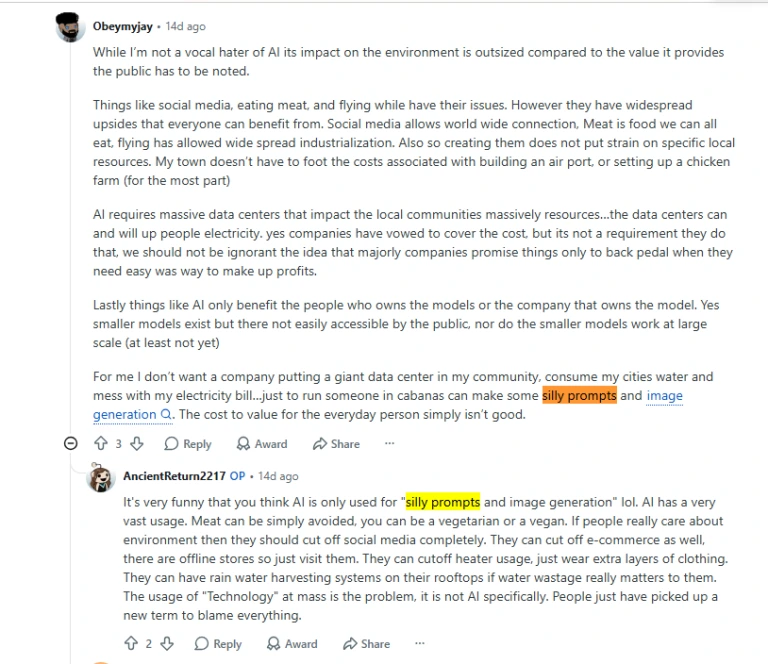
One of the most upvoted points across both threads was the double standard argument. Users pointed out that social media runs on data centers, too. Meat production creates massive local water and waste issues. Airports get government subsidies. None of those face the same scrutiny AI does.
One commenter said it directly: “Data centers aren’t great for the environment. AI is just the new roomie everyone wants to blame.”

Another pushed back on the idea that AI lacks public value, arguing that dismissing it as “silly prompts and image generation” ignores programmers, doctors, students, researchers, and disabled users who rely on it daily.
“The trajectory is the real problem, not today’s numbers”
Several users weren’t defending AI, but they were pointing at what’s coming. One commenter flagged that 30–40% of new data centers in America are being powered by natural gas on 30-year contracts. Not transitioning later. Locked in. Another noted that communities near these facilities are already seeing electricity bills go up and local water supplies strained, while the benefits flow to people nowhere near them. As one user put it: “The problem is in the implementation more than in the actual technology.”
“Use it for things that actually matter”
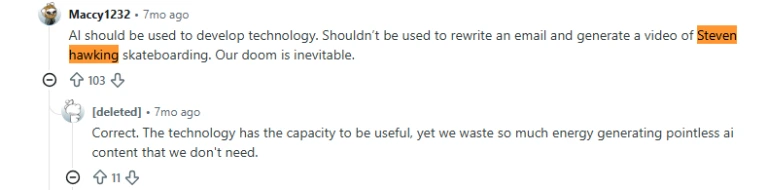
This came up repeatedly in a lot of threads. The sentiment wasn’t anti-AI, it was anti-waste. Multiple users said some version of: AI for medical research and climate modeling is a completely different conversation from AI generating marketing videos and rewriting emails. One comment that got significant traction said it plainly: “AI should be used to develop technology. It shouldn’t be used to rewrite an email and generate a video of Steven Hawking skateboarding.”
| Remember when the internet collectively decided to turn every photo into a Studio Ghibli painting? Millions of image generation requests, all at once, for a trend that lasted two weeks. That’s exactly the kind of use case people in these threads are frustrated about, not AI itself, but AI being treated as a toy while the electricity meter runs |
No consensus. But that’s kind of the point.
Can AI Actually Help the Environment?
We were a bit skeptical initially, but came out genuinely more conflicted.
Because the same technology that’s straining water supplies in drought-hit regions is also doing things that are hard to dismiss.
The cases that actually impressed me:
- MIT researchers used AI to discover more sustainable alternatives to concrete — one of the most carbon-intensive materials on the planet
- The Ocean Cleanup is using AI to accelerate plastic removal from oceans at a scale humans alone couldn’t manage
- AI models are now improving the accuracy of solar and wind forecasts, which directly helps grid operators deliver cleaner energy more reliably
- In Peru, communities using near-real-time AI-powered deforestation alerts saw forest loss drop 52% compared to communities without access to the same data
- Climate researchers are using AI to analyze national climate plans faster than any manual process could, helping identify gaps in emissions commitments earlier
- Behind many of these breakthroughs are years of expertise delivered through machine learning development services, focused on analyzing large environmental datasets and identifying patterns that would be difficult for humans to detect manually.
So, Is AI Bad for the Environment?
After going through all of this: the research, the data, the Reddit threads, the corporate pledges, here’s where we landed: it’s the wrong question.
What the evidence clearly supports:
- AI’s infrastructure has a real and growing environmental footprint — energy, water, hardware, e-waste
- That footprint is being systematically undercounted because most assessments only measure carbon
- The communities absorbing the local costs are rarely the ones benefiting from the technology
What the evidence also suggests:
- Training a single model is a one-time cost, not a continuous drain
- Efficiency is improving. DeepSeek V3 was trained on roughly 980 MWh of energy.
- AI is already doing meaningful environmental work in conservation, climate modeling, and clean energy optimization
- The harm isn’t predetermined; it depends on where data centers get built, what powers them, and what they’re actually used for
The honest answer to how AI is bad for the environment is that AI is neither the environmental villain its critics sometimes portray nor the harmless tool its supporters describe. Its footprint is real. So is its potential.
But here’s the question worth sitting with: as AI adoption continues to accelerate, the challenge won’t simply be measuring its environmental cost. It’ll be deciding whether what we’re building with it is actually worth what we’re spending on the planet to get there.
Frequently Asked Questions (FAQs)
Do companies retrain AI models constantly, or is it a one-time thing?
One-time. Model training (the expensive part) happens once. After that, companies run inference—serving that trained model to users making queries. This is why the "efficiency gains" narrative is misleading. Even if DeepSeek trained V3 on less energy than competitors, the real drain comes from serving billions of daily inferences, and that's where the scale problem lives.
What are “enabled emissions”?
Enabled emissions are greenhouse gases produced by other industries when AI helps them operate more efficiently. Example: AI locating and optimizing oil and gas extraction. The AI firm doesn't emit carbon, but it made the emissions possible and profitable. This is rarely counted in AI's environmental impact assessments, but it's arguably the larger problem—AI isn't just consuming energy; it's helping high-emitting sectors become more effective.
How much of the data center electricity still comes from fossil fuels?
56% still comes from natural gas and coal. This is critical because efficiency improvements at the per-query level keep getting wiped out by the sheer volume of usage growth. Companies like xAI aren't even waiting for the grid, they're building gas-powered turbines to run facilities independently, making them direct polluters (xAI's Memphis facility emits 1,200–2,000 tons of nitrogen oxide per year).














 Sales Enquiries:
  Business queries:
  HR:
HR: 


