



 Healthcare Software Development Services
 Healthcare App Development Services
 Real Estate Web Development Services
 Real Estate App Development Company
 E-Commerce App Development Services
 E-Commerce Web Development Services
 Blockchain E-commerce Development Company
 Fintech Software Development
 Fintech App Development Services
 E-Learning App Development Services
 Restaurant App Development Company
 Mobile Game Development Company
 Travel App Development Company
 Automotive Web Design
 AI Traffic Management System
 AI Inventory Management Software
 Logistics App Development Services
 Machine Learning Development
 ChatGPT integration services
  AI Development Company
  AI Integration Services
  Natural Language Processing Company
 Mobile App Development
  IOS App Development
  Android App Development
  Cross-Platform App Development
  Augmented Reality (AR) App Development
  Virtual Reality (VR) App Development
  Web App Development
  SaaS App Development
 Custom Software Development Services
  Flutter
  React Native
  Swift (IOS)
  Kotlin (Android)
  Mean Stack Development
  AngularJS Development
  MongoDB Development
  Nodejs Development
  Database Development
 Ruby on Rails Development
 Expressjs Development
  Full Stack Development
  Web Development Services
  Laravel Development
  LAMP Development
  Custom PHP Development
  .Net Development
  User Experience Design Services
  User Interface Design Services
  Automated Testing
  Manual Testing
  Digital Marketing Services
 Ride-Sharing And Taxi Services
 Food Delivery Services
 Grocery Delivery Services
 Transportation And Logistics
 Car Wash App
 Home Services App
 ERP Development Services
 CMS Development Services
 LMS Development
 CRM Development
 DevOps Development Services
 AI Business Solutions
 AI Cloud Solutions
 AI Chatbot Development
 API Development
 Blockchain Product Development
 Cryptocurrency Wallet Development
 About Talentelgia
  Our Team
  Our Culture
 Healthcare App Development Services
 Real Estate Web Development Services
 E-Commerce App Development Services
 E-Commerce Web Development Services
 Blockchain E-commerce
Development Company
Blockchain E-commerce
Development Company Fintech App Development Services
 Blockchain Fintech
Development Company
Blockchain Fintech
Development Company E-Learning App Development Services
 Restaurant App Development Company
 Mobile Game Development Company
 Travel App Development Company
 AI Traffic Management System
 AI Inventory Management Software
 AI Development Company
 ChatGPT integration services
 AI Integration Services
 Machine Learning Development
 Machine learning consulting services
 Blockchain Development
 Blockchain Software Development
 Smart contract development company
 NFT marketplace development services
 Asset tokenization companies
 DeFi Wallet Development Company
 IOS App Development
 Android App Development
 Cross-Platform App Development
 Augmented Reality (AR) App
Development
Augmented Reality (AR) App
Development Virtual Reality (VR) App Development
 Web App Development
 Flutter
 React
Native
React
Native Swift
(IOS)
Swift
(IOS) Kotlin (Android)
 MEAN Stack Development
 AngularJS Development
 MongoDB Development
 Nodejs Development
 Database development services
 Expressjs Development
 Full Stack Development
 Web Development Services
 Laravel Development
 LAMP
Development
LAMP
Development Custom PHP Development
 User Experience Design Services
 User Interface Design Services
 Automated Testing
 Manual
Testing
Manual
Testing About Talentelgia
 Our Team
 Our Culture
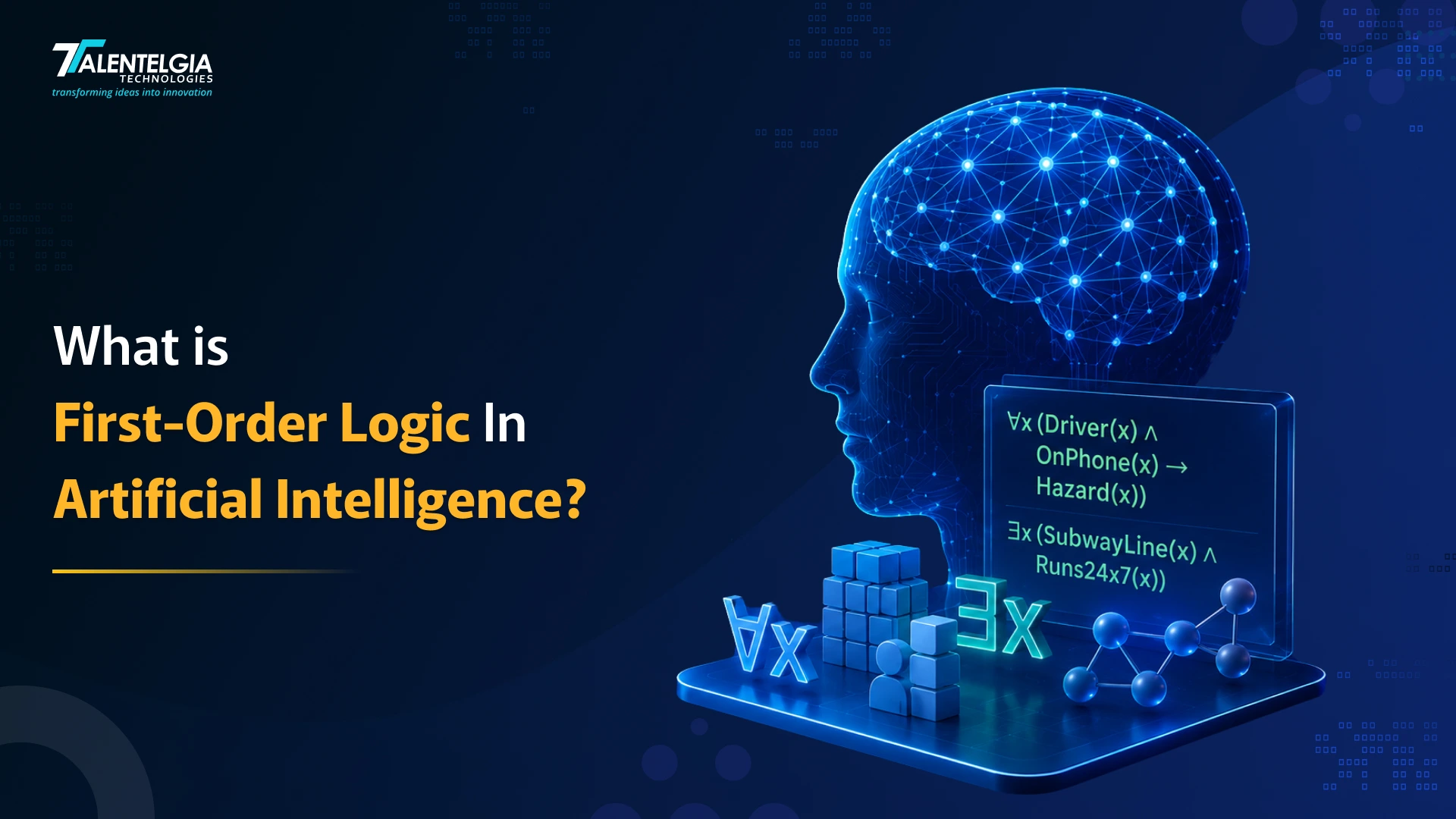
Imagine trying to describe a vibrant, bustling city using nothing but switches that can turn either ON or OFF. You can declare that “The traffic light is green” (True) or “The train is delayed” (False). However, the moment you want to express a universal urban rule, such as “Every driver on a cell phone poses a hazard” or “There is at least one subway line running 24/7”, your simple switches completely break down.
In early computing and traditional propositional logic, this was the ultimate limitation. It could handle individual, absolute facts, but it could not express general laws, relationships, or complex interactions. To build artificial intelligence systems capable of actual common-sense reasoning, human-like knowledge representation, and deep legal or medical deduction, computer scientists needed a more expressive language. That language is First-Order Logic (FOL).
Let’s pull back the curtain on this foundational pillar of symbolic AI, map its mechanics, and explore how it acts as the mathematical backbone for complex reasoning engines.
The Problem First-Order Logic (FOL) Was Built To Solve
Long before machine learning (ML), Neural Networks, or Generative AI (Gen AI) entered the picture, researchers building the first intelligent computer systems faced a deceptively simple question: how do you teach a machine about the world? This foundational challenge continues to influence the work of every AI development company building intelligent systems today. The world, after all, is not made of true and false statements. It is made of things like objects, entities, people, places, and the relationships between them.
The logical systems that existed before FOL: propositional logic, chief among them- could represent simple facts as true or false statements. But they had no way to talk about objects and the relationships between them. They couldn’t express “all dogs are mammals” without listing every dog in existence. They couldn’t reason about categories, about functions, about the structure of the world.
First-Order Logic was developed precisely to fill this gap. It extended the expressible power of logic from simple truth values to a rich language capable of describing objects, their attributes, the relationships between them, and generalizations about entire categories, while still retaining the formal precision that allows a machine to reason with it reliably.
What Is First-Order Logic?
First-Order Logic, also known as Predicate Logic or First-Order Predicate Logic, is a formal system of symbolic logic that extends propositional logic to express complex relationships between objects in a domain. Where propositional logic can only work with entire statements as atomic units (either true or false), FOL introduces the ability to talk about individual objects, their properties, and the relationships between them, along with powerful generalizations using quantifiers.
The word “first-order” has a technical meaning: it means that quantification is applied to individual objects (the “first” level), rather than to predicates or sets of objects themselves (which would make it higher-order logic). In practice, this means FOL lets you say things like “for every object in this domain” or “there exists at least one object such that”, statements of enormous expressive power for an AI system reasoning about knowledge.
FOL assumes the world is made of three kinds of things, closely mirroring the structure of natural language:
- Objects: the things in the world: people, numbers, cities, books, rules, concepts. Everything that can be referred to as an individual entity.
- Relations: properties and connections: “is red,” “is taller than,” “is the parent of,” “is adjacent to.” Both properties of individual objects and relationships between multiple objects.
- Functions: mappings that take objects and return objects: “the father of John,” “the capital of France,” “the square root of 4.” Functions name specific objects indirectly.
Propositional Logic vs. First Order Logic: What’s Their Difference?
To understand what FOL offers, you first need to understand what it transcends. Propositional logic works with statements – called propositions, that are either true or false. It can combine them using logical connectives. But it cannot look inside a statement to reason about objects and their properties. FOL was built specifically to overcome this limitation.
| Propositional Logic | First Order Logic |
|---|---|
| Treats statements as atomic: you can’t look inside them | Decomposes statements into predicates, objects, and relations |
| Can only say “John_is_a_human” as one indivisible unit | Can say “Human(John)”: separating property from object |
| Cannot express “all humans are mortal” without listing every human | Can express “∀x Human(x) → Mortal(x)” — a universal law |
| No variables: every individual must be named explicitly | Variables can stand for any object in the domain |
| Limited expressive power for real-world knowledge | Rich enough to express most human knowledge |
| Simple to compute; decidable and tractable | More computationally demanding; undecidable in full generality |
Consider how each handles a simple piece of world knowledge: “Socrates is a human. All humans are mortal. Therefore, Socrates is mortal.”
In propositional logic, you would need to represent “Socrates_is_human” and “Socrates_is_mortal” as separate, unrelated propositions. The inference from one to the other requires an explicit rule that cannot be generalized to any other individual — you’d need separate rules for every human in existence.
In FOL, you write Human(Socrates) and ∀x Human(x) → Mortal(x). From these two statements, a reasoning engine can automatically derive Mortal(Socrates), and would do so for any other individual satisfying Human(x) without any additional rules. This is the power of universality that FOL’s quantifiers unlock.
The Key Components of First-Order Logic?
FOL is constructed from a small set of fundamental building blocks. Understanding each one is essential; they are the vocabulary and grammar from which all FOL statements are assembled.
1. a , b , c — Constants
Constants name specific, individual objects in the domain being described. They are the proper nouns of FOL; each one refers to exactly one thing, unambiguously. Example: John, Paris, 42, Monday, Earth
2. x , y , z — Variables
Variables act as placeholders that can stand for any object in the domain. They don’t name a specific individual; they range over a category, enabling generalizations that apply to everything. Example: x, y, z — “For any x in the domain…”
3. P (x) — Predicates
Predicates express properties of objects and relationships between them. A predicate takes one or more objects as arguments and returns true or false; it is the verb phrase of the logical sentence. Example:
Human(x): “x is human”
Loves(x, y): “x loves y”
4. f (x) — Functions
Functions map objects to other objects. Unlike predicates, which return truth values, functions return objects. They let you refer to objects indirectly, “the thing that stands in this relationship to that object.” Example:
FatherOf(John) → specific person
CapitalOf(France) → Paris
5. ∀ ∃ — Quantifiers
Quantifiers specify how many objects a statement applies to. The universal quantifier (∀, “for all”) makes a claim about every object; the existential quantifier (∃, “there exists”) claims at least one object satisfies the condition. Example:
∀x — “For every x…”
∃x — “There exists an x such that…”
6. ∧ ∨ ¬ →— Logical Connectives
These are the conjunctions of logic — the words “and,” “or,” “not,” and “if-then” translated into formal symbols. They combine simpler FOL expressions into more complex compound statements. Example:
∧ (AND), ∨ (OR), ¬ (NOT)
→ (IMPLIES), ↔ (IFF)
Syntax: The Grammar of First-Order Logic
Syntax defines the rules for constructing valid expressions in FOL. It is the formal grammar that determines whether a logical sentence is well-formed, regardless of what it means. Just as natural language has grammar rules (a sentence must have a subject and verb), FOL has precise structural rules that every valid expression must follow.
The two fundamental categories of syntactic objects in FOL are terms and formulas:
- Terms
A term is anything that refers to an object in the domain. Terms are the “noun phrases” of FOL:
- A constant is a term: John, Paris, and 3 all refer directly to specific objects.
- A variable is a term: x, y, z stand for any object without specifying which one.
- A function applied to terms is a term: FatherOf(John) refers to a specific object (John’s father) without naming them directly.
- Formulas
Formulas are the “sentences” of FOL, expressions that are either true or false. They are built from terms using predicates and connectives:
- An atomic formula is a predicate applied to terms: Human(John), Loves(Mary, John). It is the simplest complete sentence in FOL.
- If φ and ψ are formulas, then ¬φ, φ ∧ ψ, φ ∨ ψ, φ → ψ are all formulas. Connectives combine simpler sentences into complex ones.
- If φ is a formula and x is a variable, then ∀x φ and ∃x φ are formulas. Quantifiers generalize formulas over the entire domain.
Semantics: Giving First-Order Logic Meaning
Syntax tells you whether a FOL expression is grammatically correct. Semantics tells you what it means — how the symbols connect to the real world (or the domain being modeled), and whether the expression is true or false given a particular interpretation of that world.
In FOL, semantics is formalized through the concept of an interpretation. An interpretation specifies:
- A domain D
The non-empty set of all objects that exist in the world being described. This could be all people, all numbers, all cities, or any collection of objects.
- Assignments
Mappings from each constant to a specific object in D, from each function symbol to a function over D, and from each predicate to a set of tuples over D.
With an interpretation in place, every well-formed FOL formula has a truth value, true or false. This is what makes FOL useful for AI: you can check whether a statement is true in a given model of the world, and you can use inference rules to derive new truths from known ones.
What Is a Model?
A model for a set of FOL sentences is an interpretation that makes all those sentences true simultaneously. The idea of a model is central to FOL’s use in AI: a knowledge base represents a set of constraints on the world, and any state of the world that satisfies all those constraints is a valid model. When an AI model reasons about the world, it is checking consistency with its knowledge base and deriving conclusions that hold in all valid models.
Also Read: What Is The Best AI Right Now?
Interpretation in Practice
Consider the sentence: ∀x (Customer(x) ∧ MadesPurchase(x) → ReceivesInvoice(x))
Its syntax is valid (it follows the grammatical rules of FOL). Its semantics under a given interpretation assigns meaning by specifying what the domain D is (in this case, people), what Customer means (the set of all customers), what MakesPurchase means (the set of all people who made a purchase), and what ReceivesInvoice means (the set of all people who receive invoices). Under this interpretation, the sentence is true if and only if, for every person who is both a customer and has made a purchase, it is also the case that they receive an invoice.
Quantifiers: The Power of ∀ and ∃
Quantifiers are arguably the most important innovation that FOL contributes over propositional logic. They are what enable generalizations, statements that apply to entire categories of objects rather than just specific named individuals. Without quantifiers, you cannot say “all birds can fly” without explicitly listing every bird. With them, you can express universal and existential claims of arbitrary scope.
- ∀ — Universal Quantifier
The universal quantifier asserts that a statement holds for every object in the domain. It is the formal embodiment of “always” and “all” — a claim that admits no exceptions within the specified domain.
If any single object in the domain fails to satisfy the condition, the universally quantified statement is false. It is the strictest possible generalization. Example:
∀x Bird(x) → CanFly(x)
“Every bird can fly”
∀x (Student(x) → HasID(x))
“All students have an ID”
- ∃ — Existential Quantifier
The existential quantifier asserts that at least one object in the domain satisfies the condition. It makes a weaker claim than ∀ — it does not say how many objects satisfy the condition, only that at least one does.
It is satisfied as long as one object in the domain satisfies the predicate. It is the formal expression of “something,” “some,” or “at least one.”
∃x (Doctor(x) ∧ Kind(x))
“There exists a kind doctor”
∃x (Prime(x) ∧ Even(x))
“Some prime number is even”
Real-World Applications of First-Order Logic In AI
FOL is not a theoretical curiosity. It is the logical foundation of several major categories of AI systems that have been deployed in production environments for decades, and it continues to underpin modern AI app development by enabling structured reasoning and intelligent decision-making.
1. Expert Systems
Expert systems encode the specialized knowledge of human domain experts in FOL-like rule sets. Medical diagnosis systems like MYCIN used production rules structurally equivalent to FOL to encode diagnostic knowledge and reasoning patterns. Given patient symptoms, the system applies encoded rules to suggest diagnoses and treatment recommendations, exactly the forward-chaining inference mechanism FOL enables. Expert systems remain widely used in legal, medical, and financial decision support applications today.
2. Natural Language Processing
FOL provides the formal backbone for semantic parsing, the task of converting NLP sentences into structured logical representations. Question answering systems use FOL to transform user queries into formal logical statements that can be evaluated against a knowledge base. Semantic analysis in Natural Language Processing, understanding intent, extracting relationships, and building structured representations of text, draws directly on FOL’s framework of predicates, objects, and relationships. Systems that need to “understand” rather than merely “pattern match” text often use FOL-based representations as an intermediate layer.
3. Autonomous Systems (Robotics & Planning)
Robots that interact with the physical world need to represent it formally, to know what objects are where, what actions are possible, and what the consequences of those actions will be. FOL provides the language for this: encoding the robot’s current world state as a set of FOL facts and encoding the effects of actions as logical rules. The STRIPS and PDDL planning languages, foundational to AI planning and robotics, are direct descendants of the FOL-based approach to representing actions and their preconditions and effects.
| Advantages of FOL | Disadvantages of FOL |
|---|---|
| Formally precise and mathematically well-founded, every valid inference is guaranteed correct | Inherently binary, facts must be definitively true or false; no built-in support for probability or uncertainty |
| Expressive enough to represent most human knowledge about structured domains | Computationally intractable at scale; full FOL reasoning is semi-decidable and can be infinitely slow |
| Universal quantification enables compact expression of infinite collections of facts | Commonsense reasoning is notoriously difficult to encode; “birds typically fly, except penguins” is hard to handle cleanly |
| Sound and complete inference procedures exist; if a conclusion follows, it can in principle be found | Knowledge engineering is labor-intensive; encoding expert knowledge requires significant human effort |
| Transparent and interpretable; a human expert can read and verify the knowledge base | Open-world assumptions are problematic; FOL doesn’t naturally assume that unknown facts are false |
| Directly supports automated reasoning without requiring training data | Poor at handling vague, fuzzy, or probabilistic concepts common in natural language |
| Enables knowledge to be reused, validated, and corrected explicitly | No mechanism for learning from examples; knowledge must be written, not learned |
| Language-independent, FOL knowledge can be shared across different AI systems | Difficult to scale to the full complexity and inconsistency of real-world domains |
Final Thoughts: The Future of FOL
First Order Logic is structured, disciplined, and completely clear language. It forces AI systems/technologies to see things in the world as an elegant matrix of real objects with meaningful relationships rather than in a great big group of pixel values or text probability.
If you can learn to incorporate both the mathematical precision of FOL with the scalable nature of modern machine learning, you can create an automated environment that goes beyond simply guessing at the next answer – your organization will be able to reason through it as well!
So, have you experimented with hybrid systems to regain the ability to explain your technical stack? We would like to hear about your experience.
Reach out to us by visiting our website, Talentelgia Technologies, and scheduling a meeting.












 Sales Enquiries:
  Business queries:
  HR:
HR: 


