



 Healthcare Software Development Services
 Healthcare App Development Services
 Real Estate Web Development Services
 Real Estate App Development Company
 E-Commerce App Development Services
 E-Commerce Web Development Services
 Blockchain E-commerce Development Company
 Fintech Software Development
 Fintech App Development Services
 E-Learning App Development Services
 Restaurant App Development Company
 Mobile Game Development Company
 Travel App Development Company
 Automotive Web Design
 AI Traffic Management System
 AI Inventory Management Software
 Logistics App Development Services
 Machine Learning Development
 ChatGPT integration services
  AI Development Company
  AI Integration Services
  Natural Language Processing Company
 Mobile App Development
  IOS App Development
  Android App Development
  Cross-Platform App Development
  Augmented Reality (AR) App Development
  Virtual Reality (VR) App Development
  Web App Development
  SaaS App Development
 Custom Software Development Services
  Flutter
  React Native
  Swift (IOS)
  Kotlin (Android)
  Mean Stack Development
  AngularJS Development
  MongoDB Development
  Nodejs Development
  Database Development
 Ruby on Rails Development
 Expressjs Development
  Full Stack Development
  Web Development Services
  Laravel Development
  LAMP Development
  Custom PHP Development
  .Net Development
  User Experience Design Services
  User Interface Design Services
  Automated Testing
  Manual Testing
  Digital Marketing Services
 Ride-Sharing And Taxi Services
 Food Delivery Services
 Grocery Delivery Services
 Transportation And Logistics
 Car Wash App
 Home Services App
 ERP Development Services
 CMS Development Services
 LMS Development
 CRM Development
 DevOps Development Services
 AI Business Solutions
 AI Cloud Solutions
 AI Chatbot Development
 API Development
 Blockchain Product Development
 Cryptocurrency Wallet Development
 About Talentelgia
  Our Team
  Our Culture
 Healthcare App Development Services
 Real Estate Web Development Services
 E-Commerce App Development Services
 E-Commerce Web Development Services
 Blockchain E-commerce
Development Company
Blockchain E-commerce
Development Company Fintech App Development Services
 Blockchain Fintech
Development Company
Blockchain Fintech
Development Company E-Learning App Development Services
 Restaurant App Development Company
 Mobile Game Development Company
 Travel App Development Company
 AI Traffic Management System
 AI Inventory Management Software
 AI Development Company
 ChatGPT integration services
 AI Integration Services
 Machine Learning Development
 Machine learning consulting services
 Blockchain Development
 Blockchain Software Development
 Smart contract development company
 NFT marketplace development services
 Asset tokenization companies
 DeFi Wallet Development Company
 IOS App Development
 Android App Development
 Cross-Platform App Development
 Augmented Reality (AR) App
Development
Augmented Reality (AR) App
Development Virtual Reality (VR) App Development
 Web App Development
 Flutter
 React
Native
React
Native Swift
(IOS)
Swift
(IOS) Kotlin (Android)
 MEAN Stack Development
 AngularJS Development
 MongoDB Development
 Nodejs Development
 Database development services
 Expressjs Development
 Full Stack Development
 Web Development Services
 Laravel Development
 LAMP
Development
LAMP
Development Custom PHP Development
 User Experience Design Services
 User Interface Design Services
 Automated Testing
 Manual
Testing
Manual
Testing About Talentelgia
 Our Team
 Our Culture
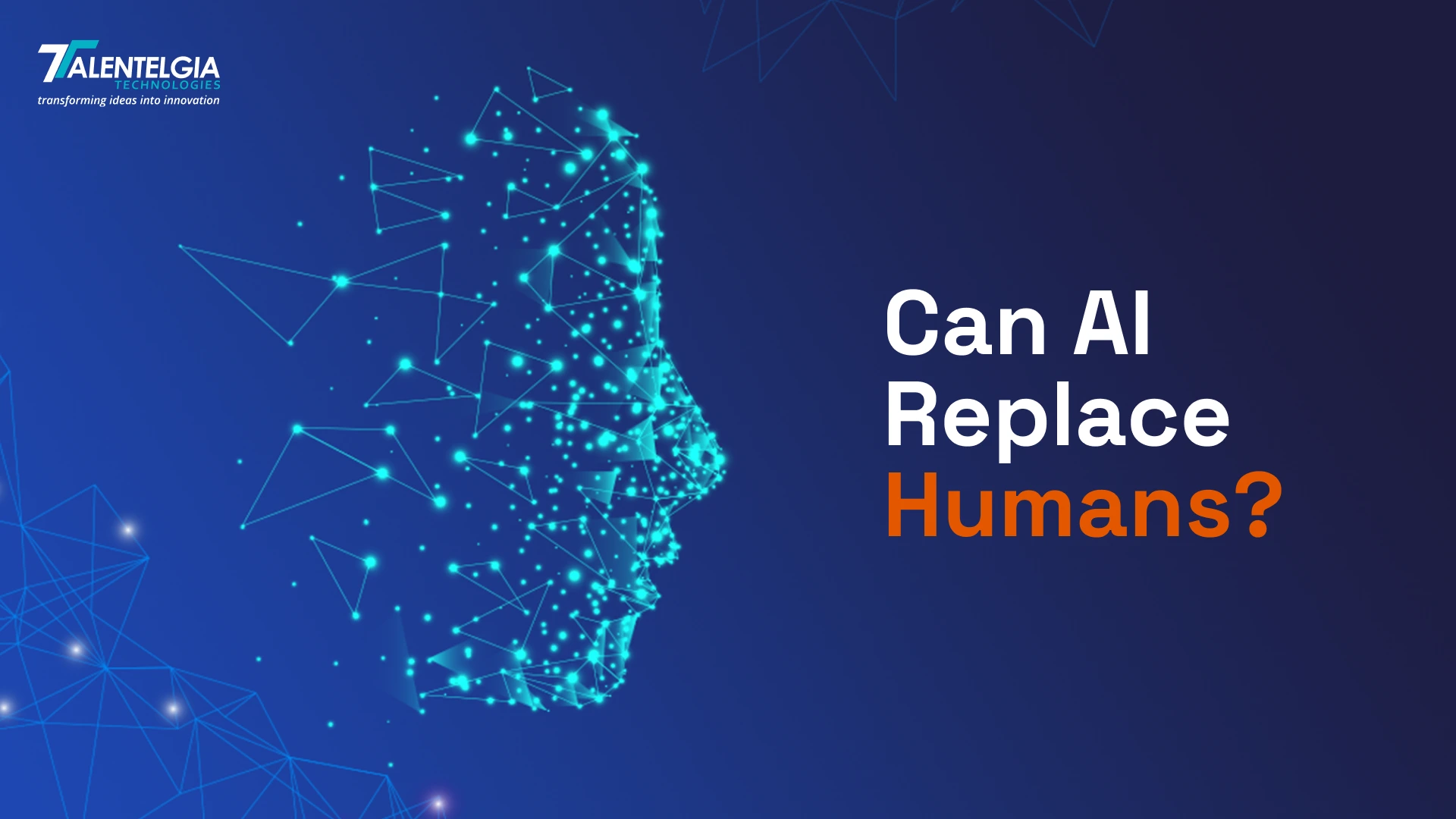
AI tools are at an all-time high, raising questions of whether AI could be the reason for the end of human skills and experiences. This is where Artificial Intelligence (AI) – one of the biggest game-changer technologies to appear in the 21st century.
AI is everywhere these days. We all know about Artificial Intelligence, but for a long time, many of us didn’t fully understand what it really was or how it worked in everyday life. That changed when easy-to-use tools like ChatGPT, Midjourney, and Whisper became available online, opening the door for anyone to explore AI without needing advanced technical skills. Today, people can create copy, long-form content, images, presentations, and even websites with just a few simple prompts, thanks to the rise of generative AI development services and easy-to-use AI tools. It’s not just impressive — it’s a major shift in how we work, create, and solve problems.
Now coming to the main question: “Can Artificial Intelligence replace Human Intelligence or not? Simply put, No! Artificial Intelligence can not replace human smartness. AI may be fast and precise with tasks that could take ages for people, but there are a lot more dimensions to human intelligence that AI doesn’t have. In this blog, we break down AI, its limits, and its possibilities.
What Exactly Is AI?
AI has moved beyond simple chatbots. Today, it is an “Agentic Ecosystem.” It doesn’t just answer questions; it takes action—booking your travel, managing supply chains, and even conducting scientific research autonomously.
At its core, AI is statistical logic, while humans possess biological consciousness. AI predicts the next most likely outcome based on trillions of data points; humans create outcomes that have never existed before.
Potential of AI: Where AI Wins
As per the Grand View Research statistics, the global AI digital transformation market was valued at US$ 167.7 million in 2025, which is projected to grow to $660,040.2 million with a CAGR of 31.2% by 2030. Its potential lies in three key areas:
1. Precision Decision-Making
AI excels at digesting millions of data points to reveal “invisible” patterns that the human brain simply cannot process.
- Healthcare: By identifying subtle trends in patient data, AI assists in life-changing diagnoses and predictive care.
- Finance: In high-stakes markets, AI provides the analytical depth required for accurate economic forecasting and risk assessment.
2. Reclaiming Human Creativity
One of AI’s greatest gifts is the gift of time. By automating mundane, repetitive “drudge work,” it liberates the human mind for higher-level pursuits.
- Efficiency: Across sectors like manufacturing and customer service, automation is driving unprecedented productivity gains.
- Meaningful Work: With the “boring” tasks handled, professionals can refocus their energy on creative problem-solving and meaningful human connection.
3. The Birth of “Impossible” Innovation
AI isn’t just improving what we already have; it is building what we never thought possible. By merging disparate data streams in innovative ways, it is birthing entirely new industries.
- New Products: AI enables the creation of services that were technically impossible just a few years ago.
- Scientific Discovery: From lab-grown materials to personalized medicine, the potential of AI insights is pushing the boundaries of the physical world.
Limits of AI: Where AI Lacks
While the latest headlines often focus on what AI can do, the most successful professionals are those who understand its “Hard Limits.” AI remains a statistical echo of the past, whereas humans are the architects of the future. Here is why the human element remains an irreplaceable cornerstone of the modern world:
1. The “Garbage In, Garbage Out” Constraint
An AI system is fundamentally a reflection of its training data. It does not possess a sense of “truth” outside of the information it has been fed.
- The Bias Trap: if the underlying data is biased, incomplete, or flawed, the AI will simply automate and amplify those exact errors.
- Data Dependency: Unlike humans, who can seek new truths, AI is tethered to its historical data sets, making it a mirror of our past mistakes rather than a pioneer of new ethics.
2. Algorithmic Patterns vs. True Innovation
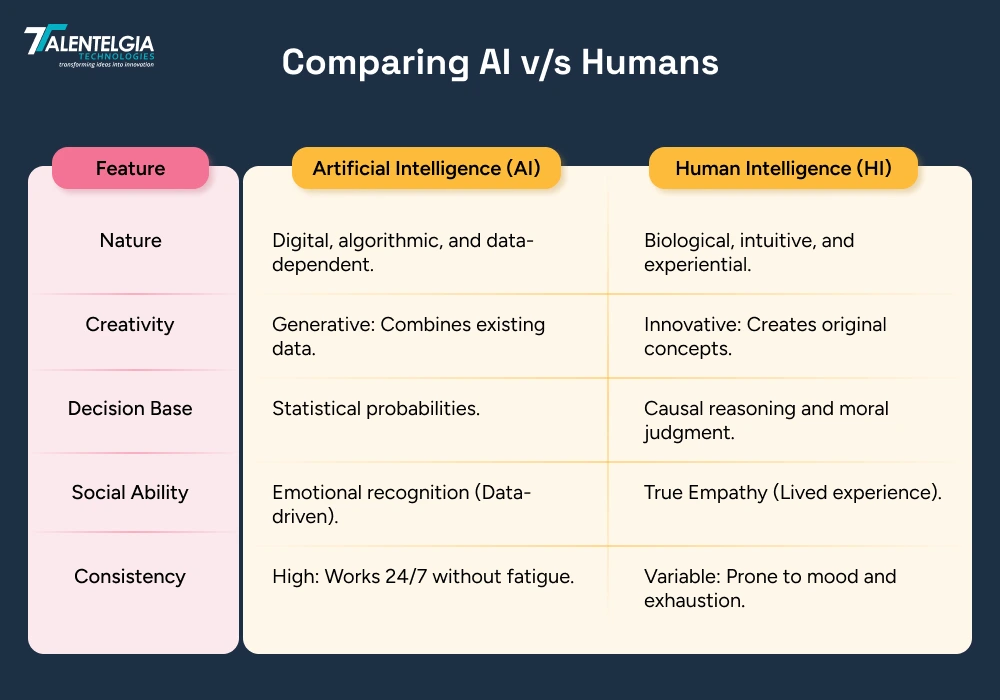
AI excels at generative synthesis, combining existing data into new iterations, but it lacks the spark of true original thought.
- The Box Problem: AI operates strictly within the confines of established algorithms and patterns; it is mathematically incapable of “thinking outside the box”.
- The Human Spark: While AI processes data, humans are driven by intuition, inspiration, and imagination. This allows us to create entirely original concepts that have no precedent in a database.
3. The Empathy Gap & Emotional Intelligence
AI has become excellent at recognizing facial expressions or analyzing tone, but it still cannot feel.
- Recognition vs. Understanding: AI can label an emotion based on a pattern, but it cannot truly understand the “why” or the lived experience behind it.
- Relationship Building: Meaningful social interactions and relationships require a deep, intuitive grasp of human behavior that a machine cannot simulate in a meaningful way.
- The Compassion Barrier: Because it lacks emotional intelligence, AI can never act as a substitute for human connection, empathy, or the nuance of shared experience.
The Waves of Artificial Intelligence
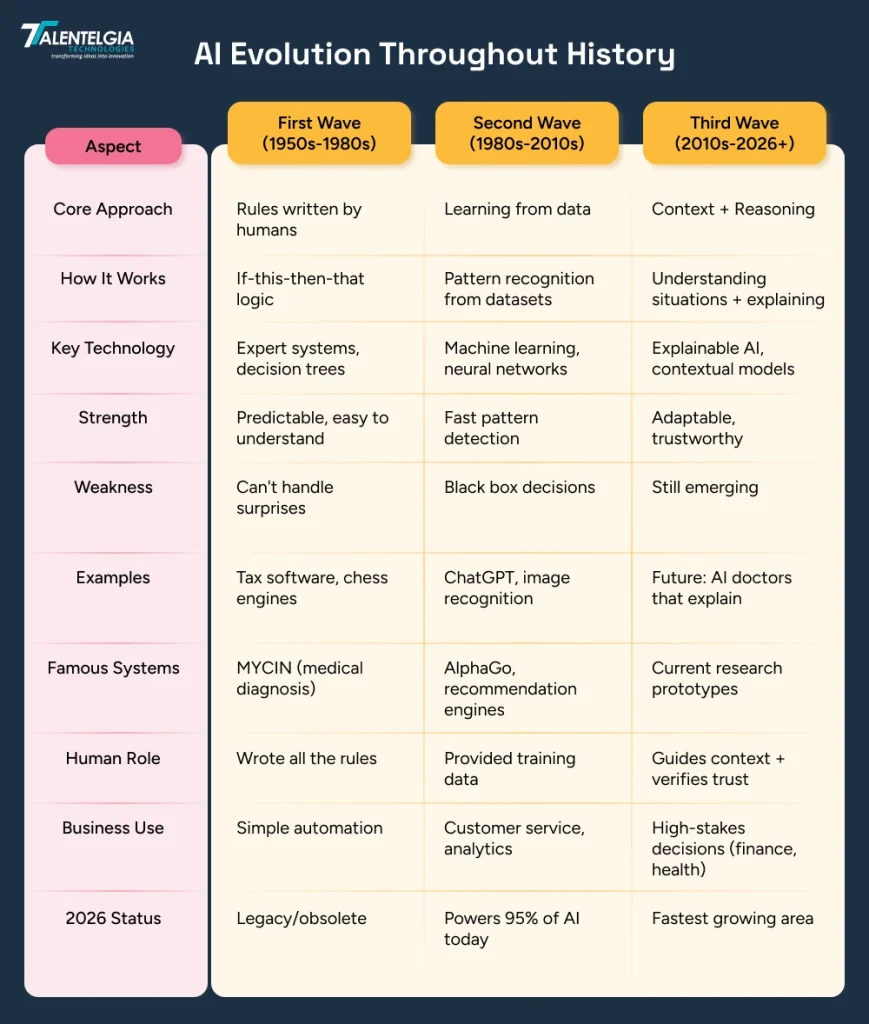
AI has not evolved in one straight line. AI development is often explained in three waves: the first wave focused on rules, the second wave focused on learning from data, and the third wave is focused on context, reasoning, and trust. DARPA (US’ Defense Advanced Research Projects Agency) uses this three-wave model to explain how this helps for the future of work.
1. The First Wave: Handcrafted Knowledge
The first wave of AI was based on rules created by humans. In this stage, machines could only do what they were specifically told to do. If experts gave the system clear instructions, it could follow them well, but it could not learn on its own or adapt when the situation changed. These systems use logical “if-then” statements to solve narrowly defined problems This was the era of expert systems and logic-based programs.
- The Logic: Experts programmed their own knowledge and rules directly into the software.
- Successes: This wave gave us chess-playing computers, tax preparation software, and traffic light systems.
- The Limit: These systems cannot learn or adapt to new situations; if a scenario wasn’t pre-programmed by a human, the AI fails.
2. The Second Wave: Statistical Learning
The second wave of AI changed everything. Instead of only following rules, machines started learning from data. This wave gave rise to machine learning, speech recognition, recommendation engines, image recognition, and many of the AI tools people use today.
DARPA explains that the theory behind many second-wave systems had existed for decades, but the real breakthrough came when better algorithms, bigger datasets, and stronger computing power became available.
- The Logic: AI creates statistical models by training on “Big Data” to categorize information and predict outcomes.
- Success: This wave powers facial recognition, voice assistants like Siri, and the generative AI (like LLMs) that took the world by storm.
- The Limit: These systems are often “black boxes”, they can tell you what something is, but they cannot explain why they reached that conclusion
3. The Third Wave: The Contextual Adaptation
The third wave of AI is where the future is heading. This wave is about building AI that can understand context, adapt to new situations, and explain why it made a decision. This AI goes beyond recognition and moves toward reasoning and contextual understanding. This matters because businesses now want more than just fast answers from AI. They want systems they can trust. This is especially important because companies are using AI in sensitive areas like hiring, healthcare, finance, and customer service, where trust, explainability, and reliability matter just as much as speed.
- The Logic: These systems learn from the world around them to understand “common sense” and perceive context, much like a human colleague.
- Success: We are seeing the rise of “Agentic AI”—systems that can plan, decide, and execute multi-step tasks with minimal supervision.
- The Goal: The aim is to create AI that can explain its actions and adapt to brand-new environments without needing to be retrained on millions of new data points.
AI vs. Humans: Replacement or Partnership?
The debate between artificial intelligence and human intelligence is not really about choosing one over the other. The more useful question is this: what kinds of intelligence does AI actually have, and where do humans still remain fundamentally different? Credible research and policy frameworks consistently show that AI is exceptionally strong at speed, scale, and pattern recognition, while humans still lead in judgment, empathy, moral reasoning, contextual understanding, and meaning-making.
What AI Does Better Than Humans?
AI has clear advantages in tasks that depend on scale, repetition, and precision. It can analyze millions of records faster than a human team, spot hidden patterns in data, and operate continuously without fatigue. That makes it highly effective in areas such as fraud detection, recommendation systems, document processing, predictive maintenance, and medical image analysis.
Another major strength of AI is consistency. A well-designed system can apply the same logic across thousands of cases without boredom, distraction, or emotional fluctuation. In high-volume environments, that creates major gains in efficiency and can improve productivity when the task is clearly defined and the data is reliable.
What Humans Still Do Better?
Human intelligence remains broader and deeper than machine intelligence. Humans can interpret tone, navigate moral trade-offs, understand culture, read emotion, and respond with empathy in ways that current AI systems cannot genuinely replicate. OECD’s AI principles explicitly stress that AI should respect human rights and democratic values, include human agency and oversight, and be designed to augment human capabilities rather than diminish them.
Humans are also better at handling the kinds of problems that do not come with neat labels or clean datasets. In real life, many decisions involve incomplete evidence, conflicting goals, social consequences, and ethical tension. A doctor speaking to a frightened patient, a leader managing a crisis, or a teacher adapting to a struggling student is doing far more than pattern matching; these situations require judgment, care, and an understanding of human meaning. This is where Human-AI Collaboration becomes important.
Some Well-Known Players In The AI Market
The modern AI market is no longer dominated by one type of product. Instead, it includes a growing mix of general-purpose assistants, enterprise copilots, research engines, and platform-based AI tools designed for different users and use cases. The most well-known names in the market today include ChatGPT, Google Gemini, Claude, DeepSeek, Perplexity, etc., each gaining attention for a different reason rather than competing in exactly the same way
Popular AI Tools In The Market
| AI Tool | Company | Best For | Key 2026 Features | Pricing | Unique Edge |
|---|---|---|---|---|---|
| ChatGPT | OpenAI | General conversations, writing, coding | ChatGPT Go (mobile-first), longer memory, image gen | Free tier + $20/mo Pro | Most versatile, beginner-friendly |
| Gemini | Personal assistance, Google apps integration | Android replacement for Assistant, personal intelligence | Free with Google account | Deep Google ecosystem (Gmail, Photos, YouTube) | |
| Claude | Anthropic | Complex reasoning, professional work | Constitutional AI, advanced coding agents | Free tier + Pro plans | Safety-focused, trustworthy outputs |
| Copilot | Microsoft | Enterprise productivity (Office 365) | Agents in Excel/Teams, sales/finance workflows | $30/user/mo (business) | Embedded in Word, Excel, Teams, Outlook |
| Meta AI | Meta | Social messaging (WhatsApp, Instagram) | Cross-app integration, consumer scale | Free | Built into Facebook, WhatsApp, Instagram |
| Perplexity | Perplexity | Research, real-time answers with sources | Always-on assistant, web citations | Free tier + Pro ($20/mo) | Answer engine (not just chat), source-backed |
| DeepSeek | DeepSeek AI | Coding, technical tasks, API integration | DeepSeek-V3/V4 models, local deployment, fast responses | Free access + API pricing | Chinese AI leader, strong coding/math, developer-focused |
The Future of AI and Human Intelligence
The future of AI and human intelligence is not a story of one replacing the other. It is far more likely to be a story of collaboration, where AI continues to grow more advanced while humans remain essential in areas that demand originality, judgment, and emotional understanding.
So, where is AI headed, and what does it mean for human intelligence? AI will keep advancing rapidly, handling more complex tasks with greater speed and sophistication. Yet humans will remain essential for creativity, strategy, relationships, and judgment—especially in roles like doctors, teachers, and leaders where empathy and intuition matter most.
AI augments, doesn’t replace.
As OpenAI’s CEO, As OpenAI’s Sam Altman puts it: Sam Altman puts it:
“AI won’t replace humans, but humans using AI will replace those who don’t.” The future belongs to those who blend both intelligences wisely.












 Sales Enquiries:
  Business queries:
  HR:
HR: 


