



 Healthcare Software Development Services
 Healthcare App Development Services
 Real Estate Web Development Services
 Real Estate App Development Company
 E-Commerce App Development Services
 E-Commerce Web Development Services
 Blockchain E-commerce Development Company
 Fintech Software Development
 Fintech App Development Services
 E-Learning App Development Services
 Restaurant App Development Company
 Mobile Game Development Company
 Travel App Development Company
 Automotive Web Design
 AI Traffic Management System
 AI Inventory Management Software
 Logistics App Development Services
 Machine Learning Development
 ChatGPT integration services
  AI Development Company
  AI Integration Services
  Natural Language Processing Company
 Mobile App Development
  IOS App Development
  Android App Development
  Cross-Platform App Development
  Augmented Reality (AR) App Development
  Virtual Reality (VR) App Development
  Web App Development
  SaaS App Development
 Custom Software Development Services
  Flutter
  React Native
  Swift (IOS)
  Kotlin (Android)
  Mean Stack Development
  AngularJS Development
  MongoDB Development
  Nodejs Development
  Database Development
 Ruby on Rails Development
 Expressjs Development
  Full Stack Development
  Web Development Services
  Laravel Development
  LAMP Development
  Custom PHP Development
  .Net Development
  User Experience Design Services
  User Interface Design Services
  Automated Testing
  Manual Testing
  Digital Marketing Services
 Ride-Sharing And Taxi Services
 Food Delivery Services
 Grocery Delivery Services
 Transportation And Logistics
 Car Wash App
 Home Services App
 ERP Development Services
 CMS Development Services
 LMS Development
 CRM Development
 DevOps Development Services
 AI Business Solutions
 AI Cloud Solutions
 AI Chatbot Development
 API Development
 Blockchain Product Development
 Cryptocurrency Wallet Development
 About Talentelgia
  Our Team
  Our Culture
 Healthcare App Development Services
 Real Estate Web Development Services
 E-Commerce App Development Services
 E-Commerce Web Development Services
 Blockchain E-commerce
Development Company
Blockchain E-commerce
Development Company Fintech App Development Services
 Blockchain Fintech
Development Company
Blockchain Fintech
Development Company E-Learning App Development Services
 Restaurant App Development Company
 Mobile Game Development Company
 Travel App Development Company
 AI Traffic Management System
 AI Inventory Management Software
 AI Development Company
 ChatGPT integration services
 AI Integration Services
 Machine Learning Development
 Machine learning consulting services
 Blockchain Development
 Blockchain Software Development
 Smart contract development company
 NFT marketplace development services
 Asset tokenization companies
 DeFi Wallet Development Company
 IOS App Development
 Android App Development
 Cross-Platform App Development
 Augmented Reality (AR) App
Development
Augmented Reality (AR) App
Development Virtual Reality (VR) App Development
 Web App Development
 Flutter
 React
Native
React
Native Swift
(IOS)
Swift
(IOS) Kotlin (Android)
 MEAN Stack Development
 AngularJS Development
 MongoDB Development
 Nodejs Development
 Database development services
 Expressjs Development
 Full Stack Development
 Web Development Services
 Laravel Development
 LAMP
Development
LAMP
Development Custom PHP Development
 User Experience Design Services
 User Interface Design Services
 Automated Testing
 Manual
Testing
Manual
Testing About Talentelgia
 Our Team
 Our Culture
| AI automation in insurance means using artificial intelligence to take over tasks a person used to handle by hand, like reviewing a claim, calculating risk on a new policy, or answering a customer’s question about coverage. The system reads the document itself, checks it against the rules, and in many cases makes the call without a human touching it at all. A person only steps in when something looks off. |
Aviva is a good example of what this looks like at scale. The insurer put over 80 AI models to work across its claims operations. Complex liability cases that once took weeks now get assessed 23 days faster, claims get routed correctly 30% more often, and customer complaints dropped by 65%. Numbers like that are the reason so many insurers, not just the largest ones, are putting real budget behind automation this year.
The bigger change is where automation shows up. It used to live in one department at a time. Now it runs across underwriting, claims, fraud checks, and customer service at once, usually through systems designed to feed each other information rather than sit apart.
This piece walks through what automation actually looks like day to day, how it stacks up against the manual process insurers grew up on, why insurers are moving on this now, where the results are already showing, and what’s still getting in the way.
What Does Automation Mean in the Insurance Industry?
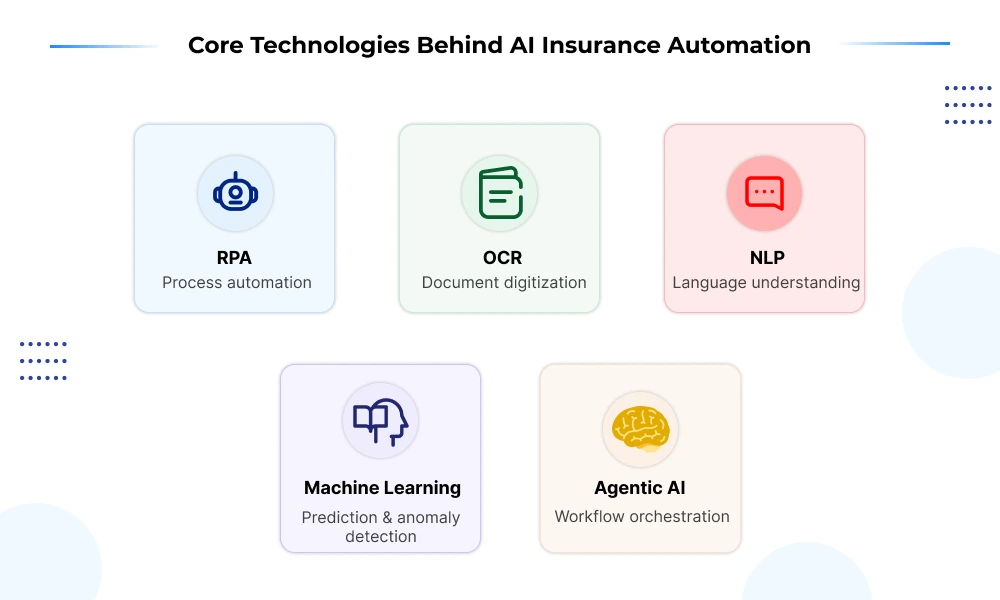
Automation is the replacement of the tasks of observation, verification, and decision-making by an individual with a system without loss of precision and insight in the decision itself. In essence, it is performed using several distinct technical bases, each performing its own task:
- Robotic process automation (RPA) takes care of the mechanical and repetitive tasks like fetching information from one software and inputting that information into another or verifying the policy number from a database. RPA does not “think” but carries out instructions as programmed.
- Optical character recognition (OCR) converts paper forms, old claims records, and handwritten notes into readable and usable information in this industry, where huge amounts of documentation are stored on paper.
- Natural language processing (NLP) allows the system to understand the content of the claim description or customer correspondence rather than looking for matching keywords.
- Machine learning analyzes historical information about claims and fraud, the pattern of the cases, and previous underwriting decisions to forecast risks and spot anomalies.
- Agentic AI, the newer layer, ties these pieces together. Instead of one tool handling one task, an AI agent can pull data, apply judgment, and hand off to a human only when a case genuinely needs one.
Also Read – RPA vs AI
That combination is what separates real automation from a simple chatbot bolted onto a website.
Automation in Insurance vs Manual Insurance Operations
Manual insurance operations rely on people to read documents, apply judgment, and move information between systems by hand. It works, but it comes with a ceiling on speed and a floor on error rates that automation doesn’t have.
The difference shows up across every stage of the workflow:
Speed
- Manual: Documents move between teams for review, approval, and data entry, often taking days for anything beyond the simplest case.
- Automated: Systems process the same submission in minutes, flagging only genuine exceptions for a human to look at.
Accuracy
- Manual: Fatigue, inconsistent judgment, and inconsistent training across staff lead to variable error rates depending on who’s handling the file.
- Automated: The same rules and checks apply to every document, every time, which is why error rates drop so sharply.
Cost at scale
- Manual: Costs rise in a straight line. More volume means more staff, more training, and more overhead, especially painful during renewal season spikes.
- Automated: Once built, a system can handle a large jump in volume with minimal added cost, since the marginal cost of processing one more document is close to zero.
Consistency
- Manual: Two adjusters can reasonably interpret the same claim differently.
- Automated: Rules are applied uniformly, which matters for both compliance and customer trust.
None of this means manual review disappears. Complex claims, ambiguous coverage questions, and anything involving a genuinely upset customer still need a person. What changes is where that person’s time goes: less on repetitive checking, more on the cases that actually need judgment.
Importance of AI Automation For Insurance Companies
AI automation isn’t just a way to cut costs anymore. According to a 2026 Grant Thornton survey covered by Insurance Journal, more than half of insurance executives say AI has already contributed to revenue growth at their organization, and 62% report it has improved the quality of their decision-making. That’s a meaningfully different conversation than the one insurers were having even a couple of years ago, when automation was mostly framed as a back-office efficiency play.
A few reasons it matters now more than it did before:
1. Volume is Outpacing Headcount
As claims, applications for policies, and inquiries from customers increase, it is simply unrealistic for an insurer to hire at the same rate. The use of automation allows a fixed number of people to process increasing workload without a corresponding increase in cost.
2. Customers Expect Speed Insurers Didn’t Use to Offer
A policyholder filing a claim today compares that experience to same-day delivery and instant approvals elsewhere, not to what insurance looked like a decade ago. Falling short on speed has a direct cost: dissatisfied claimants are far more likely to switch providers at renewal.
3. Risk Decisions Get Sharper with More Data
Underwriting and fraud detection both improve when a system can weigh far more variables, and far more claims history, than a person could reasonably review by hand.
4. Talent Gets Used Where It Actually Matters
Experienced underwriters and adjusters spend less time on routine checks and more time on the complex, judgment-heavy cases where their expertise genuinely changes the outcome.
5. Competitive Pressure is Real
With the vast majority of agencies now investing in AI business solutions, insurers who delay aren’t just missing an opportunity; they’re falling behind competitors who are already faster, cheaper, and more accurate on routine work.
None of this replaces the relationship side of insurance. Clients still make coverage decisions based on trust and advice, not algorithms. What automation changes is how much of an insurer’s time and budget gets freed up to invest in that relationship, instead of being consumed by paperwork.
AI in Insurance Use Cases
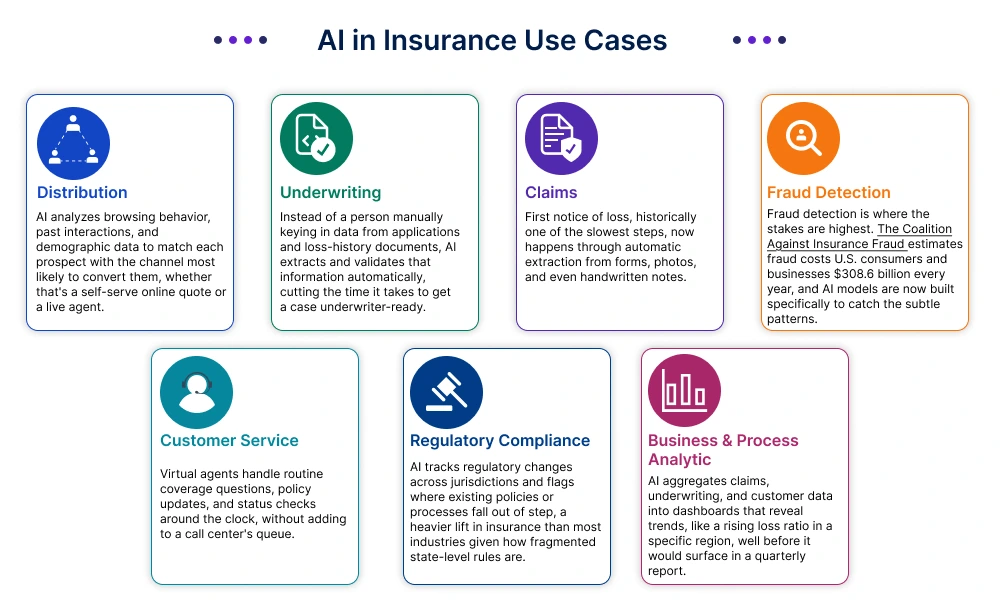
AI’s reach in insurance now spans the entire policy lifecycle, not just one department. Three areas show the clearest impact.
Distribution
- AI analyzes browsing behavior, past interactions, and demographic data to match each prospect with the channel most likely to convert them, whether that’s a self-serve online quote or a live agent.
- For agents, AI increasingly acts as a real-time coach, suggesting the next best product to pitch or the right customer to call, based on patterns from past successful sales.
- Usage-based models, especially in auto insurance, now price premiums off real driving data from connected devices instead of static demographic assumptions, a meaningfully fairer approach for careful drivers.
Underwriting
- Instead of a person manually keying in data from applications and loss-history documents, AI extracts and validates that information automatically, cutting the time it takes to get a case underwriter-ready.
- Risk scoring pulls from a wider data set than any person could review by hand, including past claims and third-party records, producing more consistent pricing decisions.
- Incoming submissions get triaged and routed automatically, so straightforward cases move fast, and complex ones land with the right underwriter instead of sitting in a shared queue.
Claims
- First notice of loss, historically one of the slowest steps, now happens through automatic extraction from forms, photos, and even handwritten notes.
- Image analysis can assess vehicle or property damage directly from submitted photos, often producing a repair estimate without an on-site inspection.
Fraud Detection
- Fraud detection is where the stakes are highest. The Coalition Against Insurance Fraud estimates fraud costs U.S. consumers and businesses $308.6 billion every year, and AI models are now built specifically to catch the subtle patterns, like inflated repair estimates or clusters of similar claims from one location, that a person reviewing cases individually would likely miss.
- AI models catch subtle patterns, like inflated repair estimates or clusters of similar claims from one location, that a person reviewing cases individually would likely miss.
Customer Service
- Virtual agents handle routine coverage questions, policy updates, and status checks around the clock, without adding to a call center’s queue.
- Reminders about renewals, requests for documents, and updating records happen in an automatic fashion, thereby ensuring that all policyholder data is updated without any manual intervention.
- Freed from repetitive queries, human agents spend more time on the complex or emotionally sensitive conversations that actually need a person.
Also Read: Generative AI Use Cases For Customer Service
Regulatory Compliance
- AI tracks regulatory changes across jurisdictions and flags where existing policies or processes fall out of step, a heavier lift in insurance than most industries given how fragmented state-level rules are.
- Automated audit trails record every action a system takes on a case, which matters when a regulator asks an insurer to justify a pricing or claims decision.
Business & Process Analytics
- AI aggregates claims, underwriting, and customer data into dashboards that reveal trends, like a rising loss ratio in a specific region, well before it would surface in a quarterly report.
- Predictive models help insurers forecast claim volume ahead of renewal cycles, informing staffing and pricing decisions in advance rather than reactively.
Challenges of AI Automation in Insurance
Automation delivers real gains, but insurers adopting it are running into a consistent set of obstacles.
1. Legacy Systems Slow Everything Down
Many insurers still run core platforms built decades ago, and connecting modern AI tools to that infrastructure is often harder and slower than the AI implementation itself.
2. Data Quality Determines Outcomes
A model trained on incomplete or inconsistent records will produce flawed risk scores and claims decisions, no matter how sophisticated the underlying algorithm is. Getting the data foundation right is usually the less glamorous, more time-consuming part of the work.
3. Bias is a Genuine Risk, Not a Theoretical One
AI systems trained on historical data can carry forward past patterns of discrimination into pricing or claims decisions. This is a big enough concern that the NAIC’s model bulletin now pushes insurers toward regular bias testing, yet by its own research, nearly a third of health insurers still don’t test their models for bias regularly.
4. Regulatory Scrutiny is Intensifying, Not Easing
Insurers operating across multiple states now face a patchwork of expectations around how AI decisions get documented and explained, and 2026 has been the year regulators moved from asking whether insurers use AI to asking how they govern it.
None of these challenges make automation not worth pursuing. They just mean the insurers seeing real results are the ones treating AI as a long-term operational shift, not a one-time tool rollout.
Wrapping Up
None of this substitutes the human element of insurance. Difficult claims issues, complicated coverage issues, and the relationship trust that keeps customers coming back at renewal time will continue to require human input. Automation changes the ratio of time spent on actual human tasks versus non-human tasks.
For companies that are trying to figure out how to get started with automation, the simple answer is: start small, start with one process, and go from there. That’s usually where a technology partner who’s done this before, rather than a generic vendor, makes the difference between a pilot that stalls and one that scales.













 Sales Enquiries:
  Business queries:
  HR:
HR: 


