


 Healthcare App Development Services
 Real Estate Web Development Services
 E-Commerce App Development Services
 E-Commerce Web Development Services
 Blockchain E-commerce Development Company
 Fintech App Development Services
 Fintech Web Development
 Blockchain Fintech Development Company
 E-Learning App Development Services
 Restaurant App Development Company
 Mobile Game Development Company
 Travel App Development Company
 Automotive Web Design
 AI Traffic Management System
 AI Inventory Management Software
 Machine Learning Development
 ChatGPT integration services
  AI Development Company
  AI Integration Services
  Generative AI Development Services
  Natural Language Processing Company
 Mobile App Development
  IOS App Development
  Android App Development
  Cross-Platform App Development
  Augmented Reality (AR) App Development
  Virtual Reality (VR) App Development
  Web App Development
  SaaS App Development
 Flutter
  React Native
  Swift (IOS)
  Kotlin (Android)
  Mean Stack Development
  AngularJS Development
  MongoDB Development
  Nodejs Development
  Database Development
 Ruby on Rails Development
 Expressjs Development
  Full Stack Development
  Web Development Services
  Laravel Development
  LAMP Development
  Custom PHP Development
  .Net Development
  User Experience Design Services
  User Interface Design Services
  Automated Testing
  Manual Testing
  Digital Marketing Services
 Ride-Sharing And Taxi Services
 Food Delivery Services
 Grocery Delivery Services
 Transportation And Logistics
 Car Wash App
 Home Services App
 ERP Development Services
 CMS Development Services
 LMS Development
 CRM Development
 DevOps Development Services
 AI Business Solutions
 AI Cloud Solutions
 AI Chatbot Development
 API Development
 Blockchain Product Development
 Cryptocurrency Wallet Development
 About Talentelgia
  Our Team
  Our Culture
 Healthcare App Development Services
 Real Estate Web Development Services
 E-Commerce App Development Services
 E-Commerce Web Development Services
 Blockchain E-commerce
Development Company
Blockchain E-commerce
Development Company Fintech App Development Services
 Finance Web Development
 Blockchain Fintech
Development Company
Blockchain Fintech
Development Company E-Learning App Development Services
 Restaurant App Development Company
 Mobile Game Development Company
 Travel App Development Company
 Automotive Web Design
 AI Traffic Management System
 AI Inventory Management Software
 AI Development Company
 ChatGPT integration services
 AI Integration Services
 Machine Learning Development
 Machine learning consulting services
 Blockchain Development
 Blockchain Software Development
 Smart contract development company
 NFT marketplace development services
 Asset tokenization companies
 DeFi Wallet Development Company
 IOS App Development
 Android App Development
 Cross-Platform App Development
 Augmented Reality (AR) App
Development
Augmented Reality (AR) App
Development Virtual Reality (VR) App Development
 Web App Development
 Flutter
 React
Native
React
Native Swift
(IOS)
Swift
(IOS) Kotlin (Android)
 MEAN Stack Development
 AngularJS Development
 MongoDB Development
 Nodejs Development
 Database development services
 Expressjs Development
 Full Stack Development
 Web Development Services
 Laravel Development
 LAMP
Development
LAMP
Development Custom PHP Development
 User Experience Design Services
 User Interface Design Services
 Automated Testing
 Manual
Testing
Manual
Testing About Talentelgia
 Our Team
 Our Culture
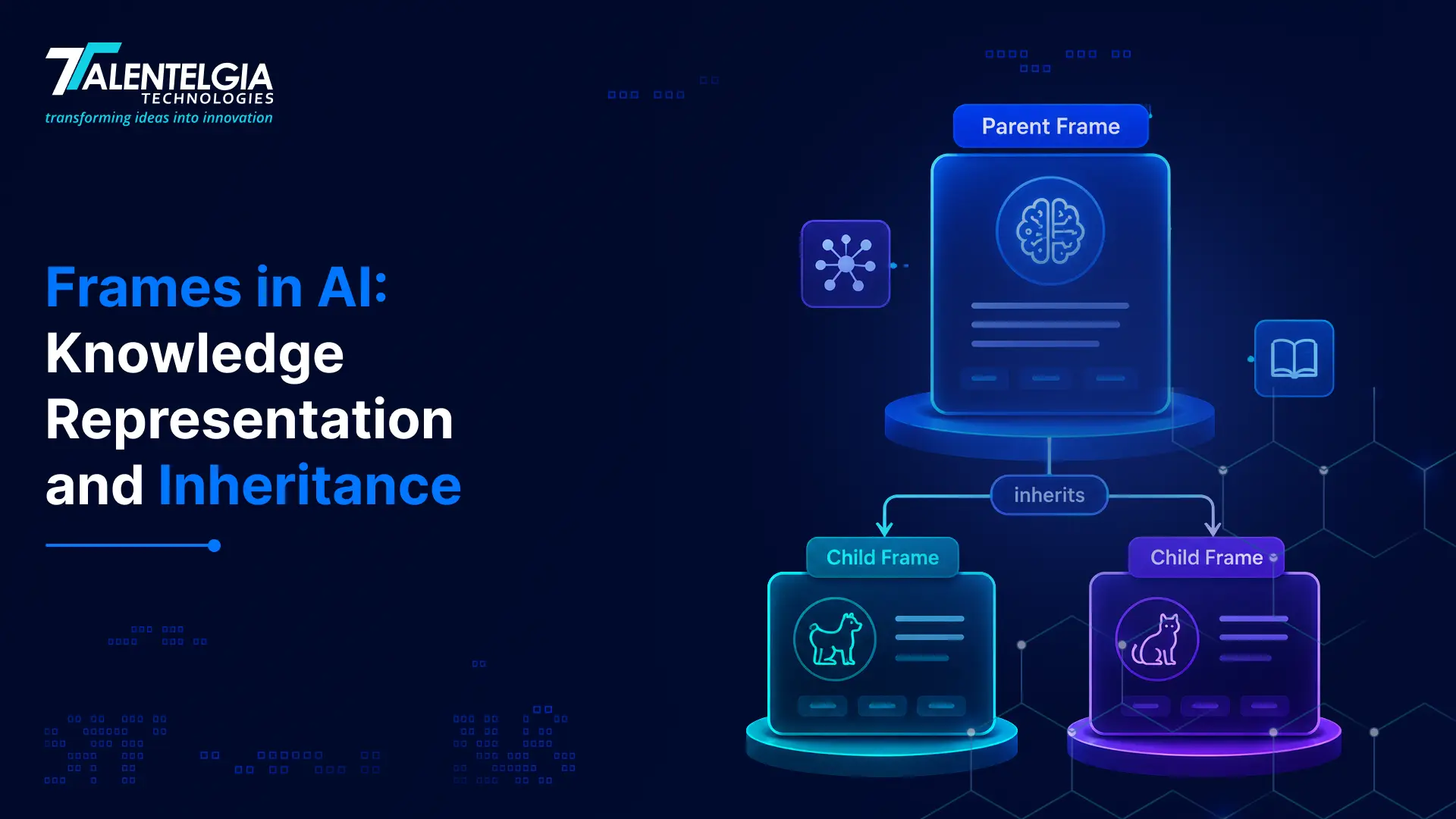
Every time an AI system identifies a dog, understands a customer complaint, or answers a context-aware question, it isn’t guessing. It’s drawing from structured knowledge. That structure has a name: frames in AI.
What are frames in artificial intelligence?
Well, frames are AI data structures used to divide knowledge into substructures by representing stereotyped situations. Rather than forcing machines to reason from isolated facts, frames group related information into structured templates, slots, and values that mirror how humans categorize and understand the world.
The concept was formally introduced by Marvin Minsky in 1974 in his landmark paper “A Framework for Representing Knowledge,” where he argued that human memory is not a massive lookup table but interconnected frames triggered contextually.
What makes frames in AI particularly powerful is that they represent organized, contextual, structured knowledge that supports intelligent reasoning under incomplete information.
In this blog, we’ll break down the structure of frames, how inheritance works across them, and why they remain foundational to modern AI systems.
Structure of a Frame
Frames in AI are structured knowledge representation units that organize information about objects, concepts, and situations into named slots that hold values, defaults, constraints, and procedural attachments. Every component serves a specific function. None of them are decorative.
Core Elements:
- Frame Name – The unique identifier for the concept being represented, such as “Dog” or “Employee.” It anchors the hierarchy and tells the reasoning system which template to activate when a matching situation arises.
- Slots – The attributes or properties of the concept. Facets define additional characteristics about how slots behave, including default values, acceptable ranges, and procedures that trigger when values change, making frames in AI far more powerful than simple data structures.
- Fillers – The values that fill in these slots. Fillers may consist of fixed values, default values that are applied whenever particular information is not available, processes that occur in certain conditions, and relationships to other frames.
- Default Values – Default logic is one of the strongest capabilities of frames. It allows intelligent operation despite the lack of information, without having all the attributes of an instance clearly specified.
- Procedural Attachments (Demons) – These make frames dynamic and capable of performing actions or inferences when slots are accessed or modified, making knowledge representation in AI active rather than passive. Three types exist:
- if-needed (fires when a value is missing)
- if-added (fires when a value is inserted)
- if-removed (fires when a value is deleted)
Together, these elements turn a frame from a static record into a living, reasoning structure.
Understanding Frame Inheritance
Frame inheritance is a method used in knowledge representation systems to manage and organize information efficiently. It allows one frame, “the child,” to inherit attributes and properties from another frame, “the parent,” creating a hierarchical structure that facilitates the reuse and extension of existing knowledge.
It’s simple: general properties defined once at the top flow automatically to every specific concept below, eliminating redundancy and keeping the knowledge base consistent.
Key concepts driving frame inheritance:
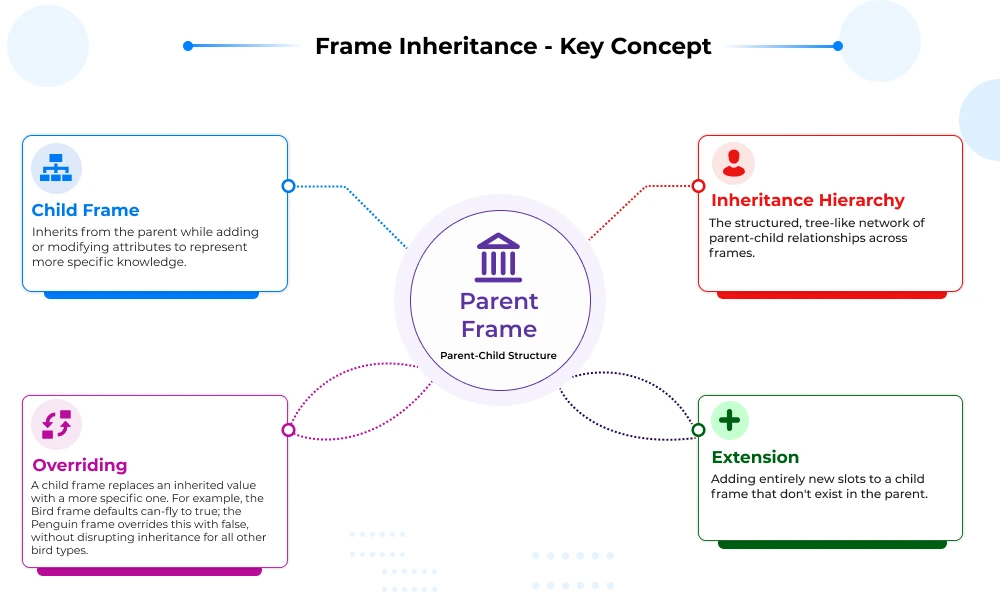
- Parent Frame – Holds common, generalizable attributes shared across all child frames beneath it
- Child Frame – Inherits from the parent while adding or modifying attributes to represent more specific knowledge
- Inheritance Hierarchy – The structured, tree-like network of parent-child relationships across frames
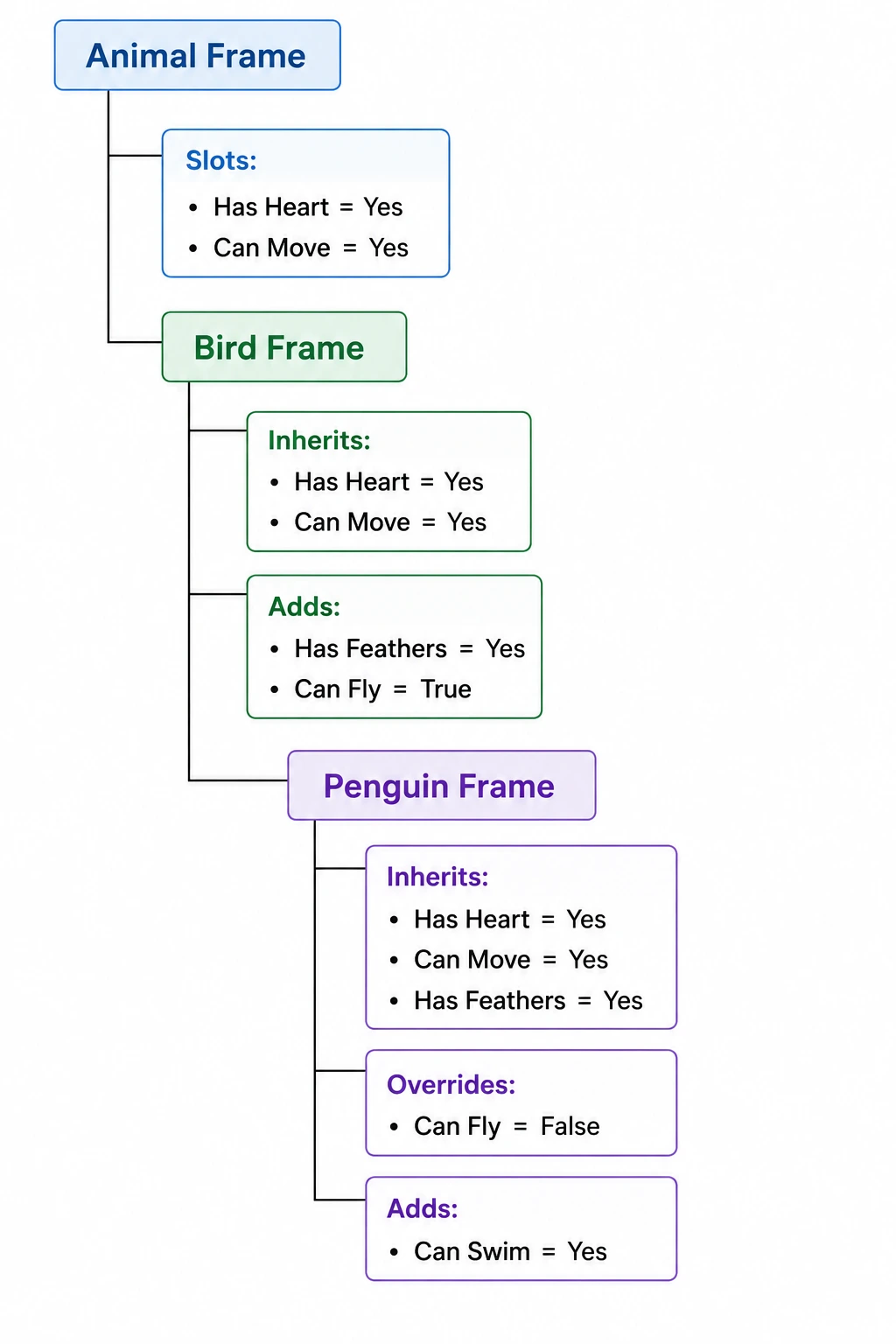
- Overriding – A child frame replaces an inherited value with a more specific one.
- Extension – Adding entirely new slots to a child frame that don’t exist in the parent.
Frame Inheritance Example
Types of Inheritance in Frames In AI
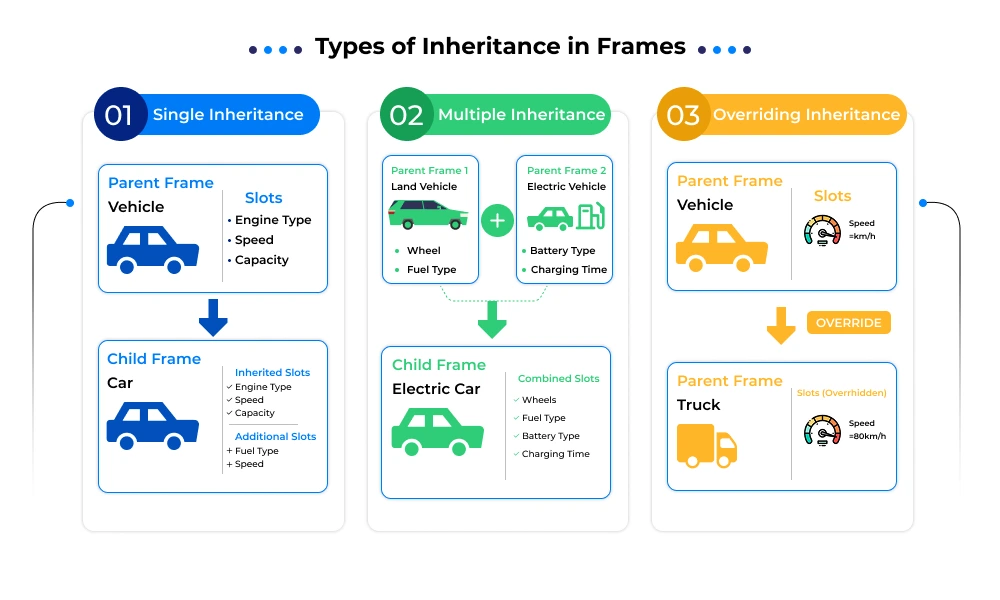
Frame inheritance operates in distinct modes depending on how knowledge flows between frames. Each child frame can inherit from one or multiple parent frames, forming a network of relationships where it can add new attributes or override existing ones to represent more specific information. Here are the three primary types:
1. Single Inheritance
A child frame inherits attributes from exactly one parent frame, following a strict linear hierarchy. It follows a linear hierarchical structure where the child acquires all slots from the parent and can extend them with its own specific attributes.
Example:
Parent Frame: Vehicle → Slots: engine type, speed, capacity
Child Frame: Car → Inherits all Vehicle slots + adds: fuel type, number of doors
The Car frame doesn’t redefine what a vehicle is. It builds on it. This keeps knowledge clean, non-redundant, and easy to maintain.
2. Multiple Inheritance
A child frame inherits attributes from more than one parent frame simultaneously, pulling knowledge from different sources into a single, unified structure. Multiple inheritance enables inheriting characteristics from several superclasses, increasing both expressiveness and complexity. When two parent frames conflict on the same slot, the system resolves it through specificity preference or explicit designer override.
Example:
Parent Frame 1: Land Vehicle → Slots: wheels, fuel type
Parent Frame 2: Electric Vehicle → Slots: battery type, charging time
Child Frame: Electric Car → Inherits from both, combining all slots into one coherent frame
This type is particularly powerful in domains like medical diagnosis, where a condition frame may need to inherit from both a symptom taxonomy and a treatment protocol hierarchy simultaneously.
3. Overriding Inheritance
Overriding occurs when a child frame modifies or replaces an attribute inherited from the parent frame with a more specific value or definition, without breaking or altering other child frames in the same hierarchy.
Example:
Parent Frame: Vehicle → speed = 100 km/h, capacity = 5 passengers
Child Frame: Truck → Overrides speed to 80 km/h, capacity to 3 tons
This override mechanism is what makes frame inheritance practical for real knowledge bases where general rules have important exceptions that must be represented accurately.
Advantages of Frames in AI Reasoning
Frames in AI provide an effective and organized manner in which knowledge can be represented and hence are very useful in AI in areas such as reasoning, decision-making, and understanding complex domains. Here’s exactly how:
1. Structured Inference
Frames eliminate the need to compute relationships from zero every single time. Instead, the AI simply walks down an existing knowledge hierarchy and pulls conclusions that are already baked in through inheritance and default values, faster, cleaner, and more consistent
2. Context-Aware Reasoning
Frames give AI a sense of the situation. When you ask a voice assistant something, it matches the keyword, activates the right frame, reads the context, and responds accordingly. That’s why the same word can trigger completely different responses depending on what’s being discussed.
3. Graceful Handling of Incomplete Data
Default values allow frames to work well even with partial output, along with being consistently logical and facilitating excellent reasoning even in ambiguous conditions. And that is a great capability in real-world deployments where complete output is not always present.
4. Explainability
When a frame-based system gives you an answer, you can actually see why it gave that answer. Which slot triggered it, which value it used, which parent frame it inherited from. Every step is visible and traceable. Compare that to a neural network, which gives you an output but can’t tell you how it got there. Frames in AI don’t have that problem. What the system knows, and how it uses that knowledge, is always on the surface.
5. Scalability and Reusability –
Once you’ve built a frame for, say, “Employee,” you don’t need to rebuild it every time a new system needs that concept. You reference it, extend it, tweak what’s needed, and move on. One well-defined frame can serve dozens of applications across the same system with no duplication or inconsistency.
6. Cognitive Alignment
Frames work the way human memory works. When you think of a “hospital,” your brain doesn’t search through random facts. It pulls up a ready-made mental structure: doctors, patients, wards, emergencies. Frames do the same thing for AI. That’s why AI built on frames feels less robotic. It’s organizing knowledge the same way we do.
Applications of Frame Inheritance in AI
1. Natural Language Processing (NLP)
Frame inheritance plays a vital role in NLP by establishing contextual relationships between words, phrases, and sentences, enabling semantic understanding by linking words to predefined frames, and helping AI models infer missing or implied information based on inherited knowledge in artificial intelligence. These capabilities are increasingly leveraged by a natural language processing company to build more accurate and context-aware AI solutions.
| Example: In practice, when a user types “Book a table for two at 7 PM,” the system doesn’t parse words in isolation. It activates a booking frame with pre-inherited slots for reservation type, party size, and time, generating an accurate response instantly. (a) Improves machine translation accuracy (b) Powers question-answering systems and chatbots (c) Supports named entity recognition by classifying words into structured categories |
2. Expert Systems
Early medical AI systems like MYCIN drew on structured knowledge about diseases, symptoms, and treatments using frames in AI, and the approach hasn’t changed, only evolved. Today, expert systems in medicine, law, and finance use frame inheritance to:
- Store domain-specific knowledge in organized parent frames
- Allow child frames for specific conditions to inherit and override general attributes
- Infer conclusions from partial data without requiring complete input every time
| Example: A disease diagnosis frame, for instance, holds general slots like symptoms, onset, and treatment. Specific diseases inherit these and add their own attributes, narrowing diagnosis systematically. |
3. Robotics
Robotic systems use situation frames in artificial intelligence to represent known scene types like kitchen, office, and warehouse, with slots for expected objects, typical spatial relationships, and associated action sequences, with scene understanding activating the appropriate frame to guide perception and action planning.
- Object recognition frames tell a robot how to grasp a fragile item vs. a heavy one
- Environmental frames define terrain types and movement constraints
- Task frames store step-by-step execution sequences for repeatable operations
| Example: An autonomous vehicle may use a general Vehicle frame containing attributes such as speed, fuel type, and navigation capabilities. A Self-Driving Car frame inherits these properties while adding AI-specific features like sensor data processing and machine learning-based decision-making. |
4. Semantic Web & Knowledge Graphs
Web ontologies built with OWL (Web Ontology Language) and RDF (Resource Description Framework) draw directly on frame concepts, representing classes with properties, default values, and inheritance hierarchies. Schema.org, the ontology used by Google, Bing, and other search engines to understand web content, is essentially a large frame-based knowledge representation system deployed at internet scale.
| Example: When Google recognizes a webpage as a recipe, it inherits structured properties such as ingredients, cooking time, nutritional information, and reviews from predefined schema classes, helping search engines display rich search results more accurately. |
Frames vs Ontologies
Frames are particularly effective for modeling stereotypical situations and supporting inheritance-based reasoning.
Ontologies, on the other hand, are designed to capture complex relationships and enable semantic interoperability across systems.
| Aspect | Frames | Ontologies |
|---|---|---|
| Primary Focus | Representing objects and situations | Representing concepts and relationships |
| Structure | Slots, fillers, and inheritance | Classes, properties, and axioms |
| Reasoning Style | Default values and inheritance | Logical inference and rule-based reasoning |
| Complexity | Relatively simple and intuitive | More expressive and formal |
| Scalability | Best for structured domains | Better suited for large knowledge networks |
| Common Technologies | Frame-based systems, expert systems | OWL, RDF, Protégé |
| Typical Applications | NLP, expert systems, robotics | Knowledge graphs, semantic web, healthcare ontologies |
Where Frames Fall Short: Limitations and Challenges
1. Limited Expressiveness
Frames in AI handle well-defined, structured knowledge cleanly. But push them toward complexity, and they buckle. Frames may not be able to represent all types of knowledge, particularly uncertain or ambiguous knowledge, the kind that’s better handled by Bayesian networks or formal logic systems.
Example – A frame can tell you a person is over 65, but it can’t easily reason: “qualifies for retirement benefits unless still employed.” That conditional logic requires more than slots and values.
2. Inheritance Conflicts
When a child frame inherits conflicting attributes from multiple parent frames, ambiguity arises over which value takes precedence, and if multiple frames define the same attribute differently, the system can produce contradictory knowledge that is time-consuming and computationally expensive to debug.
3. Scalability Bottlenecks
Frames in artificial intelligence work well when the knowledge base is manageable. But as the system grows, hundreds of disease frames, thousands of legal precedent frames, millions of product frames — the cracks start to show. Every query now has to search through a much larger hierarchy. Every update risks breaking connections across dozens of related frames. The more frames you add, the heavier the system gets, and at a certain point, performance slows to the point where it becomes a real operational problem.
4. Static by Design
Frames store predefined knowledge. They don’t adapt on the fly. In fields like medicine or technology where discoveries emerge frequently, updating frame-based knowledge can be cumbersome, and a conversational AI using frames may fail when a user shifts topics mid-dialogue.
Wrapping Up
Frames in AI may not grab headlines like generative AI development or large language models, but their influence is everywhere. From helping AI understand context and handle incomplete information to organizing knowledge in a way that supports reasoning, frames introduced ideas that remain relevant decades later. As AI systems become more advanced, the need for structured, explainable knowledge becomes even more important.
As businesses explore ways to combine structured knowledge with modern AI technologies, expert AI consulting services can help identify the right frameworks, architectures, and implementation strategies. At Talentelgia, we help organizations design intelligent, scalable AI solutions that balance innovation with explainability and long-term business value.











 Sales Enquiries:
  Business queries:
  HR:
HR: 


