



 Healthcare Software Development Services
 Healthcare App Development Services
 Real Estate Web Development Services
 Real Estate App Development Company
 E-Commerce App Development Services
 E-Commerce Web Development Services
 Blockchain E-commerce Development Company
 Fintech Software Development
 Fintech App Development Services
 E-Learning App Development Services
 Restaurant App Development Company
 Mobile Game Development Company
 Travel App Development Company
 Automotive Web Design
 AI Traffic Management System
 AI Inventory Management Software
 Logistics App Development Services
 Machine Learning Development
 ChatGPT integration services
  AI Development Company
  AI Integration Services
  Natural Language Processing Company
 Mobile App Development
  IOS App Development
  Android App Development
  Cross-Platform App Development
  Augmented Reality (AR) App Development
  Virtual Reality (VR) App Development
  Web App Development
  SaaS App Development
 Custom Software Development Services
  Flutter
  React Native
  Swift (IOS)
  Kotlin (Android)
  Mean Stack Development
  AngularJS Development
  MongoDB Development
  Nodejs Development
  Database Development
 Ruby on Rails Development
 Expressjs Development
  Full Stack Development
  Web Development Services
  Laravel Development
  LAMP Development
  Custom PHP Development
  .Net Development
  User Experience Design Services
  User Interface Design Services
  Automated Testing
  Manual Testing
  Digital Marketing Services
 Ride-Sharing And Taxi Services
 Food Delivery Services
 Grocery Delivery Services
 Transportation And Logistics
 Car Wash App
 Home Services App
 ERP Development Services
 CMS Development Services
 LMS Development
 CRM Development
 DevOps Development Services
 AI Business Solutions
 AI Cloud Solutions
 AI Chatbot Development
 API Development
 Blockchain Product Development
 Cryptocurrency Wallet Development
 About Talentelgia
  Our Team
  Our Culture
 Healthcare App Development Services
 Real Estate Web Development Services
 E-Commerce App Development Services
 E-Commerce Web Development Services
 Blockchain E-commerce
Development Company
Blockchain E-commerce
Development Company Fintech App Development Services
 Blockchain Fintech
Development Company
Blockchain Fintech
Development Company E-Learning App Development Services
 Restaurant App Development Company
 Mobile Game Development Company
 Travel App Development Company
 AI Traffic Management System
 AI Inventory Management Software
 AI Development Company
 ChatGPT integration services
 AI Integration Services
 Machine Learning Development
 Machine learning consulting services
 Blockchain Development
 Blockchain Software Development
 Smart contract development company
 NFT marketplace development services
 Asset tokenization companies
 DeFi Wallet Development Company
 IOS App Development
 Android App Development
 Cross-Platform App Development
 Augmented Reality (AR) App
Development
Augmented Reality (AR) App
Development Virtual Reality (VR) App Development
 Web App Development
 Flutter
 React
Native
React
Native Swift
(IOS)
Swift
(IOS) Kotlin (Android)
 MEAN Stack Development
 AngularJS Development
 MongoDB Development
 Nodejs Development
 Database development services
 Expressjs Development
 Full Stack Development
 Web Development Services
 Laravel Development
 LAMP
Development
LAMP
Development Custom PHP Development
 User Experience Design Services
 User Interface Design Services
 Automated Testing
 Manual
Testing
Manual
Testing About Talentelgia
 Our Team
 Our Culture
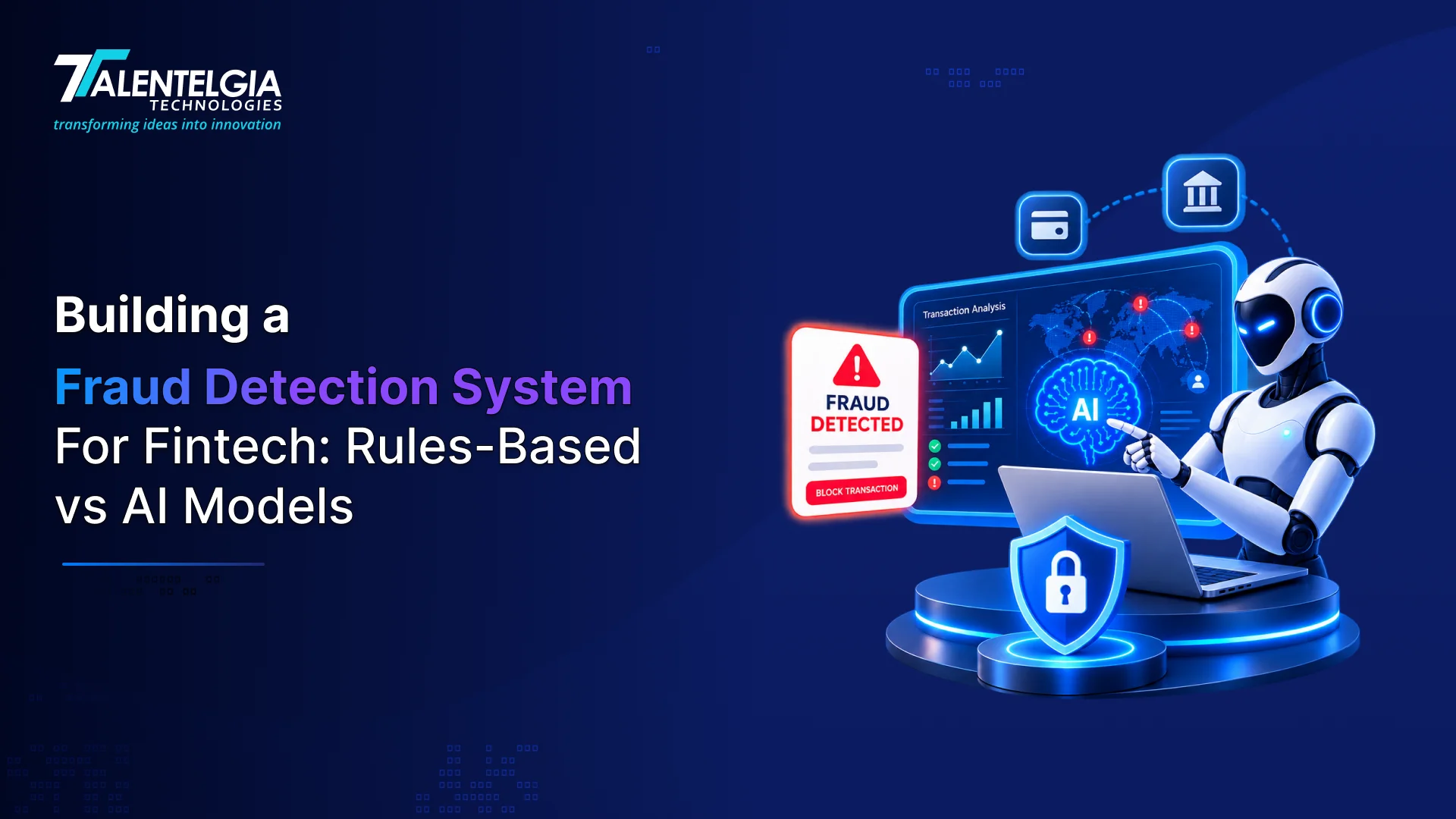
Every growth-stage fintech reaches the same fork in the road. Rules-based systems catch known fraud reliably, but they struggle against new attack patterns. AI models adapt to fraud that has never been seen before. They cost more to build and are harder to explain. The real question is not “rules or AI.” It is which architecture fits your transaction volume, fraud complexity, and the broader fintech development requirements of your product. Data maturity and regulatory exposure matter just as much.
Rules give you speed, transparency, and predictable audit trails. AI gives you adaptability and fewer false positives at scale. That comes at the cost of governance overhead and explainability work. Most fintechs handling meaningful transaction volume end up needing both. They layer the two deliberately, rather than bolting them together later. This article compares both approaches honestly and covers the trade-offs that matter. It closes with a framework for choosing rules-based detection, AI fraud detection, or a hybrid fintech fraud detection software architecture.
What Is Rules-Based Fraud Detection?
Rules-based fraud detection flags transactions using predefined conditions written by fraud and risk analysts. A rule says: if this condition is true, take this action. No learning happens. No probability is estimated. The logic is fixed until someone changes it.
Common rule types include:
- Velocity rules – block a card after five transactions in ten minutes
- Threshold-based detection – flag any transfer above a set dollar amount
- Signal-based checks – combine IP address anomalies, device fingerprinting, and location mismatches to catch account takeover attempts
Rules engines sit inside transaction monitoring pipelines and evaluate every event against a rule set in sequence. When a rule’s condition matches, the system executes an action: block, flag for review, or step up authentication. This structure makes rules fast to build and easy to explain to auditors, compliance teams, and regulators.
The tradeoff is maintenance. As fraud patterns shift, analysts must write new rules or adjust thresholds manually. Rule sets grow over years into large, overlapping libraries that are hard to test and easy to break.
What Is AI Fraud Detection?
AI fraud detection uses machine learning models trained on historical transaction data. The goal is to estimate the probability that a given transaction is fraudulent. Instead of fixed conditions, the system learns patterns from labeled examples of fraud and legitimate activity.
Two broad techniques matter here:
- Supervised machine learning – trains on transactions already labeled as fraud or not fraud. It learns which features predict risk
- Unsupervised machine learning and anomaly detection – looks for behavior that deviates from a customer’s normal pattern. It needs no prior fraud labels, which helps catch new fraud types
AI fraud detection systems draw on several signal types:
- Device and behavioral signals
- Identity and account signals
- Transaction history
- Third-party data sources
Feature engineering translates raw data, like typing speed, session length, or purchase category, into inputs a model can use. Graph-based fraud detection maps relationships between accounts, devices, and payment instruments. It exposes fraud rings that look isolated in transaction-level data alone.
Because AI models estimate probability rather than apply fixed logic, they can generalize to fraud patterns the rules never anticipated. That adaptability is the core argument for AI fraud detection in fast-growing fintech environments. It comes with real costs in data requirements, infrastructure, and governance, making the choice of architecture an important consideration when evaluating fintech software development services.
Where Rules-Based Fraud Detection Works Best
Rules-based systems remain the right choice in specific situations. This isn’t because they’re outdated. They solve certain problems better than AI does.
Rules work best when:
- Fraud patterns are well understood and stable – a known typology, like structuring transactions to avoid a reporting threshold, is easy to encode as a rule
- Historical data is limited – a new fintech without years of labeled transaction history can’t train an accurate AI model, but it can deploy sensible rules on day one
- Regulators demand full explainability – a compliance officer can point to the exact condition that triggered a block and explain it in plain language during an audit, which matters under frameworks like the FCA’s financial crime guidance
- Speed to deploy matters most – a new velocity rule or threshold can go live in hours, not the weeks a model retraining cycle requires
Where AI Fraud Detection Outperforms Rules
AI fraud detection earns its complexity where rules genuinely fall short.
- Emerging fraud – fraudsters test and evolve tactics constantly. Static rules can’t anticipate a pattern that’s never occurred. AI models built on behavioral and anomaly detection can flag deviations from normal activity, even without a prior labeled example
- Growing transaction volume – at scale, rule sets become unmanageable. Hundreds of overlapping conditions slow investigation and increase false positives. AI compresses that complexity into a single risk score built from many weighted signals
- False-positive reduction – once properly trained and tuned, models weigh dozens of signals simultaneously instead of applying binary conditions. That distinguishes unusual-but-legitimate behavior from actual fraud with more nuance
- Multi-market operations – fintechs running across multiple markets, payment rails, or product lines benefit from AI’s ability to generalize across contexts where rules would otherwise need to be duplicated
Rules-Based vs AI Fraud Detection: A Full Comparison
Choosing between rules-based and AI-driven approaches in fintech software development means weighing several trade-offs together. Detection logic, cost, speed, and governance all matter, not any single factor in isolation.
| Factor | Rules-Based Detection | AI Fraud Detection |
| Detection logic | Fixed conditions, manually defined | Learned patterns, probability-based |
| Known vs emerging fraud | Strong on known patterns | Strong on emerging, unseen patterns |
| Speed to implement | Hours to days | Weeks to months, plus training data |
| Data requirements | Minimal historical data needed | Large, labeled historical datasets |
| Explainability | Fully transparent, rule-level | Requires explainable AI techniques |
| Adaptability | Static until manually updated | Improves through retraining |
| Investigation workflow | Direct, rule-to-action mapping | Requires score interpretation tools |
False Positives, False Negatives, and Detection Accuracy
Rules tend to produce more false positives because fixed thresholds cannot account for context. A large but legitimate transaction can trigger the same rule as a fraudulent one. Industry reporting on transaction monitoring consistently shows high false-positive volumes driving up investigation costs across financial institutions.
AI models, once tuned on sufficient data, generally reduce false positives by weighing context alongside the transaction amount. But AI introduces its own risk: false negatives from underrepresented fraud types in the training data. A model only detects patterns similar to what it has seen, unless paired with unsupervised anomaly detection.
| Outcome | Rules-Based Risk | AI-Based Risk |
| False positives | Higher, from rigid thresholds | Lower, but depends on tuning |
| False negatives on known fraud | Low | Low to moderate |
| False negatives on novel fraud | High | Lower, if anomaly detection is used |
Real-Time Transaction Decisioning, Latency, and Infrastructure
Rules-based checks run fast because they evaluate simple conditions against incoming data. Real-time scoring with AI models demands more. It needs a feature store to serve fresh signals instantly. It also needs low-latency inference infrastructure and an event-driven architecture. That architecture must process transactions as streams rather than batches.
Fintechs building real-time transaction decisioning with AI need to invest in this infrastructure first. The model itself only delivers value once that groundwork exists. Without it, even an accurate model cannot score a transaction fast enough to block it before settlement.
Explainability, Governance, and Model Monitoring
Explainability is where AI fraud detection faces the most regulatory friction. Three frameworks shape what’s expected:
NIST AI Risk Management Framework – NIST organizes AI governance around four functions: Govern, Map, Measure, and Manage. Treats explainability as a core risk factor for institutions deploying AI in high-impact decisions.
US: OCC Bulletin 2011-12 / SR 11-7 – It requires institutions to understand the theory behind a model’s outputs, not just its aggregate accuracy. A black-box model that can’t explain a specific flagged transaction creates real audit exposure.
UK: FCA guidance – It prioritizes AI explainability and senior-manager oversight over rigid, prescriptive AI rules. The expectation is accountability for outcomes, not a fixed rulebook.
Model monitoring matters as much as initial validation, for a few reasons:
- Fraud patterns shift, and a model’s performance degrades over time without ongoing measurement
- Institutions increasingly build explainable AI techniques and model monitoring into the deployment pipeline itself, not as an afterthought
- Treating explainability as a fintech security requirement, not a compliance checkbox, keeps this work from becoming a bottleneck later
| Need help designing a governance layer that holds up under audit? Our fintech development agency builds decision engines and monitoring infrastructure that satisfy both engineering and compliance requirements from day one. |
Rule Maintenance vs Model Retraining and Concept Drift
Rules degrade through sprawl. Every new fraud pattern adds another rule. Over years, rule sets become dense, overlapping, and hard to test without breaking something else. Nobody fully understands the whole rule set anymore.
AI models degrade differently, through concept drift. Fraud tactics and customer behavior shift over time. A model trained on last year’s data slowly loses accuracy on this year’s transactions. Retraining pipelines need to run on a defined cadence, not only when performance visibly drops. Getting that cadence right is where fintech development work earns its keep, building automated retraining triggers instead of relying on someone noticing a drop in accuracy.
Neither maintenance burden disappears. They just take different forms: rule sprawl versus retraining discipline.
Human Review, Analyst Feedback Loops, and Case Management
Both approaches need human-in-the-loop review, but the workflows differ. Rules produce direct, explainable flags that analysts can act on immediately inside a case management system. AI produces risk scores that analysts must interpret, often supported by explainable AI outputs showing which signals drove the score.
Feedback loops matter more with AI. Analyst decisions on flagged cases should feed back into model retraining, improving future accuracy. Building that loop well usually calls for automation between the case management tool and the training pipeline, so analyst decisions don’t sit in a spreadsheet waiting to be reprocessed manually. Rules-based systems benefit from analyst feedback too, but the update process stays manual rather than running through an automated training pipeline.
Scalability and Cost as Transaction Volume Grows
Rules scale predictably in compute cost but not in operational cost. Every additional rule adds review volume and complexity for the analyst team. At high transaction volumes, rule-based systems often need more human reviewers just to keep pace.
AI scales more efficiently in operational terms once trained. A single model can evaluate millions of transactions without proportional headcount growth. The upfront and ongoing costs shift instead toward infrastructure, data science talent, and model governance.
Also Read: How AI Can Automate KYC, Fraud Detection & Customer Support in Fintech Applications
When to Use Rules, AI, or a Hybrid Fraud Detection Architecture
There is no universal answer here. The right approach depends on transaction volume, fraud complexity, available data, engineering maturity, and regulatory requirements.
Use rules-based fraud detection when
- Transaction volume is still modest, and fraud patterns are well understood.
- You lack sufficient labeled historical data to train a reliable model.
- Regulatory explainability requirements demand fully transparent decision logic.
- Engineering resources are limited and speed to deployment matters most.
Consider AI fraud detection when
- Transaction volume has grown enough that rule sets are unmanageable.
- You are seeing novel fraud patterns that existing rules consistently miss.
- False positives are creating real customer friction or review costs.
- You have the engineering maturity to build and monitor real-time scoring infrastructure.
A hybrid fraud detection architecture makes sense when
- You need the transparency of r ules for regulatory-critical decisions and the adaptability of AI for emerging threats.
- You want to use rules as a fast first-pass filter, then route ambiguous transactions to an AI-based decision engine.
- Your fraud environment includes both well-known typologies and evolving attack patterns simultaneously.
- You are scaling across multiple markets or products with different fraud profiles.
In practice, most established fintech enterprises converge on a hybrid model. Rules act as a deterministic first layer, catching clear-cut fraud and enforcing hard regulatory limits. AI fraud detection sits behind that layer, scoring the transactions rules cannot confidently resolve. This combination supports stronger financial fraud prevention than either approach running alone, while keeping explainability intact where it matters most.
Build vs Buy vs Integrate: Choosing Your Fraud Detection Approach
Fintech leaders choose between four paths, each trading control against speed and cost.
Build in-house
- What you get: full control over model logic, decision workflows, and data ownership
- What it costs: significant internal engineering capacity, ongoing data science investment, and time
- The catch: for a growth-stage fintech, this investment competes directly with core product development
Buy a third-party platform
- What you get: fast time to market and outsourced model maintenance
- What it costs: vendor dependency
- The catch: less control over custom fraud logic tailored to your specific product and customer base
Integrate specialized services
- What you get: third-party identity verification, device intelligence, or fraud scoring APIs plugged into your own stack
- What it costs: integration work, but not full build cost
- The catch: you keep your own decision orchestration layer while pulling in specialized signals you couldn’t build efficiently yourself
Hybrid stack
- What you get: internal control over the pieces that matter most, external intelligence for everything else
- What it costs: more architectural planning upfront
- The catch: this is where most established fintechs land, once volume and complexity outgrow a single-path approach
| Approach | Time to Market | Control | Cost Over Time | Best Fit |
| Build | Slow | Full | High, ongoing | High-volume, unique fraud profile |
| Buy | Fast | Low | Predictable subscription | Early-stage, standard fraud patterns |
| Integrate | Moderate | Partial | Scales with usage | Growth-stage, custom workflows |
| Hybrid | Moderate | High | Balanced | Established fintechs with complex needs |
Most growth-stage fintechs land on integration or a hybrid stack: a custom decision engine built internally, connected to external fraud intelligence APIs and machine learning capabilities where building from scratch wouldn’t be efficient. Discussing these factors with a fintech software development company can help you understand what your product actually needs, whether that means building core capabilities, integrating specialized services, or taking a hybrid approach.
Weighing build vs. buy for your fraud stack? Talentelgia’s fintech software development services connect internal systems, third-party data, and AI models into one coherent architecture, built around your actual transaction environment, not a generic off-the-shelf platform.
How to Evaluate the Right Fintech Fraud Detection Software for Your Business
Work through these four checks, in order. Skipping ahead to the technology before the data leads to the wrong architecture.
1. Map your fraud data
Identify the fraud types you currently see, their frequency, and how well existing controls catch them. This baseline determines whether rules, AI, or a hybrid setup makes sense.
2. Assess your data maturity
Do you have enough labeled historical transactions to train a reliable model? If not, rules-based detection or a vendor platform makes more sense as a starting point. Add AI once sufficient data accumulates.
3. Evaluate engineering capacity honestly
Real-time scoring, feature stores, and model monitoring need sustained investment, not a one-time build. If that capacity doesn’t exist internally, integrating with specialized fraud detection services or a fintech development services provider closes the gap faster than hiring from scratch.
4. Weigh your regulatory environment
Fintechs under strict explainability requirements need rules or explainable AI methods built in from the start. Fintech security and compliance should shape the architecture from day one, not get retrofitted after a regulator asks how a decision was made.
Conclusion
Rules-based and AI-driven fraud detection are not competing philosophies. They are tools suited to different parts of the same problem. Rules give you speed, transparency, and control over known fraud. AI gives you adaptability against fraud you have not seen yet. Most fintechs handling real transaction volume end up needing both, deliberately architected rather than stitched together after the fact.
The right fintech fraud detection software architecture depends on your transaction volume, data maturity, engineering capacity, and regulatory obligations. It does not depend on which approach sounds more advanced.
Talentelgia’s fintech development teams design and build fraud detection architectures, spanning rules engines, AI model integration, and hybrid decision systems, matched to how your business actually operates. If you’re evaluating your current fraud stack or planning your next architecture, that’s a conversation worth having early.
FAQs
Neither is universally better. Rules offer transparency and speed for known fraud patterns, which matters for regulatory audits. AI fraud detection adapts better to emerging fraud that rules were never built to catch, but it requires more data, infrastructure, and governance. Most fintechs choosing fintech fraud detection software end up combining both, using rules for known cases and AI for everything else. The right mix depends on your transaction volume and data maturity.
There’s no fixed number, but most fintechs need several months of labeled transaction history with enough fraud examples to train a reliable model. Without sufficient data, AI fraud detection produces unreliable scores and more false negatives on real fraud. Fintechs with limited history are usually better served by rules-based detection or a vendor platform first, introducing AI fraud detection once enough labeled data accumulates to support proper model training and validation.
Yes. We can design a hybrid fraud detection architecture where rules act as a fast first-pass filter and AI evaluates transactions that require deeper risk scoring. As a fintech software development company, Talentelgia can structure the rules engine, AI integration, real-time decisioning, case management, and supporting APIs around the fintech product’s transaction environment. This approach combines the transparency of rules with the adaptability of AI without requiring the entire fraud detection workflow to depend on a single method.
Rigid thresholds that ignore context are the most common cause in rules-based systems, a large but legitimate transaction can trigger the same rule as a fraudulent one. AI fraud detection reduces this by weighing multiple signals together instead of applying binary conditions, but poor tuning or unbalanced training data can still produce false positives. Getting this right directly affects both customer experience and financial fraud prevention outcomes at scale.
Regulators increasingly expect explainability wherever AI fraud detection drives customer-facing decisions. The NIST AI Risk Management Framework treats model transparency as a core governance requirement, and guidance from the FCA and OCC follows a similar direction. Fintechs deploying AI fraud detection for financial fraud prevention need to document how models reach decisions, not just report overall accuracy, to satisfy fintech security and compliance expectations during regulatory review.
It depends on engineering capacity, time-to-market requirements, transaction volume, and how unique the company’s fraud profile is. We evaluate these factors before determining whether a fintech should build core detection capabilities, integrate specialized fraud services, or use a hybrid approach. As a fintech app development company, Talentelgia can also build the surrounding application architecture so fraud detection works as part of the broader transaction, authentication, and user workflow rather than as an isolated feature.
Concept drift happens when a model’s accuracy degrades over time because fraud patterns and customer behavior change. An AI fraud detection model trained on last year’s data slowly loses accuracy on this year’s transactions if left untouched. Regular retraining, ongoing model monitoring, and fresh labeled data keep detection accuracy intact, which is essential for fintechs relying on machine learning for financial fraud prevention at scale.
Talentelgia approaches fraud detection as part of the broader fintech product architecture. Our team can develop transaction workflows, rules-based detection, AI fraud detection integrations, real-time decision engines, fraud intelligence API integrations, and security controls based on the product’s requirements.











 Sales Enquiries:
  Business queries:
  HR:
HR: 


