



 Healthcare Software Development Services
 Healthcare App Development Services
 Real Estate Web Development Services
 Real Estate App Development Company
 E-Commerce App Development Services
 E-Commerce Web Development Services
 Blockchain E-commerce Development Company
 Fintech Software Development
 Fintech App Development Services
 E-Learning App Development Services
 Restaurant App Development Company
 Mobile Game Development Company
 Travel App Development Company
 Automotive Web Design
 AI Traffic Management System
 AI Inventory Management Software
 Logistics App Development Services
 Machine Learning Development
 ChatGPT integration services
  AI Development Company
  AI Integration Services
  Natural Language Processing Company
 Mobile App Development
  IOS App Development
  Android App Development
  Cross-Platform App Development
  Augmented Reality (AR) App Development
  Virtual Reality (VR) App Development
  Web App Development
  SaaS App Development
 Custom Software Development Services
  Flutter
  React Native
  Swift (IOS)
  Kotlin (Android)
  Mean Stack Development
  AngularJS Development
  MongoDB Development
  Nodejs Development
  Database Development
 Ruby on Rails Development
 Expressjs Development
  Full Stack Development
  Web Development Services
  Laravel Development
  LAMP Development
  Custom PHP Development
  .Net Development
  User Experience Design Services
  User Interface Design Services
  Automated Testing
  Manual Testing
  Digital Marketing Services
 Ride-Sharing And Taxi Services
 Food Delivery Services
 Grocery Delivery Services
 Transportation And Logistics
 Car Wash App
 Home Services App
 ERP Development Services
 CMS Development Services
 LMS Development
 CRM Development
 DevOps Development Services
 AI Business Solutions
 AI Cloud Solutions
 AI Chatbot Development
 API Development
 Blockchain Product Development
 Cryptocurrency Wallet Development
 About Talentelgia
  Our Team
  Our Culture
 Healthcare App Development Services
 Real Estate Web Development Services
 E-Commerce App Development Services
 E-Commerce Web Development Services
 Blockchain E-commerce
Development Company
Blockchain E-commerce
Development Company Fintech App Development Services
 Blockchain Fintech
Development Company
Blockchain Fintech
Development Company E-Learning App Development Services
 Restaurant App Development Company
 Mobile Game Development Company
 Travel App Development Company
 AI Traffic Management System
 AI Inventory Management Software
 AI Development Company
 ChatGPT integration services
 AI Integration Services
 Machine Learning Development
 Machine learning consulting services
 Blockchain Development
 Blockchain Software Development
 Smart contract development company
 NFT marketplace development services
 Asset tokenization companies
 DeFi Wallet Development Company
 IOS App Development
 Android App Development
 Cross-Platform App Development
 Augmented Reality (AR) App
Development
Augmented Reality (AR) App
Development Virtual Reality (VR) App Development
 Web App Development
 Flutter
 React
Native
React
Native Swift
(IOS)
Swift
(IOS) Kotlin (Android)
 MEAN Stack Development
 AngularJS Development
 MongoDB Development
 Nodejs Development
 Database development services
 Expressjs Development
 Full Stack Development
 Web Development Services
 Laravel Development
 LAMP
Development
LAMP
Development Custom PHP Development
 User Experience Design Services
 User Interface Design Services
 Automated Testing
 Manual
Testing
Manual
Testing About Talentelgia
 Our Team
 Our Culture
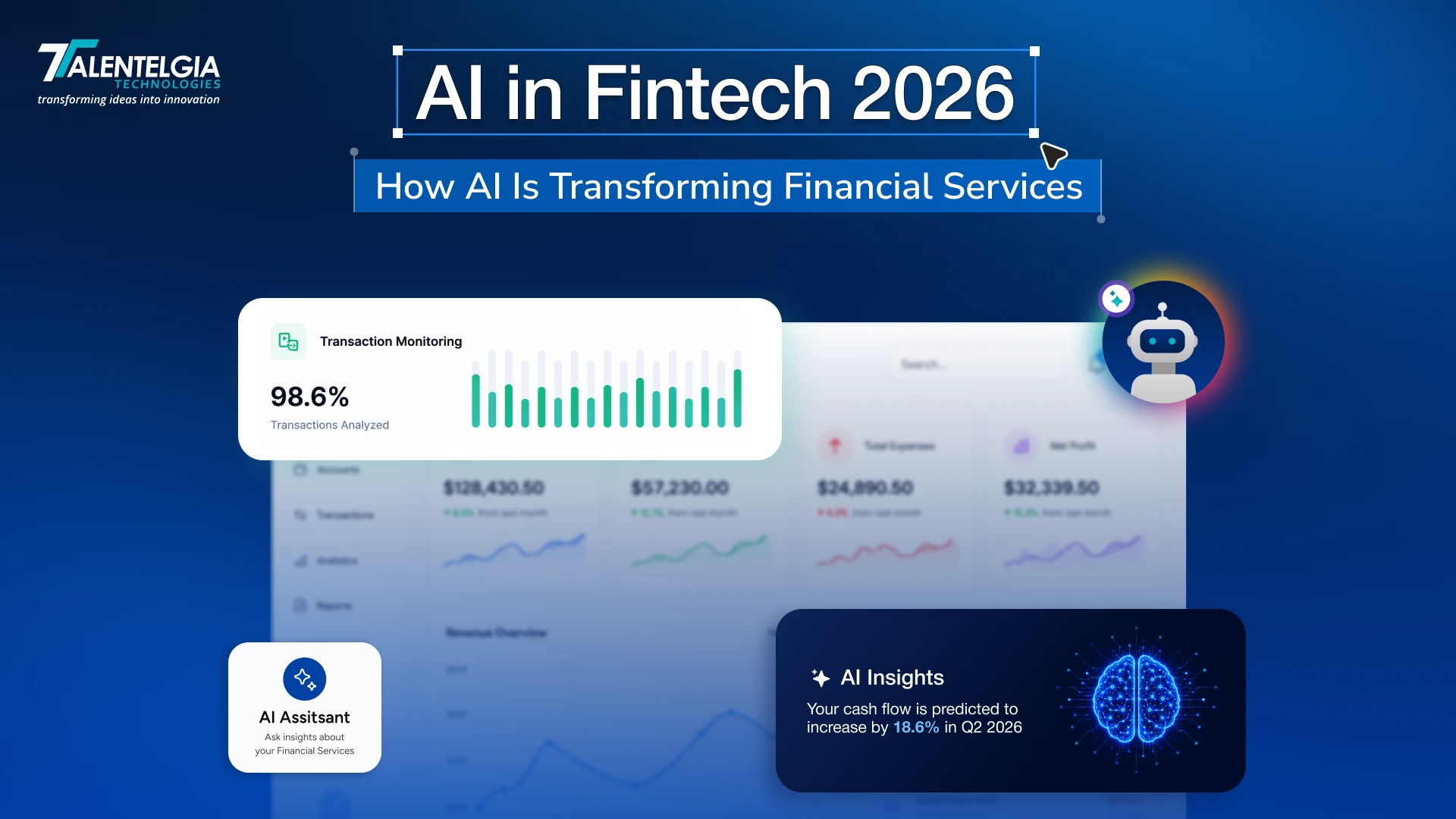
- $36.61 billion is the size of the global AI-in-fintech market in 2026, projected to hit $99.09 billion by 2031
- $40 billion – fraud: Visa’s AI systems blocked in a single fiscal year
- 81% of financial institutions are already using AI in some form, though only 14% call it transformational to strategy
The numbers say AI has arrived in fintech. The gap between “using it” and “transformed by it” says the real work is still ahead. AI in fintech has moved past chatbots and rule-based automation. It’s approving loans in minutes instead of days, catching fraud in real time before damage is done, and running early agentic workflows with only light human oversight. Traditional automation follows fixed rules; AI-powered platforms learn from data and adapt without reprogramming. That difference is now the line separating fintech companies that compete on speed from the ones playing catch-up.
This piece breaks down where AI is genuinely creating value in fintech, the risks worth taking seriously, and what actually goes into building it.
What Is AI in Fintech?
AI in fintech means applying machine learning, natural language processing, and predictive analytics to financial products and operations, not as a bolt-on feature, but as the engine behind decisions that used to need a human specialist. A traditional fintech system runs on fixed rules: if X, then Y. An AI-powered one learns from transaction histories, spending behavior, and market data, then adapts as new information comes in without anyone rewriting the code.
In practice, that shows up as:
- Fraud detection that flags anomalies the moment they happen, not after a chargeback
- Credit scoring that weighs hundreds of data points instead of a handful
- Trading systems that adjust strategy as markets move, in real time
- Compliance tools that track shifting regulations without a manual policy update
- Customer service that runs on natural conversation, not a phone menu
8 Use Cases of AI in Fintech
1. Fraud Detection and Prevention
This is the most mature use case in fintech, for good reason. And the cost of getting it wrong is enormous. Consumers reported losing $12.5 billion to fraud in 2024, a 25% jump from the year before, per the FTC’s Consumer Sentinel Network data. AI systems address this by scoring transactions in real time against device signals, behavioral patterns, and account history, flagging anomalies before money moves.
Real example: Visa’s AI-powered fraud systems reportedly blocked roughly $40 billion in fraudulent transactions in a single fiscal year, a scale no rules-based system could match.
2. Credit Scoring and Underwriting
Traditional credit scoring leans on a narrow set of inputs: credit history, income, existing debt. AI-based underwriting expands that lens, considering transaction patterns, cash flow, and alternative data sources to assess borrowers who’d otherwise be invisible to conventional models. Lenders like Upstart have built entire underwriting businesses around this approach, aiming to extend credit access without simply loosening risk standards.
3. Conversational AI and Customer Experience
AI-powered assistants now handle far more than FAQs, balance checks, transaction disputes, personalized nudges, and multi-turn account servicing, all without a human in the loop for routine cases.
Real example: Bank of America’s virtual assistant, Erica, is one of the most widely cited deployments of conversational AI in banking, handling millions of client interactions since launch.
4. Algorithmic Trading
AI-driven trading systems process market data, news sentiment, and historical patterns at a speed and scale no human desk can match, executing trades based on statistical signal rather than gut instinct.
Real example: Renaissance Technologies’ Medallion Fund has generated average annual returns of roughly 66% since 1988, using quantitative models built on data analysis, one of the most cited results in algorithmic trading.
5. RegTech and AML Compliance
New regulations keep on coming, and old ones get updated from time to time. Compliance teams can not really manually review every transaction that comes through, especially at the volume banks deal with today. That’s where AI-driven RegTech tools earn their keep. They scan the transactions for money laundering, keep pace with regulatory changes as they happen, and log everything in an audit trail without someone updating a spreadsheet by hand.
Real example: Take JPMorgan’s COIN system. Before it existed, reviewing commercial loan agreements ate up around 360,000 hours of lawyers’ and loan officers’ time every single year. COIN cut that down to seconds.
6. Document Intelligence and KYC
Onboarding a new customer seems pretty simple until you do it yourself. It’s a hectic process involving verifying ID documents, cross-checking records, and catching certain inconsistencies that signal something’s off. These tasks usually take at least one person who reads everything by hand. AI-based document intelligence does the heavy lifting now. It pulls out the relevant fields, flags mismatches, and sends only the genuinely tricky cases to a human. Faster onboarding, without skipping the verification that actually matters.
Real example: Identity-verification platforms like Socure look at things like device behavior and velocity patterns to tell a real applicant from a fraudulent one, in real time, not after the fact.
7. Hyper-Personalization
AI analyzes a customer’s spending behavior, financial goals, and risk tolerance to recommend products that actually fit them, instead of offering everyone the same savings account or credit card. That might mean a personalized savings nudge, a credit offer suited to someone’s actual repayment ability, or an investment suggestion based on real financial data, not a generic profile.
8. Agentic AI Workflows
This is the newest piece of the puzzle, and it’s moving fast. Older AI tools answer questions or flag something odd. Agentic systems actually run the task. Give one a fraud alert, and it can pull the relevant documents, put together a case summary, and send it up for approval, mostly without anyone touching it.
It’s still early days, but adoption is moving quicker than most of fintech expected. Cambridge’s CCAF 2026 survey found 21% of financial-services firms had already put AI agents into production, and another 52% were piloting them or further along.
Generative AI in Fintech
Generative AI still does serious work in fintech: drafting, summarizing, surfacing information at a scale no analyst team could match. Two examples show both sides of it.
Morgan Stanley gave 16,000 advisors instant search across 100,000+ research documents through a GPT-4 assistant; adoption hit 98%, and document retrieval jumped from 20% to 80%. Debrief now drafts meeting notes from client calls; AskResearchGPT queries 70,000+ annual reports. A human still owns every client-facing output.
Klarna’s OpenAI-built assistant handled 2.3 million chats in its first month. Two-thirds of all support conversations, cutting resolution time from 11 minutes to under 2, projected to add $40M to profit. But by May 2025, CEO Sebastian Siemiatkowski admitted Klarna had pushed automation too far and began rehiring human agents for complex cases.
The lesson: transformative for scale, not a substitute for judgment.
Read More: What Is Applied AI vs Generative AI?
Agentic AI in Fintech
Generative AI writes and answers. Agentic AI acts. It plans multi-step tasks, pulls data across systems, and moves work forward with only light human oversight. JPMorgan’s chief analytics officer called it “the era of long-running autonomous agents” in June 2026.
The market: Agentic AI in financial services is worth $7.78B in 2026, projected to hit $43.52B by 2031, 41% CAGR. Per Cambridge’s CCAF, 21% of firms have already deployed agents into production; 52% more are piloting.
Who’s doing it: JPMorgan runs 400+ production AI use cases across $10T in daily transactions. Goldman Sachs paired 12,000 engineers with agents for compliance and accounting. Morgan Stanley is opening trading platforms to client-built agents. Commonwealth Bank cut fraud losses 20% using a homegrown agent.
Every deployment shares one rule: bounded autonomy. Agents get defined permissions; anything high-stakes goes to a human.
Read More: Agentic AI Use Cases
| Generative AI | Agentic AI | |
|---|---|---|
| What it does | Drafts, summarizes, answers | Plans and executes multi-step tasks |
| Fraud response | Summarizes a suspicious transaction | Investigates, gathers evidence, routes for approval |
| Customer service | Drafts a support reply | Pulls context, drafts, updates ticket, requests approval |
| Compliance | Explains a policy | Checks case against policy, builds audit trail |
| Human role | Reviews and edits output | Approves specific actions within scope |
Risks and Compliance of AI in Fintech
Several real risks come with the territory:
- Explainability – US lending law requires creditors to give applicants specific reasons for adverse decisions, regardless of whether a rule engine or a machine learning model made the call. A model that can’t explain itself isn’t compliant, no matter how accurate it is.
- Model risk management – Frameworks like the Federal Reserve’s SR 11-7 already require banks to validate models, document assumptions, and monitor performance over time. AI models don’t get an exemption. Every production system needs an accountable owner, not just an accuracy score.
- Bias and fairness – Models trained on historical data can quietly encode historical discrimination, especially in lending and insurance. Regular bias audits and human review aren’t optional extras. They’re what keeps a model out of regulatory trouble.
- Data privacy – GDPR and various US state laws give individuals specific rights around automated decision-making, which directly shapes how credit and insurance AI can operate.
- Security – AI systems widen the attack surface. Fraudsters can probe fraud-detection models to learn their blind spots, and third-party AI vendors introduce risk institutions don’t fully control.
- Regulatory patchwork – The EU AI Act’s risk-based framework and evolving guidance from regulators like the UK FCA mean compliance obligations differ by market, product, and decision type. There’s no single global rulebook yet.
The common thread: governance, not just performance, decides whether an AI system is fintech-ready.
AI in Fintech: What Building This Actually Takes
Most posts stop at “here’s what AI can do.” Few say what it costs to get there, which is exactly where a dev-agency like ours comes to place.
Build vs. Buy
Licensing an existing model (fraud detection via Stripe Radar, for instance) is faster when the problem is common and well-understood. Building proprietary models makes sense only when you have unique data or a use case nobody’s solved off-the-shelf.
Start Narrow, not Broad
The pattern across every successful deployment we’ve covered, be it Morgan Stanley, JPMorgan or Commonwealth Bank, is the same: one high-volume workflow with clear historical data and measurable success metrics, run in parallel with existing processes before full rollout. Nobody credible starts with a company-wide “AI transformation.”
What Actually Drives Cost
- Data infrastructure work (often the biggest line item — models are only as good as the data feeding them)
- Model validation and monitoring, not just initial training
- Integration with legacy core systems, which is where most timelines slip
- Ongoing retraining and drift monitoring, not a one-time build
Measuring ROI Honestly
Roughly half of executives treat ROI as their primary success measure, yet it’s notoriously hard to prove early: the benefits (better decisions, fewer manual errors) are often indirect. The fix: define KPIs before development starts, pilot on the narrowest possible slice, and compare it against current costs (staff time, error rates, manual review volume) rather than a vague “efficiency” claim.
This is also the stage where the right implementation partner matters more than the model itself.
Wrapping Up
AI in fintech has moved past the buzzword stage. It’s approving loans in minutes, blocking billions in fraud, and now running entire workflows through agentic systems with light human oversight. This is infrastructure now, not a pilot project. Speed without governance still costs institutions dearly, though; Klarna found that out firsthand. The ones getting real value are starting narrow, measuring honestly, and building explainability in early rather than bolting it on later.
That’s usually where fintech companies get stuck: picking the right workflow to start with, and finding a team that can build it properly.
At Talentelgia Technologies, this is exactly the kind of problem we help fintech clients work through, from scoping one high-value use case to the fintech app development services that turn it into something real. Worth a conversation before the architecture’s locked in.














 Sales Enquiries:
  Business queries:
  HR:
HR: 


