



 Healthcare Software Development Services
 Healthcare App Development Services
 Real Estate Web Development Services
 Real Estate App Development Company
 E-Commerce App Development Services
 E-Commerce Web Development Services
 Blockchain E-commerce Development Company
 Fintech Software Development
 Fintech App Development Services
 E-Learning App Development Services
 Restaurant App Development Company
 Mobile Game Development Company
 Travel App Development Company
 Automotive Web Design
 AI Traffic Management System
 AI Inventory Management Software
 Logistics App Development Services
 Machine Learning Development
 ChatGPT integration services
  AI Development Company
  AI Integration Services
  Natural Language Processing Company
 Mobile App Development
  IOS App Development
  Android App Development
  Cross-Platform App Development
  Augmented Reality (AR) App Development
  Virtual Reality (VR) App Development
  Web App Development
  SaaS App Development
 Custom Software Development Services
  Flutter
  React Native
  Swift (IOS)
  Kotlin (Android)
  Mean Stack Development
  AngularJS Development
  MongoDB Development
  Nodejs Development
  Database Development
 Ruby on Rails Development
 Expressjs Development
  Full Stack Development
  Web Development Services
  Laravel Development
  LAMP Development
  Custom PHP Development
  .Net Development
  User Experience Design Services
  User Interface Design Services
  Automated Testing
  Manual Testing
  Digital Marketing Services
 Ride-Sharing And Taxi Services
 Food Delivery Services
 Grocery Delivery Services
 Transportation And Logistics
 Car Wash App
 Home Services App
 ERP Development Services
 CMS Development Services
 LMS Development
 CRM Development
 DevOps Development Services
 AI Business Solutions
 AI Cloud Solutions
 AI Chatbot Development
 API Development
 Blockchain Product Development
 Cryptocurrency Wallet Development
 About Talentelgia
  Our Team
  Our Culture
 Healthcare App Development Services
 Real Estate Web Development Services
 E-Commerce App Development Services
 E-Commerce Web Development Services
 Blockchain E-commerce
Development Company
Blockchain E-commerce
Development Company Fintech App Development Services
 Blockchain Fintech
Development Company
Blockchain Fintech
Development Company E-Learning App Development Services
 Restaurant App Development Company
 Mobile Game Development Company
 Travel App Development Company
 AI Traffic Management System
 AI Inventory Management Software
 AI Development Company
 ChatGPT integration services
 AI Integration Services
 Machine Learning Development
 Machine learning consulting services
 Blockchain Development
 Blockchain Software Development
 Smart contract development company
 NFT marketplace development services
 Asset tokenization companies
 DeFi Wallet Development Company
 IOS App Development
 Android App Development
 Cross-Platform App Development
 Augmented Reality (AR) App
Development
Augmented Reality (AR) App
Development Virtual Reality (VR) App Development
 Web App Development
 Flutter
 React
Native
React
Native Swift
(IOS)
Swift
(IOS) Kotlin (Android)
 MEAN Stack Development
 AngularJS Development
 MongoDB Development
 Nodejs Development
 Database development services
 Expressjs Development
 Full Stack Development
 Web Development Services
 Laravel Development
 LAMP
Development
LAMP
Development Custom PHP Development
 User Experience Design Services
 User Interface Design Services
 Automated Testing
 Manual
Testing
Manual
Testing About Talentelgia
 Our Team
 Our Culture
People frequently confuse “Applied AI” and “Generative AI” with one another; however, they both excel in different tasks and fail in different ways. As a result, that confusion is very crucial because the majority of AI projects fail after they have been built into a prototype and before they hit production. One of the main reasons that AI companies fail is that the particular type of AI has been applied to the wrong type of workflow.
According to Gartner research from 2026, post-prototype failure of a generative AI solution is now more than 50%. In fact, many generative AI solutions fail due to issues that are unrelated to the AI technology itself. Teams have built compelling proof-of-concept demos, but have failed to construct the surrounding elements of a production system (evaluation, monitoring, retrieval, ownership, and operational controls) to support that type of AI.
This reference guide provides guidance for product and engineering teams on identifying the most appropriate type of AI for their work and how the different categories will interact. Both categories are used, governed, and operated in a different manner and, therefore, confusing the two categories is one of the main reasons behind proof-of-concept projects failing.
Also Read: Generative AI vs Traditional AI: Understanding the Differences
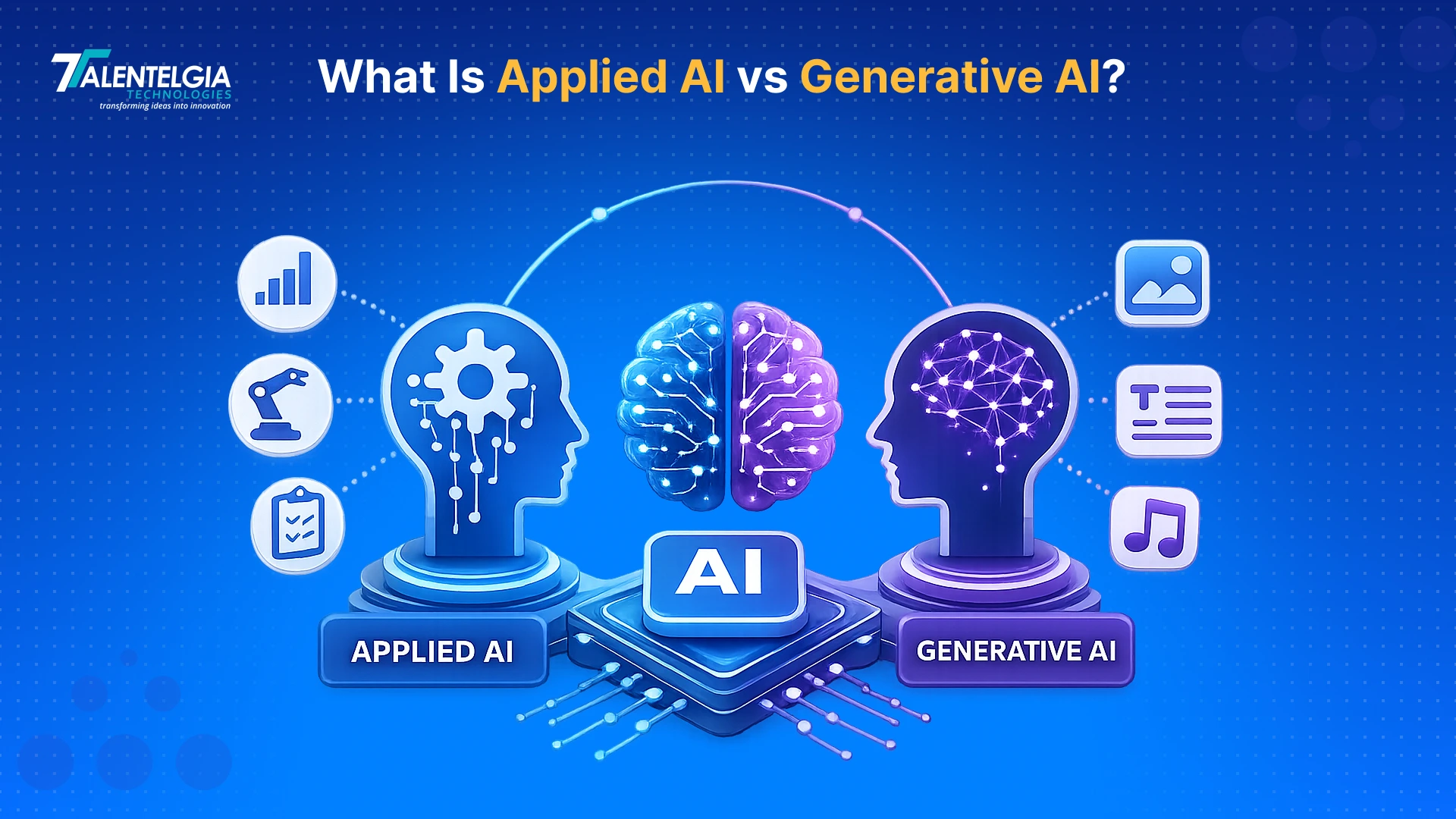
Understanding Applied AI and Generative AI: Differences & Use Cases
Applied AI and generative AI address distinct segments of overall business processes. Applied AI is centred around enhancing operational decisions and generating quantifiable results for activities such as fraud detection, forecasting, recommendation systems, price optimisation, and automating workflows through the use of machine learning.
Generative AI development focuses on producing new outputs, including text, code, summaries, images, and interactive dialogue. The two forms of AI frequently overlap in today’s enterprise application systems. Ultimately, while it is useful to understand the differences between Applied and Generative AI, what is more important is to understand how each component of the overall workflow makes decisions based upon its output; how each product or service generated by one component will automatically trigger the input of the next functional component to produce output; and how each element will be assessed, evaluated, tracked, and governed once it enters production.
What Is Applied AI?
Applied AI refers to systems designed to solve specific, defined problems using machine learning and statistical modeling. It analyzes existing data, identifies patterns, and makes predictions or decisions within pre-established parameters. It doesn’t create new content — it acts on reality to produce a determinate outcome.
Example: fraud detection, medical diagnosis, predictive maintenance, autonomous vehicles, credit scoring, recommendation engines, and quality control systems.
What Is Generative AI?
Generative AI refers to systems designed to create new, original content — text, images, video, audio, code — that did not exist before. It learns patterns from vast datasets and uses that learned understanding to produce outputs that mirror human creativity and language, often surprising even its developers.
Example: ChatGPT, DALL-E, GitHub Copilot, Midjourney, Claude, Gemini, and every AI writing assistant, image generator, or code autocomplete in the world.
How They Actually Work: No Jargon, Just Clarity
The AI conversation in 2026 is plagued by conflation. Executives use “AI” and “generative AI” interchangeably. Vendors blur the lines in their pitch decks, and leaders making million-dollar technology decisions don’t always have a precise vocabulary for what they’re actually buying. Let’s fix that — with precision, not jargon.
Understanding the mechanics, even at a high level, changes how you evaluate these technologies for your organization. Here’s what’s actually happening inside each paradigm.
How Applied AI Works?
1. Data Collection
Structured data is gathered: transaction records, sensor readings, historical outcomes, labeled examples.
2. Feature Engineering
Relevant variables are identified and transformed into formats the model can learn from.
3. Model Training
ML algorithms (decision trees, random forests, neural networks) learn patterns from labeled data, which inputs correlate with the outcomes.
4. Validation
The model is tested against held-out data to measure accuracy, precision, recall, and other performance metrics.
5. Deployment
The model is integrated into a business system, a fraud detection pipeline, a diagnostic tool, and a routing algorithm, and produces determinate outputs when new data arrives.
6. Monitoring
Performance is tracked continuously. Models drift over time and require retraining as data distributions shift
How Generative AI Works?
1. Training on Massive Data
LLMs are trained on enormous text corpora (internet, books, code). Transformers process this data in parallel — not sequentially — enabling vastly faster learning.
2. Self-Attention Mechanism
Every word in the input becomes “aware” of every other word, allowing the model to understand context, ambiguity, and relationships at scale.
3. Parameter Learning
While traditional ML models use thousands or millions of parameters, LLMs use billions or even trillions — enabling nuanced language understanding at a scale impossible for earlier architectures.
4. Next-Token Prediction
At inference time, the model statistically predicts the most likely next word (token) given the full context of the prompt — not “thinking,” but completing a statistical pattern at extraordinary depth.
5. Fine-Tuning / RLHF
Base models are refined using human feedback (Reinforcement Learning from Human Feedback) to align outputs with helpful, accurate, and safe responses.
6. GANs, VAEs, Diffusion
For image and video generation, alternative architectures like GANs (generator vs. discriminator) and Diffusion models power tools like DALL-E and Stable Diffusion.
Applied AI vs. Generative AI: What’s the Difference?
While both belong to the broader field of Artificial Intelligence, they rely on different model architectures and are designed to solve different classes of problems; they are very different in their role in a business ecosystem. Applied AI aims mainly to enhance decision-making processes, automate the execution of operational logic, and course-correct to improve results that are measurable.
Generative AI aims mainly to accelerate communication, creation of content, explanation of information, and knowledge workers’ productivity. Because these two types of AI create value differently, companies evaluate, govern, and monitor their use in production very differently.
This comparison will focus on these operational differences versus the underlying platforms/models supporting each.
| Dimension | Applied AI | Generative AI |
|---|---|---|
| Core Purpose | Solve specific, well-defined problems using existing data patterns | Create new, original content that did not previously exist |
| Input → Output | Data in → Decision, prediction, or classification out | Prompt in → Text, image, video, audio, or code out |
| Learning Approach | Supervised, unsupervised, or reinforcement learning on structured datasets | Self-supervised learning on massive unstructured corpora; transformer architecture |
| Output Type | Deterministic: classification, probability score, routing decision, alert | Probabilistic: varied, creative, sometimes unpredictable outputs |
| Accuracy Model | Measurable precision and recall against ground truth labels | Evaluated by human judgment, coherence, and factual accuracy — not binary correctness |
| Data Requirements | Domain-specific labeled data; quality over quantity | Massive unstructured training data; scale over specificity |
| Compute Needs | Moderate; scales with model complexity and inference volume | Enormous: training frontier models costs tens of millions of dollars; inference is GPU-intensive |
| Adaptability | More rigid; performs optimally within defined domain and parameters | Highly adaptable; can handle novel problems, creative tasks, and edge cases |
| Explainability | Many models are interpretable; outputs can be traced to decision logic | Black-box by nature; why a specific output was generated is difficult to trace |
| Risk Profile | Model drift, bias in training data, integration failures | Hallucinations, data privacy exposure, copyright risks, bias amplification |
| Time to Value | Longer build cycle; value delivered upon production deployment | Fast prototyping; employees can generate value from day one with prompt access |
| Human Oversight | Automated with exception handling; humans review edge cases | Human-in-the-loop essential for high-stakes outputs; review before action |
| Best-Known Examples | Google Search, Waymo, Fraud detection systems, AlphaFold | ChatGPT, Claude, DALL-E, GitHub Copilot, Gemini, Midjourney |
| Primary Business Value | Operational efficiency, risk reduction, decision automation | Content scale, creative acceleration, knowledge synthesis, developer productivity |
Use Cases by Industry: Where Each Technology Is Creating Real Value
Applied AI usually creates value through efficiency, accuracy, and operational control. It helps companies reduce errors, improve decisions, and automate repeatable workflows in measurable ways.
Generative AI creates value through speed, creativity, and productivity. It can help teams produce content faster, improve customer experiences, and unlock new business models or service experiences.
The distinction becomes most concrete in deployment. Here’s where Applied AI and Generative AI are each proving their worth.
Applied AI Use Cases
1. Healthcare – Medical Imaging & Diagnostics
AI-based Computer Vision analyzes X-rays, CT scans, and MRIs to detect diseases with accuracy rivaling specialist radiologists — at a fraction of the time and cost.
2. Financial Services – Fraud Detection
AI processes millions of transactions per second, flagging suspicious patterns in real time. Financial services global AI spending exceeded $20 billion in 2025, with fraud detection as the primary use case.
3. Manufacturing – Predictive Quality Control
Computer vision systems inspect products at thousands of items per hour, catching microscopic defects invisible to humans. A semiconductor factory cut defect detection rates by 95% and inspection costs by 35%.
4. Investment / Finance – Algorithmic Trading
68% of hedge funds now employ AI for market analysis and trading strategies. AI-powered robo-advisors now manage over $1.2 trillion in assets globally.
5. Transportation – Autonomous Vehicles & Routing
Real-time perception, object detection, path planning, and decision-making systems that react in milliseconds. Applied AI handles every safety-critical judgment in self-driving technology.
6. Retail – Recommendation Engine
Analyzes purchase history, browsing behavior, and demographic patterns to surface the most relevant products — the engine behind Amazon, Netflix, and Spotify’s core engagement loops.
Generative AI Use Cases
1. Software Development – AI Code Generation
GitHub Copilot and similar tools generate, complete, and debug code in real time. McKinsey reports cost benefits from AI in software engineering are among the most widely realized across all enterprise functions.
2. Marketing & Content – Scalable Content Creation
Revenue increases from AI are most commonly reported in marketing and sales. Generative AI drafts ads, emails, product descriptions, and social copy at a scale no human team could match.
3. Healthcare – Prior Authorization & Clinical Docs
GenAI streamlines administrative processes like prior authorization and claim adjudication, leading to significant cost savings, one of healthcare’s most financially measurable AI use cases.
4. Enterprise Operations – Meeting Intelligence & Agentic Workflows
Financial services firms build agentic GenAI workflows that capture meeting actions from video conferences, draft follow-up communications, and track commitment follow-through — automatically.
5. Customer Service – Autonomous Customer Resolution
Air carriers deploy AI agents that help customers complete transactions — rebooking flights, rerouting bags — freeing human agents for complex cases. Agentic AI is expected to have the highest customer support impact.
6. R&D / Drug Discovery – Molecular Generation
Pharma and biotech: 54% prioritize GenAI for innovation and drug development. Generative models can hypothesize novel molecular structures, dramatically compressing drug discovery timelines.
Also Read: Generative AI Use Cases For Customer Service
How Companies Should Decide Which AI To Use and When?
The question isn’t “which is better,” as both have profound value. The question is: for this specific problem, in this specific context, with this specific risk tolerance, which paradigm is the right tool? If your leadership team is currently evaluating an initiative, here’s the structured framework to determine if Gen AI is truly the right tool for the job.
| Choose Applied AI when… | Choose Generative AI when… |
|---|---|
| The problem is well-defined with clear input-output mapping and measurable success criteria | The problem is open-ended: you need creative output, exploration, or synthesis that can’t be predetermined |
| Accuracy is binary: the system either correctly classifies fraud or it doesn’t; partial credit is unacceptable | Quality is subjective: good enough at scale beats perfect in isolation, e.g., content, customer emails, code drafts |
| You have labeled domain data: historical examples that can train a purpose-built model for your specific context | You need breadth without training: the pre-trained model’s broad knowledge is the asset, not domain-specific training |
| Decisions are high-stakes and regulated: healthcare diagnosis, credit decisions, safety systems requiring auditability | Speed-to-value is paramount: employees need a tool today; months of model training is not an option |
| Explainability is required: regulators, auditors, or customers must understand why a decision was made | Human creativity is the bottleneck: you have more demand for content, code, or analysis than your team can produce |
| Automation must be reliable at scale: the system will process millions of instances without human review per transaction | Human-in-the-loop is the model: AI augments a human’s work rather than replacing human judgment entirely |
Conclusion
Even though both AI (Artificial Intelligence) and Generative AI use the same underlying technology, there are distinct differences concerning their roles in the world. Applied AIs are designed to take historical data to analyze, predict the results, and also make decisions. Conversely, Generative AIs introduce creativity into the equation as these systems create new products (text, images, and code, etc). In this article, we covered key components of both, the differences between them, and the many examples of applications that demonstrate how critical it is for all of us to understand both today.
If this has piqued your interest, you may want to consider implementing AI in your business, and for that, our software experts at Talentelgia Technologies could be your best option. They understand the mechanics of prompt engineering and apply those skills in practical projects with AI tools.
Visit our website to schedule a demo.











 Sales Enquiries:
  Business queries:
  HR:
HR: 


