



 Healthcare Software Development Services
 Healthcare App Development Services
 Real Estate Web Development Services
 Real Estate App Development Company
 E-Commerce App Development Services
 E-Commerce Web Development Services
 Blockchain E-commerce Development Company
 Fintech Software Development
 Fintech App Development Services
 E-Learning App Development Services
 Restaurant App Development Company
 Mobile Game Development Company
 Travel App Development Company
 Automotive Web Design
 AI Traffic Management System
 AI Inventory Management Software
 Logistics App Development Services
 Machine Learning Development
 ChatGPT integration services
  AI Development Company
  AI Integration Services
  Natural Language Processing Company
 Mobile App Development
  IOS App Development
  Android App Development
  Cross-Platform App Development
  Augmented Reality (AR) App Development
  Virtual Reality (VR) App Development
  Web App Development
  SaaS App Development
 Custom Software Development Services
  Flutter
  React Native
  Swift (IOS)
  Kotlin (Android)
  Mean Stack Development
  AngularJS Development
  MongoDB Development
  Nodejs Development
  Database Development
 Ruby on Rails Development
 Expressjs Development
  Full Stack Development
  Web Development Services
  Laravel Development
  LAMP Development
  Custom PHP Development
  .Net Development
  User Experience Design Services
  User Interface Design Services
  Automated Testing
  Manual Testing
  Digital Marketing Services
 Ride-Sharing And Taxi Services
 Food Delivery Services
 Grocery Delivery Services
 Transportation And Logistics
 Car Wash App
 Home Services App
 ERP Development Services
 CMS Development Services
 LMS Development
 CRM Development
 DevOps Development Services
 AI Business Solutions
 AI Cloud Solutions
 AI Chatbot Development
 API Development
 Blockchain Product Development
 Cryptocurrency Wallet Development
 About Talentelgia
  Our Team
  Our Culture
 Healthcare App Development Services
 Real Estate Web Development Services
 E-Commerce App Development Services
 E-Commerce Web Development Services
 Blockchain E-commerce
Development Company
Blockchain E-commerce
Development Company Fintech App Development Services
 Blockchain Fintech
Development Company
Blockchain Fintech
Development Company E-Learning App Development Services
 Restaurant App Development Company
 Mobile Game Development Company
 Travel App Development Company
 AI Traffic Management System
 AI Inventory Management Software
 AI Development Company
 ChatGPT integration services
 AI Integration Services
 Machine Learning Development
 Machine learning consulting services
 Blockchain Development
 Blockchain Software Development
 Smart contract development company
 NFT marketplace development services
 Asset tokenization companies
 DeFi Wallet Development Company
 IOS App Development
 Android App Development
 Cross-Platform App Development
 Augmented Reality (AR) App
Development
Augmented Reality (AR) App
Development Virtual Reality (VR) App Development
 Web App Development
 Flutter
 React
Native
React
Native Swift
(IOS)
Swift
(IOS) Kotlin (Android)
 MEAN Stack Development
 AngularJS Development
 MongoDB Development
 Nodejs Development
 Database development services
 Expressjs Development
 Full Stack Development
 Web Development Services
 Laravel Development
 LAMP
Development
LAMP
Development Custom PHP Development
 User Experience Design Services
 User Interface Design Services
 Automated Testing
 Manual
Testing
Manual
Testing About Talentelgia
 Our Team
 Our Culture
A camera above a retail shelf used to mean one thing: footage nobody checked until something went missing. That’s no longer the job it does. Computer vision has turned ordinary store cameras into working staff, counting stock, watching checkout lines, and catching theft as it happens, not after the fact. Retailers aren’t experimenting with this in a pilot store somewhere; Scandit alone runs its scanning tools across 1,700-plus retailers, including Levi’s and Sephora. The technology sits at the center of a market MarketsandMarkets expects to nearly triple by 2028. What used to require a full aisle walkthrough now happens in real time, from a single camera feed. This piece breaks down what computer vision actually is, why retailers are betting on it, the top 5 computer vision applications in the retail sector, and where it’s headed.
What Is Computer Vision In Retail?
Computer vision in retail means teaching AI to actually look at footage from store cameras and understand what’s in it, then do something useful with that understanding. That live feed used to just sit in a security room, watched by nobody until something went wrong. Now a model runs on it directly, trained to recognize shelves, products, shoppers, and the gaps where stock should be, turning a plain camera feed into a signal someone can act on right away.
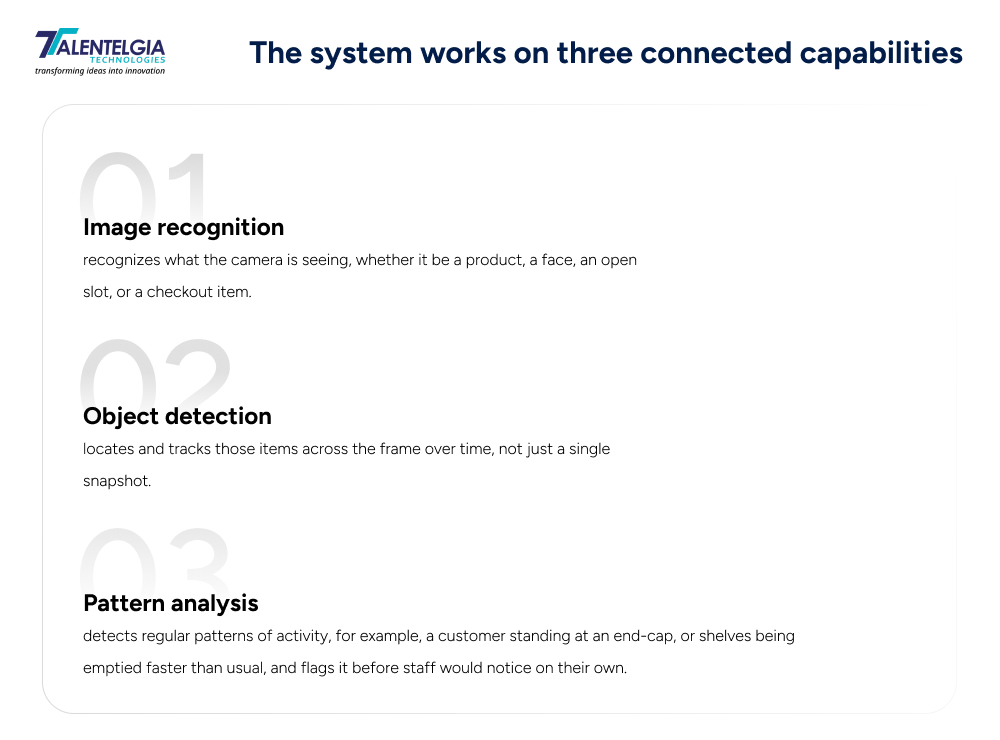
The system works on three connected capabilities:
- Image recognition – recognizes what the camera is seeing, whether it be a product, a face, an open slot, or a checkout item.
- Object detection – locates and tracks those items across the frame over time, not just a single snapshot.
- Pattern analysis – detects regular patterns of activity, for example, a customer standing at an end-cap, or shelves being emptied faster than usual, and flags it before staff would notice on their own.
Also Read: Image Recognition Apps: Use Cases & Real-Life Applications
In a store, this plays out as: a camera catches a shelf running low, matches a repeat customer to their loyalty profile, or flags a checkout mismatch in real time. The hardware (the camera) hasn’t changed. What changed is the software behind it; the same feed now drives decisions instead of just recording them.
What Are The Key Retail AI Applications Powered By Computer Vision?
Retailers aren’t experimenting with one flashy pilot anymore. The technology has split into distinct, mature applications, each solving a specific operational headache. Here are the top 5 computer vision applications in the retail sector doing the heaviest lifting right now.
1. Automated Shelf Monitoring and Inventory Management
A shelf running empty used to sit that way for hours because nobody was walking that aisle to notice. Computer vision fixes this by mounting cameras right at the shelf edge, scanning continuously, and flagging a gap the moment it appears instead of waiting for a scheduled stock check.
| Focal Systems installed 200,000 shelf-edge cameras across 500 Morrisons stores in under eight months. The result was a measurable improvement in on-shelf availability, over 2% store-wide and up to 4% in top-performing locations. Staff stopped doing manual gap-scans entirely; the system now tells them exactly which aisle needs attention. |
2. Cashierless and Frictionless Checkout
Instead of scanning items at a register, cameras and sensors track what a shopper picks up as they walk the store, building a virtual cart in real time. When they leave, the system charges them automatically. No line, no scanning.
| Amazon’s Just Walk Out is the best-known version, but the real story is more nuanced than “cashierless is the future.” Amazon pulled the tech out of its own Amazon Fresh and Whole Foods stores in 2024, replacing it with Dash Cart, a smart trolley running the same computer vision but with a visible, checkable screen. What stuck around was the third-party business: Just Walk Out now runs in over 170 stadiums, airports, hospitals, and campuses, and Amazon more than doubled that footprint in a single year. |
3. Loss Prevention and Theft Detection
Traditional security cameras only record; nobody’s watching every feed at once. Computer vision changes that by scanning every camera continuously and flagging specific behaviors, such as someone scanning one item but bagging two or a customer lingering unusually long near high-value stock, without needing a human to catch it in the moment.
| The National Retail Federation put total U.S. retail shrink at $112.1 billion in 2022, with internal and external theft responsible for roughly 65% of that figure. Tesco and Lidl have both rolled out computer-vision-based monitoring at self-checkout lanes, a system some in the industry call “supermarket VAR” for how it double-checks a transaction the way a video referee reviews a play. |
4. Visual Search and Virtual Try-on
This is one of the most trending computer vision retail applications. It’s hard to convey in words what a product actually looks like; visual search takes care of this issue. A customer provides an image rather than typing out a request, and computer vision technology compares the image to those in the catalog based on the color, texture, and shape of the items. Virtual try-on uses the same technology but in reverse. It shows how a product will look on you.
| This technology has been incorporated in the ASOS application through the Style Match feature, which enables customers to take pictures of an outfit and be presented with visually similar products in the catalogue. Meanwhile, Sephora made things even more exciting by integrating the try-on technology with the Virtual Artist feature, whereby consumers can preview shades on their faces even before buying the products. |
5. Customer Behavior Analytics and Foot Traffic Mapping
Store layout decisions used to rest on instinct. Cameras tracking movement through a store change that by converting footage into heat maps, showing exactly which aisles get congested, which get skipped entirely, and how long shoppers actually pause in front of a display versus just walking past it.
| Phillips 66 deployed an AWS-based computer vision system across its convenience stores specifically to turn existing point-of-sale camera footage into usable layout and merchandising data instead of letting it go unwatched. H&M has run similar experiments tracking in-store traffic patterns to inform its own merchandising decisions. |
Also Read: Predictive Analytics in Supply Chain: A Comprehensive Guide
Computer Vision vs. Artificial Intelligence
People use the terms interchangeably all the time, but they’re not the same thing. AI refers to a larger concept altogether. It includes anything designed to replicate human decision-making processes, be it language processing, the game of chess, or forecasting future demand. Computer vision can be seen as just one subset of artificial intelligence, namely the ability of the machine to understand visual data like images and video content.
Think of it this way:
- AI is the broad category. It encompasses natural language processing (where chatbots read texts), recommendation engines (what will you purchase next), computer vision, and various other categories.
- Computer vision is the category concerned solely with visuals such as pixels and not words or numbers.
In a retail store, this split shows up clearly. A chatbot answering a customer’s question is AI, but it’s not computer vision. A camera recognizing that a shelf is empty and alerting staff is computer vision, and it’s also a form of AI. Every computer vision system is AI. Not every AI system involves vision at all.
How Does Computer Vision Work?
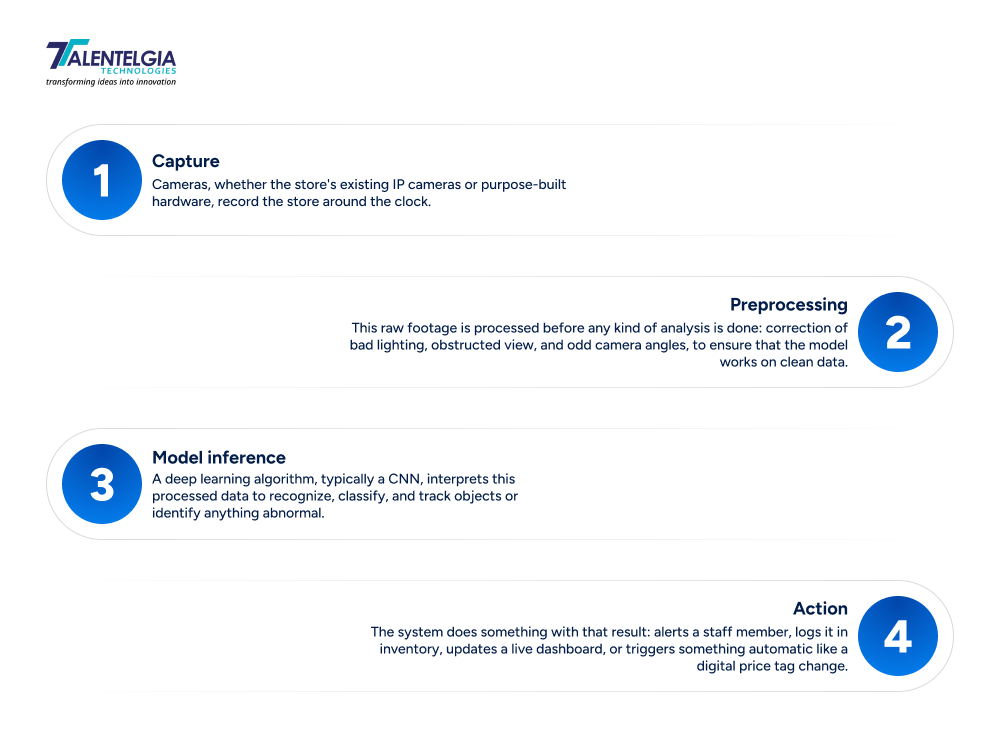
It runs in four steps, from raw footage to an actual action:
- Capture – Cameras, whether the store’s existing IP cameras or purpose-built hardware, record the store around the clock.
- Preprocessing – This raw footage is processed before any analysis is done: correcting poor lighting, obstructed views, and odd camera angles to ensure the model works on clean data.
- Model inference – A deep learning algorithm, typically a CNN, interprets this processed data to recognize, classify, and track objects or identify anything abnormal.
- Action – The system does something with that result: alerts a staff member, logs it in the inventory, updates a live dashboard, or triggers an automatic action, such as a digital price tag change.
Where this runs matters too. Some of it happens right on the device (edge computing), some gets sent to the cloud for heavier processing. Edge wins for anything time-sensitive, like catching fraud at checkout, since there’s no lag waiting on a round trip to the cloud.
Why Is Computer Vision Important For Retail Businesses?
Retail runs on things a human eye is supposed to catch but usually doesn’t, until it’s too late. That gap is exactly what computer vision closes.
- Stockouts go unnoticed for hours. A popular item runs out mid-morning, and nobody checks that aisle again until closing. Lost sales pile up quietly.
- Theft and shrinkage are hard to catch in real time. A staff member watching a dozen camera feeds can’t flag every mis-scan or concealment as it happens. Most of it gets reviewed after the fact, if at all.
- Checkout lines cost sales. Long queues push customers to abandon carts or skip a store entirely, and by the time a manager notices the line, the damage is done.
- Store layout is mostly a guessing game. Nobody really knows where shoppers stop, linger, or just walk straight past without cameras tracking it. So merchandising decisions end up based on gut feel instead of what customers are actually doing in the aisles.
- Walking every aisle to check stock isn’t sustainable. It eats up hours that staff could be spending with actual customers, and it still doesn’t catch everything.
Conclusion
Ask a shopper five years from now why they love a store, and shrinkage rates or shelf-camera counts won’t come up. They’ll just say the shelves were stocked, the line moved fast, nothing felt off. That’s the real endpoint here: not smarter-looking stores, just stores that quietly stop wasting people’s time. Amazon’s own stumble with Just Walk Out already proved one system can’t cover every format, so retail’s next stretch splits by context: autonomous checkout for stadiums, smart carts for grocery, shelf cameras doing the counting nobody wants to do by hand. Win or lose here won’t come down to who has the flashiest tech. It’ll come down to who made theirs invisible.











 Sales Enquiries:
  Business queries:
  HR:
HR: 


