



 Healthcare Software Development Services
 Healthcare App Development Services
 Real Estate Web Development Services
 Real Estate App Development Company
 E-Commerce App Development Services
 E-Commerce Web Development Services
 Blockchain E-commerce Development Company
 Fintech Software Development
 Fintech App Development Services
 E-Learning App Development Services
 Restaurant App Development Company
 Mobile Game Development Company
 Travel App Development Company
 Automotive Web Design
 AI Traffic Management System
 AI Inventory Management Software
 Logistics App Development Services
 Machine Learning Development
 ChatGPT integration services
  AI Development Company
  AI Integration Services
  Natural Language Processing Company
 Mobile App Development
  IOS App Development
  Android App Development
  Cross-Platform App Development
  Augmented Reality (AR) App Development
  Virtual Reality (VR) App Development
  Web App Development
  SaaS App Development
 Custom Software Development Services
  Flutter
  React Native
  Swift (IOS)
  Kotlin (Android)
  Mean Stack Development
  AngularJS Development
  MongoDB Development
  Nodejs Development
  Database Development
 Ruby on Rails Development
 Expressjs Development
  Full Stack Development
  Web Development Services
  Laravel Development
  LAMP Development
  Custom PHP Development
  .Net Development
  User Experience Design Services
  User Interface Design Services
  Automated Testing
  Manual Testing
  Digital Marketing Services
 Ride-Sharing And Taxi Services
 Food Delivery Services
 Grocery Delivery Services
 Transportation And Logistics
 Car Wash App
 Home Services App
 ERP Development Services
 CMS Development Services
 LMS Development
 CRM Development
 DevOps Development Services
 AI Business Solutions
 AI Cloud Solutions
 AI Chatbot Development
 API Development
 Blockchain Product Development
 Cryptocurrency Wallet Development
 About Talentelgia
  Our Team
  Our Culture
 Healthcare App Development Services
 Real Estate Web Development Services
 E-Commerce App Development Services
 E-Commerce Web Development Services
 Blockchain E-commerce
Development Company
Blockchain E-commerce
Development Company Fintech App Development Services
 Blockchain Fintech
Development Company
Blockchain Fintech
Development Company E-Learning App Development Services
 Restaurant App Development Company
 Mobile Game Development Company
 Travel App Development Company
 AI Traffic Management System
 AI Inventory Management Software
 AI Development Company
 ChatGPT integration services
 AI Integration Services
 Machine Learning Development
 Machine learning consulting services
 Blockchain Development
 Blockchain Software Development
 Smart contract development company
 NFT marketplace development services
 Asset tokenization companies
 DeFi Wallet Development Company
 IOS App Development
 Android App Development
 Cross-Platform App Development
 Augmented Reality (AR) App
Development
Augmented Reality (AR) App
Development Virtual Reality (VR) App Development
 Web App Development
 Flutter
 React
Native
React
Native Swift
(IOS)
Swift
(IOS) Kotlin (Android)
 MEAN Stack Development
 AngularJS Development
 MongoDB Development
 Nodejs Development
 Database development services
 Expressjs Development
 Full Stack Development
 Web Development Services
 Laravel Development
 LAMP
Development
LAMP
Development Custom PHP Development
 User Experience Design Services
 User Interface Design Services
 Automated Testing
 Manual
Testing
Manual
Testing About Talentelgia
 Our Team
 Our Culture
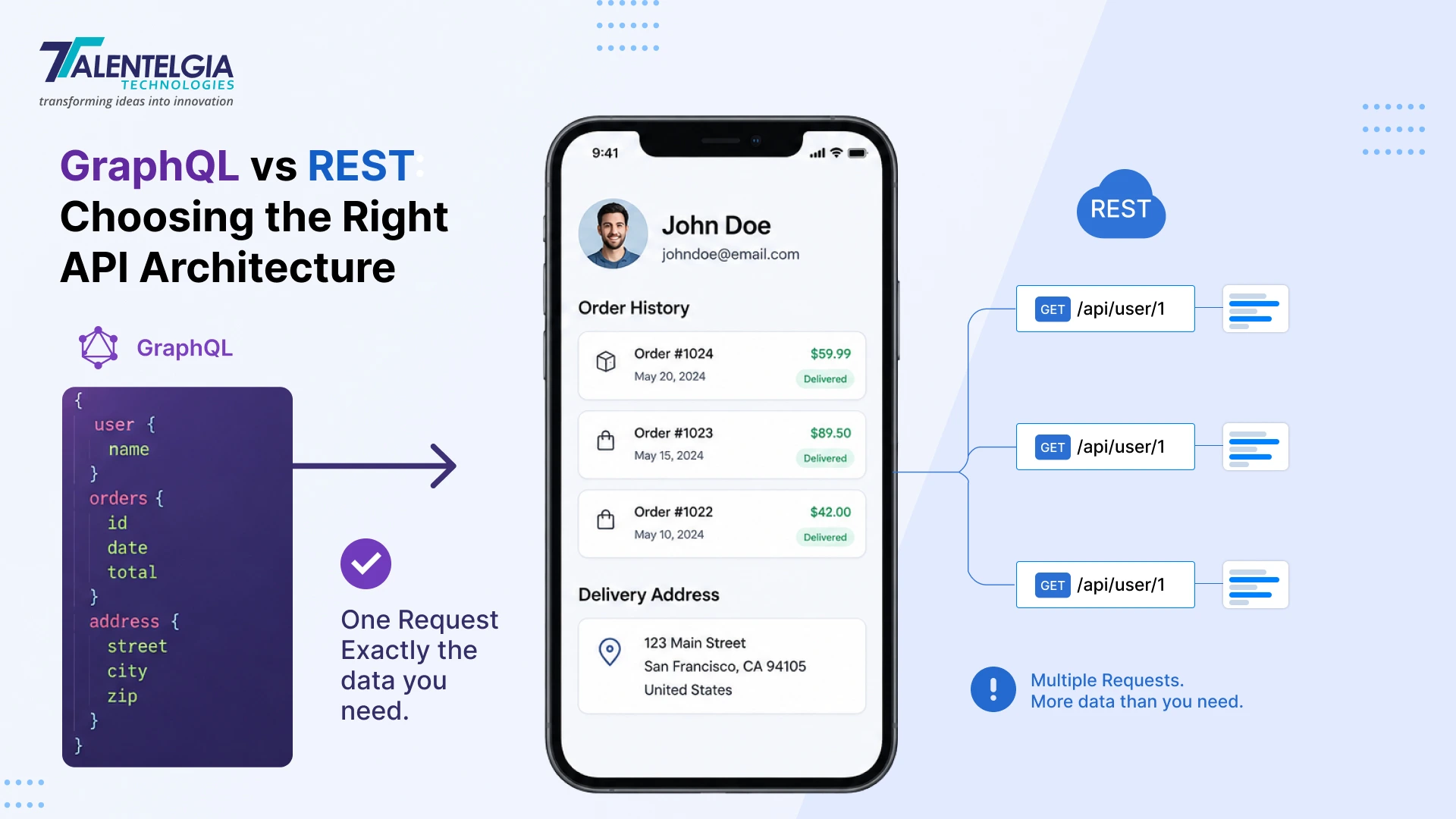
Imagine an app screen showing a user’s name, order history, and delivery address. These three data points typically live in separate parts of a backend system. Building this screen with a traditional REST setup would mean at least three separate requests to the server, each one returning more data than the screen actually needs. Facebook ran into this exact problem in 2012, which is what led them to build GraphQL. The same question still shapes engineering decisions today.
REST has not been displaced by this shift. Current estimates place REST behind approximately 83% of public APIs in active use. Gartner separately projects that enterprise GraphQL adoption will surpass 60% by 2027, rising from under 30% in 2024. Much of this growth does not involve organizations abandoning REST. GraphQL is more commonly introduced as an additional layer, positioned above existing REST or gRPC services rather than replacing them.
The relevant question for most teams, then, is not which architecture is objectively superior. It is which one suits the problem at hand. Data structure, the number and variety of client applications, and the engineering resources available for schema design all factor into that decision. The sections below outline everything about GraphQL vs REST, where each performs well, where each falls short, and how several established companies have approached this choice in practice.
GraphQL vs REST API: At a Glance
| Feature | GraphQL | REST |
|---|---|---|
| Architecture | Query language and runtime for APIs | Architectural style for designing web APIs |
| API Endpoint | Single endpoint for all operations | Multiple endpoints, each representing a resource |
| Data Fetching | Clients request exactly the fields they need | Server returns a predefined response for each endpoint |
| Over-fetching & Under-fetching | Minimizes both by allowing field-level queries | Can occur when endpoints return more or less data than required |
| Response Structure | Determined by the client query | Fixed by the server for each endpoint |
| Best for Complex Relationships | Excellent for nested and interconnected data | Requires multiple requests for related resources |
| Performance | Reduces network requests for complex screens by combining related data into one query | Performs exceptionally well for simple, independent resource requests |
| Caching | Requires client-side or custom caching strategies for optimal performance | Native HTTP caching through browsers, proxies, and CDNs |
| Versioning | Schema evolves by deprecating fields without creating new API versions | Commonly uses versioned endpoints such as /v1 and /v2 |
| Learning Curve | Moderate to steep due to schemas, resolvers, and query design | Easier to learn because it builds directly on standard HTTP concepts |
| Real-Time Support | Built-in through subscriptions | Typically implemented using WebSockets, Server-Sent Events, or additional services |
| Schema & Documentation | Strongly typed schema enables automatic documentation, validation, and introspection | Documentation is usually maintained separately using tools like OpenAPI/Swagger |
| Scalability | Well suited for applications serving multiple clients with different data requirements | Highly scalable for resource-oriented services and distributed architectures |
GraphQL vs REST API: Key Differences
Moving on to comparing GraphQL vs REST: –
1. Data Fetching Efficiency
REST locks the response shape to the endpoint. Hit /users/123, and you get whatever fields that endpoint was built to return, regardless of what you actually need. GraphQL flips this: the client writes the query, the server fills it exactly.
- When multiple clients (iOS, Android, web, dashboard) need the same data in different shapes, REST forces a choice between over-fetching or building client-specific endpoints. A single GraphQL query can pull what would otherwise take three REST calls.
- GraphQL shows roughly 28% lower latency on complex, nested queries (180ms vs 250ms). REST handles about 33% more simple requests per second and runs on ~20% less CPU.
In short: GraphQL wins on complex, nested data. REST wins on raw throughput for simple, high-volume requests.
2. Caching
REST has a clear edge here.
- A REST GET endpoint with a Cache-Control header can be cached at the CDN level — subsequent requests never even reach the server.
- GraphQL traffic mostly runs through one endpoint via POST, so standard HTTP caching (Cache-Control, ETags) doesn’t apply cleanly. Most GraphQL systems rely on client-side caching libraries like Apollo Client or Relay instead.
- Persisted queries and edge caching can partially fix this, but they’re extra engineering work REST doesn’t require.
3. The N+1 Problem
This is GraphQL’s most notorious trap. A query asking for 100 users plus each user’s recent orders can silently trigger 100 separate database calls instead of one batched call.
- One team launched a GraphQL API where users wrote queries joining 8-10 database tables. The resulting N+1 problem brought their database down and forced them to build query complexity analysis and depth limiting they’d never needed with REST.
- The standard fix is a batching tool, usually Facebook’s own DataLoader, which collects multiple data requests over a short window and dispatches them as one batched call.
4. Security Considerations
Both rely on the same baseline: OAuth 2.0, JWTs, API keys. But GraphQL opens a risk category REST mostly avoids by design, since REST’s server defines exactly what each endpoint returns.
- A malicious client can craft deeply nested queries that overload the database. Production GraphQL APIs typically need query depth limits (around 7-10 levels), cost analysis, and request timeouts as standard practice.
- One practitioner described running a max query cost of 1,000 points with a 10-second timeout in production; that’s the level of deliberate tuning GraphQL security tends to demand.
5. Learning Curve and Team Investment
- REST rides on HTTP, which most developers already know. Onboarding is quick.
- GraphQL requires learning schema-first design, resolver patterns, the N+1 problem, and client-side caching tools like Apollo or urql. Budget two to four weeks of ramp-up per developer for a team’s first GraphQL API.
- As one engineer who’s onboarded teams onto both put it: REST takes days to learn; GraphQL can take weeks or months before developers are truly productive.
6. Versioning
| REST | GraphQL | |
|---|---|---|
| Approach | New versions (/v1/, /v2/) | Fields deprecated within the same schema |
| Trade-off | Old versions linger for backward compatibility | Clients migrate gradually, no version bump needed |
When to use GraphQL vs REST?
Now, after reading the entire blog, you must be wondering about when to use GraphQL vs REST. Let’s give you a clear answer: –
Choose REST when:
- Your API maps cleanly to resources with predictable CRUD operations
- Caching matters a lot: REST’s HTTP-native caching is hard to beat without extra engineering
- You’re building a public-facing API where broad compatibility and easy onboarding matter (this is exactly why Stripe stays on REST)
- Your team is small or new to API design and needs a shallow learning curve
- Data requirements are simple and unlikely to change shape often
Choose GraphQL when:
- Multiple client types (web, mobile, IoT) need different slices of the same underlying data
- Your screens or views pull together nested, related data from several sources at once
- You’re optimizing for mobile or low-bandwidth conditions, where fewer requests and smaller payloads matter
- Your frontend iterates quickly, and you don’t want every UI change to require a backend version bump
- You need real-time updates via subscriptions
Or don’t choose. Use both.
So, can GraphQL and REST work together?
Well, yes. As the GitHub and Shopify examples show, this isn’t always an either/or decision. A common and proven pattern is exposing REST publicly for broad compatibility while running GraphQL internally as an aggregation layer, which is what Stripe does, or maintaining both APIs in parallel and letting developers pick what fits, the way GitHub does. GraphQL can even sit on top of existing REST APIs as an aggregation layer, translating multiple endpoints into a single unified schema, and modern API gateways make this hybrid approach increasingly straightforward.
If you’re evaluating which architecture fits your specific project, or need a team that’s shipped both in production, Talentelgia Technologies‘ API development team can help you assess the right approach from day one rather than course-correcting later.
What is GraphQL
GraphQL is a query language for APIs. It comes with its own server-side runtime that executes whatever query a client sends against the underlying data. The story behind it goes back to 2012, when Facebook’s mobile apps kept running into the same issue over and over: too many network calls, and each one dragging back way more data than the screen in front of the user actually required. Facebook created GraphQL to solve this problem internally, after which it was released publicly in 2015. It is currently housed under the GraphQL Foundation.
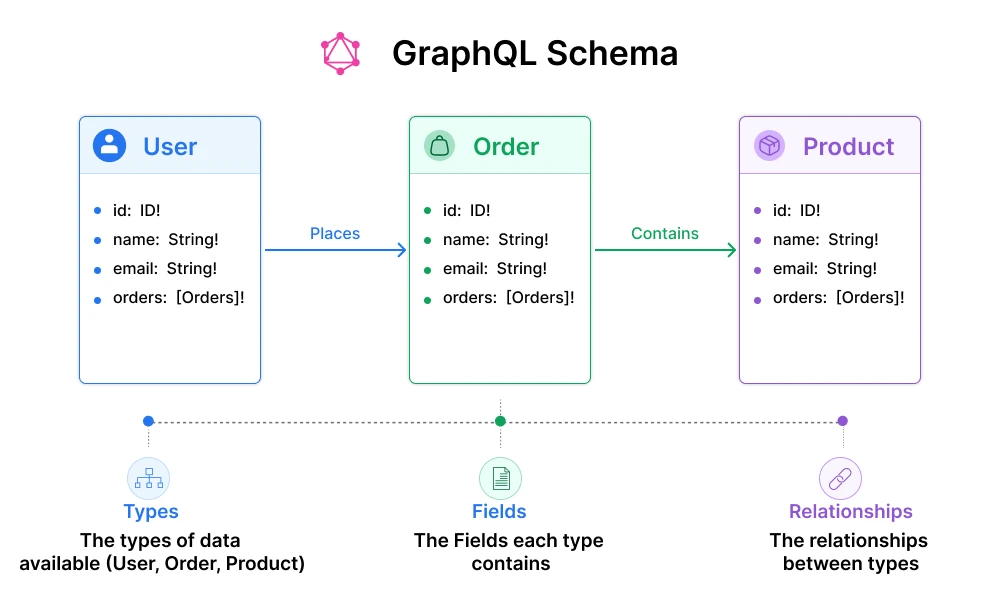
At the core of any GraphQL API sits a schema, written in GraphQL’s own schema definition language. This schema defines:
- The types of data available (a User, an Order, a Product)
- The fields each type contains
- The relationships between types
Behind every field in the schema sits something called a resolver. It’s basically a function whose only job is to go fetch that one piece of data, whatever that means in practice — querying a database, calling a third-party API, reaching into another microservice. Doesn’t matter where the data actually lives. The resolver figures that out. And because each field has its own resolver doing its own fetching, GraphQL can quietly pull data from several different sources at once and stitch it all together before it ever reaches the client, in exactly the shape the client asked for.
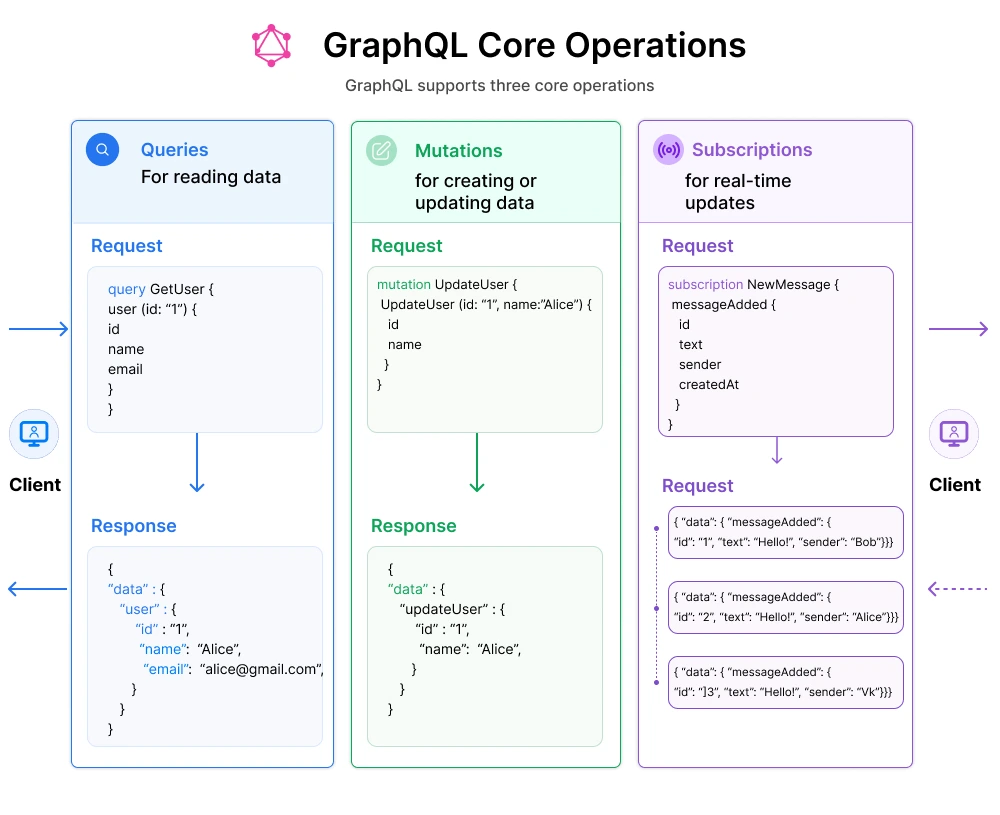
GraphQL supports three core operations:
- queries (for reading data)
- mutations (for creating or updating data)
- subscriptions (for maintaining a persistent connection that pushes real-time updates to the client).
Benefits of GraphQL
- Precise data fetching – Consumers are able to request very specific fields down to their relationships, and this solves the problem of both over-fetching and under-fetching that exists with predefined REST endpoints.
- Single endpoint, less sprawl – All the processes are performed using one endpoint, thus avoiding the necessity of managing and maintaining multiple REST endpoints for a growing application.
- Strongly typed schema – The schema is the contract for the interaction between the frontend and backend developers. It is used to validate queries before execution and allows for better development tools such as auto-completion and auto-documentation.
- Fewer round trips – Because related and hierarchical information is available in one call as opposed to many, there is less network overhead.
- Schema evolution without versioning – Additional fields may be introduced and older fields marked obsolete without disrupting any existing clients. This sidesteps the /v1/, /v2/ versioning pattern that REST APIs often fall into over time.
- Built-in real-time support – Subscriptions give applications a native way to push live updates to clients, useful for anything from chat to live dashboards.
Common Use Cases for GraphQL
- Applications with complex or deeply nested data – Dashboards, social feeds, and content management systems where data from various sources needs to be extracted for a single page.
- Multiple client types sharing one API – Web, mobile, and IoT clients often need different subsets of the same data; GraphQL lets each client request only what it needs from a shared backend.
- Mobile and low-bandwidth environments – Fewer requests and smaller payloads matter more on constrained networks, which is exactly the problem GraphQL was originally built to solve.
- Real-time features – Chat programs, live sports feeds, and collaborative apps depend on subscriptions to deliver real-time updates whenever there are changes.
- APIs that need to evolve quickly – Agile teams developing quickly evolving frontends appreciate not having to sync the backend versions for every iteration of the interface.
- Data aggregation across microservices – GraphQL is frequently used as a layer in front of multiple REST or gRPC services, stitching their data together into a single coherent API.
What is REST
REST gets called a protocol a lot, but that’s not quite right. It’s really just an architectural pattern, more conventions than rules, and the credit usually goes back to Roy Fielding, who laid the whole thing out in his doctoral thesis in 2000. It spread fast after that. Within a few years, it had basically become the default for how HTTP-based services on the web get built.
The idea itself isn’t complicated. Everything revolves around resources, and every resource gets its own URL: a user, an order, a product, whatever. You want to do something with that resource? You use a standard HTTP request to do it: GET, POST, PUT or PATCH, DELETE. None of this should feel unfamiliar if you’ve spent any real time building for the web, since these line up almost one-to-one with basic CRUD operations anyway.
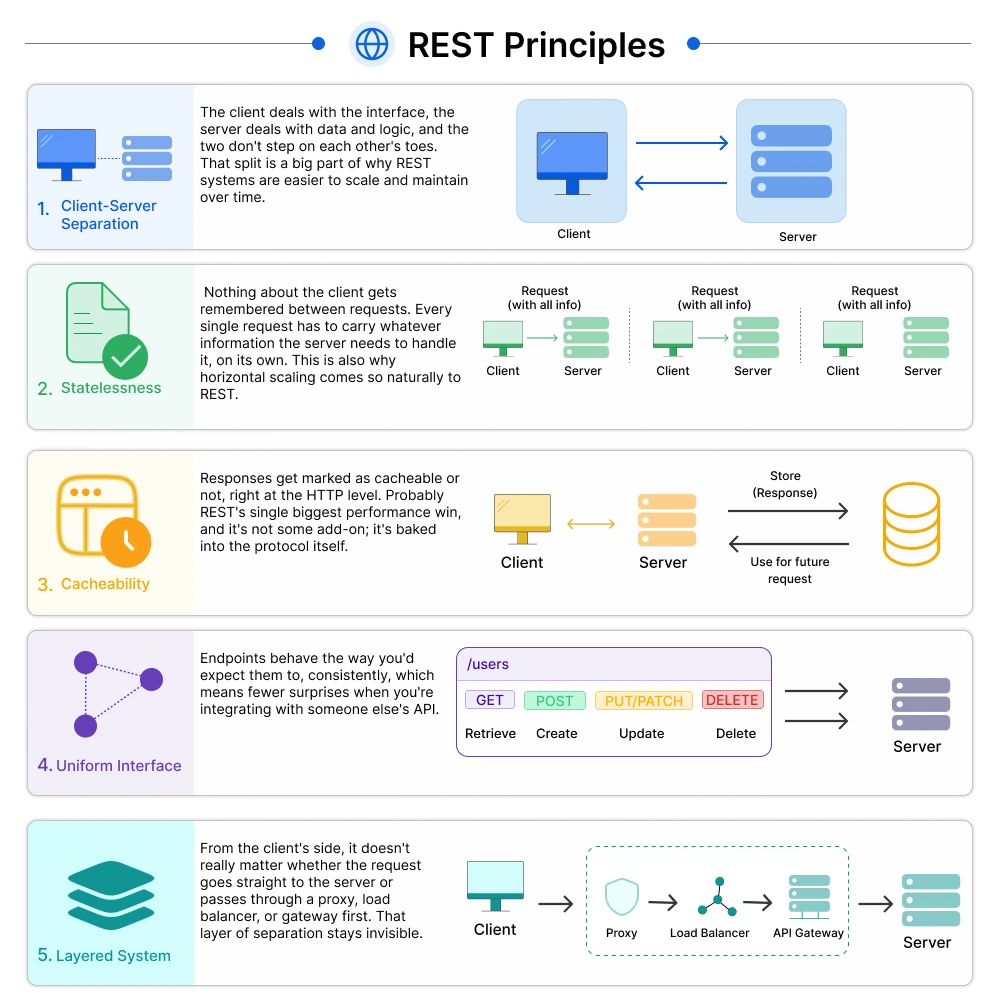
Principles Hold REST Together
- Client-server separation – The client deals with the interface, the server deals with data and logic, and the two don’t step on each other’s toes. That split is a big part of why REST systems are easier to scale and maintain over time.
- Statelessness – Nothing about the client gets remembered between requests. Every single request has to carry whatever information the server needs to handle it, on its own. This is also why horizontal scaling comes so naturally to REST.
- Cacheability – Responses get marked as cacheable or not, right at the HTTP level. Probably REST’s single biggest performance win, and it’s not some add-on; it’s baked into the protocol itself.
- Uniform interface – Endpoints behave the way you’d expect them to, consistently, which means fewer surprises when you’re integrating with someone else’s API.
- Layered system – From the client’s side, it doesn’t really matter whether the request goes straight to the server or passes through a proxy, load balancer, or gateway first. That layer of separation stays invisible.
Also Read: Best Languages to Develop REST APIs
Benefits of REST
- Simplicity – Most developers already know HTTP, so there’s barely a learning curve here. Picking up REST tends to feel less like learning something new and more like applying what you already know.
- Scalability – Requests don’t carry any shared session baggage, so spreading them across multiple servers is straightforward; there’s nothing to keep in sync between machines.
- Caching that comes built in- REST’s URL-based structure plays directly into HTTP’s native caching, so you get real performance gains without having to engineer much of anything extra.
- A mature ecosystem behind it – REST has had over twenty years to accumulate tooling, documentation generators, gateways, testing clients, monitoring setups. None of it is new or untested.
- Doesn’t care what stack you’re on – Java, Python, Go, Node. REST rides on HTTP itself, not on any particular language, so it behaves the same no matter what’s running underneath.
Common Use Cases for REST
- Public-facing APIs. Stripe, Shopify, plenty of others; they all expose REST externally, and a lot of that comes down to predictability. Third-party developers integrating with your API don’t want surprises, and REST’s well-trodden conventions give them exactly that.
- Microservices architectures. Each service running its own REST API tends to just work, since that lines up with how microservices get structured and deployed in the first place. Nobody’s fighting the architecture to make it fit.
- CRUD-heavy applications. If most of what your system does is create, read, update, and delete records, REST’s resource-based design practically maps itself onto that.
- Applications with stable, predictable data models. REST’s fixed endpoints only become a problem once your data starts shifting shape constantly. If it doesn’t, there’s nothing to work around.
Real-World Examples
GitHub: Running REST and GraphQL Side by Side
| GitHub maintains both a REST API and a GraphQL API, and its own documentation is candid about why. GitHub chose GraphQL because it offers significantly more flexibility for integrators; the ability to define precisely the data you want, and only the data you want, is a real advantage over fixed REST endpoints. The numbers GitHub itself publishes make the case concretely:Fetching a follower’s followers, and the followers of each of those followers, takes a single nested GraphQL query; the same task through REST means first calling /user/followers, then making a separate request per follower, since REST returns extra unwanted data along the way. For a more complex case, pulling a pull request together with its commits, comments, and reviews, GitHub’s own comparison shows this would take 11 separate REST requests, versus a single GraphQL call, and the REST version still returns more data than needed. |
Shopify: A Full Platform-Wide Migration to GraphQL
| Shopify offers the clearest “we tried both and picked one” story in this space. Shopify’s Storefront API runs on GraphQL, its Admin APIs are available through GraphQL, and the platform now handles over one million queries per second using GraphQL. Shopify designated its REST Admin API as legacy on October 1, 2024, and as of April 1, 2025, every new app submitted to the Shopify App Store, public or custom, is required to use the GraphQL Admin API. The performance case Shopify makes for the switch is specific and measurable: a year before formally committing to GraphQL, Shopify’s engineering team had already reduced the cost of queries by 75%, pushing throughput past what REST could support. One real merchant example: when audio brand Skullcandy migrated to Shopify, its CIO specifically credited the platform’s GraphQL environment for streamlining operations and unifying data systems, within a 90-day migration window. Shopify’s own engineering team has also been candid about the trade-off this introduces. A senior Shopify developer explained that GraphQL clients have to account for the cost of the queries they build, since every field in the schema carries an integer cost value. Shopify caps this at a points-based budget (for example, 1,000 points within 60 seconds) to prevent runaway queries. This is the query-complexity safeguard discussed earlier in this article, playing out in a real production system at scale. |
Stripe: Staying on REST by Design, Even While Using GraphQL Internally
| Stripe is the useful counterexample. Stripe’s public API is organized around REST, predictable, resource-oriented URLs, JSON responses, and standard HTTP verbs and status codes. For a platform handling payments for businesses ranging from small shops to companies like Amazon and Google, this predictability isn’t a limitation; it’s the point. A stable, well-documented, REST interface lowers the bar for any developer integrating payments, regardless of their stack or experience level. Interestingly, Stripe doesn’t avoid GraphQL altogether. It just doesn’t expose it publicly. Internally, Stripe’s own dashboard team adopted GraphQL and Apollo specifically to simplify front-end data fetching across many product teams contributing to the same dashboard at once, citing reduced over-fetching and stronger typing as concrete benefits. The team’s reasoning for keeping the public API on REST despite this internal success lines up with what’s been observed elsewhere: offering a public GraphQL interface would meaningfully expand the API’s external attack surface without enough benefit to justify it, especially given that REST endpoints come with clear, well-understood access control logic that’s harder to replicate cleanly at the field level in GraphQL. |
Frequently Asked Questions (FAQs)
Can I use GraphQL and REST together in the same project?
Yes, and it's common practice. Many teams expose a REST interface publicly for wide adoption while running a GraphQL layer internally for UI and data orchestration. GraphQL can even sit on top of existing REST APIs as an aggregation layer, translating multiple endpoints into a single unified schema. Stripe and GitHub both follow versions of this pattern.
Which is better for beginners — GraphQL or REST?
REST. It builds directly on HTTP conventions most developers already understand, so the learning curve is shallow. GraphQL requires learning schema design, resolver patterns, and concepts like the N+1 problem before a developer becomes genuinely productive; teams shipping their first GraphQL API should budget two to four weeks of ramp-up time per developer.
When to use GraphQL vs REST for a new project?
It comes down to the shape of your data and your client base. Use REST if your API maps cleanly to resources, you need easy HTTP caching, or you're building a public API where broad compatibility matters most. Use GraphQL if multiple client types need different data shapes from the same backend, your views require deeply nested data, or you're optimizing specifically for mobile and low-bandwidth conditions.












 Sales Enquiries:
  Business queries:
  HR:
HR: 


