



 Healthcare Software Development Services
 Healthcare App Development Services
 Real Estate Web Development Services
 Real Estate App Development Company
 E-Commerce App Development Services
 E-Commerce Web Development Services
 Blockchain E-commerce Development Company
 Fintech Software Development
 Fintech App Development Services
 E-Learning App Development Services
 Restaurant App Development Company
 Mobile Game Development Company
 Travel App Development Company
 Automotive Web Design
 AI Traffic Management System
 AI Inventory Management Software
 Logistics App Development Services
 Machine Learning Development
 ChatGPT integration services
  AI Development Company
  AI Integration Services
  Natural Language Processing Company
 Mobile App Development
  IOS App Development
  Android App Development
  Cross-Platform App Development
  Augmented Reality (AR) App Development
  Virtual Reality (VR) App Development
  Web App Development
  SaaS App Development
 Custom Software Development Services
  Flutter
  React Native
  Swift (IOS)
  Kotlin (Android)
  Mean Stack Development
  AngularJS Development
  MongoDB Development
  Nodejs Development
  Database Development
 Ruby on Rails Development
 Expressjs Development
  Full Stack Development
  Web Development Services
  Laravel Development
  LAMP Development
  Custom PHP Development
  .Net Development
  User Experience Design Services
  User Interface Design Services
  Automated Testing
  Manual Testing
  Digital Marketing Services
 Ride-Sharing And Taxi Services
 Food Delivery Services
 Grocery Delivery Services
 Transportation And Logistics
 Car Wash App
 Home Services App
 ERP Development Services
 CMS Development Services
 LMS Development
 CRM Development
 DevOps Development Services
 AI Business Solutions
 AI Cloud Solutions
 AI Chatbot Development
 API Development
 Blockchain Product Development
 Cryptocurrency Wallet Development
 About Talentelgia
  Our Team
  Our Culture
 Healthcare App Development Services
 Real Estate Web Development Services
 E-Commerce App Development Services
 E-Commerce Web Development Services
 Blockchain E-commerce
Development Company
Blockchain E-commerce
Development Company Fintech App Development Services
 Blockchain Fintech
Development Company
Blockchain Fintech
Development Company E-Learning App Development Services
 Restaurant App Development Company
 Mobile Game Development Company
 Travel App Development Company
 AI Traffic Management System
 AI Inventory Management Software
 AI Development Company
 ChatGPT integration services
 AI Integration Services
 Machine Learning Development
 Machine learning consulting services
 Blockchain Development
 Blockchain Software Development
 Smart contract development company
 NFT marketplace development services
 Asset tokenization companies
 DeFi Wallet Development Company
 IOS App Development
 Android App Development
 Cross-Platform App Development
 Augmented Reality (AR) App
Development
Augmented Reality (AR) App
Development Virtual Reality (VR) App Development
 Web App Development
 Flutter
 React
Native
React
Native Swift
(IOS)
Swift
(IOS) Kotlin (Android)
 MEAN Stack Development
 AngularJS Development
 MongoDB Development
 Nodejs Development
 Database development services
 Expressjs Development
 Full Stack Development
 Web Development Services
 Laravel Development
 LAMP
Development
LAMP
Development Custom PHP Development
 User Experience Design Services
 User Interface Design Services
 Automated Testing
 Manual
Testing
Manual
Testing About Talentelgia
 Our Team
 Our Culture
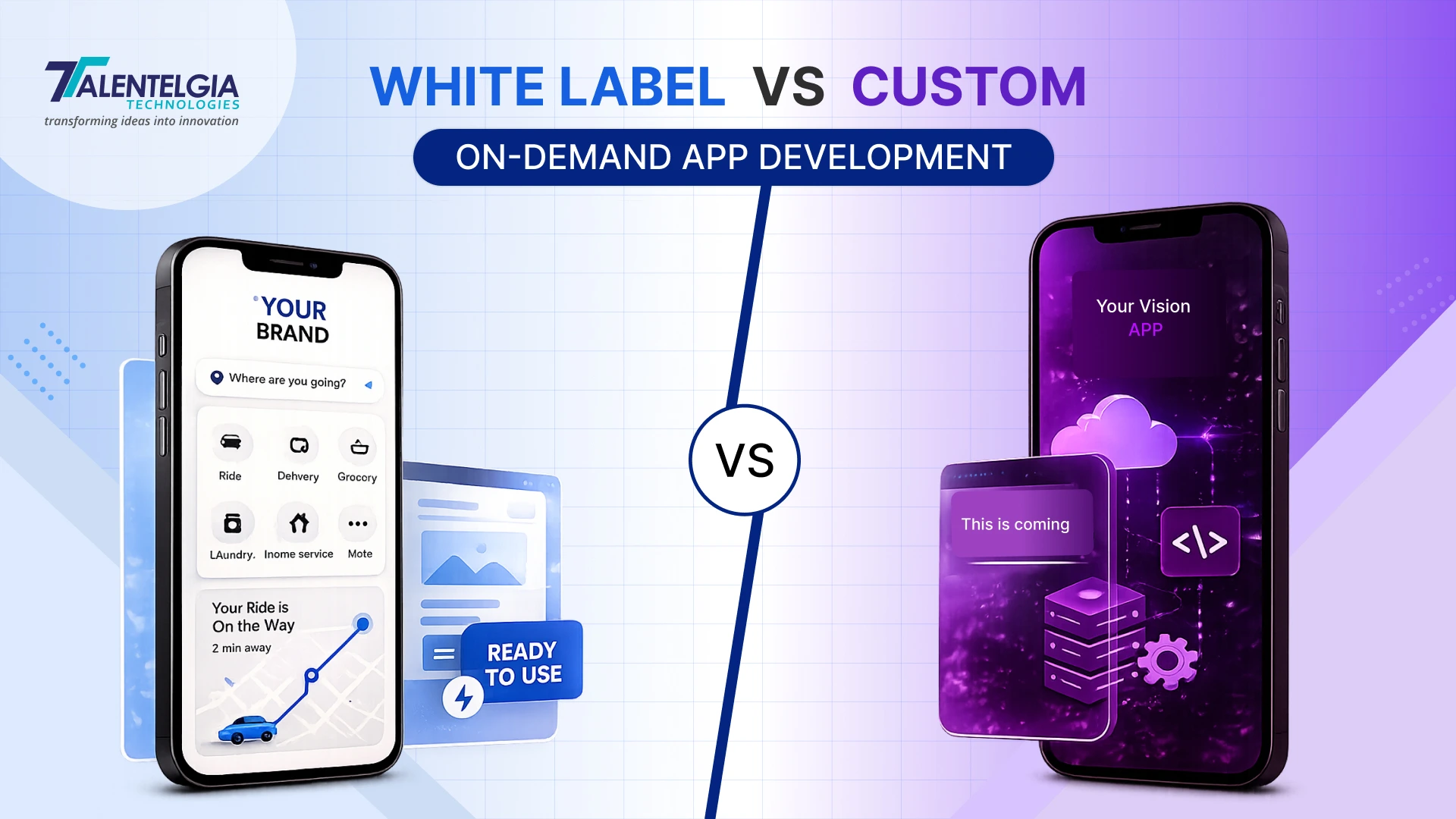
The on-demand economy isn’t slowing down anytime soon. The problem? Many businesses rush into building an app without choosing the right development approach. Grocery delivery, ride-hailing, healthcare, logistics, home services- every one of these sectors now runs through an app, and every business entering this space has to make one call early: build custom or go white-label. Get it wrong, and the cost shows up later in ways that are hard to walk back.
The money involved makes this more than a preference. The custom application development market is expected to grow by USD 53.7 billion between 2025 and 2029 at a CAGR of 9.4%, yet a basic white-label app can often be launched for as little as $5,000. That isn’t just a pricing gap. It reflects two completely different ways of thinking about software. White-label takes a codebase that already exists, already works, and rebrands it under a new name fast. Custom starts from nothing and builds toward exactly what one business needs, nothing more, nothing borrowed.
Neither wins by default. Funding, compliance, timeline, how unusual the business model actually is- all of it factors in. This breakdown lays out where each model holds up, where it doesn’t, and how to figure out which one fits before money’s already spent.
What is White-Label Development?
White-label on-demand app development means licensing a pre-built application from a vendor, applying your own branding, and deploying it as your product, without writing the underlying architecture from scratch. The vendor builds once and sells the same core to multiple clients across verticals. You get the functionality; they retain the codebase.
There are two structural variants worth distinguishing:
- Backend-only white-label: You license the server-side infrastructure: APIs, databases, order management logic, and build your own frontend on top. More flexibility, but requires in-house or contracted front-end development.
- Full-stack white-label: A complete solution covering both server and client layers. You configure branding, color schemes, and basic feature toggles. Faster to deploy, but customization depth is limited to what the vendor has built into the configuration layer.
Industries where this model dominates include food delivery, ride-hailing, telehealth, and fintech. The same approach can also be applied to multi-service on-demand app solutions, where businesses can rely on pre-built functionality to accelerate development. These are the sectors with well-defined feature sets where differentiation through core functionality is less critical than speed of entry.
What it does well:
- Compresses time-to-market from months to weeks since core development, QA, and infrastructure setup are already done
- Offloads maintenance and security patching to the vendor, reducing operational overhead
- Lowers initial capital requirement significantly; basic white-label deployments can start from $5,000, versus $100,000+ for a comparable custom build
Where it breaks down:
- Customization hits a hard ceiling defined by the vendor’s architecture, not your business requirements
- Annual maintenance fees typically run 15–20% of the initial licensing cost, compressing long-term ROI
- The risk associated with vendor dependence is quite significant. Builder.ai, which received more than $450 million in investment, declared itself insolvent in May 2025, resulting in users being locked out of their apps instantly.
- Apple’s App Store Guideline 4.2.6 explicitly flags applications that have been developed using commercial templates, putting the submission at risk.
What is Custom On-Demand App Development?
Custom on-demand app development means building the entire application from scratch: architecture, database schema, backend logic, APIs, and frontend, engineered around one business’s specific workflows. Nothing is borrowed, repurposed, or constrained by a vendor’s existing codebase. Every technical decision, from the choice of tech stack to how the real-time tracking layer communicates with the dispatch system, is made with your product’s specific requirements as the starting point.
This approach is structurally different from white-label in one fundamental way: you own the IP outright. There is no licensing agreement, no configuration ceiling, and no upstream vendor whose roadmap determines what your product can or cannot do next quarter.
In terms of scope, custom on-demand apps typically fall into two development paths:
- MVP-first builds: A scoped initial version with core user flows like request, match, track, pay, built to validate demand before full investment. Industry data from over 5,000 app development projects puts on-demand apps in the $60,000–$120,000 range at this stage, with timelines running 3–6 months depending on integration complexity.
- Full-product builds: End-to-end platforms covering multi-role dashboards, real-time logistics, two-sided payment flows, compliance layers, and analytics infrastructure. These routinely land between $150,000–$500,000, with timelines extending to 9–12 months for regulated or integration-heavy builds.
What it does well:
- Full architectural control means the system scales to match your business model, not the other way around
- Proprietary codebase becomes a defensible technical asset, not a rented infrastructure
- Compliance requirements like HIPAA, PCI DSS, SOC 2 can be built into the system from the ground up rather than retrofitted
- No recurring licensing fees eating into margin as transaction volume grows
Where it breaks down:
- 60% of first-time app projects exceed initial budget by 20% or more, often due to scope creep during development
- Annual post-launch maintenance runs 15–20% of the original development cost and falls entirely on your team
- Longer runway to market means delayed revenue and extended exposure to competitive risk
- Product-market fit is unproven while capital is already being spent
White Label vs Custom On-Demand App: Key Differences That Actually Matter
Below is a factor-by-factor breakdown of where these two models diverge, grounded in real numbers and real outcomes.
1. Time to Market
This is the sharpest difference between the two models, and the one most businesses underestimate in both directions.
White-label
A white-label on-demand app can go from vendor selection to live deployment in 2–6 weeks. The backend is already built, load-tested, and integrated with payment gateways and mapping APIs. What remains is configuration: branding, color palette, service categories, admin panel settings. There’s no sprint planning, no architecture review, no QA cycle on core functionality.
Custom development
Custom app development doesn’t work that way. Discovery and requirements scoping alone typically consume 3–6 weeks before a single line of code is written. The build itself runs 3–9 months depending on feature complexity, third-party integrations, and the number of user roles the platform needs to serve. For on-demand apps specifically, which require real-time tracking, two-sided payments, and dynamic dispatch logic, the lower end of that range is optimistic.
| Real-World Example: When IRO Sushi UK wanted a food delivery app development service that didn’t include third-party fees (Uber Eats levies a maximum 30% fee per transaction), they used the white label technology provided by Flipdish. This platform helped them build their application quickly and grow from 4 outlets to more than 27 outlets from 2019 to 2025. |
2. Total Cost of Ownership (3-Year)
Upfront cost is only one part of the equation. The more important metric is what you actually spend over three years when licensing fees, maintenance, scaling costs, and infrastructure are all factored in.
White-label
White-label platforms appear cheaper at entry; basic setups start between $5,000 and $25,000, but carry recurring costs that compound. Annual licensing or subscription fees typically run $8,000–$18,000 per year, and usage-based pricing tiers kick in as transaction volume grows. Over three years, the total cost of ownership for a mid-tier white-label deployment lands between $40,000 and $80,000, without accounting for the ceiling you’ll eventually hit on customization.
Custom development
Custom development front-loads the spend. Initial builds for on-demand platforms realistically range from $60,000 to $200,000 depending on complexity, with annual maintenance running 15–20% of that figure per year (covering bug fixes, dependency updates, infrastructure scaling, and feature additions). The 3-year TCO lands between $100,000 and $280,000. The critical difference: after year one, you’re investing in your own asset, not subsidizing someone else’s platform.
Also Read: Custom Software Development: Types and Costs
3. Customization Depth and Feature Control
White-label
White-label platforms are designed around the 80/20 rule: build features that serve 80% of common use cases and leave the remaining 20% to configuration options. For many businesses, that’s enough. Standard on-demand flows like browse, book, track, pay, and rate are well-covered by most established white-label platforms. The problem surfaces when a business model falls outside those predefined flows.
Custom development
Custom development has no such ceiling. Every user flow, every data model, every API integration, every edge case in the dispatch logic is built to specification. If a business needs dynamic pricing that adjusts based on real-time weather data, or a matching algorithm that weights driver proximity against customer rating history.
| Real-World Example: Uber did not build on a white-label ride-hailing framework. The surge pricing algorithm, the driver-matching engine, the anti-fraud layer, and the real-time dispatch system are all proprietary, and they’re the reason Uber maintained a competitive moat for years after the market was flooded with competitors. None of those systems could have been deployed through a template. The differentiation is the architecture. |
4. Scalability and Performance
White-label
Scalability in a white-label environment is controlled by the provider, and this may appear to be convenient until scalability problems become apparent. The vast majority of white-label environments use shared multi-tenant technology; your app shares server resources with other clients on the same platform. Under normal load, there is nothing to worry about. However, problems occur during peak times. Limitations for API requests and compulsory tier upgrades once certain amounts of transactions are common pain points for white-label deployments at scale.
Custom development
Custom apps are architected for your specific growth trajectory from the start. The engineering team designs for the load you anticipate, choosing infrastructure patterns based on the actual demands of your product. When load increases, you scale what needs scaling without waiting on a vendor’s infrastructure team.
| Real-World Example: Zomato, which began as a restaurant discovery platform and evolved into a full on-demand food and quick commerce platform, could not have scaled its operations across 800+ cities on a white-label basis. The platform processes millions of orders daily, with a dispatch engine, a dynamic delivery fee model, and a real-time inventory layer that required custom architecture at every level. The infrastructure that runs Zomato today is itself a competitive asset. |
5. Code Ownership and IP
White Label
This is where the two models are most frequently misrepresented. White-label vendors often market “code ownership” or “full access,” but the underlying codebase belongs to the vendor. What you own is the deployment, the branding, and the data generated through your platform.
- If you terminate the contract, you lose access to the software.
- If the vendor raises prices, you absorb it or rebuild.
- If the vendor is acquired or shuts down, you’re left with nothing.
Custom development
Custom development transfers full IP to the client. You own the source code, the design files, the database schema, and every module built for your product. That ownership has compounding value: the codebase becomes a balance sheet asset, it can be licensed or sold, and it remains fully under your control regardless of what happens in the vendor market.
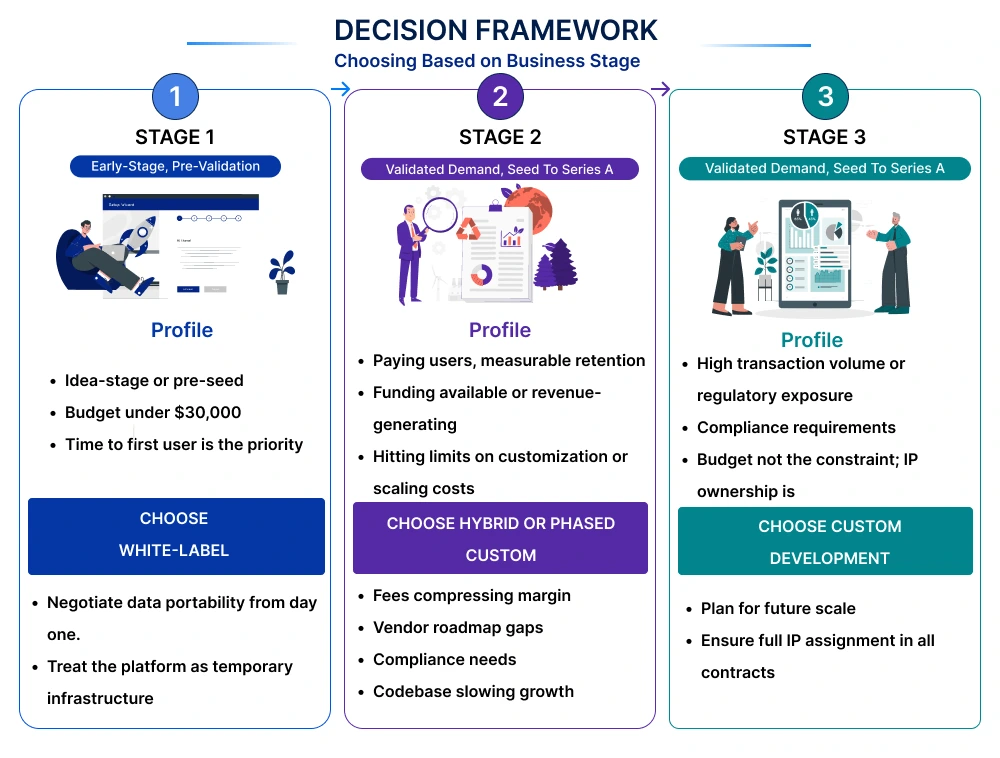
Decision Framework: Choosing Based on Business Stage
The right model isn’t determined by which option sounds better in principle. It’s determined by where your business actually is — in terms of funding, validated demand, technical complexity, and how much time you can afford to spend before generating revenue.
Stage 1: Early-Stage, Pre-Validation
Profile: Idea-stage or pre-seed. No confirmed product-market fit. Budget under $30,000. Time to first user is the primary constraint.
At this stage, spending $80,000–$200,000 on a custom build before a single paying customer has validated the concept is a capital allocation error. White-label deployment compresses the time between idea and real user data to weeks. If the market validates, you have the revenue and evidence to fund the right technical investment. If it doesn’t, you’ve spent $15,000 to find that out rather than $150,000.
- Choose white-label
- Negotiate data portability into the contract from day one
- Treat the platform as temporary infrastructure, not a permanent stack
Stage 2: Validated Demand, Seed to Series A
Profile: Paying users, measurable retention, clear unit economics. Funding available or revenue-generating. Starting to hit the ceiling on white-label customization or scaling costs.
This is where the hybrid path or a phased custom build makes the most sense. You have product data to build from, which means the custom architecture decisions are grounded in how real users actually behave on the platform, not how you assumed they would. The white-label backend + custom frontend pattern works well here if the vendor’s API supports it. A full custom migration is justified when:
- Licensing and tier-based fees are compressing margin as transaction volume grows
- The business model requires features the vendor’s roadmap doesn’t cover
- Compliance requirements are emerging that the white-label platform can’t fully satisfy
- The codebase is becoming a barrier to the product roadmap rather than an enabler
Stage 3: Scaling or Enterprise
Profile: Established transaction volume, regulatory exposure, compliance requirements, or acquisition trajectory. Budget is not the primary constraint; architecture quality and IP ownership are.
Custom development is the only viable path here. Shared multi-tenant infrastructure doesn’t support the performance and security isolation that high-volume or regulated on-demand platforms require. Compliance frameworks like HIPAA, SOC 2 Type II, and PCI DSS demand architectural control that no white-label vendor can fully delegate to a client. And for businesses heading toward M&A, owned IP is a direct valuation input; a platform built on licensed white-label software is not a proprietary technology asset in any due diligence process.
- Choose custom development
- Plan the architecture for the scale you’re moving toward, not the scale you’re at today
- Ensure full IP assignment is documented in all development contracts
Wrapping Up
White-label wins when speed and capital efficiency matter more than differentiation. Custom wins when the business model itself is the product and long-term ownership is non-negotiable. The hybrid path exists for everything in between. What determines the right call isn’t budget alone; it’s where the business is, where it’s heading, and how much technical debt it can afford to carry. Get that assessment right before a single vendor is contacted or a single line of code is written.











 Sales Enquiries:
  Business queries:
  HR:
HR: 


