



 Healthcare Software Development Services
 Healthcare App Development Services
 Real Estate Web Development Services
 Real Estate App Development Company
 E-Commerce App Development Services
 E-Commerce Web Development Services
 Blockchain E-commerce Development Company
 Fintech Software Development
 Fintech App Development Services
 E-Learning App Development Services
 Restaurant App Development Company
 Mobile Game Development Company
 Travel App Development Company
 Automotive Web Design
 AI Traffic Management System
 AI Inventory Management Software
 Logistics App Development Services
 Machine Learning Development
 ChatGPT integration services
  AI Development Company
  AI Integration Services
  Natural Language Processing Company
 Mobile App Development
  IOS App Development
  Android App Development
  Cross-Platform App Development
  Augmented Reality (AR) App Development
  Virtual Reality (VR) App Development
  Web App Development
  SaaS App Development
 Custom Software Development Services
  Flutter
  React Native
  Swift (IOS)
  Kotlin (Android)
  Mean Stack Development
  AngularJS Development
  MongoDB Development
  Nodejs Development
  Database Development
 Ruby on Rails Development
 Expressjs Development
  Full Stack Development
  Web Development Services
  Laravel Development
  LAMP Development
  Custom PHP Development
  .Net Development
  User Experience Design Services
  User Interface Design Services
  Automated Testing
  Manual Testing
  Digital Marketing Services
 Ride-Sharing And Taxi Services
 Food Delivery Services
 Grocery Delivery Services
 Transportation And Logistics
 Car Wash App
 Home Services App
 ERP Development Services
 CMS Development Services
 LMS Development
 CRM Development
 DevOps Development Services
 AI Business Solutions
 AI Cloud Solutions
 AI Chatbot Development
 API Development
 Blockchain Product Development
 Cryptocurrency Wallet Development
 About Talentelgia
  Our Team
  Our Culture
 Healthcare App Development Services
 Real Estate Web Development Services
 E-Commerce App Development Services
 E-Commerce Web Development Services
 Blockchain E-commerce
Development Company
Blockchain E-commerce
Development Company Fintech App Development Services
 Blockchain Fintech
Development Company
Blockchain Fintech
Development Company E-Learning App Development Services
 Restaurant App Development Company
 Mobile Game Development Company
 Travel App Development Company
 AI Traffic Management System
 AI Inventory Management Software
 AI Development Company
 ChatGPT integration services
 AI Integration Services
 Machine Learning Development
 Machine learning consulting services
 Blockchain Development
 Blockchain Software Development
 Smart contract development company
 NFT marketplace development services
 Asset tokenization companies
 DeFi Wallet Development Company
 IOS App Development
 Android App Development
 Cross-Platform App Development
 Augmented Reality (AR) App
Development
Augmented Reality (AR) App
Development Virtual Reality (VR) App Development
 Web App Development
 Flutter
 React
Native
React
Native Swift
(IOS)
Swift
(IOS) Kotlin (Android)
 MEAN Stack Development
 AngularJS Development
 MongoDB Development
 Nodejs Development
 Database development services
 Expressjs Development
 Full Stack Development
 Web Development Services
 Laravel Development
 LAMP
Development
LAMP
Development Custom PHP Development
 User Experience Design Services
 User Interface Design Services
 Automated Testing
 Manual
Testing
Manual
Testing About Talentelgia
 Our Team
 Our Culture
A product idea may launch with strong internal alignment and enthusiasm. That alignment often proves short-lived. The sales team requests features that conflict with the original vision, leadership pushes for accelerated timelines, and customer feedback points toward an entirely different set of priorities.
Within weeks, everyone’s building different things. The roadmap (if you even have one) gets tossed. You’re in constant firefighting mode.
This is where most product teams implode. In fact, 80% of new products launched each year fail in the marketplace, and misalignment is a major reason why.
Some skip the roadmap entirely. Others just keep on using one together in a spreadsheet, treat it like scripture for six months, then torch the whole thing when the market shifts. Neither approach works, and you end up either chaotic or rigid, sometimes both.
Here’s the thing: a product development roadmap isn’t some fancy strategic document you present to executives and forget about.
What is it then?
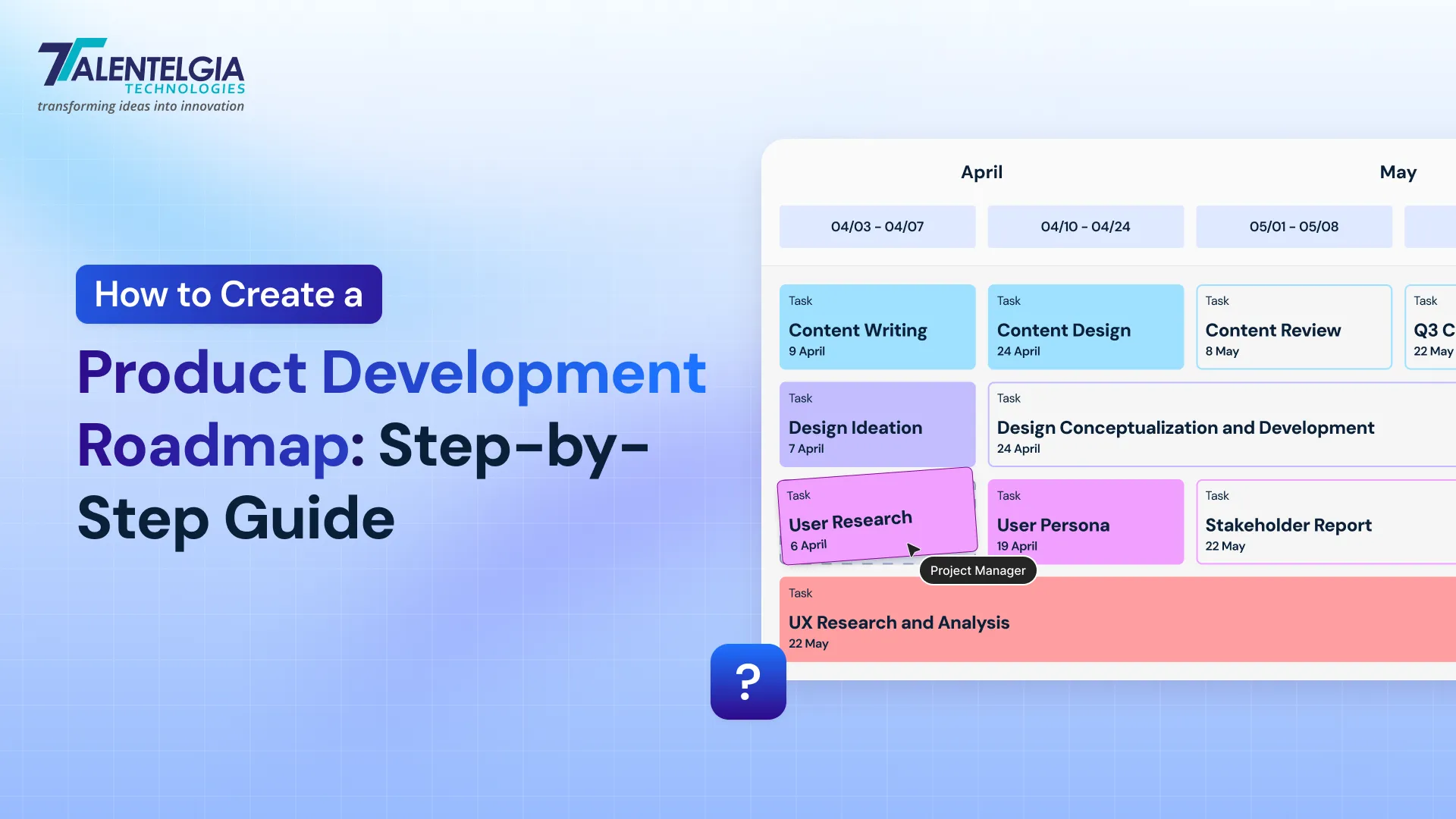
A product roadmap is your team’s shared source of truth. It’s a visual strategic plan that outlines where your product is headed, what you’re building, why it matters, and how it aligns with the stages of product development, all anchored to a realistic timeline.
But here’s the thing: it’s not just a feature list with dates slapped on it. That’s what most teams get wrong.
A real roadmap answers three critical questions:
- What are you building? (Specific features, initiatives, updates)
- Why are you building it? (How it connects to strategy and customer needs)
- When are you delivering it? (Realistic timelines, milestones, dependencies)
It’s flexible, not gospel. Markets shift. Customer feedback changes priorities. A good roadmap adapts without losing sight of the bigger picture.
It shows the why as much as the what. “We’re building X because Y” beats “We’re building X” every single time. Context drives alignment.
Who Owns It, Who Uses It, and Why It Matters
Who Actually Owns the Roadmap
Product managers take the initiative. You are gathering data, synthesizing inputs, making the tough choices about what to prioritize, and crafting the roadmap. But that’s not how things really work – the best roadmaps don’t get created in silos.
Without having all of those people at the table, you’ll have a product that will look fantastic in terms of concept but work terribly in reality. One thing you should remember is that cross-functional collaboration is not optional – it’s mandatory.
Who Actually Uses It
Different teams, different needs. Same roadmap.
- Engineering uses it to understand priorities and plan sprints. They need to see dependencies and timelines. Context matters; knowing why a feature matters changes how they approach the build.
- Design and UX plan research initiatives in sync with your roadmap. This helps them to test the user flow early on before it goes into engineering. They’re not reacting; they’re anticipating.
- Marketing and Sales time campaigns and messaging with launches. Sales especially need to know what’s coming (without hard dates that’ll blow up in their face). They’re your frontline with customers.
- Customer Success and Support prep for what’s changing. They’re the ones fielding questions. A heads-up prevents chaos.
- Leadership and executives are focused on just one thing: Does this tie into our business objectives? They need a 30,000-foot view of things, not specifics of the feature. They want to see ROI.
Visibility into what’s coming next helps the entire organization prioritize and plan. That’s alignment. That’s what separates teams that ship well from teams that ship constantly but go nowhere.
Why Create a Product Development Roadmap
- Prioritize features vs. noise – There will always be more work than time. The roadmap allows you to ask yourself what’s important and what’s not. It eliminates endless priority meetings that don’t achieve anything.
- Communicate with stakeholders – Executives stop nagging you for deadlines. Clients aren’t surprised by changes. The sales department doesn’t promise features that don’t yet exist. Everything is clear to everyone.
- Manage dependencies – Features don’t exist in a vacuum. Feature B might depend on Feature A being shipped first. Infrastructure changes might block three initiatives. A roadmap surfaces these blockers before you start building and wasting time.
- Track progress and accountability – You’re not just hoping things work out. You’ve committed to specific outcomes tied to business goals. You track what shipped, what slipped, and why. That visibility builds trust. That accountability drives execution.
- It forces honest conversations – Trade-offs become visible. You can’t build everything at full speed, so you pick what matters most. A roadmap gives you the framework to make those calls intelligently instead of politically.
- It’s your strategy made tangible – Your vision is inspiring but vague. Your sprints are tactical but myopic. A roadmap bridges that gap, showing how today’s work connects to tomorrow’s strategy.
Without it, you’re operating on hope and politics. With it, you’re operating on strategy.
What to Include in a Product Development Roadmap
A product development roadmap is much more than a checklist of dates for features. Here’s what goes in and why each piece matters.
Goals
This should be your starting point. Your goals are the outcomes you want to achieve. Follow the OKR methodology:
Objective: “Improve user onboarding experience”
Key Results:
- Reduce time-to-first-action from 15 minutes to 5 minutes
- Increase activation rate to 45% (from 32%)
- Hit 80% NPS on onboarding flow
Each individual feature, each initiative, and each milestone should be aligned with one objective or another. If it doesn’t, it probably shouldn’t be on your roadmap.
Initiatives
These are the high-level initiatives that group together related projects. These act as a transition between strategy and features. Rather than listing 20 individual features, group them into these categories:
- “Improve onboarding” (which includes simplifying the sign-up process, reducing form fields, and tooltips)
- “Develop payment infrastructure” (which includes Stripe integration, subscriptions, billing dashboard)
- Build AI/ML capabilities” (includes ChatGPT integration, machine learning development, recommendation engine)
- “Expand analytics” (which includes custom reporting, event tracking, retention dashboards)
Features
Specific, achievable deliverables. “Add dark mode.” “Implement single sign-on.” “Design custom reporting dashboard.” Features are part of initiatives and ultimately contribute to goals.
User Stories
Describe your features from the customer’s perspective. “As a power user, I want to be able to export my data in CSV format so that I can analyze it in Excel.” User stories help keep you thinking about who is going to benefit and why.
Milestones
Key release dates or moments. MVP launch. Beta release. Public launch. Major feature drop. Milestones create structure and accountability—they’re the checkpoints where you measure progress.
Timeline
Realistic dates or relative timeframes. Use quarters, sprints, or “Now / Next / Later.” Avoid over-committing. If you’re 60% confident you’ll hit a date, say so. If it’s uncertain, mark it as exploratory.
Dependencies
What blocks what? Feature B can’t start until Feature A ships. Infrastructure work might gate three initiatives. Payment system integration blocks premium features. Surface these dependencies early so you don’t hit roadblocks mid-sprint.
Success Metrics
How you’ll know this work mattered. “Reduce support tickets by 20%.” “Increase feature adoption to 35%.” “Hit $50K ARR.” Metrics tie execution back to outcomes.
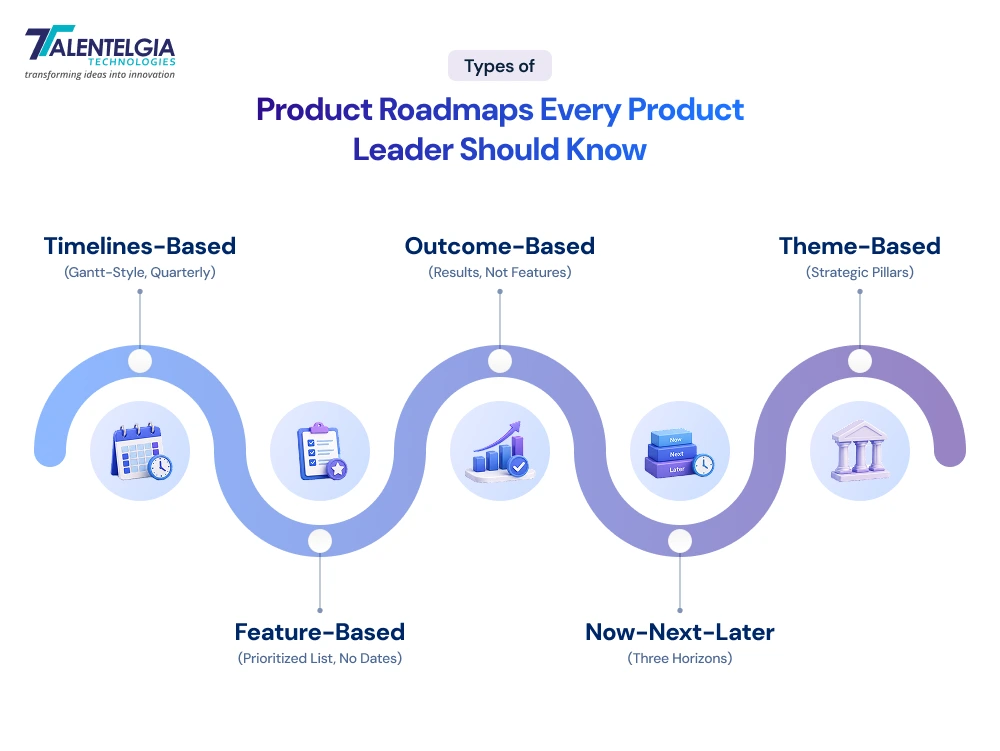
Types of Product Roadmaps Every Product Leader Should Know
There is no single roadmap template for all projects because there are diverse teams, various goals, and different ways of structuring project details.
Timeline-Based (Gantt-Style, Quarterly)
A graph that plots features against months or quarters. It indicates when things should happen. Perfect for predictability; however, inflexible; changes ruin everything.
Feature-Based (Prioritized List, No Dates)
Just a prioritized list of features with descriptions. Does not imply any strict deadlines. Agile approach, but it gives executives zero visibility into timing.
Outcome-Based (Results, Not Features)
Organized around business outcomes (“increase retention 25%”), not features. Helps teams focus on impact, not just completing things. Requires clearly defined metrics and discipline..
Now-Next-Later (Three Horizons)
Tasks are divided into three groups: current actions, actions to be taken next (1–3 months), and actions that will be taken later (3+ months). Extremely flexible and noncommittal approach.
Theme-Based (Strategic Pillars)
Features grouped under strategic themes (“improve onboarding,” “expand to enterprise,” “reduce churn”). Shows strategy without rigid timelines. Best for communication but light on execution details.
The Real Process: How to Build a Roadmap That Works
Only 52% of product teams are confident their roadmaps actually reflect the strategic context behind what they’re building. The rest are just shipping features without a clear connection to strategy. A well-built roadmap fixes this.
Here’s how to actually do it.
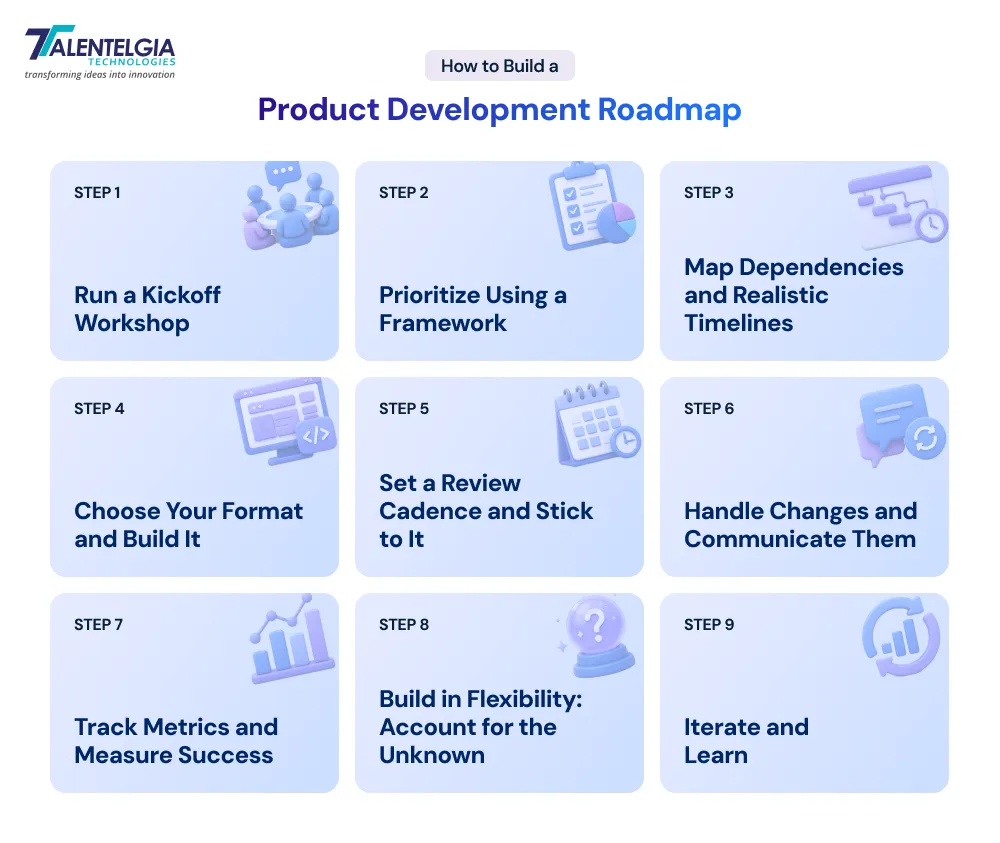
Step 1: Run a Kickoff Workshop
Don’t build this alone in a spreadsheet.
Get your team in one place (or on a Zoom call). Include product, engineering, design, sales, marketing, and leadership. Use 2–3 hours to synthesize:
- Customer feedback and pain points
- Competitive landscape
- Technical constraints and opportunities (especially for AI integration services)
- Business priorities
Use a collaborative tool (Mural, Figma, Miro) so everyone can contribute simultaneously. Document what you hear. This becomes your input pool.
Output: A shared document of problems to solve, gaps to fill, and opportunities to pursue.
Step 2: Prioritize Using a Framework
You have 100 ideas. You can make 10. Be objective!
Use RICE (if you want rigor):
- Rate each idea in terms of Reach, Impact, Confidence, and Effort
- Calculate: (Reach x Impact x Confidence) / Effort
- Rank according to score
- Discuss anomalies
Or use MoSCoW (if you want speed):
- Must have, Should have, Could have, Won’t have
- Vote as a team
- Lock in the Musts, commit to Shoulds, park the rest
Or use a 2×2 matrix (if you want simplicity):
- Plot initiatives on Impact vs. Effort
- Pick the high-impact, low-effort wins first
- Layer in strategic bets after
Choose one method and follow it throughout. Don’t mix them up or you will doubt every decision.
Output: A prioritized list tied to your goals.
Step 3: Map Dependencies and Realistic Timelines
Now ask: What blocks what? How long does this actually take?
Talk to engineering. Be honest about capacity. Don’t say “3 weeks” if it’ll take 6.
Create a dependency map:
- Feature B depends on Feature A shipping first
- Infrastructure upgrade gates three initiatives
- Design system work unblocks mobile redesign
Identify your critical path—the chain of work that everything else waits for. If that slips, everything slips.
Factor in:
- Team size and capacity (80% utilization, not 100%)
- Dependencies between teams
- Technical debt and maintenance work (15–20% of capacity)
- Holidays, conferences, planned time off
Output: A realistic sequencing of work across quarters.
Step 4: Choose Your Format and Build It
Choose a single format. Use an application that your team will maintain.
- Timeline format (Gantt Chart): Great for executives, displays “when”
- Features prioritization list: Great for teams, flexible for agile process
- Now-Next-Later list: Best for dynamic teams, highly flexible
- Goal-oriented list: Great for strategy, displays “why”
- Kanban board: Great for sprints, displays current status
Put it somewhere visible: Confluence, Notion, Figma, GitHub. Make it your source of truth.
Output: A visible, shareable roadmap.
Step 5: Set a Review Cadence and Stick to It
A roadmap that’s three months out of date is worthless.
- Weekly: 15-minute team sync on progress and blockers
- Monthly: Full team review—what shipped, what slipped, why?
- Quarterly: Leadership review tied to business metrics
- Ad-hoc: Emergency updates when priorities shift (market change, major customer issue, technical blocker)
In each review, ask:
- Are we on track?
- What changed in the market or with customers?
- Should we adjust priorities?
- What risks are we missing?
Output: An updated roadmap and alignment across teams.
Step 6: Handle Changes and Communicate Them
Plans change. That’s not failure, that’s reality.
When priorities shift:
- Document why (customer feedback, market shift, technical blocker, business pivot)
- Update the roadmap immediately
- Communicate to stakeholders within 24 hours (not three weeks later)
- Explain the trade-off (what are we deprioritizing to make room?)
Be transparent. “We’re moving X to later because Y” beats radio silence and confusion.
Use your review meetings to surface needed changes early. Don’t wait until things are broken.
Output: A roadmap that reflects reality, not fantasy.
Step 7: Track Metrics and Measure Success
A roadmap without metrics is just a wish list.
For each major milestone, define success upfront:
- “Launch with <5 critical bugs”
- “Hit 10,000 activated users in first month”
- “Reduce onboarding time by 40%”
- “Increase feature adoption to 35% of user base”
After launch, track actual results vs. what you predicted. This teaches you:
- Were your estimates accurate?
- Did the feature move the needle?
- Where did you misjudge customer behavior?
Use these learnings to build better roadmaps next time.
Output: Data-driven insights that improve your process.
Step 8: Build in Flexibility: Account for the Unknown
Reserve 15–20% of capacity for:
- Critical bugs that need fixing
- Customer escalations
- Technical debt that can’t wait
- Opportunities you didn’t predict
If you allocate 100% to planned work, you’ll miss every deadline and burn out your team.
Output: A roadmap your team can actually execute.
Step 9: Iterate and Learn
After each quarter, run a retrospective:
- What did we ship? What didn’t we ship? Why?
- What assumptions were wrong?
- What surprised us?
- How do we improve next time?
Apply these lessons to the next digital product development roadmap planning cycle. With time, you’ll get better at forecasting, prioritization, and estimation.
The roadmap isn’t set-and-forget. It’s a living process that gets better with practice.
Output: Continuous improvement in how you plan and execute.
| Pick one. Don’t mix formats. It creates confusion. If your team is agile, use Now-Next-Later or Feature-Based. If you need predictability, use Timeline. If strategy matters most, use Theme or Outcome. |
Do You Need A Product Roadmap?
Here’s the honest answer: probably yes.
But let’s be real about it.
You absolutely need one if:
- You’re coordinating multiple teams (engineering, design, marketing, sales). Without alignment, everyone’s building different things. A roadmap forces agreement.
- You have stakeholders asking “when will X ship?” constantly. A roadmap kills the constant back-and-forth meetings. Point to the roadmap. Done.
- You’re managing technical debt alongside new features. A roadmap permits you to allocate time to both instead of pretending you’ll “get to it later.”
- You’re planning go-to-market around feature launches. Sales and marketing need to know what’s coming and when. A roadmap lets them plan campaigns, create enablement materials, and set customer expectations.
- You want to track progress and measure success. A roadmap with milestones gives you checkpoints to review what shipped, what didn’t, and why.
- You have limited resources and can’t build everything. A roadmap forces prioritization instead of politics deciding what gets built.
You might not need one if:
- You’re a solo founder building solo. You know what needs to happen. Write it down somewhere. Not a formal roadmap, just notes. But write it down anyway.
- You’re on a tiny team (<5 people) working on one thing. Talk daily. Update a Trello board. Skip the formal process.
- You’re in pure firefighting mode (outages, critical bugs). Fix the emergency first. Roadmap later. But don’t stay in firefighting mode for six months and call it normal.
Wrapping Up
Most teams benefit from a roadmap. It doesn’t have to be fancy. A well-maintained spreadsheet beats beautiful software nobody updates. A simple Now-Next-Later view beats a 50-page strategic document.
Start simple. If your roadmap dies in a drawer, you built the wrong one.
That’s it. Stop overthinking it. Stop waiting for the perfect tool or the perfect process. Build something your team will actually use and update. Everything else is noise.











 Sales Enquiries:
  Business queries:
  HR:
HR: 


