



 Healthcare Software Development Services
 Healthcare App Development Services
 Real Estate Web Development Services
 Real Estate App Development Company
 E-Commerce App Development Services
 E-Commerce Web Development Services
 Blockchain E-commerce Development Company
 Fintech Software Development
 Fintech App Development Services
 E-Learning App Development Services
 Restaurant App Development Company
 Mobile Game Development Company
 Travel App Development Company
 Automotive Web Design
 AI Traffic Management System
 AI Inventory Management Software
 Logistics App Development Services
 Machine Learning Development
 ChatGPT integration services
  AI Development Company
  AI Integration Services
  Natural Language Processing Company
 Mobile App Development
  IOS App Development
  Android App Development
  Cross-Platform App Development
  Augmented Reality (AR) App Development
  Virtual Reality (VR) App Development
  Web App Development
  SaaS App Development
 Custom Software Development Services
  Flutter
  React Native
  Swift (IOS)
  Kotlin (Android)
  Mean Stack Development
  AngularJS Development
  MongoDB Development
  Nodejs Development
  Database Development
 Ruby on Rails Development
 Expressjs Development
  Full Stack Development
  Web Development Services
  Laravel Development
  LAMP Development
  Custom PHP Development
  .Net Development
  User Experience Design Services
  User Interface Design Services
  Automated Testing
  Manual Testing
  Digital Marketing Services
 Ride-Sharing And Taxi Services
 Food Delivery Services
 Grocery Delivery Services
 Transportation And Logistics
 Car Wash App
 Home Services App
 ERP Development Services
 CMS Development Services
 LMS Development
 CRM Development
 DevOps Development Services
 AI Business Solutions
 AI Cloud Solutions
 AI Chatbot Development
 API Development
 Blockchain Product Development
 Cryptocurrency Wallet Development
 About Talentelgia
  Our Team
  Our Culture
 Healthcare App Development Services
 Real Estate Web Development Services
 E-Commerce App Development Services
 E-Commerce Web Development Services
 Blockchain E-commerce
Development Company
Blockchain E-commerce
Development Company Fintech App Development Services
 Blockchain Fintech
Development Company
Blockchain Fintech
Development Company E-Learning App Development Services
 Restaurant App Development Company
 Mobile Game Development Company
 Travel App Development Company
 AI Traffic Management System
 AI Inventory Management Software
 AI Development Company
 ChatGPT integration services
 AI Integration Services
 Machine Learning Development
 Machine learning consulting services
 Blockchain Development
 Blockchain Software Development
 Smart contract development company
 NFT marketplace development services
 Asset tokenization companies
 DeFi Wallet Development Company
 IOS App Development
 Android App Development
 Cross-Platform App Development
 Augmented Reality (AR) App
Development
Augmented Reality (AR) App
Development Virtual Reality (VR) App Development
 Web App Development
 Flutter
 React
Native
React
Native Swift
(IOS)
Swift
(IOS) Kotlin (Android)
 MEAN Stack Development
 AngularJS Development
 MongoDB Development
 Nodejs Development
 Database development services
 Expressjs Development
 Full Stack Development
 Web Development Services
 Laravel Development
 LAMP
Development
LAMP
Development Custom PHP Development
 User Experience Design Services
 User Interface Design Services
 Automated Testing
 Manual
Testing
Manual
Testing About Talentelgia
 Our Team
 Our Culture
Every year, thousands of designers make the jump, some straight out of agency life, some after years of freelancing, some with funding behind them and a clear growth plan from day one. The starting points look different. The challenges, though, are remarkably similar.
Because running a web design business is a lot more than just the craft. It’s about building something that generates consistent revenue, attracts the right clients, and scales without everything depending on you personally. That gap between being a good designer and running a good business is where most people get stuck, regardless of how much experience or capital they’re starting with.
The market makes the case for trying. Mordor Intelligence puts the global web design industry at $61.23 billion in 2025, projected to reach $92.06 billion by 2030. Demand isn’t the problem. Structure, pricing, positioning, and execution are.
This guide covers all of it: what it actually takes to build a web design business that works, whether you’re going independent for the first time or building something you intend to scale.
How Web Design, Development, and UX Design are Different?
These three get lumped together constantly, and honestly, the confusion makes sense. While they do intersect, work together, and in some cases, are done by the same person, they aren’t the same.
Here’s the simplest way to think about it:
- A web designer is concerned with how a website should look, from layout to color schemes, typography to visual hierarchies. They primarily work in the browser environment and care about aesthetics just as much as functionality.
- Web developers take care of the technicalities that go behind a website’s operation. Front-end developers translate designs into code, while back-end developers worry about servers, databases, and other unseen elements.
- UX designers think about how the site operates for the end user. All their actions revolve around the end-user experience.
What Does A Web Design Business Entail?
Starting a web development business may seem simple enough in theory until you actually get involved. Not only do you need to design sites, but you have to deal with your clients, get revisions done, send out bills, receive your approvals, and somehow find your next job before you even finish your current job. The design part is probably half the job on a good day.
Here’s what the actual scope of work looks like:
- Website design and builds (WordPress, Webflow, Shopify)
- Landing pages for ads or lead generation
- Website redesigns for existing businesses
- Ongoing maintenance and support retainers
- Basic SEO setup and performance optimization
How Web Design Businesses Make Money?
| Revenue Model | How It Works |
|---|---|
| Project-based | Fixed price per website build |
| Hourly | Charged by time spent |
| Retainer | Monthly fee for ongoing work |
| Productized packages | Set deliverables at set prices |
Typically, most designers begin with project work but progress into retainers as soon as they can secure regular clients because retainers provide more reliable income.
Who your clients will be:
Local businesses, startup companies, online retailers, and, at times, large corporations that need overflow work. The majority of early clients come through referrals, not cold outreach.
One of those things that no one prepares you for up front: client management is an art form all on its own. Managing expectations, receiving feedback, and managing your time are just as important as the design.
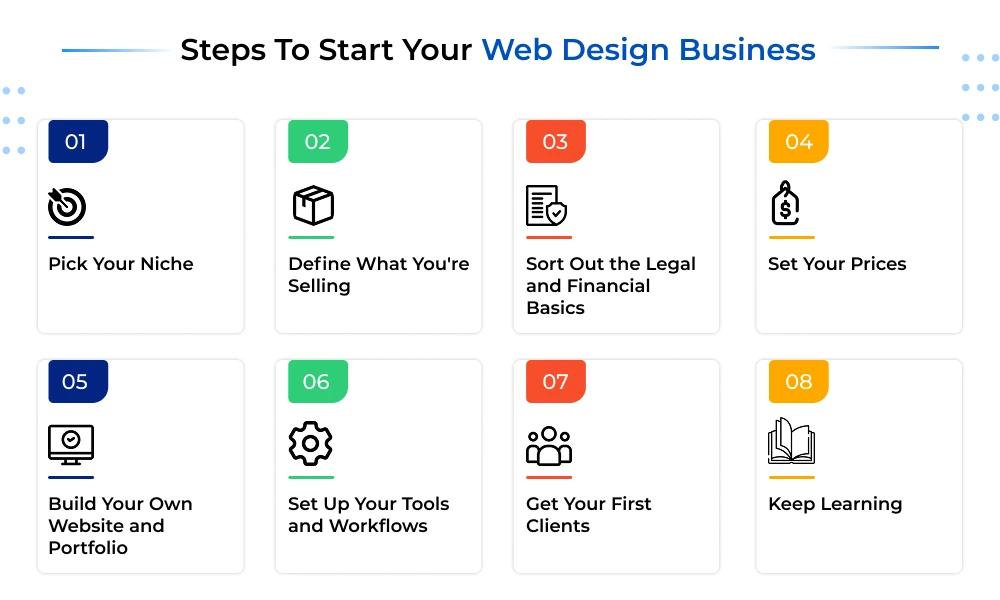
Steps To Start Your Web Design Business
Step 1: Pick Your Niche
The biggest mistake new web designers make is trying to work with everyone. “I’m a web designer” is a weak pitch. “I build websites for fitness coaches” is a business.
Picking a niche does three things:
It makes your marketing sharper, your pitches more confident, and your pricing easier to justify. A specialist can charge more than a generalist, always.
To find yours, start by looking at your own background. Industries you’ve worked in, communities you’re already part of, problems you actually understand. Then check if that niche has real demand and can afford to pay for quality work.
Some of the strongest niches right now:
- Local service businesses (salons, clinics, contractors)
- E-commerce brands
- Coaches and consultants
- Restaurants and hospitality
- Real estate agencies
Your niche can evolve. But starting specific gets you traction faster than starting broad.
Step 2: Define What You’re Selling
Once you know who you’re serving, figure out exactly what you’re offering them. Don’t just list “web design” as a service; think about what a client actually walks away with.
Common service offerings:
- Full website builds (WordPress, Webflow, Shopify)
- Landing pages for ads or lead generation
- E-commerce stores
- Website redesigns
- Monthly maintenance and support
- SEO setup and optimization
- Branding and visual identity
How you package these matters as much as what they are. Two approaches work well:
- Bundled packages – group related services under one price. Easier to sell, easier to scope. A “Launch Package” might include design, development, and basic SEO in one flat fee.
- Retainers – monthly fees for ongoing work. This is what turns unpredictable freelance income into something stable. Most designers aim to get here as quickly as possible.
Step 3: Sort Out the Legal and Financial Basics
Not the exciting part, but skipping it costs you later.
- Business structure: The most common business structures among solo web designers are either a sole proprietorship or an LLC. An LLC protects you from liability, separates personal from business funds, and makes you appear more professional to customers. You can get advice on what works best for you from a business lawyer or accountant before registering.
- Contracts: Every single project needs one: no exceptions, including friends and family. Your contract should cover scope of work, payment schedule, what happens if a client cancels, revision limits, and who owns the final files. No contract means no protection if things go sideways.
- Finances: Open a separate business bank account from day one. Track every expense. Set aside a portion of every payment for taxes. This is the thing most new business owners get blindsided by in their first year.
Step 4: Set Your Prices
Price is one area where many web designers undercut themselves early on and spend years recovering from it.
While most newbies price out around $800 – $1500 per website, this limit will go away very quickly when you begin building up your portfolio and gaining some confidence. Most small businesses’ websites run anywhere from $3,000-$15,000, depending on pages, features, design complexity, and content, so there’s real room to grow into.
A practical way to set your rates:
- Check what your competition in the market charges
- Add up your monthly business expenses: software, hosting, tools, taxes
- Work backwards from how much you need to earn and how many clients you can realistically take on
- Add a margin based on the value you provide, rather than the effort that you put in
Just something to keep in mind: the client isn’t paying for the hours put in, but for what was accomplished by doing so. If the website is done right, it can provide business for many years to come.
Step 5: Build Your Own Website and Portfolio
Your website is your most important sales tool. It’s not just a portfolio; it’s proof that you can do what you say you can.
Build it the same way you’d build one for a paying client. If you wouldn’t charge $5,000 for what you’ve built for yourself, a client won’t pay $5,000 either.
What your website needs:
- A clear explanation of who you help and what you do
- Portfolio work with context, not just screenshots, but the problem you solved
- Services page with pricing, or at least a starting range
- Testimonials, even from small early projects
- A simple contact or booking form
If you’re just starting and don’t have client work yet, build sample projects for your niche. A mock restaurant site, a coach landing page, and a demo e-commerce store. They count.
Step 6: Set Up Your Tools and Workflows
Before your first client, have your systems in place. Scrambling to find an invoice template while a client is waiting to pay you is not a great look.
The core stack you need:
| Category | Tools to Consider |
|---|---|
| Project management | Asana, Trello, Monday |
| Contracts and proposals | PandaDoc, Proposify, AND.CO |
| Invoicing and accounting | FreshBooks, QuickBooks, Xero |
| Time tracking | Toggl, Harvest |
| Design | Figma, Adobe XD |
| Communication | Loom, Zoom, Slack |
Beyond tools, map out your project workflow from kickoff to handover: briefing, research, wireframes, design, development, QA, launch. Having a repeatable process makes every project smoother and makes you look like you’ve done this a hundred times, even if it’s only your third.
Step 7: Get Your First Clients
The first few clients almost always come from your existing network – a former colleague, a friend’s business, someone who saw you mention it on LinkedIn. Don’t overlook this. Reach out directly, tell people you’re open for work, and ask for referrals from anyone you’ve already helped.
Once you’re up and running, here’s how to keep the pipeline moving:
Free strategies that actually work:
- Join Facebook groups in your target industry, not to spam, but to show up, answer questions, and become a familiar face
- Guest on industry podcasts or write for publications your ideal clients actually read; both build credibility faster than cold outreach ever will
- Post consistently on social media using the 80/20 rule: 80% helpful content your audience genuinely wants, 20% about your work, including recent projects, client wins, process breakdowns
- Make sure your own website has foundational SEO in place. You’re a web designer, so your site should be findable
- Offer to build a website for an influential person in your niche using one of your templates in exchange for promotion. One shoutout from the right person beats months of cold emailing
- Give existing clients a reason to refer: a free month of service, a gift card, anything that makes saying your name worth their while
- Go to networking events even outside your niche. People know people. Someone who can’t hire you might know ten people who can.
Paid strategies worth considering once you have a budget:
- Run targeted social media ads aimed at decision-makers and business owners in your niche
- Advertise in a popular email newsletter your audience subscribes to
- Sponsor a banner on a high-traffic industry blog
- Rent a booth at an industry conference or convention, bring business cards, and talk to everyone
- Host a “Lunch and Learn” on Zoom with relevant guest speakers. Invite their audiences too. It positions you as a connector, not just a service provider
Step 8: Keep Learning
Things move quickly in web design. The technologies, skills, and customer needs that were effective two years ago have already changed. Staying updated can help you earn more money and attract more clients.
Make learning part of your daily routine instead of a distant afterthought. Read up on blog posts by other designers, enroll in classes to improve your weaknesses, and get certifications on any tools or platforms you’ll be using with customers. And pay close attention to how AI tools are changing the industry, not to fear it, but to stay ahead of it.
Also Read: Web Design Companies In Los Angeles – Top 10 List
Common Web Design Business Pitfalls And How To Avoid Them
Now that you are familiar with how to start a web design business, it’s time to also be aware of the fair share of ups and downs that come with a web design business. Most of the mistakes that sink early-stage businesses aren’t about design skills. They’re about the stuff nobody warned you about.
Scope creep
A client asks for “just one more thing” and then another. Before you know it, you’ve done twice the work for the same price. The fix is simple: a clear contract with a defined scope of work and the confidence to enforce it. When requests go beyond what was agreed, point back to the brief and outline what additional work will cost. It feels uncomfortable at first. It gets easier every time.
Underselling yourself
It’s difficult for newcomers to know how to set their prices, and they tend to be tempted by going cheap to attract customers. However, if you do that right at the start, then that will be an expectation you will find difficult to change. Remember: designers earning $75k+ annually charge an average of $131 per hour. That’s where confident pricing gets you.
Skipping insurance
It’s easy to overlook until something goes wrong. Web design businesses handle client data, miss deadlines, and occasionally make mistakes, all of which carry real liability. At a minimum, look into general liability insurance, errors and omissions coverage, and cyber liability insurance. It’s not glamorous, but it’s what separates a real business from a risky one.
Also Read: Top Web Development Trends 2025
Wrapping Up
Starting a web design business is more than being skilled in designing. It involves creating an enterprise that runs smoothly regardless of your presence. The designers involved do not necessarily have to be the most talented individuals around, but those who regularly attended, charged fairly for their services, had good relationships with their clients, and continued improving themselves despite success.
There is a lot of money to be made from this field. Opportunities exist. The only thing left to do is to take action.













 Sales Enquiries:
  Business queries:
  HR:
HR: 


