



 Healthcare Software Development Services
 Healthcare App Development Services
 Real Estate Web Development Services
 Real Estate App Development Company
 E-Commerce App Development Services
 E-Commerce Web Development Services
 Blockchain E-commerce Development Company
 Fintech Software Development
 Fintech App Development Services
 E-Learning App Development Services
 Restaurant App Development Company
 Mobile Game Development Company
 Travel App Development Company
 Automotive Web Design
 AI Traffic Management System
 AI Inventory Management Software
 Logistics App Development Services
 Machine Learning Development
 ChatGPT integration services
  AI Development Company
  AI Integration Services
  Natural Language Processing Company
 Mobile App Development
  IOS App Development
  Android App Development
  Cross-Platform App Development
  Augmented Reality (AR) App Development
  Virtual Reality (VR) App Development
  Web App Development
  SaaS App Development
 Custom Software Development Services
  Flutter
  React Native
  Swift (IOS)
  Kotlin (Android)
  Mean Stack Development
  AngularJS Development
  MongoDB Development
  Nodejs Development
  Database Development
 Ruby on Rails Development
 Expressjs Development
  Full Stack Development
  Web Development Services
  Laravel Development
  LAMP Development
  Custom PHP Development
  .Net Development
  User Experience Design Services
  User Interface Design Services
  Automated Testing
  Manual Testing
  Digital Marketing Services
 Ride-Sharing And Taxi Services
 Food Delivery Services
 Grocery Delivery Services
 Transportation And Logistics
 Car Wash App
 Home Services App
 ERP Development Services
 CMS Development Services
 LMS Development
 CRM Development
 DevOps Development Services
 AI Business Solutions
 AI Cloud Solutions
 AI Chatbot Development
 API Development
 Blockchain Product Development
 Cryptocurrency Wallet Development
 About Talentelgia
  Our Team
  Our Culture
 Healthcare App Development Services
 Real Estate Web Development Services
 E-Commerce App Development Services
 E-Commerce Web Development Services
 Blockchain E-commerce
Development Company
Blockchain E-commerce
Development Company Fintech App Development Services
 Blockchain Fintech
Development Company
Blockchain Fintech
Development Company E-Learning App Development Services
 Restaurant App Development Company
 Mobile Game Development Company
 Travel App Development Company
 AI Traffic Management System
 AI Inventory Management Software
 AI Development Company
 ChatGPT integration services
 AI Integration Services
 Machine Learning Development
 Machine learning consulting services
 Blockchain Development
 Blockchain Software Development
 Smart contract development company
 NFT marketplace development services
 Asset tokenization companies
 DeFi Wallet Development Company
 IOS App Development
 Android App Development
 Cross-Platform App Development
 Augmented Reality (AR) App
Development
Augmented Reality (AR) App
Development Virtual Reality (VR) App Development
 Web App Development
 Flutter
 React
Native
React
Native Swift
(IOS)
Swift
(IOS) Kotlin (Android)
 MEAN Stack Development
 AngularJS Development
 MongoDB Development
 Nodejs Development
 Database development services
 Expressjs Development
 Full Stack Development
 Web Development Services
 Laravel Development
 LAMP
Development
LAMP
Development Custom PHP Development
 User Experience Design Services
 User Interface Design Services
 Automated Testing
 Manual
Testing
Manual
Testing About Talentelgia
 Our Team
 Our Culture
Here’s the uncomfortable truth most enterprise leaders already know but rarely say out loud: the way work gets done inside large organizations hasn’t fundamentally changed. What’s changed is the volume. More data, more systems, more decisions, but the same human-dependent workflows underneath it all. Skilled people are spending their days on tasks that shouldn’t require their skills in the first place.
Traditional automation gave us speed on simple, repetitive work. AI chatbot development gave us a friendlier interface. But neither touched the real bottleneck. And that was a complex, multi-step execution that still needs a human in the loop at every turn.
That’s the gap autonomous AI agents are closing. These aren’t smarter chatbots or faster rule engines. They plan, make decisions, use tools, and see tasks through from start to finish, with minimal hand-holding.
The conversation in boardrooms has shifted. It’s no longer “should we explore AI agents?” It’s “why aren’t we already running these at scale?”
This guide answers that question. It breaks down what autonomous AI agents actually are, what’s under the hood, how they operate, and what’s genuinely at stake for enterprises that move now versus those that wait.
What Are Autonomous AI Agents?
An autonomous AI agent is a system designed to perceive its environment, reason towards a concrete goal, and perform actions so that the above needs do not involve waiting for detailed human instructions at every step of this process. IBM defines it as an intelligent agent that can reason and plan, being able to act, choosing which tools to use when to escalate, and how to adapt as the environment changes. This is a basic shift from the way AI has operated until now.
Traditional AI systems, on the other hand, are designed to execute predefined tasks based on fixed rules, prompts, or trained patterns. They are highly effective for prediction, classification, and repetitive automation, but they typically depend on human instructions, structured workflows, and constant oversight to function correctly.
Traditional AI vs. Autonomous AI Agents — The Core Distinction
| Dimension | Traditional AI / Automation | Autonomous AI Agents |
|---|---|---|
| Core Objective | Executes predefined tasks and rules | Pursues goals and business outcomes autonomously |
| Input Style | Requires explicit instructions and commands | Operates using goals, context, memory, and constraints |
| Operating Model | Reactive and workflow-based | Proactive, adaptive, and goal-driven |
| Decision-Making | Rule-based and deterministic | Context-aware reasoning and dynamic decision-making |
| Workflow Scope | Handles isolated or single-step tasks | Manages multi-step, end-to-end workflows |
| Planning Ability | No independent planning capability | Breaks goals into sequenced executable actions |
| Adaptability | Fails or requires manual intervention when conditions change | Adjusts plans dynamically based on new information |
| Learning Capability | Requires retraining or manual rule updates | Improves through feedback, memory, and continuous interactions |
| Context Awareness | Limited understanding of the surrounding context | Maintains persistent contextual and situational awareness |
| Memory | Stateless or session-limited | Uses both short-term and long-term memory |
| Tool & System Usage | Limited to predefined integrations | Dynamically interacts with APIs, CRMs, ERPs, databases, and enterprise tools |
| Human Involvement | Requires continuous supervision | Minimal oversight with escalation only when needed |
| Error Handling | Stops or breaks on unexpected scenarios | Self-corrects, retries, and adapts execution paths |
| Orchestration Capability | Operates in isolated workflows | Supports multi-agent coordination and AI orchestration systems |
| Enterprise Value | Automates repetitive manual tasks | Enables intelligent automation, operational scalability, and enterprise transformation |
In enterprise deployments, autonomy doesn’t mean unchecked freedom. What distinguishes truly autonomous AI agents is their capacity to reason iteratively, evaluate outcomes, adapt plans, and pursue goals without ongoing human input but always within scoped permissions, audit trails, and escalation paths set by enterprise policy.
A practical example: an enterprise AI agent tasked with onboarding a new vendor can independently pull contract templates, verify compliance requirements, route approvals, update the ERP, and flag exceptions, start to finish, zero hand-holding.
The Core Components of Autonomous AI Agents
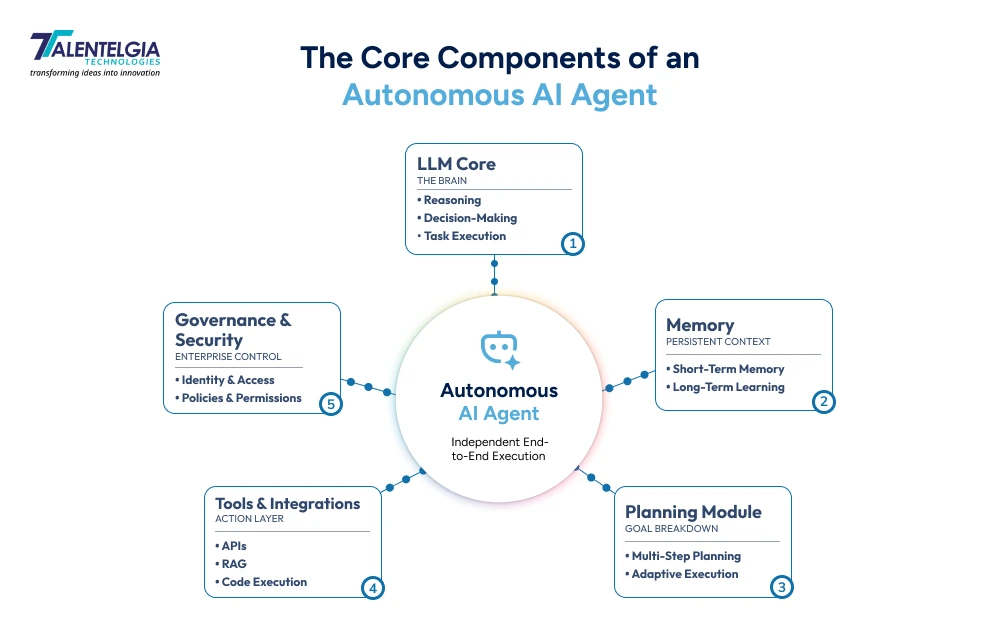
An AI autonomous agent is a complete architecture of components that work together to make independent, end-to-end execution possible.
1. The LLM Core: The Brain – The large language model sits at the center. It interprets goals, reasons through problems, selects tools, and sequences actions. Everything else in the architecture takes direction from here.
2. Memory: Context That Persists – Agents operate across two memory types:
- Short-term: Active context within a running task (what’s happened, what’s pending)
- Long-term: Stored knowledge that carries across sessions ( past decisions, user preferences, workflow history)
Without memory, every task starts from zero. With it, agents compound their usefulness over time.
3. Planning Module: Breaking Goals into Actions – Complex goals don’t execute in one shot. Planning modules decompose objectives into sequenced, manageable steps, and critically, they adjust mid-task when new information changes the picture.
4. Tools and Integrations: How Agents Act on the World – Reasoning alone achieves nothing. These intelligent AI agents extend their reach through:
- APIs – triggering actions across enterprise systems
- RAG pipelines and vector databases – pulling accurate, real-time information
- Code execution environments – running scripts, processing data, generating outputs
5. Governance and Security Layer: The Enterprise Non-Negotiable – Only 11% of organizations have implemented governance frameworks for AI agents, despite rapid deployment growth, a gap that creates serious exposure. Production-grade agents operate inside sandboxes, identity controls, and policy engines that scope access, enforce permissions, and maintain audit trails.
How Autonomous AI Agents Work?
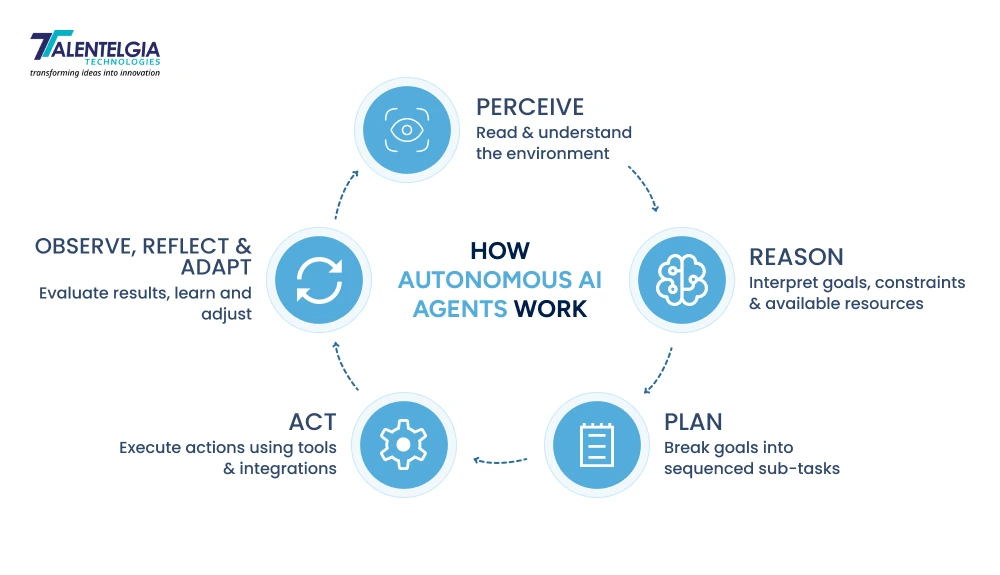
Autonomous AI agents operate through a continuous, self-correcting loop. Here’s exactly how that loop runs:
Step 1: Perceive
Before the agent does anything, it reads its environment. This means pulling in structured data from databases, unstructured data from documents, real-time inputs from APIs, user instructions, sensor feeds, and IoT signals. It then filters noise, extracts relevant features, and builds a working picture of the current situation. Without accurate perception, everything downstream breaks.
Step 2: Reason
The LLM takes over here. It interprets the assigned objective, understands constraints, and maps out what needs to happen. This isn’t simple keyword matching; the agent weighs priorities, identifies dependencies between tasks, and evaluates what tools and data it has permission to access before committing to a plan.
Step 3: Plan
Complex goals don’t execute in one shot. The planning module decomposes the objective into a sequenced series of sub-tasks, each with a defined action, a target system, and an expected outcome. Two primary reasoning frameworks govern this stage:
- Chain of Thought (CoT): The agent reasons step-by-step without external feedback – structured, linear decomposition
- ReAct (Reason + Act): The agent follows a Thought → Action → Observation cycle — thinking through the next move, taking an action such as querying an API, then observing the result before deciding what comes next. This is the industry standard for dynamic, unpredictable workflows
Step 4: Act
With a plan in place, the agent moves. It connects through an orchestration layer to enterprise tools, databases, CRMs, ERPs, code execution environments, and communication platforms. Each action is scoped by permission controls set at configuration: the agent can only touch systems it’s been authorized to access. Multi-agent systems, where specialized agents work in parallel: one planning, one retrieving, one executing, one validating.
This level of intelligent coordination is helping enterprises accelerate autonomous enterprise automation across complex operational environments.
Step 5: Observe, Reflect and Adapt
After acting, the agent evaluates. Did the result match the expected outcome? If yes, it proceeds. If not, it reassesses, revises the plan, and tries again. This self-correction is powered by:
- Reinforcement signals — positive or negative feedback that adjusts future decisions
- Heuristic updates — logic thresholds recalibrated based on what worked
- Self-assessment loops — the agent identifies its own errors and tests fixes automatically
The loop runs continuously until one of three things happens: the goal is achieved, a time limit is reached, or a governance boundary triggers escalation to a human.
Exploring the Different Types of Autonomous AI Agents
| Agent Type | How It Works | Best For | Example |
| Simple Reflex | IF condition → THEN action. No memory, no learning | Predictable, rule-driven environments | Automated thermostats, fraud triggers |
| Model-Based | Maintains an internal world model; uses past context to fill in gaps | Partially observable environments | Self-driving navigation, inventory management |
| Goal-Based | Evaluates multiple possible actions against a defined objective | Multi-path decision scenarios | Supply chain optimization, route planning |
| Utility-Based | Assigns scores to outcomes and selects the highest-value action | Conflicting priorities, trade-off decisions | Resource allocation, pricing engines |
| Learning Agents | Improves over time using four components: learning element, performance element, critic, and problem generator | Evolving, dynamic environments | Fraud detection, personalization engines |
| Hierarchical Agents | Break complex tasks into layered subtasks distributed across operational levels | Large-scale, multi-department workflows | Enterprise ERP automation, procurement |
| Hybrid Agents | Combines reactive speed with deliberative planning | Environments requiring both real-time and long-term reasoning | Customer service + escalation workflows |
Why Enterprises Are Investing in Autonomous AI Agents?
- McKinsey projects generative AI, driven largely by autonomous agents, will contribute $2.6 to $4.4 trillion annually to global GDP
- The AI agents market is forecast to hit $52.6 billion by 2030, at a ~45% CAGR, one of the fastest-growing technology markets on record
- Gartner projects 40% of enterprise applications will include task-specific AI agents by the end of 2026, up from less than 5% today.
The conclusion is hard to argue with: this is no longer a technology bet. It’s a business decision with measurable outcomes already on the board.
Where Enterprises Are Actually Deploying Agents – Use Cases
Here’s what deployment of these AI workflow automation agents looks like across the six highest-ROI functions:
Customer Support and Service Operations
Agents triage incoming tickets, resolve standard queries end-to-end, route complex cases to humans, and monitor queue health across regions, all without a human touching routine volume. Autonomous support resolution is the fastest ROI use case in agentic AI, measurable within weeks and requiring minimal integration complexity to start.
Software Development and DevOps
Agentic AI systems interpret backlog requirements, generate code, run tests, identify failures, and propose patches. Morgan Stanley deployment reclaimed 280,000 developer hours across 9 million+ lines of code reviewed, shifting engineers from mechanical coordination to actual product work.
Finance, Risk, and Compliance
AI autonomous agents reconcile transactions, detect anomalies, review contracts for risk signals, and auto-generate regulatory reports across jurisdictions. Fraud triage agents detect and act on suspicious activity within milliseconds. Loan underwriting agents pull credit data, run risk models, and generate decisions for standard profiles, without adjuster involvement.
Supply Chain Management
Multi-agent systems monitor supplier performance, forecast demand shifts, optimize inventory across warehouses, and re-route deliveries in real time, simultaneously processing variables that no human team can track at that speed or scale. Many enterprises rely on AI orchestration systems to synchronize these autonomous workflows across logistics and procurement operations.
Revenue Operations and Marketing
Agents monitor pipeline health continuously, flag stalled deals, adjust campaign targeting within defined parameters, and recalibrate when conversion rates shift, giving revenue teams persistent intelligence instead of periodic reports.
Read – Agentic AI Use Cases
Conclusion
AI agents are more likely to become an important aspect of enterprise operations, working alongside employees rather than working as isolated tools. The focus isn’t just automating the repetitive tasks but creating powerful systems capable of handling increasingly complex workflows with speed, adaptability, and context awareness at a scale that would have been nearly impossible via traditional automation.
So, are you looking to build AI-powered solutions or integrate the best autonomous AI agents into existing workflows? Working with an experienced AI development company can help accelerate deployment while ensuring scalability, security, and long-term operational value
Frequently Asked Question (FAQ)
Are autonomous AI agents better than traditional automation?
Yes. Traditional automation only follows fixed rules, while autonomous AI agents can adapt, reason, and make decisions based on changing situations. This makes them more useful for handling complex business processes that require flexibility and real-time problem-solving.
Can autonomous AI agents replace human employees?
Autonomous AI agents are designed to support employees, not completely replace them. They handle repetitive and time-consuming tasks so teams can focus more on strategy, creativity, customer relationships, and important business decisions.
What are examples of autonomous AI agents?
Examples of autonomous AI agents include AI customer support agents, coding assistants, fraud detection systems, virtual sales assistants, autonomous supply chain management systems, and AI-powered workflow automation tools. These agents can independently analyze data, make decisions, complete tasks, and improve business operations with minimal human involvement.
What types of tasks can autonomous AI agents handle?
Autonomous AI agents can handle customer support, scheduling, data analysis, workflow automation, report generation, software testing, fraud detection, inventory management, lead qualification, and compliance monitoring. They are especially useful for repetitive, data-heavy, and multi-step business processes that require speed and accuracy.










 Sales Enquiries:
  Business queries:
  HR:
HR: 


