


 Healthcare App Development Services
 Real Estate Web Development Services
 E-Commerce App Development Services
 E-Commerce Web Development Services
 Blockchain E-commerce Development Company
 Fintech App Development Services
 Fintech Web Development
 Blockchain Fintech Development Company
 E-Learning App Development Services
 Restaurant App Development Company
 Mobile Game Development Company
 Travel App Development Company
 Automotive Web Design
 AI Traffic Management System
 AI Inventory Management Software
 Machine Learning Development
 ChatGPT integration services
  AI Development Company
  AI Integration Services
  Generative AI Development Services
  Natural Language Processing Company
 Mobile App Development
  IOS App Development
  Android App Development
  Cross-Platform App Development
  Augmented Reality (AR) App Development
  Virtual Reality (VR) App Development
  Web App Development
  SaaS App Development
 Flutter
  React Native
  Swift (IOS)
  Kotlin (Android)
  Mean Stack Development
  AngularJS Development
  MongoDB Development
  Nodejs Development
  Database Development
 Ruby on Rails Development
 Expressjs Development
  Full Stack Development
  Web Development Services
  Laravel Development
  LAMP Development
  Custom PHP Development
  .Net Development
  User Experience Design Services
  User Interface Design Services
  Automated Testing
  Manual Testing
  Digital Marketing Services
 Ride-Sharing And Taxi Services
 Food Delivery Services
 Grocery Delivery Services
 Transportation And Logistics
 Car Wash App
 Home Services App
 ERP Development Services
 CMS Development Services
 LMS Development
 CRM Development
 DevOps Development Services
 AI Business Solutions
 AI Cloud Solutions
 AI Chatbot Development
 API Development
 Blockchain Product Development
 Cryptocurrency Wallet Development
 About Talentelgia
  Our Team
  Our Culture
 Healthcare App Development Services
 Real Estate Web Development Services
 E-Commerce App Development Services
 E-Commerce Web Development Services
 Blockchain E-commerce
Development Company
Blockchain E-commerce
Development Company Fintech App Development Services
 Finance Web Development
 Blockchain Fintech
Development Company
Blockchain Fintech
Development Company E-Learning App Development Services
 Restaurant App Development Company
 Mobile Game Development Company
 Travel App Development Company
 Automotive Web Design
 AI Traffic Management System
 AI Inventory Management Software
 AI Development Company
 ChatGPT integration services
 AI Integration Services
 Machine Learning Development
 Machine learning consulting services
 Blockchain Development
 Blockchain Software Development
 Smart contract development company
 NFT marketplace development services
 Asset tokenization companies
 DeFi Wallet Development Company
 IOS App Development
 Android App Development
 Cross-Platform App Development
 Augmented Reality (AR) App
Development
Augmented Reality (AR) App
Development Virtual Reality (VR) App Development
 Web App Development
 Flutter
 React
Native
React
Native Swift
(IOS)
Swift
(IOS) Kotlin (Android)
 MEAN Stack Development
 AngularJS Development
 MongoDB Development
 Nodejs Development
 Database development services
 Expressjs Development
 Full Stack Development
 Web Development Services
 Laravel Development
 LAMP
Development
LAMP
Development Custom PHP Development
 User Experience Design Services
 User Interface Design Services
 Automated Testing
 Manual
Testing
Manual
Testing About Talentelgia
 Our Team
 Our Culture
Edge computing is already being implemented around us– from smartwatches on your wrists to computers dissecting both intersection and in-transit traffic flow. Other such applications are smart analysis of utility grids, oil rigs safety monitoring, streaming video optimization, and drones for crop management. And these applications are likely to expand further.
According to Grand View Research statistics, the edge computing market was $23.65 billion in 2024, which is expected to reach $327.79 billion by 2033, with a CAGR of 33% during the forecast period (2025 – 2033). A massive portion of this growth percentage comes from enterprises. Major enterprises have migrated their computing resources from data center ownership to the cloud. As businesses increasingly adopt AI Cloud Solution frameworks to enhance scalability and real-time data processing, the shift becomes even more pronounced. However, with mobile devices becoming increasingly powerful, and the rise of fast cellular networks like 5G is seems to drive companies out of their data centers as they look for new advancements in cloud systems towards the edge computing systems.
Understanding Edge Computing: Key Technologies, Working Process & Benefits
Ever wondered why your factory sensors or store cameras feel sluggish? Or why cloud bills keep climbing? Edge Computing can fix that!
Think of it like this: instead of sending every bit of data across the country to a giant cloud server (slow and expensive), edge computing processes info right where it’s created—on your machines, shelves, or delivery trucks (Lightning-fast decisions, lower costs, works offline). As a business owner, this could be your secret weapon for 2026. So, let’s break it down plain and simple.
What Is Edge Computing?
Traditionally, businesses relied on ‘Cloud Computing’, where data is sent to massive data centers (often hundreds of miles away) to be processed.
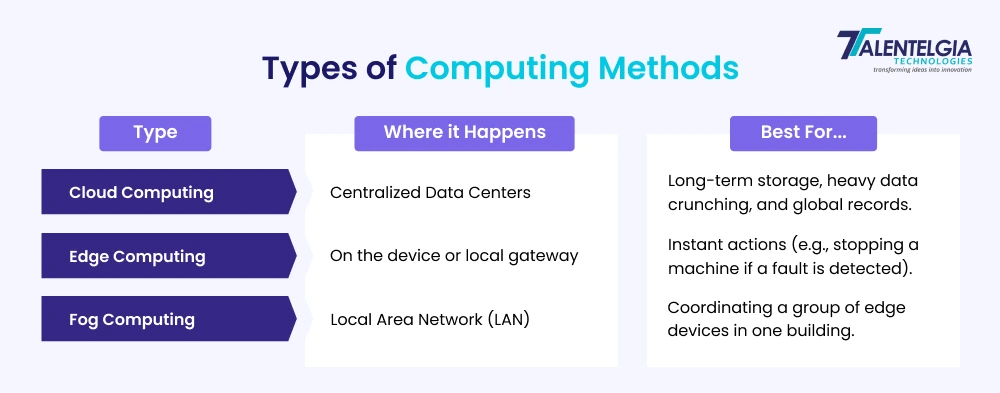
Edge Computing flips this model. It brings the “brain power” (computation and storage) directly to the “edge” of your network—meaning the physical location where the data is actually created. This could be a smart camera in your retail store, a sensor on a factory machine, or a handheld device in a warehouse.
In simpler analogy, if Cloud Computing is a giant centralized bakery that ships bread across the country, Edge Computing is having a small oven in every local sandwich shop. You get what you need instantly, without waiting for the delivery truck.
Key Technologies in Edge Computing
To understand edge computing in 2026, you don’t need to be a coder (at least not the Business owners). But knowing the “building blocks” that make this speed possible helps YouTube look at the key technologies that power edge computing.
1. IoT Devices: The “Eyes and Ears.”
Internet of Things (IoT) devices are the physical hardware at the “edge” of your business. These devices have moved beyond simple sensors to become Intelligent Assets. These don’t just collect data; they can take action. For example, an IoT vibration sensor on a factory motor can detect a microscopic fault and trigger an automatic shutdown before the machine breaks.
Read More:- How To Develop an IoT Application? Features & Cost
2. 5G Connectivity: The ‘Backbone”
Data is only useful if it can move fast. The 5G connectivity is the backbone that makes edge computing viable for large-scale businesses. 5G reduces the delay (latency) to under 10 milliseconds. This is what allows an autonomous forklift to stop the split second a person walks in front of it.
3. AI at the Edge (Edge AI): The “Local Brain.”
The biggest breakthrough in 2026 is that AI no longer needs a massive data center to function. It can now live directly on your devices. Using specialized AI chips (like NPUs), devices can perform complex tasks—like recognizing a defect in a product or a security threat in a video feed—instantly and offline.
Edge vs. Cloud vs. Fog: What Is Their Difference?
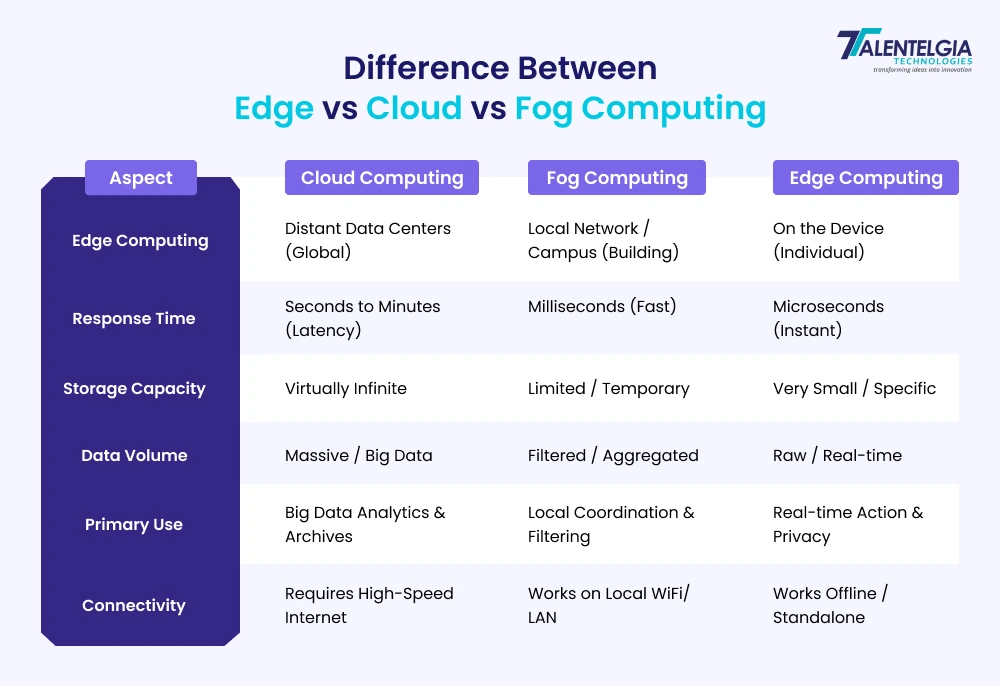
Because edge computing uses a distributed architecture, it is sometimes confused with or used interchangeably with cloud computing and fog computing. Although these three naturally share some attributes, including distributed architecture and proximity of storage and compute resources to the data’s point of origin, they have their differences:
1. Cloud Computing: The Centralized Powerhouse
Cloud computing is the “macro” layer. It involves massive clusters of servers in remote data centers (like AWS, Azure, or Google Cloud) that provide nearly infinite storage and processing power.
Importance: It serves as the long-term memory and heavy-duty brain of your business. It is where you run complex AI training, store years of historical data, and manage global business operations that don’t require millisecond responses.
2. Fog Computing: The Local Coordinator
Fog computing is the “middle” layer. It acts as a bridge between the distant cloud and the local edge. Think of it as a local area network (LAN) that connects multiple edge devices within a single building or campus (like a factory or a large hospital).
Importance: It gathers data from dozens of local sensors, cleans it up, and makes “neighborhood” decisions.
For example, in a smart factory, the “Fog” node might coordinate ten different robots to ensure they don’t collide, without needing to ask the cloud for permission.
3. Edge Computing: The Instant Responder
Edge computing is the “micro” layer. It happens at the extreme “fingertips” of your network—on the device itself or a small gateway inches away. It is designed for tasks where even a one-second delay is a failure.
Importance: It is the “reflex” of your business. It handles immediate actions, like a self-driving delivery bot stopping for a pedestrian or a biometric scanner granting access to an employee.
Working Process of Edge Computing: Step-by-Step Guide
Before edge computing came into existence, every piece of data generated at some endpoint, an employee’s desktop in a corporate office or a security camera inside an isolated warehouse, had to be sent back to a data center for processing and storage. The applications would use the data, gain insight, and then (when appropriate) send some of it back to the device.
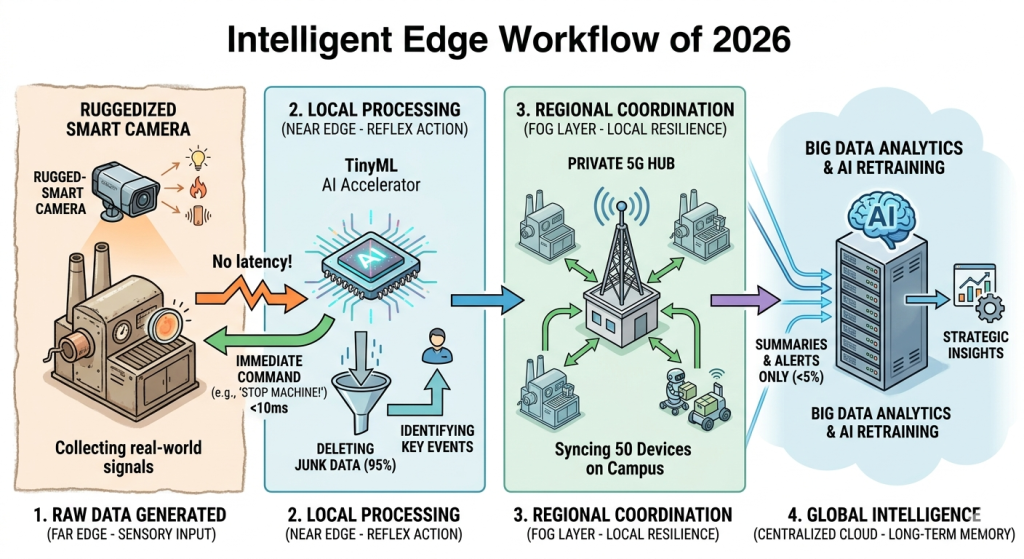
1. Data Generation
Everything starts at the “Far Edge.” This layer is made up of your physical devices—smart cameras, industrial sensors, medical wearables, or even a connected delivery truck.
2. Local Processing & Filtering
Once data is collected, it moves to an Edge Node or Gateway located just feet away. This is the core of the “Edge,” where the heavy lifting happens.
3. Regional Coordination
For businesses with many devices—like a large warehouse—data from multiple edge nodes is often sent to a Fog Node.
4. Cloud Integration
Only the “highlights” are sent to the Centralized Cloud. This usually includes summarized reports, alerts, or data needed for long-term trends.
Real-World Business Use Cases
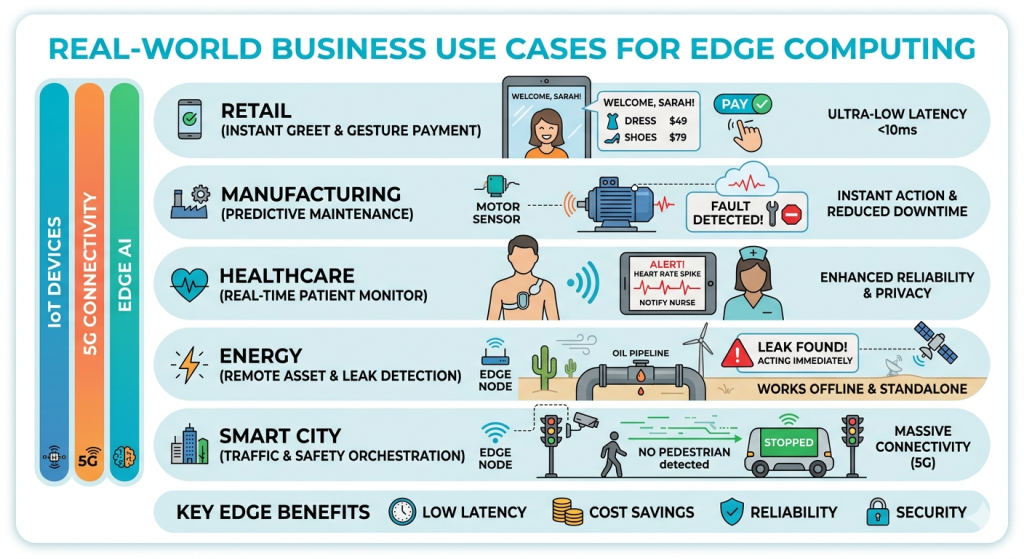
1.Retail:
Smart mirrors that suggest outfits in real-time or “just-walk-out” checkout systems that track items as they leave shelves.
2. Manufacturing:
“Predictive Maintenance” sensors that hear a tiny vibration in a motor and shut it down before it breaks, saving thousands in downtime.
3. Healthcare:
Wearable devices that monitor a patient’s heart rate and alert a nurse instantly if something is wrong, rather than waiting for a cloud sync.
4. Energy:
Sensors on oil pipelines or wind turbines in remote areas that detect leaks or faults and act immediately without needing a 5G signal
Major Benefits of Edge Computing for Your Business
As analyst firms like Gartner and Forrester have noted, we are now in the era of “Edge Intelligence,” where localized processing is the primary driver of operational ROI. Here is an elaborate breakdown of the major benefits your business can expect from adopting a modern edge strategy.
1. Lightning-Fast Speed (Low Latency)
In 2026, customers expect instant responses. Edge computing reduces “latency” (the delay) because data doesn’t have to travel to a distant server and back. This is critical for things like autonomous forklifts in a warehouse or real-time facial recognition for VIP customers.
2. Drastic Cost Savings
Sending massive amounts of “junk” data to the cloud is expensive. By processing data locally and only sending what’s necessary, you significantly reduce your internet bandwidth bills and cloud storage fees.
3. Unmatched Reliability
If your internet goes down, a cloud-reliant business stops. Edge devices can keep running and making decisions offline, syncing back up once the connection returns. This is a lifesaver for remote offices or construction sites.
4. Enhanced Privacy and Security
Keeping sensitive data (like customer faces or medical records) on-site rather than sending it across the public internet reduces your “attack surface.” In 2026, with stricter privacy laws, edge computing helps you stay compliant by keeping data local.
Top Companies that Use Edge Computing: Which Is Best For You?
If you want to actually roll out those edge computing capabilities into the enterprise, you’ll need to reach out to top edge enterprise providers as well. All this would again call for an enterprise software development services provider, like Talentelgia, to take care of the integration part. Speaking of the best edge computing providers, we recommend:
| Category | Top Companies | Best For Your Business If… | Key Metric to Watch |
| Cloud Giants | Azure, AWS, Google | You need seamless cloud integration and high-level AI capability. | Integration Speed: How fast can you sync your local edge to your global cloud? |
| Telco & Networking | Verizon, AT&T, Cisco | You prioritize raw connectivity speed (5G) and low-latency safety. | Network Latency: Is the response guaranteed to be under 10 milliseconds? |
| Industrial Hardware | Siemens, Dell, HPE | You need rugged durability on a factory floor or remote location. | Uptime & Resilience: Can this hardware survive heat, dust, and vibrations? |
The Future of Edge Computing….
Edge computing has transitioned from being an emerging technology to becoming a core part of our digital infrastructure. With businesses producing wider use of real-time information, edge computing supplies the power needed for on-the-spot decisions and business needs.
From VA programs that help autonomous vehicles reach quick decisions about safety to smart city initiatives optimizing traffic, edge computing is already changing how businesses and industry run. When coupled with 5G networks, these capabilities are taken to the next level of performance and enable new applications across sectors, ranging from healthcare, especially in advancing healthcare app development, to manufacturing.
Edge computing, in other words, is not just the latest tech trap for businesses prepared for a connected future. It is about building a foundation for innovation and being ahead of the curve in an ever-competitive world, where every millisecond makes a difference.










 Sales Enquiries:
  Business queries:
  HR:
HR: 


