



 Healthcare App Development Services
 Real Estate Web Development Services
 E-Commerce App Development Services
 E-Commerce Web Development Services
 Blockchain E-commerce Development Company
 Fintech App Development Services
 Fintech Web Development
 Blockchain Fintech Development Company
 E-Learning App Development Services
 Restaurant App Development Company
 Mobile Game Development Company
 Travel App Development Company
 Automotive Web Design
 AI Traffic Management System
 AI Inventory Management Software
 Machine Learning Development
 ChatGPT integration services
  AI Development Company
  AI Integration Services
  Generative AI Development Services
  Natural Language Processing Company
 Mobile App Development
  IOS App Development
  Android App Development
  Cross-Platform App Development
  Augmented Reality (AR) App Development
  Virtual Reality (VR) App Development
  Web App Development
  SaaS App Development
 Flutter
  React Native
  Swift (IOS)
  Kotlin (Android)
  Mean Stack Development
  AngularJS Development
  MongoDB Development
  Nodejs Development
  Database Development
 Ruby on Rails Development
 Expressjs Development
  Full Stack Development
  Web Development Services
  Laravel Development
  LAMP Development
  Custom PHP Development
  .Net Development
  User Experience Design Services
  User Interface Design Services
  Automated Testing
  Manual Testing
  Digital Marketing Services
 Ride-Sharing And Taxi Services
 Food Delivery Services
 Grocery Delivery Services
 Transportation And Logistics
 Car Wash App
 Home Services App
 ERP Development Services
 CMS Development Services
 LMS Development
 CRM Development
 DevOps Development Services
 AI Business Solutions
 AI Cloud Solutions
 AI Chatbot Development
 API Development
 Blockchain Product Development
 Cryptocurrency Wallet Development
 About Talentelgia
  Our Team
  Our Culture
 Healthcare App Development Services
 Real Estate Web Development Services
 E-Commerce App Development Services
 E-Commerce Web Development Services
 Blockchain E-commerce
Development Company
Blockchain E-commerce
Development Company Fintech App Development Services
 Finance Web Development
 Blockchain Fintech
Development Company
Blockchain Fintech
Development Company E-Learning App Development Services
 Restaurant App Development Company
 Mobile Game Development Company
 Travel App Development Company
 Automotive Web Design
 AI Traffic Management System
 AI Inventory Management Software
 AI Development Company
 ChatGPT integration services
 AI Integration Services
 Machine Learning Development
 Machine learning consulting services
 Blockchain Development
 Blockchain Software Development
 Smart contract development company
 NFT marketplace development services
 Asset tokenization companies
 DeFi Wallet Development Company
 IOS App Development
 Android App Development
 Cross-Platform App Development
 Augmented Reality (AR) App
Development
Augmented Reality (AR) App
Development Virtual Reality (VR) App Development
 Web App Development
 Flutter
 React
Native
React
Native Swift
(IOS)
Swift
(IOS) Kotlin (Android)
 MEAN Stack Development
 AngularJS Development
 MongoDB Development
 Nodejs Development
 Database development services
 Expressjs Development
 Full Stack Development
 Web Development Services
 Laravel Development
 LAMP
Development
LAMP
Development Custom PHP Development
 User Experience Design Services
 User Interface Design Services
 Automated Testing
 Manual
Testing
Manual
Testing About Talentelgia
 Our Team
 Our Culture
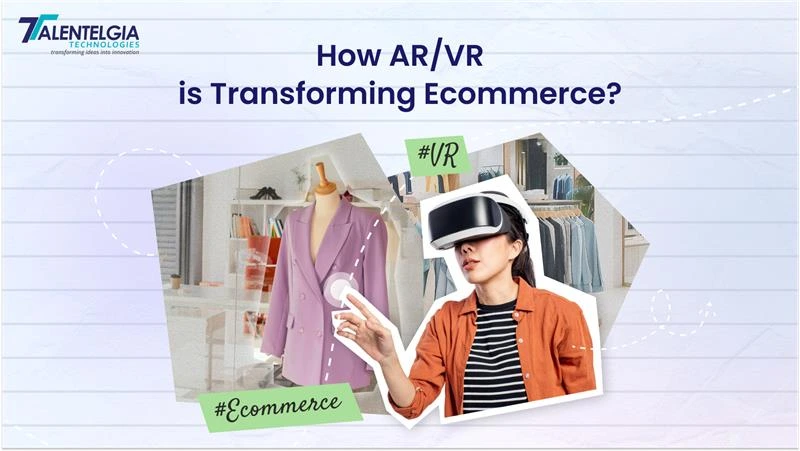
Ecommerce has scaled rapidly. But there is still one limitation that has remained constant. It is how a customer is unable to physically experience a product before making a decision.
Consumers mainly rely on images, descriptions, and reviews. They make purchase decisions with a certain uncertainty. Questions around fit, appearance, and usability influence their behavior, and that leads to abandoned carts, product returns, and missed conversions. That is definitely causing a revenue problem for e-commerce retailers.
This is where AR and VR in ecommerce are creating wonders.
AR and VR technologies are transforming digital commerce by allowing interactive and immersive product experiences. Customers can now visualize products within their own environment, explore detailed 3D models, and engage with virtual storefronts.
Businesses are increasingly adopting these technologies. And their impact can be seen clearly. The global augmented and virtual reality market is projected to reach US$50.9bn by 2026, and that is clearly a strong shift toward immersive digital experiences. (Statista)
Let’s explore in detail how AR and VR are reshaping eCommerce, how they bring value to both businesses and consumers.
Understanding AR vs VR in eCommerce
Augmented Reality (AR) and Virtual Reality (VR) are addressing the same issue within the eCommerce platform. It is the absence of product experience. But both of them are dealing with it in different ways.
The main feature of AR in ecommerce is that it enriches the real environment with digital information. This way, users can create projections of products, put them on themselves, or interact with them as if they were present in front of them. The key benefit of AR is its ease of use, as there is no special hardware required; it is accessible on a mobile device.
In turn, VR technology provides an immersive environment. Instead of adding features to reality, it completely substitutes reality. Customers wearing VR glasses can get access to virtual stores and interact with products there.
Read More:- eCommerce Development Companies in India
How AR is Transforming eCommerce ?
AR naturally fits into the customer’s existing shopping behavior, changing their experience.
Here’s how:
Context-Aware Product Visualization (Spatial Computing)
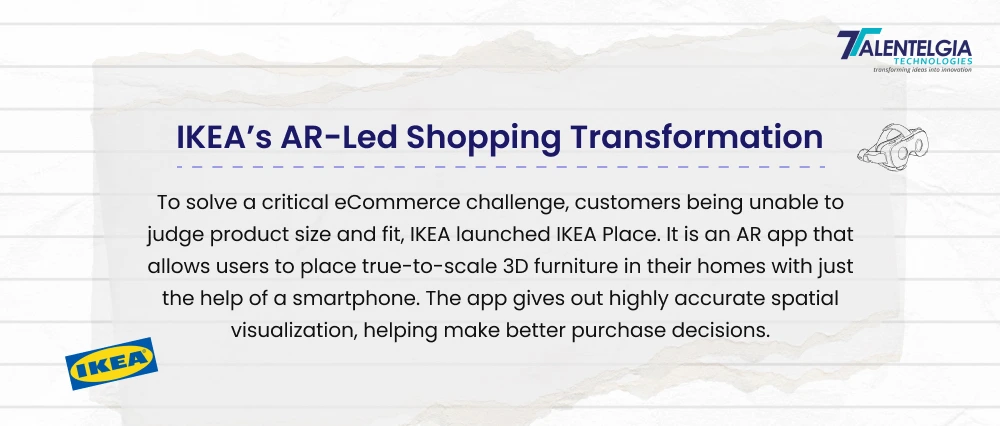
AR uses SLAM (Simultaneous Localization and Mapping) and depth sensing to map physical environments in real time.
- Products are anchored to real surfaces using plane detection
- Accurate scaling ensures true-to-size placement within user environments
- Lighting estimation adjusts shadows and reflections for realism
Virtual Try-Ons (Fashion, Beauty, Eyewear)
AR-powered try-ons replicate in-store experiences digitally.
- See how products look in real time
- Experiment with styles, colors, and variations
- Improve confidence in purchase decisions
Brands like L’Oréal and Sephora have used AR to enhance customer engagement and reduce return rates in high-touch categories like beauty.
AR-Driven Customization & Product Configuration
Augmented Reality for ecommerce gives customers the ability to customize products visually before purchase.
- Customize colors, textures, sizes, and features
- Use real-time configurators for better decision-making
- Create a more tailored shopping experience
This trend is supported by consumer behavior, as evidenced by 71% consumers expecting personalized experience from vendors.
3D Asset Interaction & Layered Information
AR transforms static PDPs (product detail pages) into interactive 3D environments.
- Users inspect products from any angle using gesture-based controls
- Metadata layers (dimensions, features, materials) can be embedded contextually
- Complex products can be broken down into visual components
This reduces dependency on long descriptions and replaces them with exploratory interaction.
How VR Is Reshaping Online Shopping
challenges the limitations by providing a different way to shop altogether. It offers: –
Virtual Stores & Showrooms
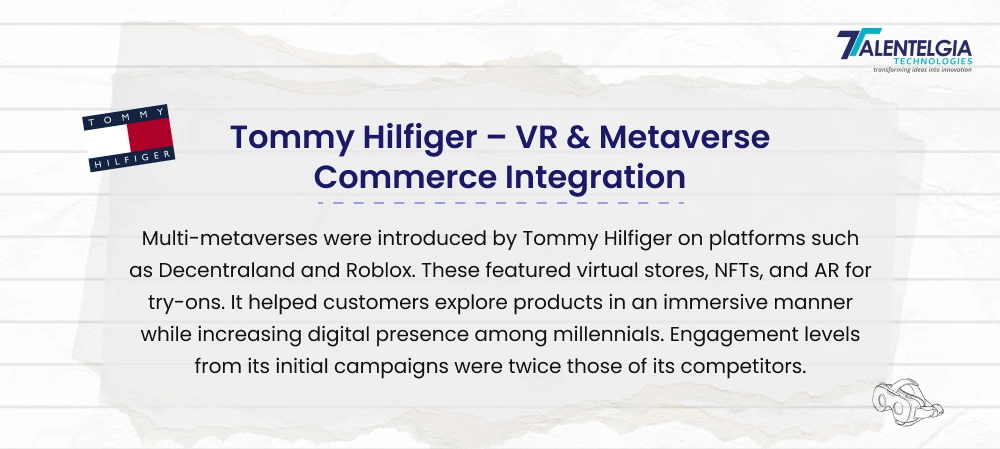
VR in ecommerce enables customers to enter digital retail environments that replicate or reimagine physical stores.
- Browse products in a 3D space instead of static grids
- Navigate aisles, racks, and product displays
- Experience store layouts remotely
Ralph Lauren and Walmart have tried virtual showrooms to extend their in-store experiences digitally.
Read More ABout:- Top 10 E-Commerce Integration Tools
6DoF Interaction & Spatial Presence
This technology uses six degrees of freedom (6DoF) tracking to capture user movement in 3D space.
- Users can walk around, pick up, and inspect products naturally
- Interaction mimics physical retail behaviors (reach, turn, approach)
- Depth perception improves understanding of scale and structure
Simulated Usage Environments
VR enables products to be experienced within use-case scenarios, not just viewed.
- Furniture can be explored within fully designed interiors
- Vehicles can be tested in simulated environments
- Equipment or tools can be interacted with in operational contexts
This shifts decision-making from “How does this look?” to “How does this perform?”
Persistent Virtual Spaces & Identity Layers
Unlike AR, VR can support persistent environments and user identity systems.
- Users return to the same virtual spaces over time
- Avatars create continuity in interaction
- Social commerce becomes possible through shared environments
Business Benefits of AR & VR in eCommerce
Augmented reality and virtual reality in ecommerce have moved from experimental stages towards achieving tangible results in terms of sales, operational efficiency, and consumer behavior.
Here’s how: –
Higher Conversions Through Informed Decisions
- Real-scale visualization and virtual trials improve clarity
- Stronger product understanding leads to faster decisions
Based on data from Shopify, products that incorporate AR/3D content have been seen to achieve up to 94% greater conversion rates because of the enhanced buyer confidence. This increase in purchase confidence directly leads to higher augmented reality sales. And that makes AR a revenue-driving tool rather than just an engagement feature.
Read more:- How To Start An E-Commerce Business
Lower Return Rates and Cost Reduction
Returns remain a major challenge in eCommerce, often caused by a mismatch between expectation and reality.
- AR reduces this gap through accurate visualization
- Virtual try-ons minimize incorrect purchases
AR/VR adoption has been linked to up to a 25% drop in product returns and a 20% lift in conversion rates.
Increased Engagement and Purchase Intent
Interactive environments hold user attention longer and deepen product exploration.
- 3D interaction increases dwell time
- Gamified experiences improve brand recall
Stronger Brand Differentiation
In saturated markets, experience is becoming a key differentiator.
- AR/VR shifts focus from product to experience
- Positions brands as innovative and customer-centric
A growing majority of retailers are actively investing in immersive technologies, making early adoption a competitive advantage.
Conclusion
The future of AR and VR technology is one that will involve brands utilizing their technology early on, and in ways that are beneficial throughout the customer experience. That’s not to say that businesses need to get in on every emerging technology like E-commerce App Development Services that becomes available. But it does require intentionality, recognizing where customers might be faltering in their purchasing journey, and applying technology to fill that gap.
It’s all about making the buying process seamless, intuitive, and easy to understand. Not because of more features. But because simplicity sells, AR and VR technology have that potential when applied effectively.
FAQs
What is the future of AR and VR in eCommerce?
The future of AR and VR in eCommerce includes more advanced personalization, AI integration, wearable devices, and fully immersive shopping environments that blend physical and digital experiences.
Are AR and VR expensive to implement for eCommerce businesses?
The cost varies depending on complexity. AR is relatively more affordable and scalable, while VR requires higher investment in hardware and development. However, both technologies can deliver strong ROI through increased conversions and engagement.
How do AR and VR impact customer buying behavior?
AR and VR influence buying behavior by reducing uncertainty, increasing engagement, and making product experiences more interactive. This leads to higher trust, faster decision-making, and improved purchase intent.
How does AR increase sales in eCommerce?
AR increases sales by helping customers visualize products in real-world contexts, reducing hesitation and improving purchase confidence. This leads to higher conversion rates and stronger buying intent.












 Write us on:
  Business queries:
  HR:
HR: 


