


 Healthcare App Development Services
 Real Estate Web Development Services
 E-Commerce App Development Services
 E-Commerce Web Development Services
 Blockchain E-commerce Development Company
 Fintech App Development Services
 Fintech Web Development
 Blockchain Fintech Development Company
 E-Learning App Development Services
 Restaurant App Development Company
 Mobile Game Development Company
 Travel App Development Company
 Automotive Web Design
 AI Traffic Management System
 AI Inventory Management Software
 AI Development Company
  ChatGPT integration services
  AI Integration Services
  Generative AI Development Services
  Natural Language Processing Company
 Machine Learning Development
  Machine learning consulting services
  Blockchain Development
  Blockchain Software Development
  Smart Contract Development Company
  NFT Marketplace Development Services
  Asset Tokenization Company
 DeFi Wallet Development Company
 Mobile App Development
  IOS App Development
  Android App Development
  Cross-Platform App Development
  Augmented Reality (AR) App Development
  Virtual Reality (VR) App Development
  Web App Development
  SaaS App Development
 Flutter
  React Native
  Swift (IOS)
  Kotlin (Android)
  Mean Stack Development
  AngularJS Development
  MongoDB Development
  Nodejs Development
  Database Development
 Ruby on Rails Development
 Expressjs Development
  Full Stack Development
  Web Development Services
  Laravel Development
  LAMP Development
  Custom PHP Development
  .Net Development
  User Experience Design Services
  User Interface Design Services
  Automated Testing
  Manual Testing
  Digital Marketing Services
 Ride-Sharing And Taxi Services
 Food Delivery Services
 Grocery Delivery Services
 Transportation And Logistics
 Car Wash App
 Home Services App
 ERP Development Services
 CMS Development Services
 LMS Development
 CRM Development
 DevOps Development Services
 AI Business Solutions
 AI Cloud Solutions
 AI Chatbot Development
 API Development
 Blockchain Product Development
 Cryptocurrency Wallet Development
 About Talentelgia
  Our Team
  Our Culture
 Healthcare App Development Services
 Real Estate Web Development Services
 E-Commerce App Development Services
 E-Commerce Web Development Services
 Blockchain E-commerce
Development Company
Blockchain E-commerce
Development Company Fintech App Development Services
 Finance Web Development
 Blockchain Fintech
Development Company
Blockchain Fintech
Development Company E-Learning App Development Services
 Restaurant App Development Company
 Mobile Game Development Company
 Travel App Development Company
 Automotive Web Design
 AI Traffic Management System
 AI Inventory Management Software
 AI Development Company
 ChatGPT integration services
 AI Integration Services
 Machine Learning Development
 Machine learning consulting services
 Blockchain Development
 Blockchain Software Development
 Smart contract development company
 NFT marketplace development services
 IOS App Development
 Android App Development
 Cross-Platform App Development
 Augmented Reality (AR) App
Development
Augmented Reality (AR) App
Development Virtual Reality (VR) App Development
 Web App Development
 Flutter
 React
Native
React
Native Swift
(IOS)
Swift
(IOS) Kotlin (Android)
 MEAN Stack Development
 AngularJS Development
 MongoDB Development
 Nodejs Development
 Database development services
 Ruby on Rails Development services
 Expressjs Development
 Full Stack Development
 Web Development Services
 Laravel Development
 LAMP
Development
LAMP
Development Custom PHP Development
 User Experience Design Services
 User Interface Design Services
 Automated Testing
 Manual
Testing
Manual
Testing About Talentelgia
 Our Team
 Our Culture

In 2026, businesses cannot be slow to develop applications. Customer requirements shift rapidly, there is a lot of competition, and long planning cycles can often turn into an impediment. That’s why an increasing number of companies are using low-code platforms to create apps faster, better, and with less effort.
App development platforms are growing up, no longer hobbled by bad tools. Modern low-code dev platforms enable us to visually construct, codify, and deploy applications. Using low-code apps, teams don’t have to build from the ground up each time—instead, they can turn ideas into running solutions in days or weeks, versus months.
And as businesses increasingly rely on low-code to stay agile and innovative, choosing the right business application platform becomes even more critical. In this post, we’ll take a closer look at some of the best low-code platforms in 2026, including a curated list of top low-code app development platforms and leading low-code platforms for web development that are helping teams build high-quality applications faster and more efficiently.
What are low-code platforms?
Low-code platforms are anything that makes it easy to build applications without a lot of code. Instead of building everything from scratch, they can create apps using visual builders, drag-and-drop components, and ready-made features. This method allows teams to move at a quicker pace and take the emphasis off code and put it onto ideas.
The app is low code, so developers and non-technical business people can build it. These low-code platforms manage a lot of the heavy lifting, such as data connection, workflow, and integration underneath, in turn easing software development time and effort. For the company, that equates to faster time to market for applications and better ability to update them as the business’s needs evolve.
In other words, low-code answers the question of how to connect business and technology. They help companies develop scalable, secure apps, save time, cut costs, and deliver new applications in a more flexible way.
Best Low-Code App Development Platforms
With many businesses seeking efficient ways to develop apps faster and smarter, some low-code app development platforms have emerged as leaders for 2026.
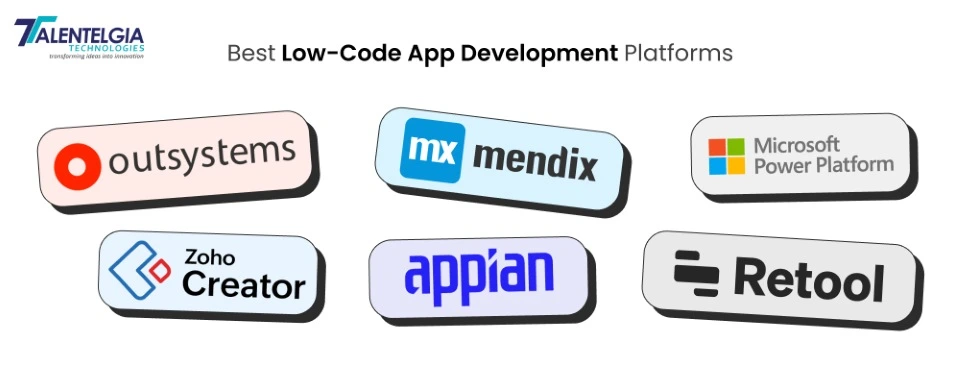
These platforms enable powerful applications to be produced with minimal code, allowing teams to move from idea to launch quickly and confidently. Below is a breakdown of some of the leading options.
1. OutSystems
OutSystems is a leading low-code development platform that allows businesses to create enterprise-grade applications. It combines modern design with an agile development approach, enabling teams to build applications that can grow and evolve with changing business demands.
Key highlights:
- Ideal for large organizations
- Extensive mobile and web app support
- Powerful integration options
OutSystems is a strong choice for companies looking for a comprehensive solution without long development timelines.
2. Mendix
Mendix is known for its ease of use and strong collaboration features. Whether you’re a developer or a business user, Mendix simplifies app creation through visual tools and intelligent guidance.
Key highlights:
- Supports rapid innovation
- Encourages collaboration between teams
- Excellent for both simple and complex applications
As a low-code app development platform, Mendix is widely appreciated by developers and business leaders driving digital transformation.
3. Microsoft Power Platform (Power Apps)
As part of the broader Microsoft ecosystem, Power Apps integrates smoothly with tools like Office 365 and Azure. This makes it especially valuable for organizations already using Microsoft products.
Key highlights:
- Quick app creation using templates
- Seamless integration with data and services
- Strong automation features
Power Apps is a reliable low-code platform for building business applications and internal tools that connect easily with existing systems.
4. Appian
Appian focuses strongly on business process management and workflow automation. It is an excellent choice for organizations looking to streamline tasks and improve operational efficiency.
Key highlights:
- Excellent for workflow-based solutions
- Built-in automation capabilities
- Secure and scalable architecture
Appian suits companies that need a low-code development platform to modernize operations while reducing complex coding requirements.
5. Retool
Retool is a developer-friendly platform designed for building internal tools quickly. It works well for dashboards, admin panels, and data-driven applications with minimal development overhead.
Key highlights:
- Drag-and-drop UI builder
- Simple integration with databases and APIs
- Ideal for internal operations
Retool speeds up the process of building and iterating internal applications, especially for data-focused teams.
6. Zoho Creator
Zoho Creator is an affordable low-code app development platform that is particularly popular among small and medium-sized businesses. Its simple interface and wide range of integrations make app creation quick and accessible.
Key highlights:
- Simple visual development
- Integrates seamlessly with other Zoho tools
- Cost-effective pricing
With Zoho Creator, even non-technical users can build custom applications with ease.
Some of the low-code platforms for web development
Low-code platforms aren’t just for mobile or internal apps; they’re a popular tool for creating modern, responsive web applications as well. Most low-code web development platforms come with built-in features such as UI/UX design tools, Integrations, Security, and scalability layers for businesses that intend to launch web apps faster without getting into extensive coding.
- OutSystems is one of the go-to options for web development if you need something very fast and can scale. It‘s well-suited for complex web applications; indeed, it makes building user interfaces much responsive to the needs of the team and enterprise.
- Mendix is a good fit for cloud-native and responsive web applications. Its visual development model allows teams to build and deliver web applications that adapt across devices as business requirements change.
- Workflow-driven Web platforms Formed in 2002, Appian provides comprehensive solutions to automate everyday business processes. It’s widely used for developing web applications that automate business processes, enhance work efficiency, and ensure secure data transactions.
- Zoho Creator is best for simple to medium complication web apps and business portals. It provides a way for teams to make functional web applications fast, so it could be a good solution for small and mid-sized businesses.
When combined, these low-code solutions empower organizations to minimize development time, ensure cross-device consistency, and bring about robust web applications without the difficulty of standard development approaches.
Conclusion
In 2026, as application development matures, low-code platforms are the safe bet for companies looking to develop apps quickly and easily. Such platforms ease the development burden for teams who wish to build feature-rich, scalable, and secure applications that offer high performance on both web and mobile.
OutSystems, Mendix, Microsoft Power Platform (Power Apps), Appian, Retool, and Zoho Creator lead the pack to offer expanded capabilities for organizations of any size. And every platform has its own unique set of strengths, so you can pick a solution that best matches the specific business objectives, technical needs, and development capacities.

By choosing the correct low-code platform and aligning it with the proper approach, companies can speed up digital transformation and time to market, while remaining competitive in a rapidly evolving digital environment.












 Write us on:
  Business queries:
  HR:
HR: 


