


 Healthcare Software Development Services
 Healthcare App Development Services

 Real Estate Web Development Services
 Real Estate App Development Company

 E-Commerce App Development Services
 E-Commerce Web Development Services
 Blockchain E-commerce Development Company

 Fintech Software Development
 Fintech App Development Services
 E-Learning App Development Services

 Restaurant App Development Company

 Mobile Game Development Company

 Travel App Development Company

 Automotive Web Design
 AI Traffic Management System

 AI Inventory Management Software

 Logistics App Development Services
 Machine Learning Development
 ChatGPT integration services
 AI Development Company
 AI Integration Services
 Natural Language Processing Company
 Mobile App Development
 IOS App Development
 Android App Development
 Cross-Platform App Development
 Augmented Reality (AR) App Development
 Virtual Reality (VR) App Development
 Web App Development
 SaaS App Development
 Custom Software Development Services
 Flutter
 React Native
 Swift (IOS)
 Kotlin (Android)
 Mean Stack Development
 AngularJS Development
 MongoDB Development
 Nodejs Development
 Database Development
 Ruby on Rails Development
 Expressjs Development
 Full Stack Development
 Web Development Services
 Laravel Development
 LAMP Development
 Custom PHP Development
 .Net Development
 User Experience Design Services
 User Interface Design Services
 Automated Testing
 Manual Testing
 Digital Marketing Services

 Ride-Sharing And Taxi Services
 Food Delivery Services
 Grocery Delivery Services
 Transportation And Logistics
 Car Wash App
 Home Services App
 ERP Development Services
 CMS Development Services
 LMS Development
 CRM Development
 DevOps Development Services
 AI Business Solutions
 AI Cloud Solutions
 AI Chatbot Development
 API Development
 Blockchain Product Development
 Cryptocurrency Wallet Development
 About Talentelgia
 Our Team
 Our Culture
 Healthcare App Development Services
 Real Estate Web Development Services
 E-Commerce App Development Services
 E-Commerce Web Development Services
 Blockchain E-commerce
Development Company
 Fintech App Development Services
 Blockchain Fintech
Development Company
 E-Learning App Development Services
 Restaurant App Development Company
 Mobile Game Development Company
 Travel App Development Company
 AI Traffic Management System
 AI Inventory Management Software
 AI Development Company
 ChatGPT integration services
 AI Integration Services
 Machine Learning Development
 Machine learning consulting services
 Blockchain Development
 Blockchain Software Development
 Smart contract development company
 NFT marketplace development services
 Asset tokenization companies
 DeFi Wallet Development Company
 IOS App Development
 Android App Development
 Cross-Platform App Development
 Augmented Reality (AR) App
Development
 Virtual Reality (VR) App Development
 Web App Development
 Flutter
 React
Native
 Swift
(IOS)
 Kotlin (Android)
 MEAN Stack Development
 AngularJS Development
 MongoDB Development
 Nodejs Development
 Database development services
 Expressjs Development
 Full Stack Development
 Web Development Services
 Laravel Development
 LAMP
Development
 Custom PHP Development
 User Experience Design Services
 User Interface Design Services
 Automated Testing
 Manual
Testing
 About Talentelgia
 Our Team
 Our Culture

What Is the PHP2Shell Vulnerability?
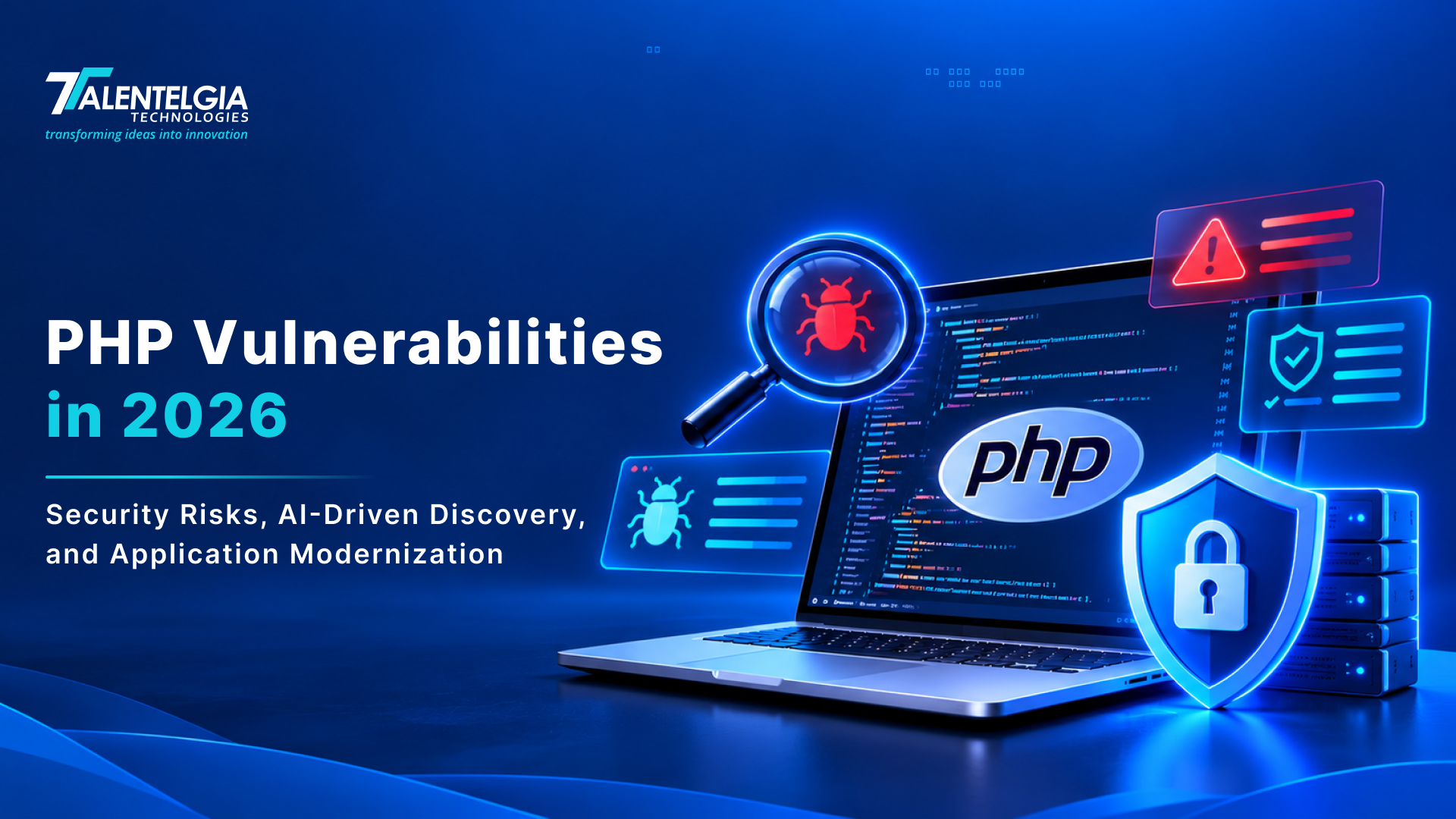
Disclosed on October 21, 2026, PHP2Shell refers to two critical vulnerabilities in PHP’s core runtime: CVE-2026-109618 and CVE-2026-109619. Both received CVSS v4.0 scores of 9.2 and can enable unauthenticated remote code execution under exploitable conditions. The PHP project’s official security advisory urges users to update immediately.
Unlike a vulnerable application plugin, these flaws exist within PHP itself, the software that interprets and executes PHP code. Consequently, applications built with frameworks such as Laravel, or content management systems such as WordPress and Drupal, may be exposed when they run on an affected PHP installation.
Understanding CVE-2026-109618 and CVE-2026-109619
The vulnerabilities involve two different memory-management failures:
- CVE-2026-109618 — out-of-memory corruption: PHP’s handling of an out-of-memory condition can interrupt request processing while internal data remains partially initialized. Subsequent cleanup may treat that invalid data as legitimate, potentially enabling code execution.
- CVE-2026-109619 — stale global state: Internal state can retain references to request memory after that memory has been freed. A later request handled by the same worker may use those stale references before the state is correctly initialized.
Both flaws demonstrate how errors in low-level memory handling can undermine the security of applications running above the runtime. Successful exploitation is possible without authentication, but exposure does not establish that a particular server has been compromised.
Why Is the PHP2Shell News Such a Big Deal?
The vulnerability affects the runtime, not just application code
A website can have carefully written application code and still inherit vulnerabilities from its execution environment. Updating a WordPress plugin, changing application logic, or installing a theme update does not fix a vulnerable PHP runtime.
PHP deployments also vary considerably. Some run PHP-FPM behind Nginx, while others use Apache’s mod_php, CGI-based configurations, managed hosting, or containerized deployments. The actual risk and remediation process depend on the runtime version, execution model, and configuration.
Remote code execution can compromise business systems
Remote code execution (RCE) means an attacker can cause a vulnerable system to execute commands or code under the conditions permitted by the exploit and the process’s privileges.
Depending on the environment, a successful attack could expose application secrets, database credentials, or customer data; modify website content; disrupt services; or provide a foothold for further compromise. The extent of damage depends on process permissions, network access, secret management, and the surrounding infrastructure.
Legacy deployments complicate remediation
PHP’s widespread adoption means affected runtimes can exist across websites, APIs, internal tools, and older business applications. However, the number of PHP-powered websites is not the same as the number of vulnerable installations.
The operational challenge is finding every relevant runtime, including abandoned virtual machines, old container images, staging environments, and third-party products. An organization cannot reliably remediate assets it has not inventoried.
How AI Is Changing the PHP2Shell Security Story
PHP2Shell also illustrates how AI-assisted security research is changing vulnerability discovery. According to OpenAI’s account of the research, AI models helped researchers uncover these PHP flaws as part of the Patch the Planet initiative.
AI can help researchers navigate large codebases, explore unusual execution paths, formulate hypotheses about memory-safety failures, and investigate potential exploit techniques. These capabilities can reduce the effort needed to examine complex software, particularly when bugs depend on subtle interactions between request processing, memory allocation, and cleanup.
But AI-assisted discovery is not the same as autonomous discovery or a validated exploit. Researchers must reproduce the issue, establish its impact, understand the conditions required for exploitation, and work with maintainers to develop and verify a fix.
The same capabilities can also benefit attackers by lowering the cost of vulnerability analysis and exploit development. The defensive priority is therefore to shorten the time between discovery, disclosure, patch availability, and deployment.
For engineering teams, this means strengthening dependency inventories, automated security testing, patch management, and incident response, not assuming that AI tools alone can secure an application.
Which PHP Versions Are Affected, and How Can Businesses Respond?
The PHP project released the following security-fixed versions on October 21, 2026.
| PHP branch | Fixed release |
|---|---|
| PHP 8.5 | 8.5.12 |
| PHP 8.4 | 8.4.27 |
| PHP 8.3 | 8.3.36 |
| PHP 8.2 | 8.2.35 |
Install the appropriate fixed release for your branch, or a later release containing the fixes. PHP 8.1 and earlier no longer receive routine upstream security updates, although some operating-system and enterprise vendors may provide backported patches. Confirm the status with your vendor rather than assuming every package follows upstream versioning.
Immediate actions for development and IT teams
- Inventory PHP runtimes. Check production, staging, virtual machines, containers, managed hosting, and third-party products. Verify the PHP version actually serving requests, not just the version installed on an administrator’s workstation.
- Patch and redeploy. Apply the appropriate security update using your distribution, hosting provider, or container-image maintenance process. Rebuild and redeploy affected images where necessary.
- Restart the relevant processes. Ensure PHP-FPM workers, Apache processes, or other PHP-serving processes are running the patched runtime. Verify the active version after deployment.
- Investigate possible compromise. Review web server, application, authentication, and endpoint logs for suspicious requests, unexpected child processes, modified files, unfamiliar accounts, and unusual outbound connections. Patching does not reverse an earlier compromise.
- Reduce exposure while remediation is pending. Follow the official advisory and vendor-specific guidance. Where necessary, restrict access or temporarily isolate an affected internet-facing service. A WAF or configuration workaround may reduce particular attack paths but is not a substitute for a security-fixed runtime.
Important October 23 update: The PHP Security Team also disclosed CVE-2026-115560, a separate related vulnerability not fixed by the October 21 releases. Its reported exploitability requires an uncommon combination of PHP configuration and application behavior. The Canadian Center for Cyber Security advisory recommends disabling session.upload_progress.enabled while awaiting a security update. Check the latest PHP advisory before applying this setting or finalizing a remediation plan, and verify whether a subsequent fix has become available.
Should Businesses Continue Using PHP or Consider Modernization?
PHP2Shell does not mean PHP is obsolete, nor does it mean every PHP application should be rewritten. A supported, regularly maintained PHP application may remain the most practical option. The immediate response to a known vulnerability is remediation, not an automatic technology migration.
However, the incident is a useful opportunity to assess whether an application remains supportable and whether its maintenance model can keep pace with security requirements.
When modernization may make sense
Consider a broader modernization assessment when an application:
- Depends on unsupported PHP versions or unmaintained libraries.
- Cannot be patched without unacceptable compatibility problems.
- Has tightly coupled components that make testing and releases risky.
- Has architectural limitations affecting integrations, scalability, or product development.
- Lacks reliable deployment processes, ownership, or visibility into dependencies.
Choosing the right path
There are three main options:
- Patch and maintain: Best when the application remains fit for purpose and can run on a supported, secure stack.
- Modernize incrementally: Upgrade dependencies, improve testing, isolate high-risk components, or replace specific modules while preserving working functionality.
- Migrate to another technology: Consider this when business requirements, architectural constraints, or long-term support needs justify the investment.
Migration introduces its own risks, including compatibility gaps, data conversion, service interruptions, retraining, and new security weaknesses. Moving from PHP to Node.js, .NET, or another stack does not automatically improve security. Outcomes still depend on architecture, dependency management, configuration, and maintenance.
Before choosing a path, assess the application’s business criticality, technical debt, support requirements, operating costs, and expected future changes.
How Talentelgia Can Help Businesses Secure and Modernize Applications
The right response begins with understanding the existing system, not assuming that every legacy application needs replacement.
Talentelgia offers services including Custom PHP Development, Laravel Development, and LAMP Stack Development. These capabilities are relevant when businesses need to maintain PHP applications, improve their structure, or plan upgrades.
The appropriate scope depends on the application’s current architecture, dependencies, business requirements, and the team’s ability to maintain the resulting system. Migration-specific experience, delivery scope, and security-assessment capabilities should be confirmed before making project commitments.
If your organization is reviewing an older PHP application, discuss a technical assessment with Talentelgia to identify maintenance risks, upgrade options, and potential modernization priorities before committing to a rewrite.
Frequently Asked Questions About PHP2Shell
PHP2Shell is the name used for two critical PHP runtime vulnerabilities, CVE-2026-109618 and CVE-2026-109619. Under exploitable conditions, they can allow unauthenticated remote code execution.
The October 21 fixes are available in PHP 8.5.12, 8.4.27, 8.3.36, and 8.2.35. Older branches require checking vendor backports or upgrading to a supported release.
Yes. WordPress runs on PHP, so a site using a vulnerable runtime may be exposed regardless of whether its WordPress core and plugins are up to date. Updating WordPress alone does not fix the underlying PHP vulnerabilities.
No. Patch the runtime first. Consider modernization separately, based on supportability, architecture, maintenance requirements, and business objectives.












 Sales Enquiries:
 Business queries:
 HR:


