


 Healthcare Software Development Services
 Healthcare App Development Services
 Real Estate Web Development Services
 Real Estate App Development Company
 E-Commerce App Development Services
 E-Commerce Web Development Services
 Blockchain E-commerce Development Company
 Fintech Software Development
 Fintech App Development Services
 E-Learning App Development Services
 Restaurant App Development Company
 Mobile Game Development Company
 Travel App Development Company
 Automotive Web Design
 AI Traffic Management System
 AI Inventory Management Software
 Logistics App Development Services
 Machine Learning Development
 ChatGPT integration services
  AI Development Company
  AI Integration Services
  Natural Language Processing Company
 Mobile App Development
  IOS App Development
  Android App Development
  Cross-Platform App Development
  Augmented Reality (AR) App Development
  Virtual Reality (VR) App Development
  Web App Development
  SaaS App Development
 Custom Software Development Services
  Flutter
  React Native
  Swift (IOS)
  Kotlin (Android)
  Mean Stack Development
  AngularJS Development
  MongoDB Development
  Nodejs Development
  Database Development
 Ruby on Rails Development
 Expressjs Development
  Full Stack Development
  Web Development Services
  Laravel Development
  LAMP Development
  Custom PHP Development
  .Net Development
  User Experience Design Services
  User Interface Design Services
  Automated Testing
  Manual Testing
  Digital Marketing Services
 Ride-Sharing And Taxi Services
 Food Delivery Services
 Grocery Delivery Services
 Transportation And Logistics
 Car Wash App
 Home Services App
 ERP Development Services
 CMS Development Services
 LMS Development
 CRM Development
 DevOps Development Services
 AI Business Solutions
 AI Cloud Solutions
 AI Chatbot Development
 API Development
 Blockchain Product Development
 Cryptocurrency Wallet Development
 About Talentelgia
  Our Team
  Our Culture
 Healthcare App Development Services
 Real Estate Web Development Services
 E-Commerce App Development Services
 E-Commerce Web Development Services
 Blockchain E-commerce
Development Company
Blockchain E-commerce
Development Company Fintech App Development Services
 Blockchain Fintech
Development Company
Blockchain Fintech
Development Company E-Learning App Development Services
 Restaurant App Development Company
 Mobile Game Development Company
 Travel App Development Company
 AI Traffic Management System
 AI Inventory Management Software
 AI Development Company
 ChatGPT integration services
 AI Integration Services
 Machine Learning Development
 Machine learning consulting services
 Blockchain Development
 Blockchain Software Development
 Smart contract development company
 NFT marketplace development services
 Asset tokenization companies
 DeFi Wallet Development Company
 IOS App Development
 Android App Development
 Cross-Platform App Development
 Augmented Reality (AR) App
Development
Augmented Reality (AR) App
Development Virtual Reality (VR) App Development
 Web App Development
 Flutter
 React
Native
React
Native Swift
(IOS)
Swift
(IOS) Kotlin (Android)
 MEAN Stack Development
 AngularJS Development
 MongoDB Development
 Nodejs Development
 Database development services
 Expressjs Development
 Full Stack Development
 Web Development Services
 Laravel Development
 LAMP
Development
LAMP
Development Custom PHP Development
 User Experience Design Services
 User Interface Design Services
 Automated Testing
 Manual
Testing
Manual
Testing About Talentelgia
 Our Team
 Our Culture
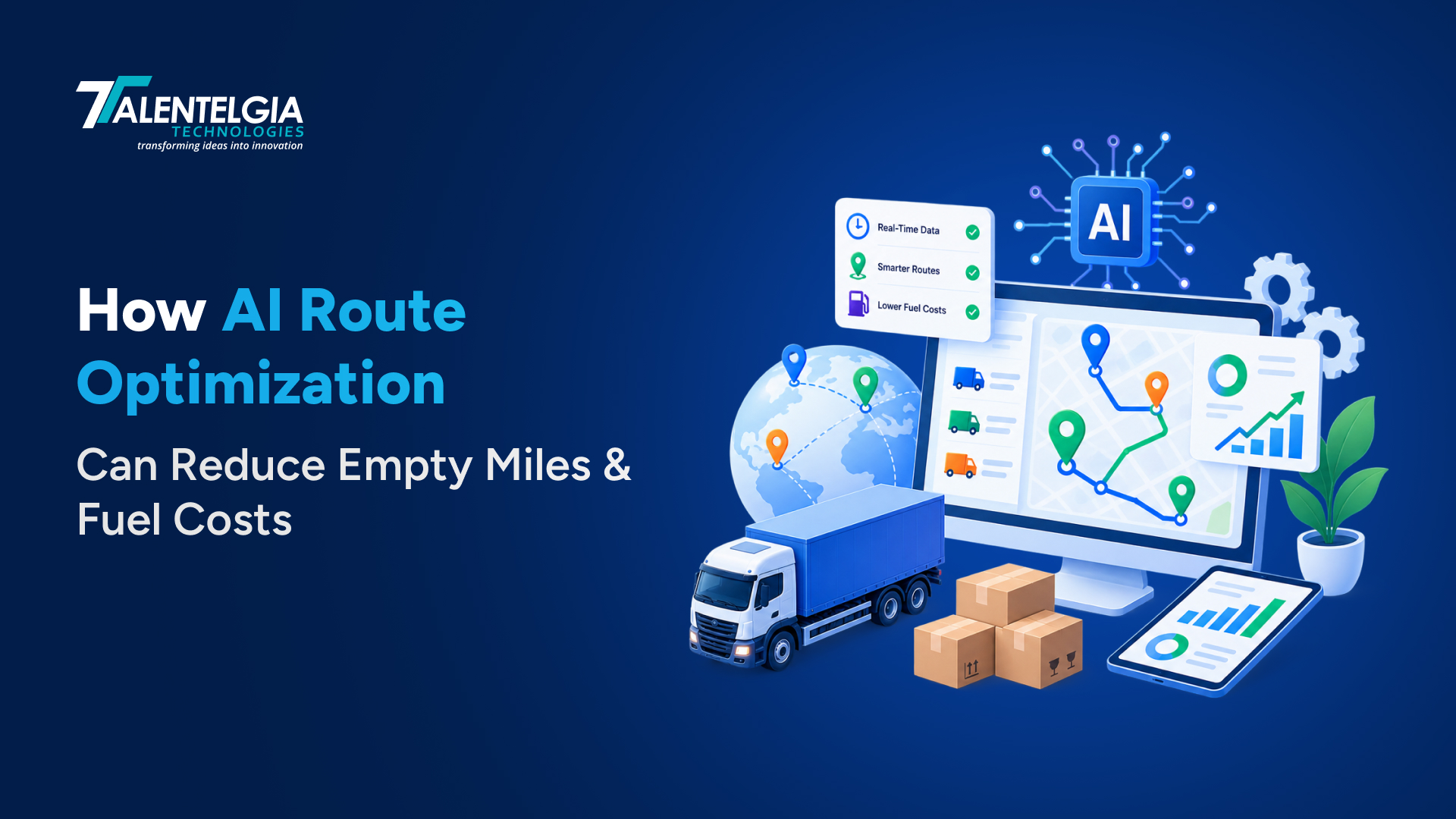
AI route optimization uses artificial intelligence, real-time data, and advanced optimization models to help logistics companies plan more efficient routes while accounting for traffic, delivery windows, vehicle capacity, driver availability, and changing operational conditions. Unlike static route planning, AI can continuously adapt routes as conditions change.
For logistics leaders, one of its most measurable benefits is reducing empty miles and fuel costs. Unproductive mileage, congestion, idling, inefficient dispatching, and avoidable detours increase fuel consumption without improving fleet revenue. AI-powered routing helps identify more efficient vehicle assignments and routes, improving utilization while reducing unnecessary travel.
The financial impact of inefficient routing can be substantial. A Federal Highway Administration analysis estimated that highway truck bottlenecks caused more than 243 million hours of truck delay annually, representing approximately $7.8 billion in direct user costs. This guide explains how AI route optimization can reduce empty miles and fuel consumption, how it compares with traditional optimization, what technology architecture it requires, and what logistics leaders should consider when buying, building, or implementing an AI-powered routing solution.
What Is AI Route Optimization?
AI route optimization uses machine learning and operations research to calculate delivery and fleet routes. These routes adapt to real-world conditions in real time. It goes beyond simple mapping. Traditional GPS navigation finds the fastest path between two points. Route optimization software solves a harder problem. It sequences dozens or hundreds of stops across multiple vehicles while respecting time windows, capacity limits, and driver hours.
There are three distinct approaches in use today, and they aren’t interchangeable.
- Traditional VRP solving uses operations research to compute mathematically optimal or near-optimal routes for a fixed set of stops and constraints. It’s fast, explainable, and works well when conditions don’t change mid-route.
- ML-enhanced routing layers machine learning on top of a VRP solver. Models predict variables the solver can’t calculate alone. Examples include traffic-adjusted travel time and how long a driver actually spends at a stop.
- AI and deep-learning approaches use reinforcement learning and neural networks. They handle dynamic, high-volume routing where conditions shift constantly, like same-day delivery or ride-hailing.
| Approach | Best for | Limitation |
|---|---|---|
| Traditional VRP solving | Stable networks, planned routes, smaller stop counts | Doesn’t adapt mid-day without re-running the solver |
| ML-enhanced routing | Fleets needing accurate ETAs and service-time forecasts | Still depends on a solver for the core routing logic |
| AI / deep-learning routing | High-volume, real-time, constantly changing networks | Higher data and engineering requirements to deploy well |
Most production systems combine all three: a VRP solver for routing math, machine learning for prediction, and rules for hard business constraints. This layered approach is what vendors usually mean by AI logistics applications development, rather than plain route planning.
Where Empty Miles Actually Come From
Before evaluating any solution, it’s worth naming the specific failure points that create empty miles in the first place. Fixing them is the whole point of the technology below.
- Deadheading after delivery – A vehicle finishes its last drop and drives back to the depot or the next pickup with nothing loaded, because no backhaul was matched in time.
- Static, once-a-day planning – Routes are built at 6 a.m. against that morning’s known orders. Any load or cancellation that surfaces afterward gets handled manually, or not at all, which strands capacity that could have filled an empty leg.
- Poor stop sequencing – Routes built on straight-line distance or driver habit rather than a solved network, which adds avoidable miles even when every stop is technically covered.
- Fragmented data across systems – Order data in a TMS, location data in telematics, and capacity data in a spreadsheet don’t talk to each other, so dispatchers can’t see a matching opportunity even when one exists.
ATRI’s 2026 Analysis of the Operational Costs of Trucking reported that carriers reduced truck counts by 2.4% while an average of 10% of trucks remained unseated. That deadhead mileage stayed elevated. Direct evidence that empty-mile risk is a structural, ongoing problem rather than an occasional planning miss.
How AI Route Optimization Closes the Empty-Mile Gap
Each failure point above maps to a specific capability. AI route optimization doesn’t reduce empty miles through one feature. It closes the gap in layers.
- Backhaul matching – The system can identify a compatible pickup near a vehicle’s planned delivery area and evaluate whether adding it makes operational and economic sense, turning what would have been an empty return leg into a productive trip.
- ML-enhanced sequencing – It solves the full stop network rather than a single next-best-stop decision, cutting the backtracking and out-of-the-way driving that inflate mileage even on “full” routes.
- Live telematics integration – It gives the system real-time vehicle position, so it can match a nearby load to a nearby vehicle instead of defaulting to the closest depot.
- Unified data ingestion – It pulls order, capacity, and location data into one system, which is what makes a backhaul match visible to the solver in the first place. Most fleets lose this opportunity to fragmented systems, not bad algorithms.
Fleet case data and telematics vendors report total miles driven dropping 10–18% after implementing AI route optimization compared to manual or static routing, with reductions coming from tighter stop sequencing, reduced deadhead miles, and multi-stop planning instead of point-to-point routing. Fleets already running near-optimal manual routes typically see smaller gains. The size of the improvement tracks directly to how much empty-mile waste existed beforehand.
How AI Route Optimization Cuts Fuel Costs
Fuel savings follow a different mechanism than mileage savings, and the two compound rather than overlap.
- Traffic-aware travel-time prediction – replaces a static distance matrix that assumes a road takes the same time at 7 a.m. and 3 p.m. Gradient-boosted models trained on historical GPS pings predict travel time by hour, day, and location, which lets the solver route around congestion instead of idling through it.
- Service-time prediction – estimates how long a driver actually spends at a stop using stop history, delivery type, and customer characteristics. Without it, routes are built on wrong dwell-time assumptions, which produces missed windows, rushed driving, and extra idling to compensate.
- Fewer total miles – it is itself a fuel outcome. Every mile removed through better sequencing or backhaul matching is a mile of fuel not burned.
- Fewer failed or re-attempted deliveries – cut down on the re-driving that a missed time window creates, which is a fuel cost that rarely shows up in a route-planning ROI calculation but shows up on the fuel card.
ATRI’s 2026 Analysis of the Operational Costs of Trucking found that the average cost to operate a truck reached $2.336 per mile in 2025, a 3.4% increase over the previous year and the highest per-mile cost recorded in the report’s history. Fleet case data and telematics vendors report fuel cost reductions of 10–25% after implementing AI route optimization. That is a wider range than the mileage reduction figure because fuel savings stack traffic avoidance and idle-time reduction on top of the distance reduction itself.
How AI Route Optimization Works: The Technology Stack
AI route optimization is not one tool. It’s a stack of connected systems, each solving a specific part of the routing problem.
Data Ingestion
Order data, addresses, time windows, vehicle capacity, and delivery constraints are pulled in through APIs from a TMS, ERP, or order management system. Effective logistics software development is critical at this layer because these systems need to exchange clean, consistent data before the optimization engine can make reliable routing decisions. Duplicate customer records, missing time windows, and inconsistent address formatting can quietly wreck route quality and inflate mileage and fuel spend, long before optimization logic runs.
GPS and Telematics Data
Live vehicle location, speed, and stop status stream in continuously, usually through a telematics provider’s API or an OBD-connected device. This is the actual line between route optimization software and AI route optimization: one plans once at 6 a.m., the other knows where truck 14 is at 11:40. This is what makes a same-day backhaul match possible.
Vehicle Routing Problem (VRP)
The Vehicle Routing Problem is the mathematical core of route planning. Operations research treats routing as a constrained optimization problem, minimizing distance or time while satisfying capacity, time-window, and driver-hour constraints. Google OR-Tools is a widely used open-source optimization library that supports vehicle routing problems involving capacities, time windows, pickups, deliveries, and multiple vehicles.
Operations Research and Optimization Solvers
The solver evaluates possible combinations and searches for solutions that satisfy defined constraints. This remains the foundation of mileage reduction. AI doesn’t replace it. In many real-world fleets, a well-configured solver with accurate data outperforms a poorly designed AI model.
OSRM and Routing Engines
OSRM calculates real road-network travel times between every stop pair, producing the distance matrix the solver needs. It runs Dijkstra or contraction hierarchies over OpenStreetMap data. Commercial alternatives like Google’s Distance Matrix API or HERE add live traffic data that OSRM’s static graph doesn’t capture on its own. The difference between a matrix that assumes free-flowing roads and one that reflects the fuel-wasting congestion a driver will actually hit.
ML-Based Travel-Time Prediction
This is where machine learning earns its place for fuel savings specifically. Skip this step and even a perfectly solved VRP produces arrival windows that are wrong by design. This means idling, rerouting on the fly, and burning fuel to make up time that was never realistically available.
Service-Time Prediction
A vehicle can lose significant time at loading docks, customer locations, warehouses, or delivery points. ML models estimate service duration using historical stops, customer characteristics, delivery type, time of day, and operational conditions. More accurate service-time estimates help the optimizer build realistic arrival schedules instead of ones that force drivers to speed or idle to recover lost time.
Reinforcement Learning
Reinforcement learning can support dynamic routing by learning policies from repeated decisions and their outcomes, rather than treating every routing problem as an isolated calculation. This is particularly relevant to highly dynamic environments where empty-mile risk changes by the hour. However, it isn’t necessary for every fleet or routing problem.
Dynamic Re-Routing
Dynamic re-routing responds when operational conditions change after routes are dispatched. New orders, traffic disruptions, vehicle breakdowns, missed appointments, cancellations, or driver delays can trigger recalculation. It is the mechanism that actually captures a backhaul or reroutes around a fuel-wasting jam. A mature system shouldn’t constantly rebuild every route; it should use business rules to determine which changes justify re-optimization.
Cloud Architecture
Cloud architecture connects the optimization, data, and operational layers, separating data ingestion, route calculation, prediction, APIs, dispatch, and analytics into independent services. This lets compute resources scale with planning workloads while keeping operational systems responsive enough to catch a mileage-saving opportunity before it disappears.
Feedback Loops
Actual drive times, service times, completed routes, delays, overrides, and exceptions feed back into analytics and machine-learning models. Over time, this builds a clearer picture of how planned routes perform against actual miles driven and actual fuel burned, and the system improves its predictions during future planning cycles.
Building this stack correctly requires operations research expertise, not just general mobile app development. If your team is scoping an AI-driven system, it likely needs machine learning and data engineering support to design the prediction layer. And that’s a specialized build worth getting right the first time. Need help scoping that prediction layer? Talentelgia’s AI and data team can assess your routing data first.
| Building this stack correctly requires operations research expertise, not just general mobile app development. If your team is scoping an AI-driven system, it likely needs machine learning and data engineering support to design the prediction layer. That’s a specialized build worth getting right the first time. Need help scoping that prediction layer? Talentelgia’s AI and data team can assess your routing data first. |
Business Impact: What AI Route Optimization Actually Changes
AI route optimization is a cost-reduction case before it’s a technology case. The impact shows up across several operating metrics, not just fuel.
ATRI’s 2026 Analysis of the Operational Costs of Trucking found that the average cost to operate a truck reached $2.336 per mile in 2025, a 3.4% increase over the previous year and the highest per-mile cost recorded in the report’s history. Excluding fuel, operating costs rose 4.2% to $1.854 per mile.
The cost pressure extended across several major operating categories. Tolls increased 13.2%, repair and maintenance costs rose 8.6%, driver benefits increased 6.6%, and tire costs grew 6.4%. ATRI also reported that carriers reduced truck counts by 2.4%, while an average of 10% of trucks remained unseated. Deadhead mileage stayed elevated, adding further pressure to fleet utilization.
These figures do not mean AI route optimization can eliminate broader trucking costs. They highlight why reducing avoidable miles, improving vehicle utilization, minimizing inefficient assignments, and responding faster to operational disruptions can have a meaningful financial impact.
| Metric | Manual / Static Routing | AI Route Optimization | Source Basis |
|---|---|---|---|
| Total miles driven | Baseline | 10–18% lower | Verizon Connect, fleet case data |
| Fuel cost | Baseline | 10–25% lower | ATRI cost data, multiple fleet telematics vendors |
| Daily planning time | 2–4 hours (10-driver ops) | 70–95% lower | Dispatch automation case data |
| On-time delivery rate | Baseline | Measurable improvement, case-dependent | Fleet case reporting |
Treat these as directional industry ranges, not guarantees. Actual results depend heavily on how inefficient current routing is today, fleet size, and data quality going in. A fleet running near-optimal manual routes already will see smaller gains than one still routing on spreadsheets.
Also Read: AI In Logistics: Everything You Need To Know
Buy vs. Build vs. Partner: What Fits Your Fleet
This is the decision that determines everything downstream: cost, timeline, and how much control you keep over your own routing logic.
Off-the-shelf SaaS
Platforms like Routific, OptimoRoute, and Circuit cover a large share of use cases well. Pricing typically runs $35–$80 per vehicle per month, with enterprise tiers moving to custom quotes. These tools deploy in days, require no engineering team, and handle standard constraints like time windows and vehicle capacity competently. Where they fall short: deep TMS integration, multi-depot complexity, industry-specific constraints (refrigerated freight, hazmat, drayage), and full data ownership. You’re renting a routing engine, not owning one.
Custom Route Optimization Software
It gives you full control over constraints, integrations, and the underlying optimization logic. Custom software fits when your operation has routing rules a generic SaaS tool can’t model. It also fits when you need deep TMS or ERP integration, or when per-vehicle SaaS pricing costs more than a custom build. Verified cost estimates from logistics-focused development firms place custom AI route optimization builds between roughly $75,000 and $400,000. The range depends on integration complexity and the depth of the machine learning layer. It also depends on whether you’re building a routing MVP or a full production system with dynamic re-routing and multi-depot support. Simpler, static-logic route optimization software without a learning component can come in well under that range.
A Logistics Software Development Partner
A logistics software development partner sits between hiring an in-house team and buying SaaS. You get access to operations research and ML expertise without carrying full-time headcount for a skill set most companies don’t need permanently. This path suits mid-size to enterprise fleets that need customization and integration depth. They don’t want to build and retain an optimization engineering team internally.
Decision Framework
| Factor | Favors SaaS | Favors Custom Build / Partner |
|---|---|---|
| Fleet size | Under 30 vehicles | 30+ vehicles, especially multi-depot |
| Constraint complexity | Standard time windows, capacity | Industry-specific rules (cold chain, hazmat, drayage) |
| Existing TMS | Minimal, or SaaS handles integration natively | Established TMS needing deep, two-way integration |
| Data maturity | Basic address and order data | Rich historical data ready to train ML models |
| Internal engineering capability | Limited or none | In-house team, or budget for a development partner |
| Budget and timeline | Fast deployment, lower upfront cost | Longer runway, budget for $75K–$400K+ build |
Fleet size alone shouldn’t decide this. A 20-vehicle refrigerated carrier with complex compliance rules may need custom logistics software development sooner than a 100-vehicle fleet running standard parcel delivery.
What Fleet Optimization Software Should Include
Whether you buy or build, use this as an evaluation checklist rather than a feature wish list.
- Real-time re-optimization – routes should adjust automatically to new orders, cancellations, and traffic, not just at day-start planning.
- Hard and soft constraints – hard constraints (vehicle capacity, driver hours, delivery windows) must never be violated. Soft constraints (customer preference, driver familiarity with a route) should be optimized for, not enforced absolutely.
- Driver and vehicle profiles – routing needs to account for vehicle type, capacity, certifications, and individual driver constraints. No two vehicles should be treated as interchangeable.
- GPS and telematics integration – live location and status data are what make optimization dynamic instead of a one-time morning calculation.
- Analytics and reporting – cost per delivery, on-time rate, miles per stop, and fuel cost need to be visible and exportable. A dashboard no one checks doesn’t count.
- TMS, ERP, and CRM integrations – route optimization software isolated from order and customer systems creates manual reconciliation work. That work erodes the efficiency gains.
- Alerts and exception handling – dispatchers should know when a route slips, a vehicle breaks down, or a delivery window is at risk. They shouldn’t find out after the fact.
- Operational controls – dispatchers should be able to override an AI-generated route when local knowledge says the algorithm is wrong. A system that can’t be overridden isn’t production-ready.
The strongest fleet optimization platforms treat these as an integrated system, not a checklist of separate add-ons bolted onto a routing engine.
Implementing AI Route Optimization Across Your Fleet
Rolling out AI route optimization works best in phases. Skipping phases is the most common reason implementations stall.
Phase 1: Data audit
Before any routing logic runs, audit address data accuracy, historical delivery times, vehicle capacity records, and driver hour data. Poor input data produces poor routes regardless of how sophisticated the algorithm is. This phase typically surfaces more data-quality issues than teams expect.
Phase 2: Pilot/shadow Mode
Run the new system alongside existing manual or legacy routing without replacing it yet. Compare AI-generated routes against actual dispatcher decisions on the same day’s orders. This establishes a real baseline instead of relying on vendor-reported industry averages, and it surfaces constraint gaps before they affect live operations.
Phase 3: Controlled Rollout
Move a subset of routes, vehicles, or a single depot onto live AI-generated routing. Monitor closely: on-time rate, driver acceptance, fuel cost per route, and how often dispatchers need to override the system. Build in a feedback mechanism so drivers and dispatchers can flag routes that don’t reflect real-world conditions.
Phase 4: Full Deployment and Continuous Learning
Expand across the fleet once controlled rollout metrics hold steady. The system should keep learning from completed routes, driver feedback, and seasonal pattern shifts. Route optimization software isn’t a one-time deployment; the ML layer degrades in accuracy without ongoing retraining against fresh operational data.
Realistic timelines vary by fleet complexity and data readiness. Treat any vendor’s fixed-week promise with some skepticism until your own data audit is complete.
Common Challenges (and How to Handle Them)
Implementing route optimization can introduce operational challenges beyond the technology itself. The most common issues usually involve data, people, integrations, ownership, and system complexity.
1. Poor Data Quality
The Problem:
Inaccurate addresses, missing time windows, outdated vehicle profiles, and inconsistent order data can undermine even well-designed optimization engines.
How to Handle It:
Audit routing data before implementation. Validate addresses, standardize formats, identify missing fields, and establish data-quality rules before optimization enters production.
2. Driver Adoption Resistance
The Problem:
Drivers may reject routes when software overlooks practical conditions they encounter regularly. Local road knowledge, loading delays, customer preferences, and site-specific restrictions can affect route feasibility.
How to Handle It:
Provide controlled route overrides and a structured feedback channel. Involve drivers during the pilot so operational knowledge becomes part of the routing rules.
3. Integration Gaps
The Problem:
Disconnected routing, TMS, ERP, telematics, and dispatch systems can force manual data entry. That can quietly reduce the efficiency gained through route optimization.
How to Handle It:
Map every integration during the data-audit phase. Define data ownership, API requirements, event flows, failure handling, and synchronization rules before production deployment.
4. Vendor Lock-In
The Problem:
Some SaaS platforms can make migration difficult through proprietary APIs, limited data exports, or restricted access to historical routing information.
How to Handle It:
Review data ownership, export capabilities, API access, retention policies, and termination terms before signing. Confirm that route history and operational data remain accessible if you later move to custom logistics software development.
5. Over-Automation
The Problem:
Not every routing problem requires AI. Simple, stable routes with few stops may perform well using traditional VRP optimization.
How to Handle It:
Match system complexity to the routing problem. Use machine learning where prediction or dynamic decision-making adds measurable value, rather than adding AI to every optimization workflow.
How to Choose an AI Route Optimization Development Partner
Generic mobile app development experience isn’t enough for this category. Evaluate potential partners against a narrower, more specific set of criteria.
Optimization And Operations Research Expertise
Ask directly whether the team has implemented VRP solvers like OR-Tools, not just consumed a mapping API. There’s a meaningful difference between routing logic built on genuine optimization science and a wrapper around a third-party API.
Machine Learning And Data Engineering Capability
Prediction models for traffic and service time need dedicated ML engineering. So do the pipelines to train and retrain them. A general software team learning on the job isn’t enough.
Cloud Architecture And API Design
Route optimization workloads need low-latency, scalable infrastructure, particularly for real-time re-optimization at fleet scale.
Tms, Gps, And Telematics Integration Experience
This is where projects most commonly stall. A partner who has connected carrier data sources, telematics platforms, and warehouse or ERP systems before will move faster. Expect fewer integration surprises.
| Talentelgia has built this layer directly. Carrier data pipelines for a North American 3PL (Soren) pulling from Rate Mate, CargoChief, and DAT into an Azure warehouse, and fleet data integration work with connected-vehicle platforms like Fleetsu. |
Security, Data Ownership, And Observability
Confirm who owns the routing data and trained models after launch. Ask how the system is monitored in production, and how model drift gets detected and corrected.
Post-Launch Support
AI route optimization systems need ongoing model monitoring and retraining, not a one-time delivery. Ask how the partner handles this after go-live, and get it in the contract.
A logistics software development partner with demonstrated data engineering and API integration experience is a stronger signal than a portfolio of generic apps. This holds even outside pure routing projects.
Ready to Move Past Manual Routing?
AI route optimization only delivers ROI when the underlying data, integrations, and algorithms are built correctly. Our company’s logistics software development team has hands-on experience with carrier data pipelines, cloud data warehousing, and API integrations across freight modes.
Ready to evaluate your fleet’s routing setup? Talk to Talentelgia’s team about your buy-vs-build options today.
Frequently Asked Questions (FAQs)
Standard cloud-based AI route optimization software typically deploys in 1 to 4 weeks for most fleets. Highly customized enterprise systems, built by a logistics software development partner with deep TMS integration and multi-depot support, can take 60 to 90 days. Timeline depends heavily on data readiness and integration complexity, not just the software itself.
Verified estimates from logistics-focused development firms place custom AI route optimization builds between roughly $25,000 and $400,000. Cost depends on integration complexity, machine learning depth, and whether you need a routing MVP or full production system with dynamic re-routing. Simpler, static-logic route optimization software without a learning component can come in well under that range.
Yes. AI does not always require rebuilding the entire routing platform. Machine learning can be introduced as a prediction layer for travel time, service duration, ETAs, demand patterns, or other operational variables while an existing VRP solver continues handling core route optimization.
Manual route planning for a 10-driver operation typically consumes 2–4 hours daily. After implementing AI logistics software, reported reductions in planning time range from 70–95%, freeing dispatchers for exception handling instead of manual sequencing. Actual time savings depend on fleet size and how manual the prior routing process was.
Route optimization software plans routes once, typically each morning, using a fixed VRP solver. AI route optimization adds machine learning and live telematics data, allowing routes to adapt in real time as conditions change. The distinction is whether the system knows where a vehicle is mid-route or only where it was planned to be.
The FHWA estimates major highway freight bottlenecks create more than 243 million truck-hours of delay annually in the United States, valued at approximately $7.8 billion using its stated methodology. This congestion is a core reason AI route optimization and dynamic re-routing matter more than static, once-a-day route planning for fleet optimization.
Fleet case data and telematics vendors report total miles driven dropping 10–18% after implementing AI route optimization, compared to manual or static routing. Reductions come from tighter stop sequencing, reduced deadhead miles, and multi-stop route planning instead of point-to-point routing. Fleets already running near-optimal manual routes typically see smaller gains.
Yes. Our logistics software development company can evaluate your fleet requirements, routing constraints, existing systems, data availability, integration needs, and long-term scalability requirements to help determine whether an off-the-shelf platform, custom development, or a hybrid approach is the better fit.











 Sales Enquiries:
  Business queries:
  HR:
HR: 


