


 Healthcare App Development Services
 Real Estate Web Development Services
 E-Commerce App Development Services
 E-Commerce Web Development Services
 Blockchain E-commerce Development Company
 Fintech App Development Services
 Fintech Web Development
 Blockchain Fintech Development Company
 E-Learning App Development Services
 Restaurant App Development Company
 Mobile Game Development Company
 Travel App Development Company
 Automotive Web Design
 AI Traffic Management System
 AI Inventory Management Software
 AI Software Development
  AI Development Company
  AI App Development Services
  ChatGPT integration services
  AI Integration Services
  Generative AI Development Services
  Natural Language Processing Company
 Machine Learning Development
  Machine learning consulting services
  Blockchain Development
  Blockchain Software Development
  Smart Contract Development Company
  NFT Marketplace Development Services
  Asset Tokenization Company
 DeFi Wallet Development Company
 Mobile App Development
  IOS App Development
  Android App Development
  Cross-Platform App Development
  Augmented Reality (AR) App Development
  Virtual Reality (VR) App Development
  Web App Development
  SaaS App Development
 Flutter
  React Native
  Swift (IOS)
  Kotlin (Android)
  Mean Stack Development
  AngularJS Development
  MongoDB Development
  Nodejs Development
  Database Development
 Ruby on Rails Development
 Expressjs Development
  Full Stack Development
  Web Development Services
  Laravel Development
  LAMP Development
  Custom PHP Development
  .Net Development
  User Experience Design Services
  User Interface Design Services
  Automated Testing
  Manual Testing
  Digital Marketing Services
 Ride-Sharing And Taxi Services
 Food Delivery Services
 Grocery Delivery Services
 Transportation And Logistics
 Car Wash App
 Home Services App
 ERP Development Services
 CMS Development Services
 LMS Development
 CRM Development
 DevOps Development Services
 AI Business Solutions
 AI Cloud Solutions
 AI Chatbot Development
 API Development
 Blockchain Product Development
 Cryptocurrency Wallet Development
 About Talentelgia
  Our Team
  Our Culture
 Healthcare App Development Services
 Real Estate Web Development Services
 E-Commerce App Development Services
 E-Commerce Web Development Services
 Blockchain E-commerce
Development Company
Blockchain E-commerce
Development Company Fintech App Development Services
 Finance Web Development
 Blockchain Fintech
Development Company
Blockchain Fintech
Development Company E-Learning App Development Services
 Restaurant App Development Company
 Mobile Game Development Company
 Travel App Development Company
 Automotive Web Design
 AI Traffic Management System
 AI Inventory Management Software
 AI Software Development
 AI Development Company
 ChatGPT integration services
 AI Integration Services
 Machine Learning Development
 Machine learning consulting services
 Blockchain Development
 Blockchain Software Development
 Smart contract development company
 NFT marketplace development services
 IOS App Development
 Android App Development
 Cross-Platform App Development
 Augmented Reality (AR) App
Development
Augmented Reality (AR) App
Development Virtual Reality (VR) App Development
 Web App Development
 Flutter
 React
Native
React
Native Swift
(IOS)
Swift
(IOS) Kotlin (Android)
 MEAN Stack Development
 AngularJS Development
 MongoDB Development
 Nodejs Development
 Database development services
 Ruby on Rails Development services
 Expressjs Development
 Full Stack Development
 Web Development Services
 Laravel Development
 LAMP
Development
LAMP
Development Custom PHP Development
 User Experience Design Services
 User Interface Design Services
 Automated Testing
 Manual
Testing
Manual
Testing About Talentelgia
 Our Team
 Our Culture
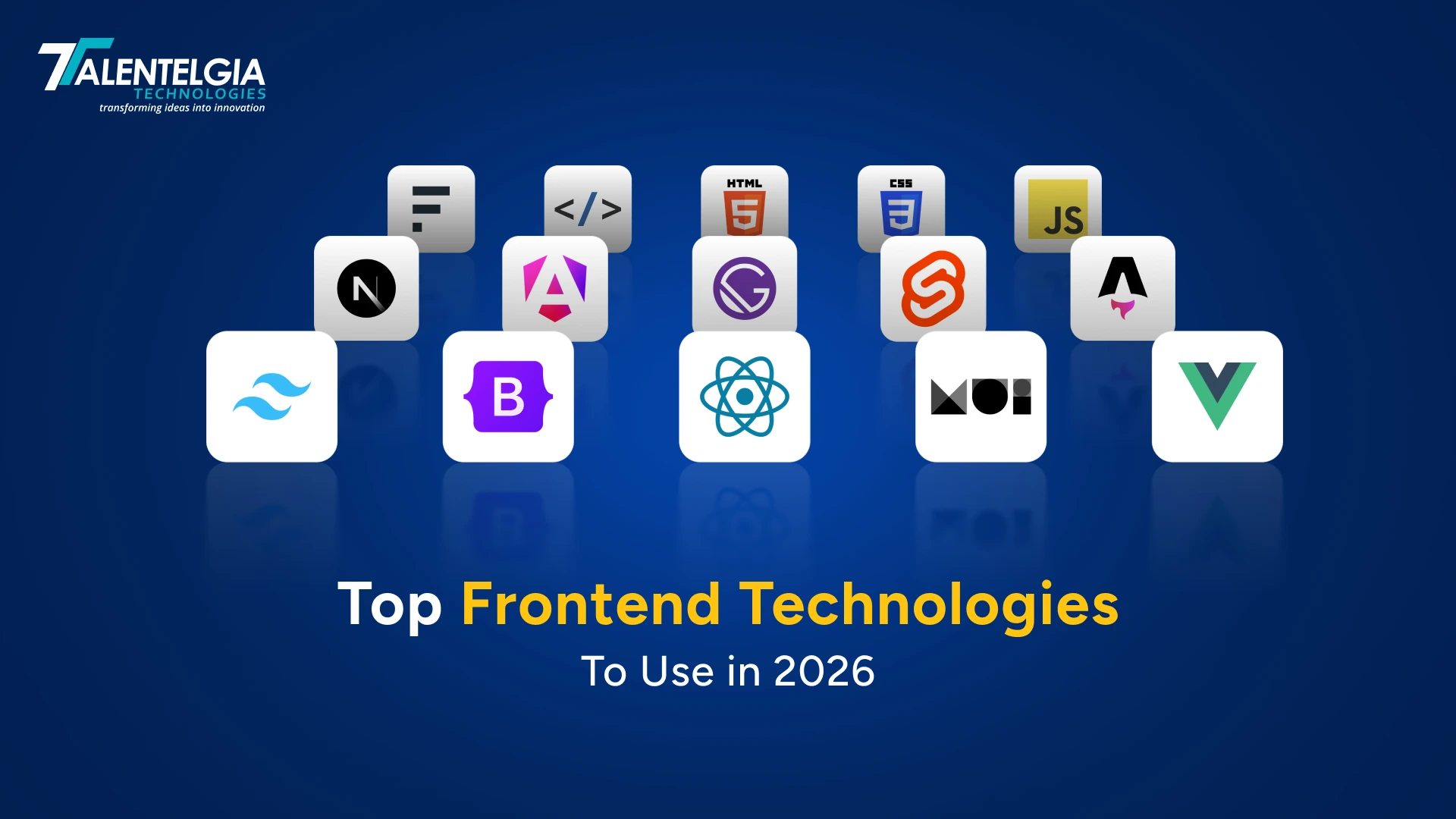
Frontend technologies have become more important than ever as digital experiences continue to change, especially in web development. In 2026, businesses and developers are not content with just looking good; it has to work fast, scale up (or down), perform across platforms, and still allow frictionless interaction. This demand and growth have forced modern frontend technologies to mature at an incredible rate, developing power tools and frameworks that make development easier while enabling rich user interfaces.
From the core building blocks — the HTML, CSS, and JavaScript stacks—to powerful frameworks, build tools, and modern UI technologies that make our work easier downstream: today’s ecosystem is more flexible than it has been at any other point in the history of front-end development. For those building a high-demand web app, a complex user interface, it’s essential to know frontend development technologies that will help you grow amongst your competitors and be ahead of time.
In this guide, we will look at the best technologies for frontend web developers to work with in 2026 — what’s hot and upcoming languages, popular frameworks, styles, and build systems, and much more. If you want to improve your skills or decide on the frontend developer tech stack that fits best for your next project, this list will help you make conscious decisions with confidence.
Core Foundations
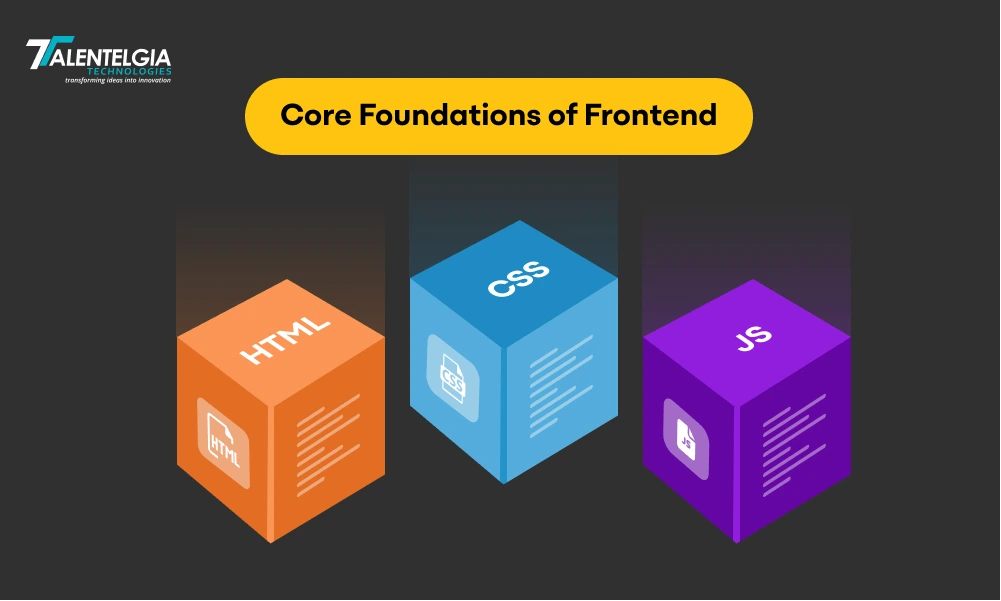
Every new user interface builds on good bases. Despite the maturity of modern frontend technologies, fundamental frontend technologies such as HTML, CSS, and JavaScript (JSS) are what are used today to build performant, scalable web applications. These are the fundamentals that you should learn for working with today’s frontend development in 2026.
1. HTML
HTML (HyperText Markup Language) is the starting point of all web experiences and an important technology for frontend development. It determines the structure of a webpage, making sure your content is well-organised and easy to navigate for both browsers and search engines. Clean and semantic HTML still matters for performance, SEO, and usability despite the growing world of advanced frameworks.
In 2026, HTML includes improved accessibility support, better multimedia capabilities, and a more responsive layout. Most of today’s HTML is interested in using some semantic tag, or in an effort to make your content cleaner and provide a better user experience. These advancements have made HTML one of the leading frontend developer technologies, especially when it comes to creating scalable and more inclusive interfaces.
A solid foundation in HTML makes everything else around the modern front end–CSS, JS frameworks, and new UI technologies easier to integrate. It is the solid foundation upon which all other frontend tools and frameworks run.
2. CSS
CSS — Cascading Style Sheets. This is one of the most important frontend technologies to create UI and style any user interface, making it a core component of modern User Interface Design Services. It takes care of layout, colors, fonts, spacing, as well as responsiveness, and makes creating informative web pages from structured HTML much easier. As a crucial frontend technology, CSS has a direct influence on user friendliness and overall usability of your website.
With newer CSS features such as Flexbox, Grid, transitions, and responsive design methodologies, developers are no longer vulnerable to using percentages and their crude cousins, floats, to make things nest well on all devices. It is still a cornerstone in frontend development technologies and acts as an impactful force behind the energizing modern UI technology, which helps developers to create clear directives for building user-friendly, clean UIs.
3. JSS
JSS (JavaScript Style Sheets) is a styling methodology that allows developers to write CSS directly inside JavaScript. The library is also a component-based frontend, and it’s used in modern libraries and frameworks. By handling styles together with logic, JSS enables to creation of dynamic and reusable UI components, and it becomes an essential piece of front-end development technologies.
JSS comes packed with features like scoped styles, theme management, and dynamic styling based on application state. This makes JSS an integral part of frontend technologies for web app development that demand flexibility and maintainable design systems.
Popular Frameworks & Libraries
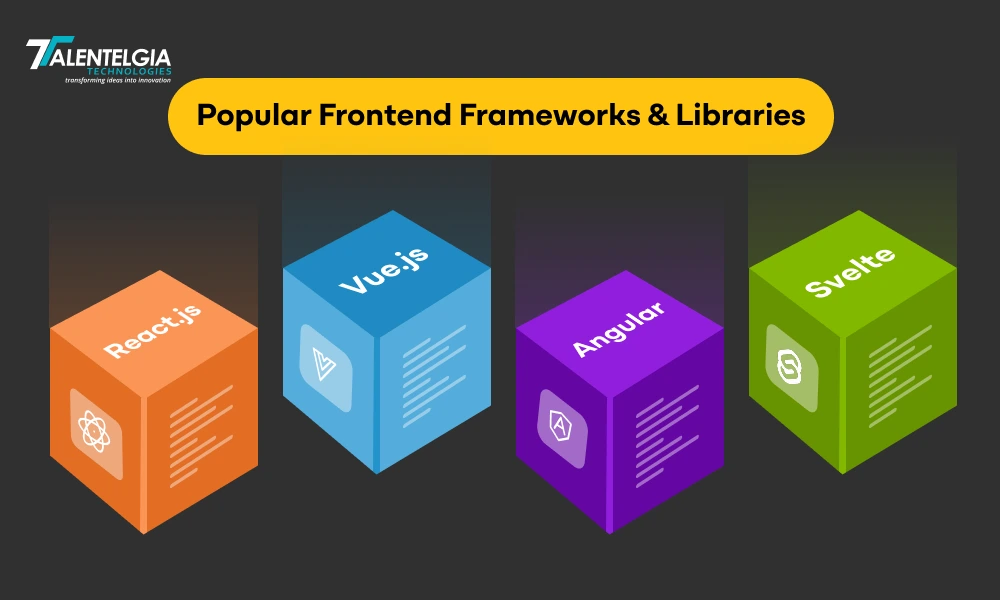
Nowadays, frameworks are used by web applications to facilitate development and enhance performance. Frontend technologies like these make it very easy for developers to develop interactive, scalable, and maintainable UIs without long development times. These libraries are one of the fundamental linchpins that help to manage thousands of lines of code for UI(User Interface) logic very neatly and properly, especially in case you are developing complex user interfaces.
4. React.js
React.js is extremely popular for building dynamic and interactive user interfaces. Built by Meta, it’s designed around a component-based architecture that enables developers to build reusable UI components – making applications more manageable and scalable. Its virtual DOM helps make applications more performant by changing only elements of the interface.
React.js integrates well with current frontend development (it is flexible and has a huge selection of tools and libraries). It is often employed to create SPA (Single Page App) dashboards and intricate user interfaces. To anyone wishing to pursue dependable frontend developer technologies, React.js is a solid and efficient option for making fast and reactive web apps.
5. Vue.js
Vue.js is an evolution of the JavaScript framework and one of the most adaptable frontend technologies to create user interfaces. It will be flexible and easy to integrate, so it can be used for small projects to huge applications. Vue is popular among those using modern front-end tools due to its declarative syntax and gradual learning curve.
Vue, with its reactive data binding and component-based architecture, is easier to use. Vue.js makes building UI and managing app state much more convenient and enjoyable. It integrates well with the front-end developer toolset, allowing developers to create fast and maintainable applications through easily pluggable components. For frontend teams in search of productive techs, which for sure one would want to give it all , for instance, Vue.js achieves a good balance between performance, simplicity, and scalability.
6. Angular
Angular is a mature framework developed and maintained by Google, which can be found at the top list when comparing enterprise-grade frontend technologies. It’s a pragmatic way to create web apps with some techniques already implemented, such as routing, form handling, and state management. That means Angular is an excellent option for teams dealing with sophisticated frontend technologies and large projects.
With Angular’s TypeScript-focused framework, you can create an efficient and maintainable application with a lightweight application building system. It is a very handy tool for modern front-end technologies, especially when we require reliability, consistency, and long-term stability. Angular is a fully-featured, mature framework whose every Angular feature helps developers create powerful user interfaces.
7. Svelte
Svelte is the next-generation framework that has a very different approach from existing frontend frameworks. Rather than doing a lot of the work at runtime, Svelte does much of it at compile-time, which leads to better performance as well as smaller bundle sizes. It’s part of what makes it a tantalising solution amidst contemporary frontend technologies.
With the virtual DOM out of the equation, Svelte developers are able to produce more straightforward and leaner code for interfaces that make a lot of interactive updates. It dovetails nicely with today’s frontend development tools and particularly so where performance is concerned. For programmers looking to build with leaner technologies for frontend devs, Svelte has arisen as a streamlined, fast, and developer-friendly framework.
Also Read: Svelte vs Vue: Which Is The Best Choice?
Styling & UI Tools
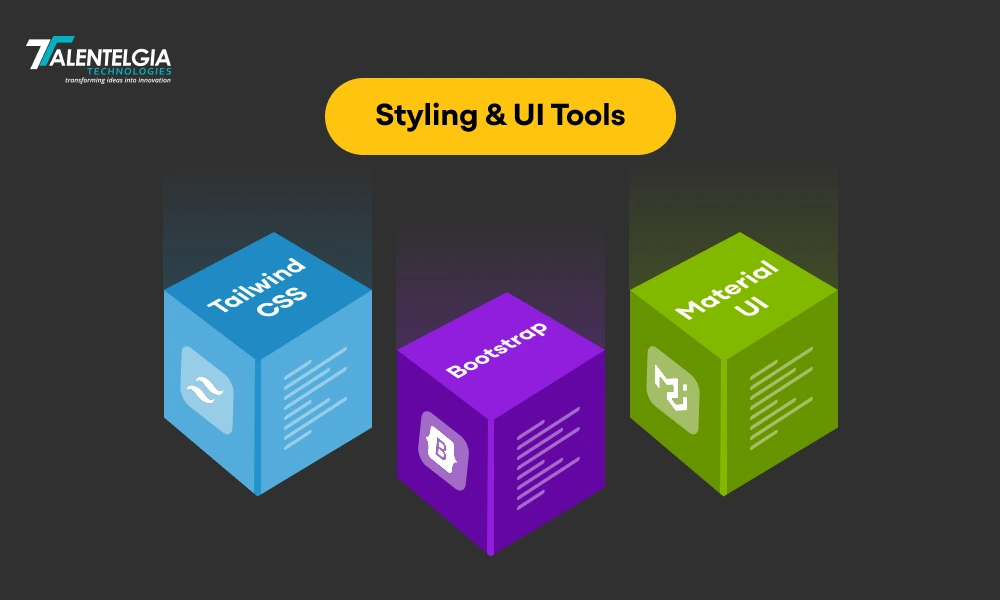
Styling tools are also instrumental in driving modern user interfaces in order to create more consistent designs. These User Interface (UI) technologies enable devs to design a responsive, scalable, and uniform look in far less time. In the jungle that is frontend technologies and frameworks, styling libraries make building and managing interfaces easier.
8. Tailwind CSS
TailwindCSS is a utility-first framework that has leaped to become the de facto standard for UI styling in frontend development. Rather than pre-made components, it offers a set of utility classes for building objects directly in your markup. This method provides more control of layout and styling while keeping everything consistent.
As a modern UI tech, Tailwind CSS helps you speed up your development with reusable utility patterns and minimal setup. It plays well with new frontend development technologies and frameworks, so it’s a preferred choice for teams who appreciate flexibility, speed, and clean design systems.
9. Bootstrap/Material UI
Bootstrap and Material UI Bootstrap and Material UI are very popular UI frameworks that enable developers to create consistent, responsive GUIs with ease. Bootstrap provides a grid system and predefined components, whereas Material UI is based on Google’s Material Design principles to develop complex React Components. Both are commonly used in modern frontends.
Simple reasons why styling is made easy, thanks to these frameworks are pre-designed components, themes, and responsiveness utilities. Bootstrap and Material UI are some of the standard frontend development technologies that reduce design overhead and accelerate development. For teams seeking battle-tested technology in the hands of frontend developers, they present stability, consistency, and ease of use across many projects.
Build Tools & Meta-Frameworks
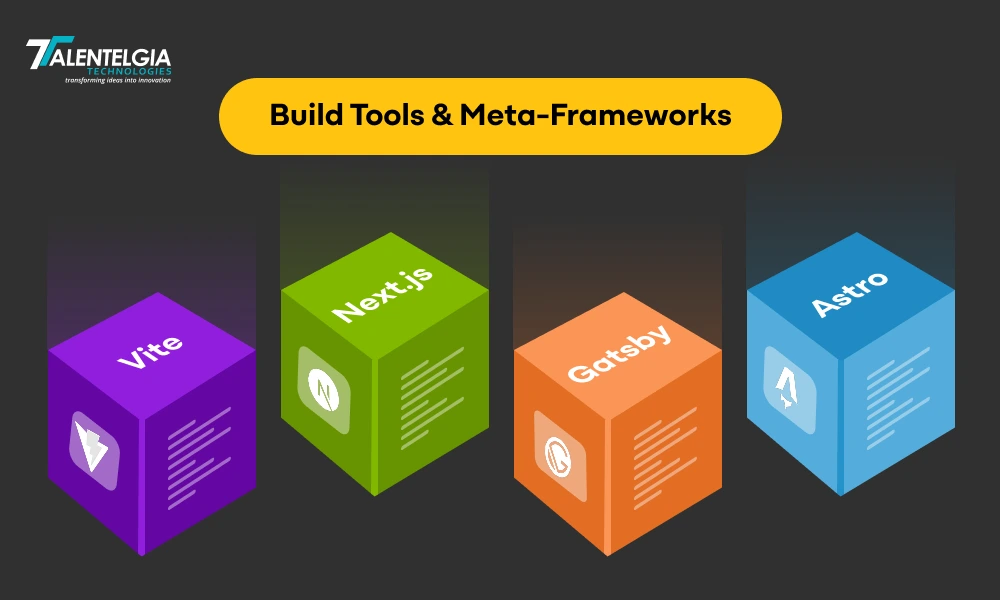
Tools and meta-frameworks are necessary to fix performance, project structure, and development speed. Those frontend developer tools ensure efficiency by taking care of bundling, optimizations, and app setup. Modern frontend technologies make heavy use of them to serve fast and snappy web applications.
10. Vite
Vite is an opinionated web dev build tool that serves as the fastest way to develop frontend projects. It has quick boot-up and hot module replacement, which is why it is one of the best frontend technologies nowadays. Using native ES modules, Vite lowers the barrier of entry and produces better performance in local development.
As a modern frontend development technology, Vite works well with major frameworks and libraries. It allows developers to create high-performance applications with optimized production tasks and is one of the most dependable technologies for front-end development on fast-paced projects.
11. Next.js
Next.js is a flexible meta-framework over React, widely used in modern frontend technologies. It comes with built-in features such as routing, server-side rendering, and static site generation to help developers create fast and search engine optimization-friendly web applications. These features make it popular among advanced frontend development technologies.
As one of the progressive frontend development technologies, Next.js where performance tuning and application layout far easier. It is scalable-friendly and works well with the React ecosystem; it’s part of the most favorite tech stack for high-traffic applications created by front-end developers.
Read More: Why use NextJS over ReactJS?
12. Gatsby
Gatsby is a radical new take on websites built with React. It is one of the most popular tools within frontend technologies due to its focus on speed and static site generation. Gatsby makes a lot of tricks behind the scenes at build time to ensure your users can enjoy a smooth and fast experience.
Featured among contemporary frontend development technologies, Gatsby plays nicely with APIs, headless CMS, and new data sources. It allows developers to build scalable content-rich applications, and is therefore one of the top choices for frontend technologies with a spotlight on speed, performance and maintainability.
13. Astro
Astro is a new web development framework to build faster, more efficient websites using significantly less JavaScript. It is one of the most favoured frontend technologies that offer lightweight pages and faster loading of web pages or applications. This makes Astro a good fit for modern front-end stack developments.
As the frontend development landscape continues to change, Astro provides a way for developers to work simultaneously with multiple frameworks in a single project without sacrificing performance. It is ideal for blogs, marketing sites, and documentation-type applications, and it’s one of the nice technologies to catch the attention of front-end developers dedicated to speed and simplicity.
Emerging & Specialized
New and niche tools are pushing the edges of what is possible with frontend technologies that go beyond websites.
These frontend technologies allow software developers to create cross-platform and highly responsive interfaces without having to maintain multiple codebases. They are a key player in the progression of new frontend development technologies.
14. Flutter
Flutter is an open-source UI toolkit created by Google Inc. that allows developers to create power-packed and user-friendly natively compiled applications from a single codebase, making it a popular choice for businesses working with a Flutter app development company to build cross-platform solutions. Commonly used across modern front-end development, Flutter ensures a uniform UI/UX across web, mobile, and desktop devices. It uses the Dart programming language and offers a large number of well-designed, customizable widgets.
An advanced UI technology kit to develop applications, Flutter is optimized for performance and visual consistency. Being a library for modern frontend developer technologies, with an ability for teams used to building single-page applications (SPAs) to greatly decrease development time while continuing to deliver rich user experiences across different platforms.
Read More:- Flutter App Development Cost
15. React Native
Today, a large number of developers are focusing on building mobile apps using JavaScript and React. Being one of the most popular modern frontend technologies, React Native provides code sharing across platforms and almost native performance. This is why it has become a very good choice among the current frontend technologies.
Too, these days React Native is one of the best frontend development technologies that comes with native components so as to build faster and smoother mobile applications. It is particularly useful for developers who are already comfortable with React, making it one of the more workable options for frontend developers concentrating on mobile-first and cross-platform app design.
16. Htmx
HTMX is a small JS library that enables you to build dynamic user interfaces using nothing but simple HTML attributes. As an old, ahead-of-its-time technology that reduces the need for the heavier JavaScript frameworks, it still allows for rich interactivity among modern frontend technologies. This makes HTMX a novel player in the current frontend technologies world.
And as frontend development, maybe HTMX suits you for use in applications that center around additional server-driven UI updates. It’s great for developers who want something quick and lightweight, which is why it’s becoming one of the best frontend technologies to use when developing clean, fast, and maintainable UIs.
Conclusion
The frontend space is booming with a powerful market of toolsets and frameworks, providing more freedom to developers than ever. From the very basics, such as HTML and CSS, to advanced frameworks, build tools, and cutting-edge UI technologies, you'll find them in action with clear examples to guide you on your way toward building rapid responsive web applications that work across any number of devices. Demonstrating how these frontend technologies can complement each other is critical to developing high-performance, maintainable digital experiences.
Select which frontend technologies to use based on the specific requirements of your project, expected performance goals, and team skill set. Keeping up to date with the modern frontend development technology through what it has on offer for frontend developers is how teams would be able to develop next-level interfaces that have improved usability, performance, and long-term value.













 Write us on:
  Business queries:
  HR:
HR: 


