


 Healthcare App Development Services
 Real Estate Web Development Services
 E-Commerce App Development Services
 E-Commerce Web Development Services
 Blockchain E-commerce Development Company
 Fintech App Development Services
 Fintech Web Development
 Blockchain Fintech Development Company
 E-Learning App Development Services
 Restaurant App Development Company
 Mobile Game Development Company
 Travel App Development Company
 Automotive Web Design
 AI Traffic Management System
 AI Inventory Management Software
 AI Development Company
  ChatGPT integration services
  AI Integration Services
  Generative AI Development Services
  Natural Language Processing Company
 Machine Learning Development
  Machine learning consulting services
  Blockchain Development
  Blockchain Software Development
  Smart Contract Development Company
  NFT Marketplace Development Services
  Asset Tokenization Company
 DeFi Wallet Development Company
 Mobile App Development
  IOS App Development
  Android App Development
  Cross-Platform App Development
  Augmented Reality (AR) App Development
  Virtual Reality (VR) App Development
  Web App Development
  SaaS App Development
 Flutter
  React Native
  Swift (IOS)
  Kotlin (Android)
  Mean Stack Development
  AngularJS Development
  MongoDB Development
  Nodejs Development
  Database Development
 Ruby on Rails Development
 Expressjs Development
  Full Stack Development
  Web Development Services
  Laravel Development
  LAMP Development
  Custom PHP Development
  .Net Development
  User Experience Design Services
  User Interface Design Services
  Automated Testing
  Manual Testing
  Digital Marketing Services
 Ride-Sharing And Taxi Services
 Food Delivery Services
 Grocery Delivery Services
 Transportation And Logistics
 Car Wash App
 Home Services App
 ERP Development Services
 CMS Development Services
 LMS Development
 CRM Development
 DevOps Development Services
 AI Business Solutions
 AI Cloud Solutions
 AI Chatbot Development
 API Development
 Blockchain Product Development
 Cryptocurrency Wallet Development
 About Talentelgia
  Our Team
  Our Culture
 Healthcare App Development Services
 Real Estate Web Development Services
 E-Commerce App Development Services
 E-Commerce Web Development Services
 Blockchain E-commerce
Development Company
Blockchain E-commerce
Development Company Fintech App Development Services
 Finance Web Development
 Blockchain Fintech
Development Company
Blockchain Fintech
Development Company E-Learning App Development Services
 Restaurant App Development Company
 Mobile Game Development Company
 Travel App Development Company
 Automotive Web Design
 AI Traffic Management System
 AI Inventory Management Software
 AI Development Company
 ChatGPT integration services
 AI Integration Services
 Machine Learning Development
 Machine learning consulting services
 Blockchain Development
 Blockchain Software Development
 Smart contract development company
 NFT marketplace development services
 IOS App Development
 Android App Development
 Cross-Platform App Development
 Augmented Reality (AR) App
Development
Augmented Reality (AR) App
Development Virtual Reality (VR) App Development
 Web App Development
 Flutter
 React
Native
React
Native Swift
(IOS)
Swift
(IOS) Kotlin (Android)
 MEAN Stack Development
 AngularJS Development
 MongoDB Development
 Nodejs Development
 Database development services
 Ruby on Rails Development services
 Expressjs Development
 Full Stack Development
 Web Development Services
 Laravel Development
 LAMP
Development
LAMP
Development Custom PHP Development
 User Experience Design Services
 User Interface Design Services
 Automated Testing
 Manual
Testing
Manual
Testing About Talentelgia
 Our Team
 Our Culture
Almost every business uses “some kind of software” in 2026! What differentiates them is whether that software is enabling the business to move ahead or just holding it back quietly. Most professionals look at custom-made software like how they look at a new website— build once; fixed cost; a nice to have. But that framing is Outdated!
Today’s custom software applications are more than mere tools; they’re operating leverage, driving margins, customer experiences and compliance, as well as speed at which teams work. The reason is simple: Return on Investment (ROI) is often ignored at the beginning. The ROI on custom software isn’t just about direct revenue, as in many cases, the biggest returns, appear in areas executives care about most:
- Time saved across teams
- Quicker decisions
- Fewer costly errors
- Better customer retention
- Lower risk exposure
- Reduced dependency on manual work
This blog explains how businesses evaluate ROI on custom software development and how it will look in 2026. It also describes how it is appraised by the executives, which is applied to new lines of business.
ROI on Software Development: Cost, Benefits, and Development Process
Return on Investment (ROI) is an essential metric for measuring the profitability of any investment. It measures the amount of net gain or loss created versus the amount invested. In short, it tells you how much you gained for every penny spent. However, ROI on software goes well beyond dollar and cents calculations.
According to Netguru’s report from 2024, custom software solutions can lead to an average increase of 80% higher customer acquisition rates through personalized experiences. Another report says businesses that invest in a tailored technology stack are 3x times more likely to outpace their competitors in revenue growth. Imagine if you wore a suit two sizes too big: You wouldn’t, right?
| Aspect | Custom Software | Off-The-Shelf |
| Upfront Cost | High ($50K-$500K+) | Low ($1K-$50K) |
| Ongoing Costs | Low maintenance (15-20% yearly) | Recurring subscriptions |
| Timeline | 3-12 months | Days to weeks |
| ROI Break-even | 12-24 months | 3-6 months |
So why try to shoehorn your business processes into generic, off-the-shelf software? Now, custom software is more like a perfectly tailored suit designed not only to fit your specific needs but also to maximise your performance. And that translates directly to ROI.
Custom Software vs Off-The-Shelf Software: Quick Comparison
In the fast-paced digital economy of 2026, choosing between custom-built software and an off-the-shelf solution is no longer just a technical decision—it’s a high-stakes financial maneuver. It’s the difference between buying a suit off the rack that “mostly fits” and commissioning a bespoke garment designed to move exactly the way you do.
To get the best Return on Investment (ROI), you have to look past the initial price tag and focus on how the software will actually drive your business forward.
Read More:- Software Development For Startups
Custom Software
Custom software is designed from the ground up to solve your specific business problems. It follows your workflows, integrates perfectly with your existing data, and grows as you do. In 2026, this often means building proprietary AI agents that “learn” your unique business logic.
Where It Works Best?
- Proprietary Workflows: If you have a unique way of doing things that no one else in your industry does, custom code is the only way to automate it without breaking the process.
- High-Security Industries: For FinTech, Healthcare, or Defense, where “standard” security isn’t enough, custom builds allow you to control every single data packet.
- Large-Scale Automation: When you have thousands of employees, paying “per-user” for a SaaS tool becomes a massive drain. A one-time custom build can save millions in the long run.
- Unique Customer Experiences: If you want your client portal or mobile app to look and feel completely different from your competitors, you have to build it yourself.
The Limitations
- The “Time Tax”: You won’t have it tomorrow. Quality custom software takes months to design, code, and test.
- High Entry Price: The upfront cost is significant. You are hiring a full team of experts to build an asset from scratch.
- Maintenance Burden: Since you own the code, you are responsible for fixing bugs and keeping it updated. If your dev team disappears, you have a “black box” that no one knows how to fix.
Development Process
Phase 1: Discovery & Strategy
- The Goal: Define the “Why.” Architects and business analysts interview your team to map out every unique workflow.
- The Deliverable: A detailed Software Requirements Specification (SRS) and a project roadmap.
Phase 2: UI/UX Design
- The Goal: Create a “Blueprint.” Designers build wireframes and high-fidelity prototypes.
- The Deliverable: A visual “clickable” model of the app so you can see how it feels before a single line of code is written.
Phase 3: Development & Coding
- The Goal: The heavy lifting. Developers build the front-end (what you see) and the back-end (the logic and database).
- The Deliverable: Functional software “Sprints”—regular updates where you see new features being added every 2 weeks.
Phase 4: QA & User Testing
- The Goal: Breaking the software to make it stronger. Testers run security audits, “stress tests,” and ensure it works on all devices.
- The Deliverable: A bug-free, secure, and stable “Release Candidate.”
Phase 5: Deployment & Evolution
- The Goal: Go live. The software is launched, and data is migrated.
- The Deliverable: A living asset that you continue to update and improve based on user feedback.
Off-The-Shelf Software
These are ready-made products (usually SaaS) designed to serve a broad audience. They are packed with features that work for 80% of businesses. They are fast to deploy but often force you to change your business processes to fit the software’s limitations.
Where It Works Best?
- Standard Business Functions: You don’t need a custom email client or a custom accounting tool. QuickBooks, Salesforce, and Microsoft 365 already do these things perfectly.
- Startups & Small Businesses: When cash flow is tight and you need to move fast, paying a monthly fee for a proven tool is a “no-brainer.”
- Rapid Testing: If you’re testing a new business idea, use an OTS tool to “Proof of Concept.” You can always build a custom version later if the idea works.
- Industry Compliance: Many OTS tools include built-in legal compliance (e.g., tax laws or GDPR) that would be incredibly expensive to code manually.
The Limitations
- The “Rigidity” Problem: You have to change your business to fit the software. If your workflow requires Step A to happen before Step B, but the software only allows B to happen before A, you’re stuck.
- The Subscription Trap: As you grow, those “small” monthly fees per user start to snowball. In 2026, many vendors will also add “AI Usage Fees” that can make your monthly bill unpredictable.
- Feature Bloat: You’re often paying for a “Professional Suite” filled with 100 features, even though your team only uses five of them. This creates a cluttered, confusing interface.
- Vendor Lock-in: If the provider raises their prices or goes out of business, your data is trapped in their system, making it difficult and expensive to leave.
Development Process
Phase 1: Selection & Procurement
- The Goal: The “Best Fit.” You demo multiple vendors, check their 2026 AI capabilities, and sign a subscription contract.
- The Deliverable: Access credentials to the platform.
Phase 2: Configuration & Setup
- The Goal: Making the “standard” tool yours. You toggle settings, set up user permissions, and “brand” the interface with your logo.
- The Deliverable: A configured environment ready for your data.
Phase 3: Integration & API Wrapping
- The Goal: Connection. Your IT team uses tools like Zapier or custom APIs to make the software “talk” to your existing CRM or email tools.
- The Deliverable: A connected tech stack where data flows between the new tool and your old ones.
Phase 4: Data Migration & Training
- The Goal: Moving in. You upload your spreadsheets or databases into the new system and run “lunch and learn” sessions for your staff.
- The Deliverable: An active user base that knows how to navigate the software.
Phase 5: Maintenance & Vendor Updates
- The Goal: Staying current. You don’t fix bugs; the vendor does. You simply wait for their scheduled updates and new feature rollouts.
- The Deliverable: A “hands-off” software experience managed by the provider.
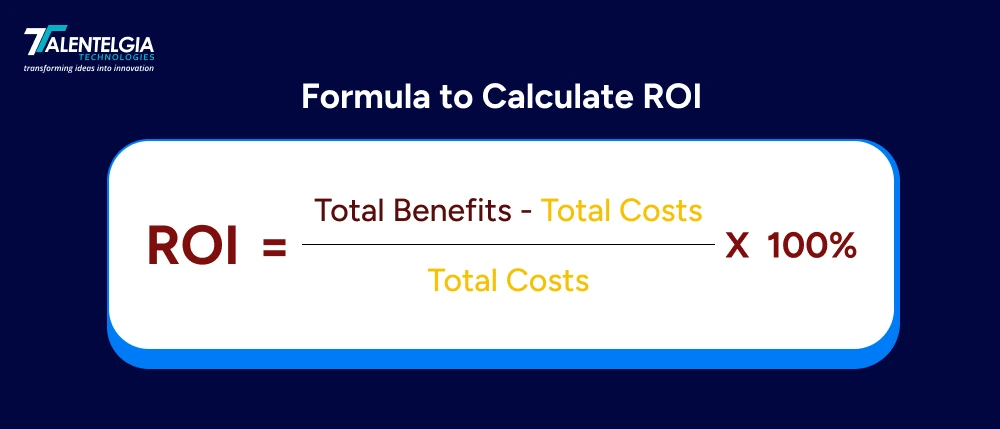
Cost & Budgeting Formula: The ROI Equation
When calculating ROI, the formula is straightforward, but the variables are complex:
Cost & ROI: Custom Software vs Off-The Shelf
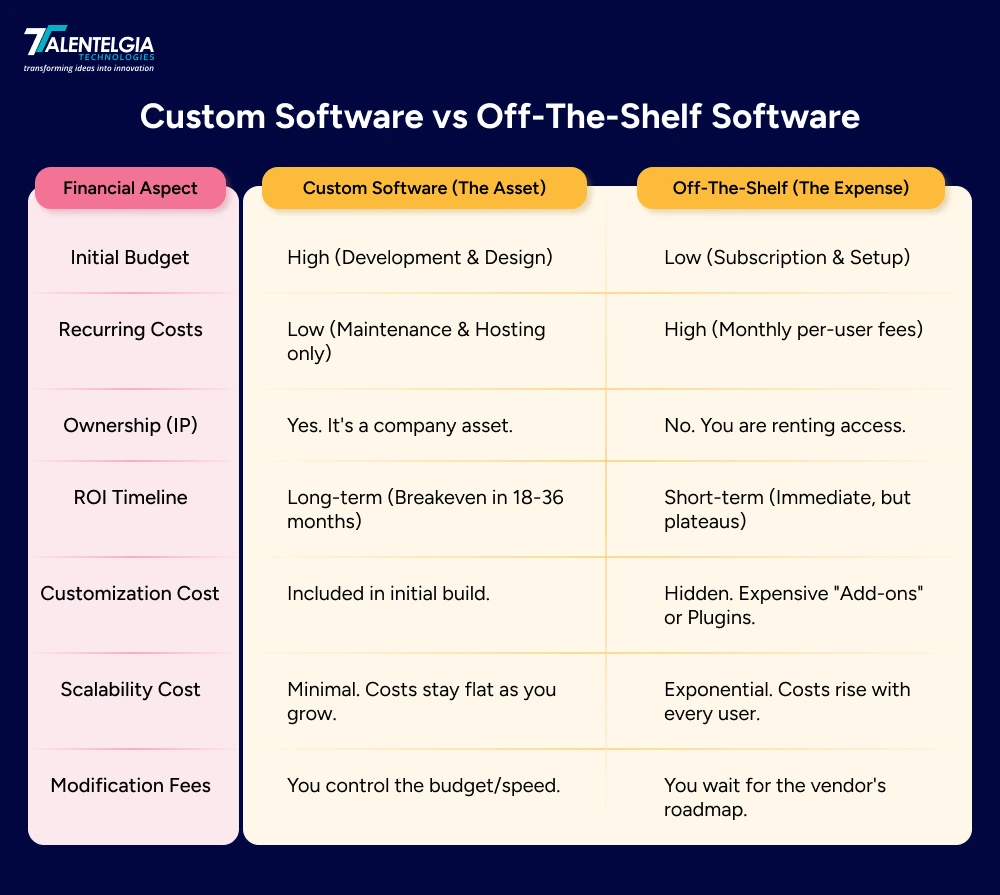
In 2026, the financial landscape has shifted: Custom software is an Asset (Capital Expenditure), while Off-The-Shelf is a Service (Operating Expenditure). Here is how they stack up across the most critical financial aspects.
1. The Entry Point (Upfront Investment)
- Custom: Requires a significant initial investment. You are paying for a dedicated team of architects and developers to build your vision. It feels expensive on Day 1, but you are buying the “Digital Factory,” not just the product.
- Off-The-Shelf: Very low entry cost. You can usually start with a monthly “Pro” plan for a few hundred dollars. It’s perfect for protecting your immediate cash flow.
2. The “Scaling Tax” (Long-Term Licensing)
- Custom: Once built, you own it. Whether you have 10 employees or 10,000, your licensing cost is $0. This is where the ROI of custom software explodes as your company grows.
- Off-The-Shelf: Most 2026 SaaS models use “Per-Seat” or “Per-Agent” pricing. As your team grows, your monthly bill balloons. If you scale quickly, you might eventually pay more in annual rent than it would have cost to build the tool yourself.
3. Integration & Efficiency Gains
- Custom: Designed to fit your existing workflow perfectly. There is zero “Manual Data Entry” because the tool is built to talk to your other systems. This creates a High ROI through massive time savings.
- Off-The-Shelf: You often have to pay for “Middleware” (like Zapier or custom APIs) to make the tool work with your other software. If the integration isn’t perfect, your team loses hours every week fixing data errors—a “Hidden Cost” that drains your ROI.
So, Which Software To Choose, Custom or Off-The-Shelf?
Deciding between custom software and off-the-shelf solutions isn't a one-size-fits-all game—both have their sweet spots depending on your business stage, budget, and goals. Honestly, there's no "better" option universally; it's about matching the tool to the task.
Custom builds your moat for complex, evolving needs.

Off-the-shelf gets you in the game fast for routine operations.

Assess your pain points, growth plans, and risk tolerance—both paths can lead to winning ROI when chosen right. What’s your biggest bottleneck right now? Contact us and share your interests!











 Write us on:
  Business queries:
  HR:
HR: 


