


 Healthcare App Development Services
 Real Estate Web Development Services
 E-Commerce App Development Services
 E-Commerce Web Development Services
 Blockchain E-commerce Development Company
 Fintech App Development Services
 Fintech Web Development
 Blockchain Fintech Development Company
 E-Learning App Development Services
 Restaurant App Development Company
 Mobile Game Development Company
 Travel App Development Company
 Automotive Web Design
 AI Traffic Management System
 AI Inventory Management Software
 Machine Learning Development
 ChatGPT integration services
  AI Development Company
  AI Integration Services
  Generative AI Development Services
  Natural Language Processing Company
 Mobile App Development
  IOS App Development
  Android App Development
  Cross-Platform App Development
  Augmented Reality (AR) App Development
  Virtual Reality (VR) App Development
  Web App Development
  SaaS App Development
 Flutter
  React Native
  Swift (IOS)
  Kotlin (Android)
  Mean Stack Development
  AngularJS Development
  MongoDB Development
  Nodejs Development
  Database Development
 Ruby on Rails Development
 Expressjs Development
  Full Stack Development
  Web Development Services
  Laravel Development
  LAMP Development
  Custom PHP Development
  .Net Development
  User Experience Design Services
  User Interface Design Services
  Automated Testing
  Manual Testing
  Digital Marketing Services
 Ride-Sharing And Taxi Services
 Food Delivery Services
 Grocery Delivery Services
 Transportation And Logistics
 Car Wash App
 Home Services App
 ERP Development Services
 CMS Development Services
 LMS Development
 CRM Development
 DevOps Development Services
 AI Business Solutions
 AI Cloud Solutions
 AI Chatbot Development
 API Development
 Blockchain Product Development
 Cryptocurrency Wallet Development
 About Talentelgia
  Our Team
  Our Culture
 Healthcare App Development Services
 Real Estate Web Development Services
 E-Commerce App Development Services
 E-Commerce Web Development Services
 Blockchain E-commerce
Development Company
Blockchain E-commerce
Development Company Fintech App Development Services
 Finance Web Development
 Blockchain Fintech
Development Company
Blockchain Fintech
Development Company E-Learning App Development Services
 Restaurant App Development Company
 Mobile Game Development Company
 Travel App Development Company
 Automotive Web Design
 AI Traffic Management System
 AI Inventory Management Software
 AI Development Company
 ChatGPT integration services
 AI Integration Services
 Machine Learning Development
 Machine learning consulting services
 Blockchain Development
 Blockchain Software Development
 Smart contract development company
 NFT marketplace development services
 Asset tokenization companies
 DeFi Wallet Development Company
 IOS App Development
 Android App Development
 Cross-Platform App Development
 Augmented Reality (AR) App
Development
Augmented Reality (AR) App
Development Virtual Reality (VR) App Development
 Web App Development
 Flutter
 React
Native
React
Native Swift
(IOS)
Swift
(IOS) Kotlin (Android)
 MEAN Stack Development
 AngularJS Development
 MongoDB Development
 Nodejs Development
 Database development services
 Expressjs Development
 Full Stack Development
 Web Development Services
 Laravel Development
 LAMP
Development
LAMP
Development Custom PHP Development
 User Experience Design Services
 User Interface Design Services
 Automated Testing
 Manual
Testing
Manual
Testing About Talentelgia
 Our Team
 Our Culture
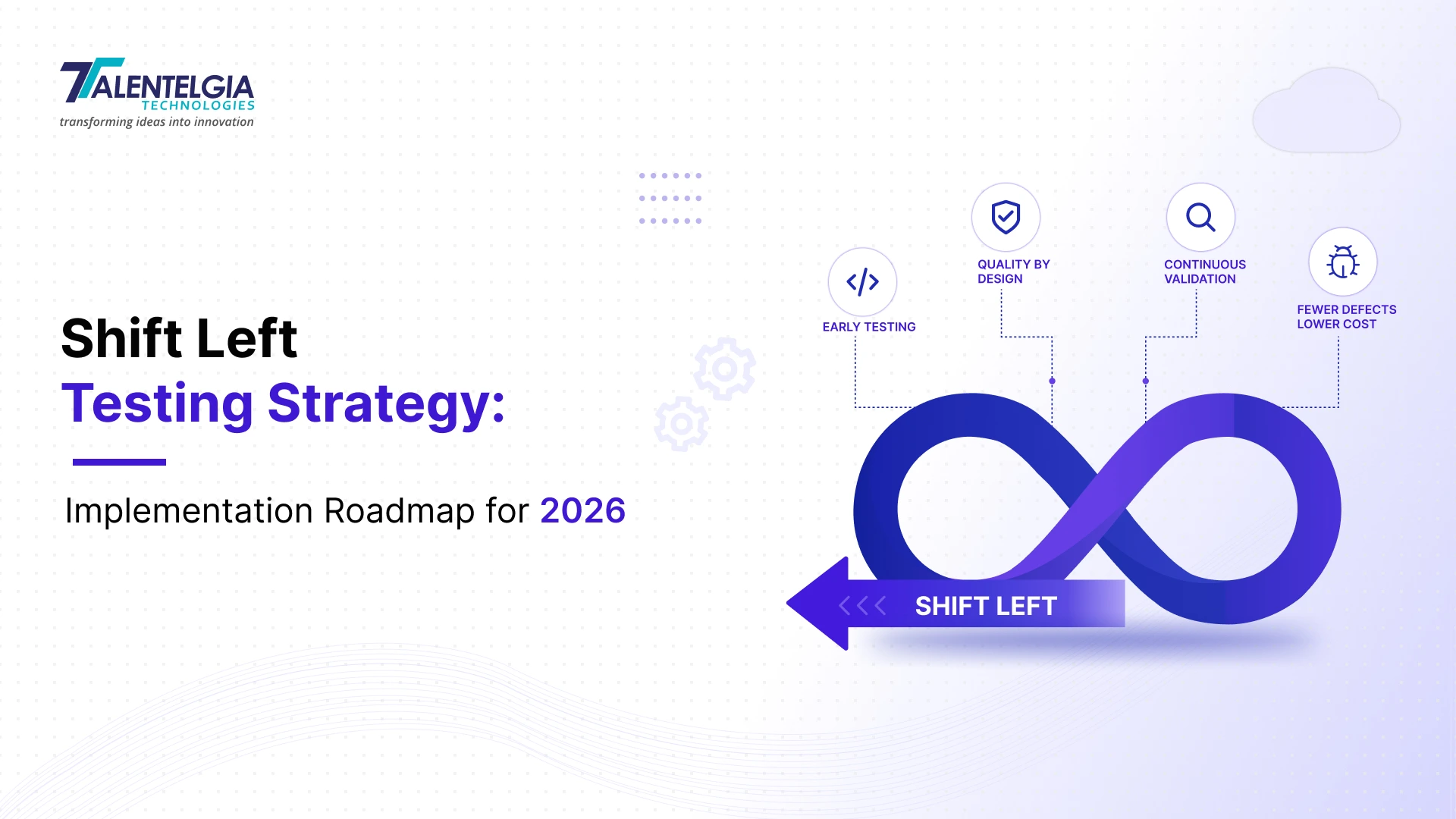
A defect caught during a code review costs you a conversation. The same defect, discovered after release, costs you a hotfix, a regression cycle, a support queue, and possibly a customer. Research from the IBM Systems Sciences Institute and NIST puts a number on that gap: the cost of fixing a bug climbs roughly tenfold at every stage it survives past requirements. Yet most engineering teams still treat testing as something that happens after the code is “done,” not while it’s being written.
Shift left testing exists to close that gap. It’s not a new tool or a QA fad. It’s a restructuring of when testing happens in your SDLC, moving validation into requirements, design, and early development instead of bolting it on before release. Done right, it changes who owns quality (everyone, not just QA) and how expensive your bugs are allowed to get before someone notices them.
This piece skips the theory-heavy detour most shift-left guides take. Instead, this article explains how to apply shift left into your CI/CD workflow, offers a maturity-level deployment strategy, and defines AI test tools’ place in 2026.
What Is Shift Left Testing?
Shift left testing repositions testing activities earlier in the SDLC, into requirements, design, and early development, rather than confining them to a dedicated phase before release. The term originates from Larry Smith’s 2001 paper and refers to the SDLC’s conventional left-to-right visualization, where requirements sit on the left and deployment on the right. Traditional testing occurs near that right edge, after development is marked complete. Shift left moves validation activities toward the left, running development and testing in parallel instead of sequentially.
This isn’t limited to functional testing. Shift left extends across multiple testing dimensions:
- Functional testing – validated incrementally as features are built, not after completion.
- API testing – contracts and integrations checked before the full application stack exists.
- Static code analysis – syntax and logic errors flagged before code reaches runtime.
- Security scanning (DevSecOps) – vulnerabilities identified during development rather than in a pre-release audit.
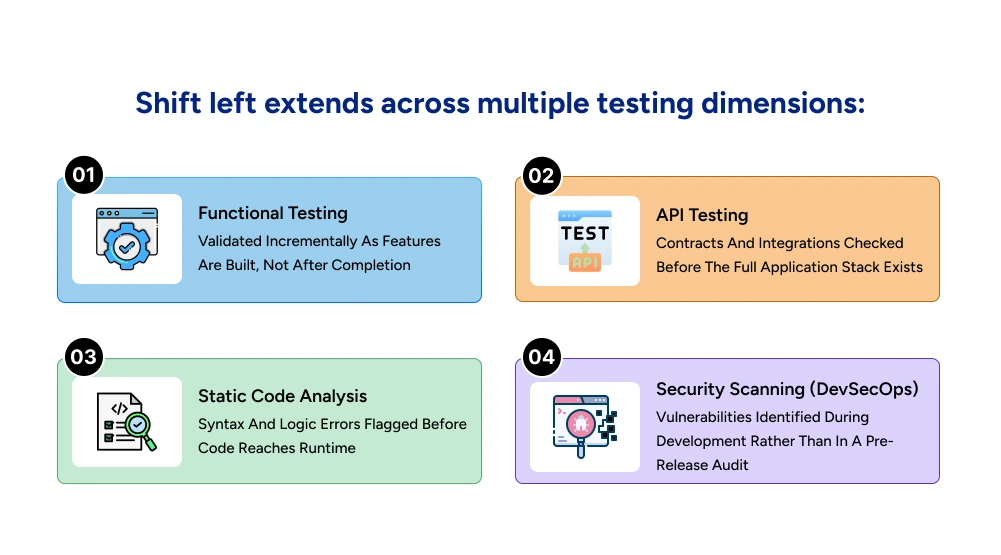
The underlying principle is consistent across all four: defects are cheaper and faster to resolve the closer they’re caught to the point of introduction. Shift left reframes testing from a reactive, defect-detection exercise into a proactive, defect-prevention discipline embedded across the SDLC.
Benefits Of Shift Left Testing
The cost of fixing a defect rises the later it’s caught; a bug flagged during design review is a five-minute conversation; the same bug discovered in production means a hotfix, a regression cycle, and potentially a customer-facing incident. That escalation is the core business case for shifting testing earlier, but the benefits extend well past cost.
- Faster, cheaper defect resolution – a bug caught seconds after a commit is fixed while the developer still has full context. The same bug found weeks later during integration testing means re-learning code, tracing dependencies, and untangling whatever got built on top of the faulty piece since.
- Stronger dev-QA collaboration – embedding QA into sprint planning and requirement reviews removes the “throw code over the wall” dynamic that traditional testing phases create. Testers catch ambiguous requirements before they become defects; developers get context on edge cases before writing a single line.
- Native compatibility with CI/CD – automated tests firing on every commit are what make multiple daily deployments possible. Batch-testing an entire feature before release doesn’t scale to that release cadence.
- Reduced rework – validating architecture and API contracts before dependent services are built prevents the multi-week refactors that late-stage defect discovery triggers.
- Defense-in-depth quality – defects that slip past unit tests get caught at integration, and issues missed there surface in regression. No single late-stage gate is carrying all the risk.
Also Read: Automation Testing Myths & Misconceptions vs. The Real Story
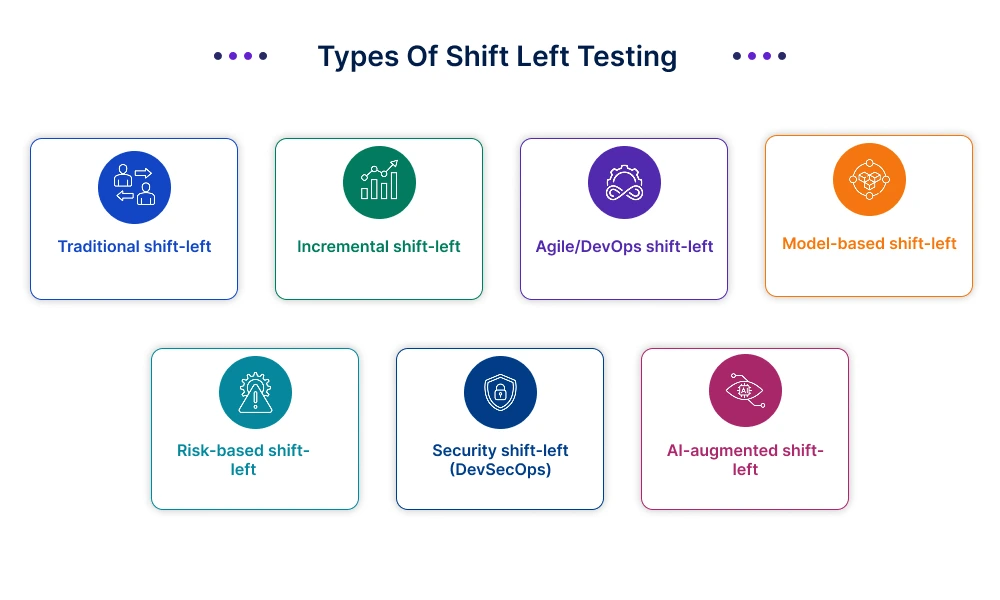
Types Of Shift Left Testing
Shift left isn’t a single implementation. It’s a spectrum of approaches, and the right one depends on system complexity and how mature your existing process already is.
Traditional Shift-Left
- Moves existing test types, mainly unit and integration testing, earlier, without changing team structure or collaboration models.
- Low disruption, easy to adopt incrementally.
- Main drawback: it relocates the bottleneck earlier rather than removing it, and system-level or acceptance testing often still gets neglected.
Incremental Shift-Left
- Breaks complex builds into smaller segments, testing each one before the next is layered on top.
- Common in projects with high hardware or system complexity, where segments need to be validated before dependencies stack up.
- Reduces defect accumulation by catching issues module-by-module instead of at the end.
Agile/DevOps Shift-Left
- Embeds testing directly into sprints and CI/CD pipelines rather than treating it as a downstream phase.
- QA participates in sprint planning and backlog refinement, not just execution.
- Currently the default model most enterprises are converging toward, largely because it’s the only approach compatible with multiple daily deployments.
Model-Based Shift-Left
- Generates test cases from system models and specifications before a single line of code is written.
- Validates requirements completeness and surfaces design-phase issues early.
- Best suited to domains with formal specs: finance, healthcare, aerospace, where design-stage errors are the most expensive to leave unchecked.
Risk-Based Shift-Left
- Prioritizes test coverage on high-impact, high-probability-of-failure functionality first, rather than treating all test cases equally.
- Requires assessing both the impact of failure (with business analysts or designers) and the likelihood of failure (with the development team).
- Useful when time or resources don’t allow full early-stage coverage across an entire system.
Security Shift-Left (DevSecOps)
- Introduces vulnerability scanning and security checks during development instead of at a pre-release audit.
- Catches issues while they’re still cheap to patch, rather than after they’ve shipped.
AI-Augmented Shift-Left
- The newest layer: models flag defect-prone code changes, generate test cases from application analysis, and self-heal scripts when UI elements change.
- Reduces the manual overhead that traditionally capped how early and how often teams could realistically test.
Comparing Shift Left Vs Shift-Right Testing
Shift left and shift right cover different halves of the same lifecycle.
- Shift left is prevention-focused: catch defects before they reach production.
- Shift right is detection-focused: catch what shift left couldn’t predict, because no pre-production environment fully replicates real user behavior, real traffic patterns, or real-world edge cases.
A mature testing strategy runs both simultaneously, not one instead of the other.
| Aspect | Shift Left | Shift Right |
|---|---|---|
| Timing | Requirements through development | Post-deployment, in production |
| Objective | Prevent defects before they’re built | Detect issues that only surface under real usage |
| Core activities | Unit testing, static analysis, API/contract testing, code review | A/B testing, canary releases, chaos engineering, synthetic monitoring |
| Environment | Controlled dev/test environments | Live production environment |
| Tooling | Jenkins, SonarQube, Selenium, Postman | Datadog, New Relic, feature-flag platforms |
| Collaboration | Developers, QA, testers | DevOps, SRE, customer support |
| Feedback speed | Immediate, within the commit/build cycle | Delayed, surfaces after release, via monitoring or user reports |
Where they intersect matters most: shift-right data should feed back into shift-left practice. A production incident caught via monitoring becomes a new test case written earlier in the next cycle; that loop is what actually compounds quality improvements over time, rather than treating each release as a fresh start.
Mapping Shift Left to Your CI/CD Pipeline
Shift left only becomes a strategy, not a slogan, once it’s mapped to actual stages in your delivery pipeline. Each stage should catch a different kind of defect, at a cost proportional to how early it fires. The governing principle: fail fast, fail cheap, catch problems while they’re still cheap to fix, not after they’ve moved further down the line.
Pre-Commit (on the developer’s machine, before code is even shared)
- Basic checks like formatting and code-style validation.
- Fast, targeted tests scoped to just the code that changed.
- Costs nothing in terms of build infrastructure — this is the cheapest point at which a defect can be caught, before it even enters the shared codebase.
Pull Request Stage (when a developer proposes merging their changes, minutes)
- The full set of unit tests (tests that check small, individual pieces of functionality in isolation) for the changed component.
- Automated code-quality scans that flag security issues or messy code before a human reviewer even looks at it.
- Checks that confirm one service’s API hasn’t broken its agreed “contract” with another, especially important when an application is built from many smaller interconnected services.
- A minimum test-coverage requirement, so changes can’t merge without adequate testing.
- This stage should complete in under 10 minutes, since it’s what developers are actively waiting on.
Merge to Main Branch (minutes to tens of minutes)
- Integration tests — checking that different parts of the system work correctly together, using real databases and dependencies rather than simulated ones.
- Building the final packaged version of the application.
- Scanning for known vulnerabilities in third-party libraries the code depends on, and checking that no passwords or credentials were accidentally committed.
- Scanning container images if the application ships in that format.
Staging/Pre-Production (10–20 minutes)
- A broader regression suite, confirming existing functionality still works after the change.
- Load and performance testing, simulating real traffic to see how the system holds up under pressure. This is placed here rather than earlier because it takes longer to run and isn’t needed on every single change.
- Security testing that behaves like a real attacker probing the live, running application from the outside.
- Smoke tests — quick checks confirming the most critical features still function right after deployment.
Production (ongoing)
- Gradual rollouts to a small slice of real users before releasing to everyone, to limit blast radius if something’s wrong.
- Continuous monitoring to catch issues that no pre-production environment could fully predict
- This is where shift-right takes over; real-world findings get fed back into earlier stages as new test cases for next time.
As a general rule, the bulk of your testing (roughly 70%) should be fast, low-cost unit tests, with fewer, slower, and more expensive tests as you move closer to production.
How To Implement the Shift Left Testing Approach?
Shift left is a sequence, and skipping steps produces the most common failure pattern: automation bolted onto unclear requirements, or tests running early with no one owning the results.
1. Start with Requirements, not Tools
- Involve QA during requirement gathering, not after the spec is finalized.
- Define verifiable scenarios for each condition: valid input, invalid input, edge cases, before any code is written.
- Vague requirements are the single biggest cause of defects surfacing late.
2. Set Coding and Quality Standards Early
- Define acceptable code quality, security, and performance thresholds before developers start writing tests.
- Without this, teams shift testing earlier without agreeing on what “passing” actually means.
- Gives developers and QA a shared baseline to build automation against.
3. Build Pipeline Gates, not Just Pipeline Stages
- A CI/CD pipeline alone doesn’t mean you’re shifting left; each stage needs an enforced gate.
- Static analysis and unit tests block the pull request.
- Integration tests block the merge.
- Security scans block the deployment.
- Tests that run but don’t block anything get ignored the moment a deadline tightens.
4. Automate the Highest-Value Tests First
- Prioritize unit, API, and integration tests tied to your most frequent defect patterns, not whichever tests are easiest to automate.
- Review recent sprints for recurring defect types to identify where early automation pays off fastest.
5. Assign Clear Ownership
- Developers own unit tests.
- QA or a shared pod owns integration and contract tests.
- A named owner maintains pipeline gates.
- Without explicit ownership, test suites decay within a few release cycles as flaky tests pile up and nobody’s accountable for fixing them.
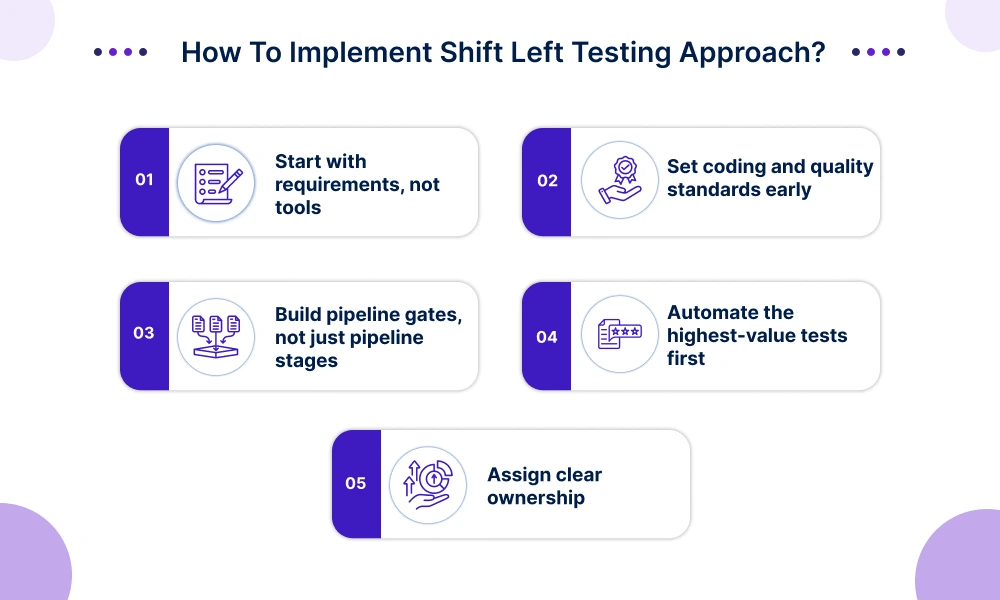
Each step builds on the one before it; pipeline gates without clear requirements just enforce ambiguity faster, and automation without ownership decays fast.
Where AI Fits Into Shift Left Testing in 2026
AI removed the bottleneck that kept teams from shifting left as aggressively as they wanted to. Writing and maintaining tests manually was always the ceiling; AI is what’s raising it.
1. Automated Test Generation
- AI analyzes existing code patterns and requirement documents to generate test scenarios automatically, including edge cases manual test writers commonly miss.
- Cuts into the most time-consuming part of QA work: writing and updating test cases traditionally eats a large share of a tester’s week.
- Particularly useful on large-scope projects where manual test authoring can’t keep pace with the rate code is shipped.
2. Predictive Analytics and Risk-Based Prioritization
- Machine learning models analyze historical defect data, code commits, and past test results to flag which modules are most likely to fail.
- Lets QA teams focus limited testing time on high-risk areas instead of spreading effort evenly across stable and volatile code alike.
- Reduces wasted testing cycles on components that haven’t meaningfully changed.
3. Self-Healing Tests
- Test maintenance has historically been one of the highest hidden costs in automation; a single UI element ID change can break an entire suite.
- AI-powered tests use contextual and visual cues to relocate the intended element automatically when the interface changes, rather than failing outright.
- Frees QA time from constant script repair toward exploratory testing and more complex scenario design.
4. Enhanced Test Coverage
- AI examines code, user behavior, and historical failure data to identify application areas conventional test suites tend to overlook.
- Surfaces gaps earlier in the cycle instead of leaving them to be discovered post-release.
5. Shift-Left Intelligence in Pull Requests
- AI embedded directly in the PR workflow can flag defect probability and suggest relevant test cases before code is even merged, pushing quality checks further left than most teams have historically managed.
- Signals a shift from AI just running tests to AI reasoning about which tests matter for a given change.
Also Read: Software Testing Basics: Everything You Need to Know
Wrapping Up
Shift-left testing isn’t a checklist item; it’s a structural shift in when quality gets built into your SDLC. Start with requirements, not tools. Map testing to real pipeline gates. Let AI absorb the manual bottleneck instead of expecting teams to do more with the same bandwidth. And treat shift-right monitoring as the feedback loop that makes shift left smarter over time, not a separate discipline.
At Talentelgia Technologies, our engineering teams build this balance directly into delivery, combining automated testing for speed and repeatability with manual testing wherever human judgment catches what scripts can’t. If you’re looking to build software where quality isn’t an afterthought, that’s exactly where we can help.













 Write us on:
  Business queries:
  HR:
HR: 


