



 Healthcare Software Development Services
 Healthcare App Development Services
 Real Estate Web Development Services
 Real Estate App Development Company
 E-Commerce App Development Services
 E-Commerce Web Development Services
 Blockchain E-commerce Development Company
 Fintech Software Development
 Fintech App Development Services
 E-Learning App Development Services
 Restaurant App Development Company
 Mobile Game Development Company
 Travel App Development Company
 Automotive Web Design
 AI Traffic Management System
 AI Inventory Management Software
 Logistics App Development Services
 Machine Learning Development
 ChatGPT integration services
  AI Development Company
  AI Integration Services
  Natural Language Processing Company
 Mobile App Development
  IOS App Development
  Android App Development
  Cross-Platform App Development
  Augmented Reality (AR) App Development
  Virtual Reality (VR) App Development
  Web App Development
  SaaS App Development
 Custom Software Development Services
  Flutter
  React Native
  Swift (IOS)
  Kotlin (Android)
  Mean Stack Development
  AngularJS Development
  MongoDB Development
  Nodejs Development
  Database Development
 Ruby on Rails Development
 Expressjs Development
  Full Stack Development
  Web Development Services
  Laravel Development
  LAMP Development
  Custom PHP Development
  .Net Development
  User Experience Design Services
  User Interface Design Services
  Automated Testing
  Manual Testing
  Digital Marketing Services
 Ride-Sharing And Taxi Services
 Food Delivery Services
 Grocery Delivery Services
 Transportation And Logistics
 Car Wash App
 Home Services App
 ERP Development Services
 CMS Development Services
 LMS Development
 CRM Development
 DevOps Development Services
 AI Business Solutions
 AI Cloud Solutions
 AI Chatbot Development
 API Development
 Blockchain Product Development
 Cryptocurrency Wallet Development
 About Talentelgia
  Our Team
  Our Culture
 Healthcare App Development Services
 Real Estate Web Development Services
 E-Commerce App Development Services
 E-Commerce Web Development Services
 Blockchain E-commerce
Development Company
Blockchain E-commerce
Development Company Fintech App Development Services
 Blockchain Fintech
Development Company
Blockchain Fintech
Development Company E-Learning App Development Services
 Restaurant App Development Company
 Mobile Game Development Company
 Travel App Development Company
 AI Traffic Management System
 AI Inventory Management Software
 AI Development Company
 ChatGPT integration services
 AI Integration Services
 Machine Learning Development
 Machine learning consulting services
 Blockchain Development
 Blockchain Software Development
 Smart contract development company
 NFT marketplace development services
 Asset tokenization companies
 DeFi Wallet Development Company
 IOS App Development
 Android App Development
 Cross-Platform App Development
 Augmented Reality (AR) App
Development
Augmented Reality (AR) App
Development Virtual Reality (VR) App Development
 Web App Development
 Flutter
 React
Native
React
Native Swift
(IOS)
Swift
(IOS) Kotlin (Android)
 MEAN Stack Development
 AngularJS Development
 MongoDB Development
 Nodejs Development
 Database development services
 Expressjs Development
 Full Stack Development
 Web Development Services
 Laravel Development
 LAMP
Development
LAMP
Development Custom PHP Development
 User Experience Design Services
 User Interface Design Services
 Automated Testing
 Manual
Testing
Manual
Testing About Talentelgia
 Our Team
 Our Culture
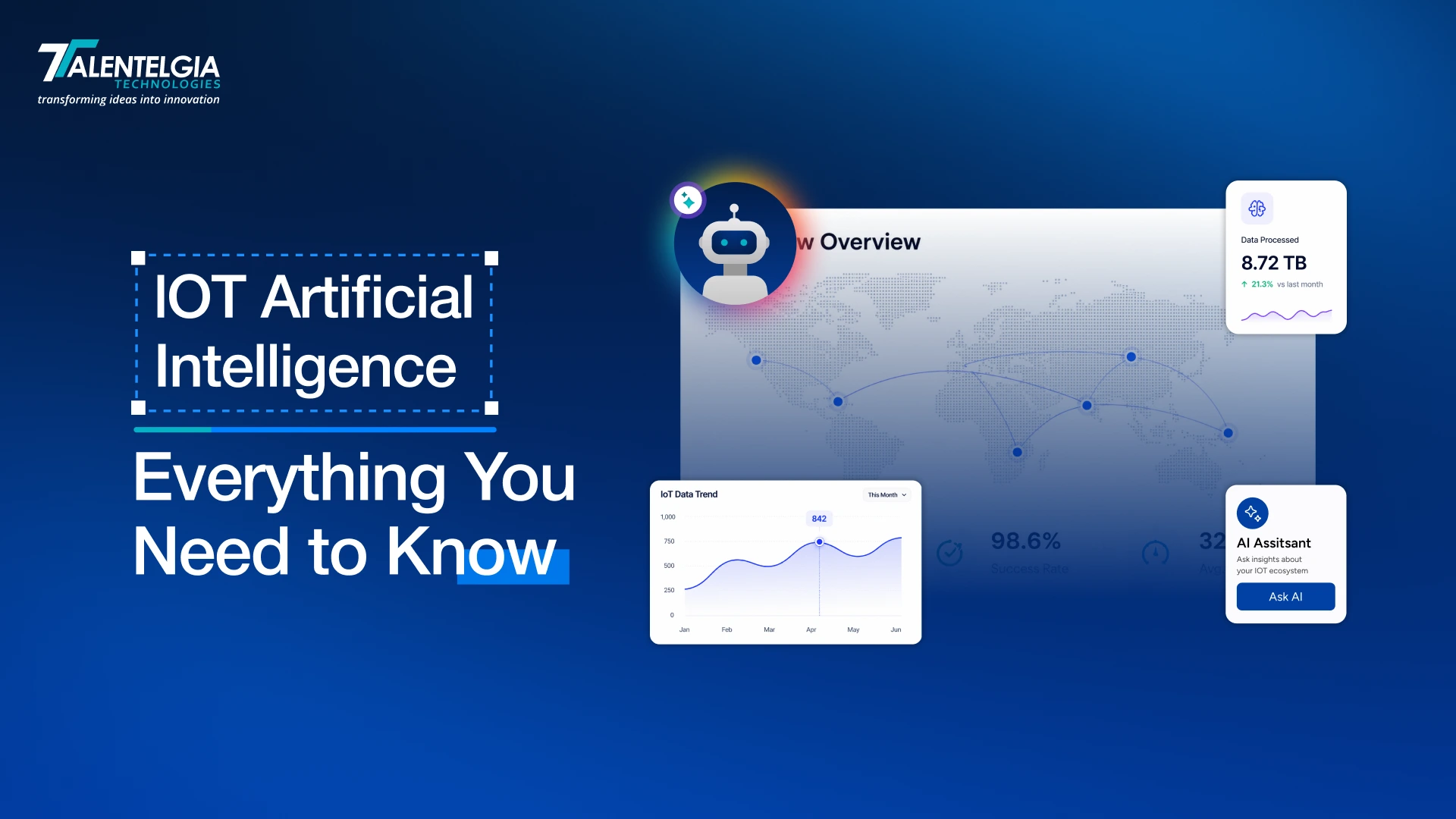
Artificial Intelligence of Things (AIoT) combines Artificial Intelligence (AI) with the Internet of Things (IoT) to turn connected devices into intelligent systems capable of analyzing data, predicting outcomes, and making decisions in real time. Instead of simply collecting information, AIoT enables machines to learn from continuous data streams, automate actions, and improve operational efficiency without constant human intervention.
From predicting equipment failures in manufacturing and optimizing traffic in smart cities to reducing energy consumption in commercial buildings, AIoT is transforming how industries operate. As organizations deploy billions of connected devices worldwide, the challenge is no longer gathering data but making that data actionable.
In this guide, you’ll learn what AIoT is, how it works, the technologies behind it, its benefits, real-world applications, implementation challenges, and where the future of Artificial Intelligence of Things is headed.
How AI and IoT Work Together – What Actually Changed
IoT without AI is simply an extremely costly monitoring platform. Sensors generate data, dashboards present it, and someone must interpret it manually after that. This is completely impractical at large scales because even a single smart factory can generate millions of data points per hour, and not everyone is interpreting all of this data.
AI without IoT has nothing real to work with. Algos require current and ongoing information to train and respond accordingly. Without the continuous input that comes from the connected devices, AI remains hypothetical. Combining the two negates the restriction.
This combination has a name: Artificial Intelligence of Things.
So what is Artificial Intelligence of Things? AIoT is the convergence of AI and IoT into a single intelligent system, where connected devices do not just collect data but actively learn from it, make decisions based on it, and improve over time without human intervention.
That’s how it happens:
- Data turns into insights – All thanks to IoT sensors that measure everything. This data then gets processed by AI, which detects any patterns and turns raw figures into actual action.
- Systems adapt on their own – Instead of following fixed rules, AIoT systems learn from behavior over time. A smart building learns when occupancy peaks and adjusts energy use accordingly. A production line learns what early-stage equipment stress looks like before a breakdown happens.
- Prediction replaces reaction – This is the biggest shift. Traditional systems wait for something to go wrong, then respond. AIoT systems spot the warning signs before the problem exists and act early, whether that means scheduling maintenance, rerouting a shipment, or flagging a security threat.
The result is infrastructure that gets smarter the longer it runs. Every data point feeds the model. Every decision improves the next one. That is what separates AIoT from everything that came before it.
What Is IoT?
Internet of Things is literally what its name suggests. These are all the physical objects connected to the internet and communicating with each other to act based on the information they are exchanging.
This isn’t limited to just smart home technologies, such as smart speakers or thermostats. Internet of Things covers a very wide spectrum – from wearables tracking your vital signs, to sensors attached to industrial machines monitoring their performance, to whole cities optimizing their traffic flow.
How it actually works – the basics:
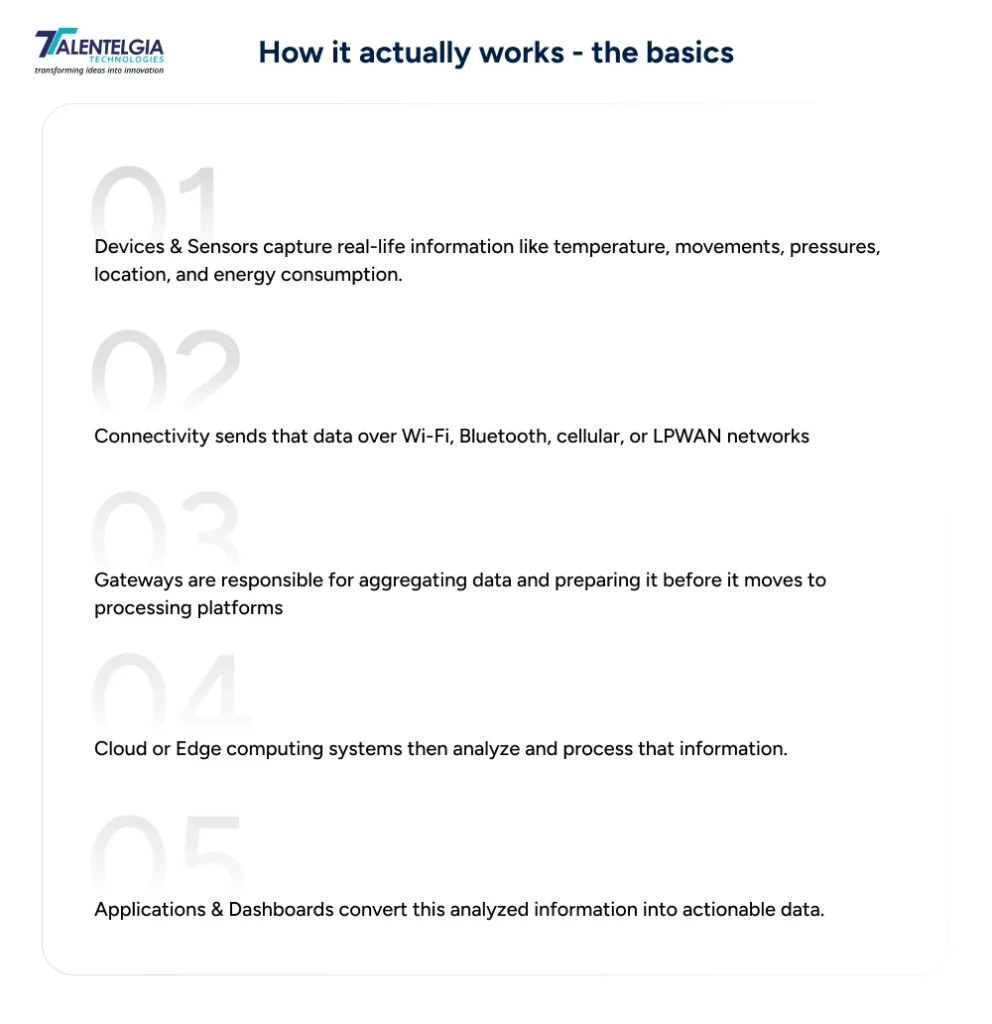
- Devices & Sensors capture real-life information like temperature, movements, pressures, location, and energy consumption.
- Connectivity sends that data over Wi-Fi, Bluetooth, cellular, or LPWAN networks
- Gateways are responsible for aggregating data and preparing it before it moves to processing platforms
- Cloud or Edge computing systems then analyze and process that information.
- Applications & Dashboards convert this analyzed information into actionable data.
What Is AI And Why Does It Matter Here?
Think about how you get better at something over time. You make mistakes, you learn from them, you adjust. AI works on the same principle, except instead of mistakes, it learns from data. The more it sees, the better it gets at spotting patterns, making predictions, and deciding what to do next.
That is really all AI is. Software that learns from experience rather than following a fixed set of instructions.
Under the AI umbrella, three layers matter most in the context of IoT:
- Machine Learning (ML) – Algorithms that learn from data without having to be specifically programmed for all possible scenarios. Give it enough data samples, and soon it will make predictions accurately on its own.
- Deep Learning – A more advanced subset of ML that uses layered neural networks modeled after the human brain. It handles complex, unstructured data like images, audio, sensor streams, and finds patterns humans would never catch manually.
- Natural Language Processing (NLP) – Trains machines to understand and respond to human language. The reason you can talk to a device and get a useful answer back.
The Real Benefits of AIoT
Artificial Intelligence in the Internet of Things does not just make existing systems faster. It fundamentally changes what those systems are capable of. Here is what that actually looks like.
Predictive Maintenance Over Reactive Repair
The difference between planned and unplanned downtime is enormous. Unplanned equipment failure in industries like oil and gas, manufacturing, and logistics does not just cost the repair bill. It even costs everything that stopped around it. Internet of Things and Artificial Intelligence sensors monitor equipment continuously, and AI identifies failure patterns before they become failures. Maintenance gets scheduled. Production keeps running.
Risk Management that Actually Works in Advance
Traditional risk management identifies what went wrong. AIoT identifies what is about to go wrong. AI analyzes data from connected devices to flag financial risks, safety hazards, and cyber threats before they materialize.
Scalability without Proportional Cost Increase
As IoT networks grow, the data volume grows with them. Without AI, scaling an IoT deployment means scaling the human team analyzing it, which is neither practical nor affordable. AI handles the summarizing, pattern recognition, and decision-making across thousands of connected endpoints simultaneously. The network gets bigger. The overhead does not.
Utility and Resource Optimization
Energy, water, and infrastructure management become genuinely efficient when AIoT is running them. Usage patterns are analyzed, waste is identified, and systems adjust automatically based on real behavior rather than fixed schedules. This directly reduces operational costs and supports sustainability targets that businesses are increasingly held to.
Enhanced Data Value Across the Entire Operation
IoT generates enormous volumes of raw data. Most of it goes unanalyzed because the volume is too large for human teams to process meaningfully. AI changes the economics of that entirely. Every data point becomes usable. Patterns that would never surface in a manual review get identified automatically. The data that an organization was already collecting starts delivering returns it was never delivering before.
Also Read: AI In Construction – How AI Is Revolutionizing the Construction Industry?
It’s Not All Smooth – Challenges of AIoT
Artificial Intelligence in the Internet of Things is powerful. It is also genuinely hard to implement well. Here is what stands in the way.
Security is a Moving Target
The more devices connected to a network, the larger the attack surface. AIoT systems collect sensitive data ranging from personal health records to financial transactions to critical infrastructure operations, which makes them high-value targets. And the problem is not just external attacks. AI algorithms themselves can be manipulated through poisoned data inputs, producing harmful decisions that look completely normal from the outside.
- A single compromised device can become an entry point into an entire network
- Inadequate security exposes businesses to financial losses, legal liability, and permanent reputational damage
- Most IoT devices were not designed with enterprise-grade security in mind, making retrofitting difficult and expensive
Data Privacy is not a Checkbox
There are vast amounts of personal and operational data being generated by AIoT systems all the time. Having an answer as to who owns the data, where it is stored, for how long, and who can have access to it is a critical question of trust, as well as compliance with regulations such as GDPR and CCPA. Meeting minimum requirements isn’t enough to secure data.
- Cross-border data flows create conflicting regulatory obligations
- Edge AI devices storing data locally create new governance blind spots
- The more personalized the AIoT system, the more sensitive the data it requires
Interoperability is Still a Genuine Mess
There is no universal standard for how AIoT devices communicate. Different manufacturers use different protocols, different data formats, and different connectivity standards.
- Compatibility issues between devices from different manufacturers slow deployment and increase costs
- Lack of standardization limits how effectively AIoT systems can share data across an organization
- Every custom integration point is another potential failure point in the system
Scalability Gets Expensive Fast
Adding more devices to an Artificial Intelligence of Things network is easy. Managing the data that those devices generate at scale is not. Traditional data processing infrastructure was not designed for the volume, velocity, and variety of AIoT data streams.
- Data processing bottlenecks emerge well before networks reach their intended scale
- Network infrastructure upgrades required to support large Internet of Things and Artificial Intelligence deployments carry significant capital costs
- Without edge computing strategies in place, sending everything to the cloud creates latency and cost problems simultaneously
Energy Consumption at Scale
Many AIoT devices run continuously. In deployments with thousands or tens of thousands of endpoints, sensors on a factory floor, monitors across a logistics network, the cumulative energy demand becomes a real operational cost and an environmental consideration.
- Continuous operation requirements conflict directly with sustainability targets that many organizations are working toward
- Limited battery life on remote sensors creates maintenance overhead that grows with network size
- Choosing the wrong hardware at the deployment stage compounds energy inefficiency across the entire network lifetime
AIoT Use Cases by Industry
Manufacturing
On a production line, the margin between acceptable and defective is often invisible to the human eye, especially at speed and scale. AIoT changes that entirely. Computer vision systems powered by edge AI inspect every unit in real time, flag defects instantly, and do it consistently across every shift without fatigue or variation. Quality control stops being a bottleneck and starts being a competitive advantage.
Also Read: Top 5 Computer Vision Applications In The Retail Sector
| Case Study: Sheriff Tea Egg, Taiwan Sheriff Tea Egg built its reputation on what it calls “the finickiest tea eggs” — each one the product of 12 manufacturing steps and 72 hours of craftsmanship. As production scaled across multiple lines and international markets, manual inspection could no longer keep up with the volume or the standard. Working with ASUS IoT and system integrator PH Precision, the company deployed an AI vision inspection system built around the ASUS IoT PE4000G industrial edge computer and AISVision software. The system runs inspection in real time, assigns every product a unique serial number, and feeds anomaly data directly into a production tracking dashboard. Yield rate improved from 93% to over 97%. Manual inspection dependency dropped significantly. |
Recycling and Sustainability
Sorting mixed-material waste accurately at scale is one of the hardest problems in recycling. Human sorters cannot reliably identify fiber blends or material compositions at production-line speeds. AIoT solves this with deep learning vision systems that classify materials precisely, in real time, without slowing throughput.
| Case Study: Textile Recycling, ASUS IoT Edge AI Textile recycling has a precision problem. Consumer goods contain complex fiber blends like cotton-polyester, wool composites, and polycotton that traditional sorting systems cannot identify accurately at production-line speeds. The result is misclassified material, recovered fiber that cannot be reused, and sustainability targets that never get met. ASUS IoT deployed an Edge AI sorting solution using CNN-based models running on three industrial edge devices: – The PE3000G for real-time vision processing – The PE8000G for advanced material classification and foreign object detection – The PE2100U for conveyor control. The entire system runs on-site with no cloud dependency, enabling real-time decisions at the point of sorting. Sorting accuracy improved substantially. Throughput increased. Manual sorting dependency dropped. And the facility now has a scalable AIoT architecture that grows without requiring infrastructure overhaul. |
Smart Cities and Transportation
Urban traffic management at the city scale is a problem no human team can solve in real time. The variables, vehicle volume, signal timing, emergency routing, weather, and accidents interact too fast and across too wide an area. Artificial Intelligence of Things changes the equation entirely by processing data from thousands of sources simultaneously and making decisions in milliseconds.
| Case Study: Alibaba ET City Brain, Hangzhou Hangzhou was once among China’s three most congested cities. Alibaba’s ET City Brain deployed AI across a network of traffic cameras, GPS feeds, IoT sensors, and signal infrastructure to monitor and manage urban traffic flow in real time. The system adjusts signal timing dynamically, identifies incidents automatically, and creates on-demand green corridors for emergency vehicles — without human operators intervening. Main road speeds improved by approximately 15%, and emergency response times dropped by around 50%. |
Aerospace and Predictive Maintenance
An aircraft engine failure mid-flight is not a maintenance problem. It is a safety catastrophe. The aviation industry has always known that predictive maintenance saves lives as much as it saves money, but doing it accurately across a global fleet of thousands of engines requires a level of data processing that only AIoT makes possible.
| Case Study: Rolls-Royce IntelligentEngine Rolls-Royce has an installed base of more than 13,000 civil aerospace jet engines in service around the world. Each engine carries multiple sensors generating continuous performance data, transmitted wirelessly during flights, downloaded post-landing, and fed into AI models running on Microsoft Azure. Rolls-Royce uses AI forecasting to automatically update predicted maintenance deadlines for every life-limited component inside each engine, part of its Blue Data Thread strategy. It is a digital information thread connecting every Rolls-Royce-powered aircraft, airline operation, maintenance shop, and factory. A Rolls-Royce Trent engine can fly around the world over 1,000 times between significant engine events, and through multi-variable forecasting, the system maps expected flight patterns against component life data to generate accurate maintenance deadlines down to individual part numbers. |
Also Read: AI in Business: Opportunities and Challenges
Where Is All This Going? The Future of AIoT
The technology is already delivering results at scale. What comes next pushes it further: faster, smarter, and deeper into every industry.
- Edge AI gets more powerful – Processing is moving off the cloud and onto the device itself. As edge AI matures, IoT devices will handle complex inference locally, reducing latency, cutting bandwidth costs, and enabling real-time decisions in environments where cloud dependency is not an option.
- 5G and 6G expand what’s possible – Faster speeds, reduced latency, and the capability to handle more simultaneous connections will make scaling up AIoT networks much easier. This could especially benefit sectors such as medicine, driverless cars, and factory automation.
- Digital twins become standard – Digital representations of real-world things such as factories, engines, and even whole city networks will soon become the standard way to monitor and simulate processes. The more data Artificial Intelligence of Things systems generate, the more accurate and useful these twins become.
- Explainable AI builds trust – As Internet of Things and Artificial Intelligence systems take on higher-stakes decisions, transparency becomes non-negotiable. Explainable AI, systems that can show their reasoning, will become a baseline requirement across regulated industries like healthcare, finance, and infrastructure.
Conclusion
Artificial Intelligence of Things is no longer a futuristic concept. It is already transforming how industries operate, make decisions, and respond to problems in real time. From predictive maintenance to smart cities, it is turning connected systems into intelligent IoT ones that continuously learn and improve.
The challenges around security, scalability, and data privacy are real, but so is the opportunity. As edge AI, 5G, and automation continue to evolve, AIoT will become deeply embedded across modern infrastructure.
The real question is no longer whether businesses should adopt AIoT.
It is how quickly they can adapt before intelligent systems become the standard.
Frequently Asked Questions (FAQs)
How does AIoT work?
AIoT works by collecting real-time data through connected IoT devices, processing that data using artificial intelligence and machine learning algorithms, and automatically triggering actions or recommendations. This enables predictive maintenance, operational optimization, and faster decision-making across connected systems.
What are the main benefits of AIoT?
The main benefits of AIoT include predictive maintenance, real-time decision-making, improved operational efficiency, lower costs, enhanced security, and optimized resource utilization. AIoT helps organizations transform raw IoT data into actionable business intelligence and automated processes.
What technologies are used in AIoT?
AIoT combines technologies such as IoT sensors, machine learning, deep learning, computer vision, edge computing, cloud computing, big data analytics, and 5G connectivity. Together, these technologies enable connected devices to collect, analyze, and act on real-time information.
What is the future of Artificial Intelligence of Things?
The future of Artificial Intelligence of Things lies in smarter edge computing, digital twins, autonomous systems, and advanced predictive analytics. As AI and IoT technologies evolve, AIoT is expected to drive intelligent automation across industries and accelerate digital transformation.
Is AIoT the same as the Industrial Internet of Things (IIoT)?
No. AIoT and IIoT are not the same. IIoT focuses on connecting industrial machines and equipment, while AIoT adds artificial intelligence to those connected systems, enabling predictive maintenance, autonomous decision-making, and advanced operational optimization.










 Sales Enquiries:
  Business queries:
  HR:
HR: 


