



 Healthcare Software Development Services
 Healthcare App Development Services
 Real Estate Web Development Services
 Real Estate App Development Company
 E-Commerce App Development Services
 E-Commerce Web Development Services
 Blockchain E-commerce Development Company
 Fintech Software Development
 Fintech App Development Services
 E-Learning App Development Services
 Restaurant App Development Company
 Mobile Game Development Company
 Travel App Development Company
 Automotive Web Design
 AI Traffic Management System
 AI Inventory Management Software
 Logistics App Development Services
 Machine Learning Development
 ChatGPT integration services
  AI Development Company
  AI Integration Services
  Natural Language Processing Company
 Mobile App Development
  IOS App Development
  Android App Development
  Cross-Platform App Development
  Augmented Reality (AR) App Development
  Virtual Reality (VR) App Development
  Web App Development
  SaaS App Development
 Custom Software Development Services
  Flutter
  React Native
  Swift (IOS)
  Kotlin (Android)
  Mean Stack Development
  AngularJS Development
  MongoDB Development
  Nodejs Development
  Database Development
 Ruby on Rails Development
 Expressjs Development
  Full Stack Development
  Web Development Services
  Laravel Development
  LAMP Development
  Custom PHP Development
  .Net Development
  User Experience Design Services
  User Interface Design Services
  Automated Testing
  Manual Testing
  Digital Marketing Services
 Ride-Sharing And Taxi Services
 Food Delivery Services
 Grocery Delivery Services
 Transportation And Logistics
 Car Wash App
 Home Services App
 ERP Development Services
 CMS Development Services
 LMS Development
 CRM Development
 DevOps Development Services
 AI Business Solutions
 AI Cloud Solutions
 AI Chatbot Development
 API Development
 Blockchain Product Development
 Cryptocurrency Wallet Development
 About Talentelgia
  Our Team
  Our Culture
 Healthcare App Development Services
 Real Estate Web Development Services
 E-Commerce App Development Services
 E-Commerce Web Development Services
 Blockchain E-commerce
Development Company
Blockchain E-commerce
Development Company Fintech App Development Services
 Blockchain Fintech
Development Company
Blockchain Fintech
Development Company E-Learning App Development Services
 Restaurant App Development Company
 Mobile Game Development Company
 Travel App Development Company
 AI Traffic Management System
 AI Inventory Management Software
 AI Development Company
 ChatGPT integration services
 AI Integration Services
 Machine Learning Development
 Machine learning consulting services
 Blockchain Development
 Blockchain Software Development
 Smart contract development company
 NFT marketplace development services
 Asset tokenization companies
 DeFi Wallet Development Company
 IOS App Development
 Android App Development
 Cross-Platform App Development
 Augmented Reality (AR) App
Development
Augmented Reality (AR) App
Development Virtual Reality (VR) App Development
 Web App Development
 Flutter
 React
Native
React
Native Swift
(IOS)
Swift
(IOS) Kotlin (Android)
 MEAN Stack Development
 AngularJS Development
 MongoDB Development
 Nodejs Development
 Database development services
 Expressjs Development
 Full Stack Development
 Web Development Services
 Laravel Development
 LAMP
Development
LAMP
Development Custom PHP Development
 User Experience Design Services
 User Interface Design Services
 Automated Testing
 Manual
Testing
Manual
Testing About Talentelgia
 Our Team
 Our Culture
| Key Takeaways * AI voice agents answer real phone calls, run live qualification conversations, and log everything to your CRM; no human required on the first touch. * Most buyers only interview one agent before deciding who to work with – 67% of first-time buyers and 76% of repeat buyers, per NAR’s 2025 Profile of Home Buyers and Sellers. Whoever gets that one conversation has a real edge, and after-hours leads are the ones brokerages are most likely to miss entirely. * Good qualification reads context, not just keywords, distinguishing “just browsing” from “lease ends in 60 days” and scoring leads as hot, warm, or cold accordingly. * Professional-grade voice AI handles natural conversation flow, real-time CRM sync, smart scheduling, and fair housing compliance; basic automation doesn’t. * Top platforms split into two lanes: ready-made tools (Smith.ai, EliseAI) versus developer-built infrastructure (Retell AI, Synthflow). The right pick depends on your team’s resources and use case. |
A buyer fills out a form on Zillow at 9:40 pm. Three agents get notified. One calls back the next morning. One never calls at all. One picks up in under 10 seconds, except it’s not a person; it’s an AI voice agent, already asking about budget, timeline, and whether they’re pre-approved. That third agent gets the showing.
This is precisely what is going on in real estate today. The AI voice agent dials real phone numbers, engages in live two-way conversation, poses the same questions that an ISA trained for the job would ask, and logs everything back into the CRM before humans enter the scene.
In this guide, we explore the ins and outs of these AI voice agents for real estate, why brokerages have embraced them at an unprecedented pace compared to almost any other proptech sector, how they perform live qualification on the phone, which features distinguish the true tools from simple voicemail technology, and how the top platforms stack up against each other.
What is an AI Voice Agent For Real Estate?
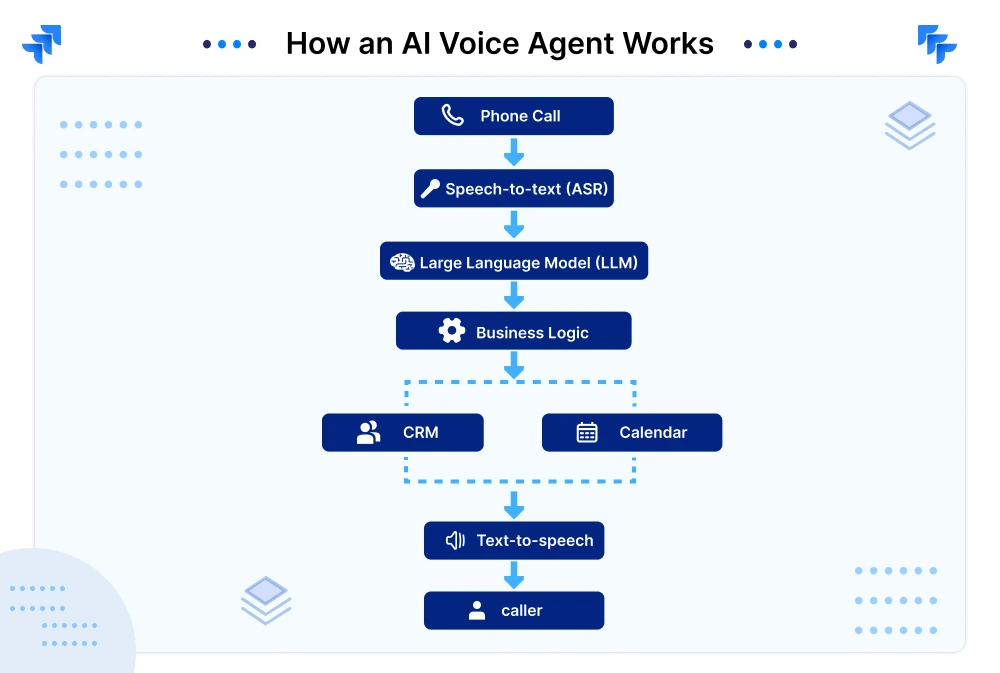
An AI voice agent for real estate is software that picks up the phone, talks like a person, and runs an actual qualification conversation, with no human on the other end. It’s built on automatic speech recognition (ASR) to hear the caller, large language models to understand and reason through what they’re saying, and text-to-speech (TTS) to reply in a natural voice.
Most of these systems are built by a natural language processing company that specializes in exactly this kind of real-time language understanding, since generic speech tools fumble industry-specific phrasing. The difference from a chatbot is simple: this happens on a real phone call, in real time, with interruptions, follow-ups, and tangents, the way an actual conversation works.
It also speaks the language of the industry. Say “good schools nearby,” and it knows you mean a family-friendly area. Mention “contingent offer,” “earnest money,” or “HOA restrictions,” and it responds with the right context instead of fumbling.
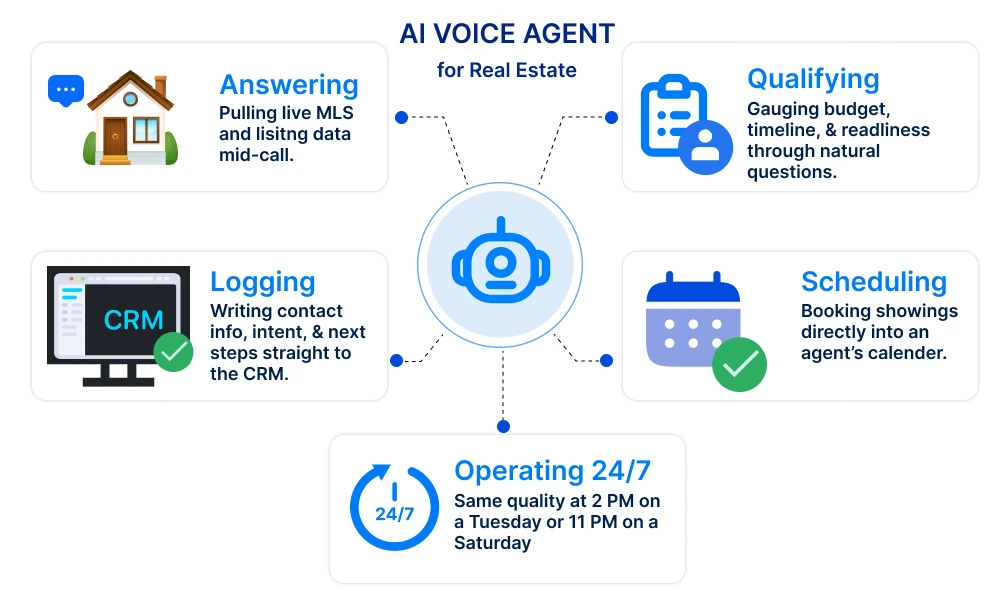
In practice, a real estate voice agent is doing several jobs at once:
- Qualifying – gauging budget, timeline, and readiness through natural questions
- Answering – pulling live MLS and listing data mid-call
- Scheduling – booking showings directly into an agent’s calendar
- Logging – writing contact info, intent, and next steps straight to the CRM
- Operating 24/7 – same quality at 2 pm on a Tuesday or 11 pm on a Saturday
It’s not a smarter voicemail. It’s the first conversation a lead has with your brokerage, and increasingly, it’s the one that decides whether they stay a lead at all.
Why Real Estate Businesses Need AI Voice Bots In 2026?
Real estate runs on calls, and calls don’t scale the way the rest of the business does. Leads pour in from portals, ads, walk-ins, and referrals at all hours, but agents are finite; they’re in showings, in traffic, asleep. That mismatch is the actual problem.
A few things make it worse:
- Buyers commit fast, and first impressions decide who they commit to – According to NAR’s 2025 Profile of Home Buyers and Sellers, 67% of first-time buyers and 76% of repeat buyers interview only one agent before deciding who to work with. There usually isn’t a second chance to make that first impression; the agent who’s slow to answer simply loses the conversation to someone faster.
- Online search now comes first, but agents still close the deal – NAR’s same report found 46% of buyers start their search online versus 20% who begin by contacting an agent directly, yet 88% ultimately buy through an agent or broker. By the time someone actually calls, they’ve usually done the online research and are further along than a cold lead, which raises the cost of missing that call.
- After-hours inquiries are routine, not rare – Evening and weekend leads are some of the highest-intent calls a brokerage gets, and they’re exactly the ones most likely to go unanswered.
- Manual follow-up doesn’t hold up at volume – During a campaign or new launch, call volume spikes far faster than headcount can.
Voice has stayed the one part of the funnel that CRMs and chatbots never actually fixed. That gap is the need.
Ways AI Voice Agents Transform Real Estate Teams
- Instant response on every call – No more “I’ll call you back after this showing.” Every inquiry gets picked up the moment it comes in, while the buyer’s interest is still hot.
- Genuine 24/7 coverage – Buyers browse and call at odd hours: late nights, weekends, right after work. The agent’s day off, lunch break, or family dinner is no longer a dead zone where leads pile up unanswered.
- Showing scheduling without the back-and-forth – It checks calendars, confirms property access, books slots, and sends reminders, the tedious admin work that quietly eats hours every week, handled without a single human touch.
- Consistent follow-up across long sales cycles – Real estate deals can stretch for months. The AI remembers every prior conversation, references specific properties already discussed, and keeps nudging, so no lead goes cold simply because a human got busy with ten other relationships at once.
- Multilingual reach – It switches language based on who’s calling, mid-conversation if needed, opening up markets that language gaps used to shut agents out of, without the cost of hiring multilingual staff.
- Patterns agents can’t see manually – Every call adds to a growing dataset, which leads to sources actually converted, which objections come up most often, and how response time correlates with closed deals. That’s the kind of insight that used to take a data team; now it’s a byproduct of every call.
None of this replaces what makes a good agent good: the trust, the negotiation, the judgment calls. It just clears everything off their plate that was never really about selling in the first place, so that’s where their time actually goes.
How Does Voice AI Qualify Real Estate Leads?
Qualification is where AI voice agents for real estate earn their keep, not by asking more questions, but by understanding what’s actually behind them, every single call, regardless of volume.
Understanding What Buyers Actually Mean
Real prospects don’t talk in checklists. Someone says, “I want a three-bedroom near good schools under $400K,” and the system has to pull four separate qualifiers: bedroom count, location preference, school quality, budget ceiling, out of one casual sentence. This goes beyond keyword matching:
- Reading context, not just words – “family-friendly neighborhood” gets mapped to school ratings, safety, and nearby parks, not treated as a vague phrase.
- Catching implied preferences – “something with character” signals older homes with architectural detail, not a generic search filter.
- Asking when something’s unclear – instead of guessing, it follows up naturally: “What’s your current place like, so I get a sense of what you’re looking to move into?”
Getting to Budget and Timeline Without Sounding Like a Form
Good qualification doesn’t open with “What’s your budget?” It builds context first, something closer to “so I can show you the right properties, what range feels comfortable?” From there, it digs further:
- Whether they’re pre-approved and have a down payment ready
- Whether the purchase is contingent on selling another property first
- How urgent the timeline actually is – “just browsing” gets handled very differently from “lease ends in 60 days”
That distinction, researching versus ready, is the entire point of qualification.
Scoring and Routing the Lead
Every answer feeds a weighted score: budget fit, timeline urgency, financing readiness, and how specific their criteria are, combined rather than judged in isolation. The output sorts leads into three lanes:
- Hot – pre-approved, moving soon, fits the inventory: routed to a live agent immediately, often as a warm handoff
- Warm – genuinely interested but earlier in the process: enters a mixed AI-and-human follow-up sequence
- Cold – long timeline, low urgency: nurtured automatically, with the score updated the moment circumstances change
The result is that no lead is judged on a single answer, and no agent wastes time chasing someone who was never actually ready.
Features For Real Estate Voice AI
| Feature | Basic automation | Professional voice AI |
|---|---|---|
| Conversation flow | Scripted, robotic | Natural pauses, handles interruptions |
| CRM sync | Manual export | Real-time, field-mapped |
| Scheduling | Checks availability only | Factors travel time, conflicts, buffers |
| Follow-up | Single channel | Adapts to phone, email, or text by preference |
| Lead qualification | Fixed checklist of questions | Adaptive discovery conversation, adjusts based on answers |
| Customer support hours | Office hours only; after-hours calls go to voicemail | True 24/7 live coverage, handling detailed pricing, zoning, or spec questions with no queue |
| Compliance | Basic recording only | Fair housing programming, TCPA compliance |
1. Conversation that Doesn’t Repeat Itself
A well-built AI voice agent for real estate tracks context across the whole call, not just the last sentence. If a prospect mentions kids early on, it doesn’t circle back later and ask if they have a family when discussing school districts; that kind of repetition is the fastest way to expose that you’re talking to a machine.
2. Lead Qualification
This is the core engine. The agent runs a real discovery conversation to pull out the details that actually matter:
- Budget range and financing or pre-approval status
- Specific location preferences, down to the neighborhood or micro-market
- How urgent the move is – a 30-day closer versus someone just browsing
It does this conversationally, adjusting follow-up questions based on what’s already been said, instead of reading down a fixed checklist.
3. 24/7 Customer Support
Buyers research listings at night, on weekends, whenever their schedule allows, not during office hours. A real estate voice agent answers every one of those calls live, handling detailed questions about pricing, zoning, or property specs without needing a human on shift. No queue, no voicemail, no “we’ll call you back tomorrow.”
4. Real-Time, bi-directional CRM Sync
As the call happens, the AI writes straight into your CRM, be it budget, property preferences, timeline, or next steps, through a direct system connection (an API or webhook) rather than someone manually typing it in afterward. It also works both ways: the AI can pull up existing lead info from the CRM mid-call, so it already knows who it’s talking to. Nothing sits in a call log waiting to be copied over later; the CRM record is already updated by the time the call ends.
5. Scheduling that Accounts for Logistics, Not Just Open Slots
This goes past “is the agent free”. It considers travel time between showings, respects buffer windows, and can coordinate lockbox codes or building access instructions so the agent shows up with a complete packet, not just an address.
6. Compliance Embedded Within the Conversation Itself
As per fair housing guidelines, the AI voice agent for real estate is coded in such a way that it will never ask any questions related to race, religion, familial status, or so forth. And in case the caller brings up any of these details on its own, the system is smart enough to redirect the conversation to the property aspects only.
7. Multilingual Detection, Not Just Multilingual Support
Stronger systems detect the caller’s spoken language automatically and adapt dialect in real time, which matters more than it sounds. Cross-border investors and relocation buyers are a growing share of inbound interest in most markets.
Also Read: How to Make an AI Voice Assistant?
How an AI Voice Agent Works
Best AI Voice Agents for Real Estate: Detailed Breakdown
| Platform | Best For | Standout Features | Pricing |
|---|---|---|---|
| Smith.ai | Brokerages wanting a human safety net | Hybrid model – AI handles routine calls, live North America-based agents step in for complex ones | From $95/mo (AI), $292.50/mo (live receptionist) |
| EliseAI | Large multifamily/property management portfolios | VoiceAI handles leasing calls in 7 spoken languages, books tours, checks live unit availability | Quote-based, enterprise |
| Retell AI | Teams wanting fast, developer-built agents | ~600ms latency, real-time function calling for bookings, drag-and-drop flow builder | ~$0.07–0.10/min, PAYG |
| Synthflow | Enterprises needing in-house telephony control | Enterprises needing in-house telephony control; sub-100ms latency on their own network, pre-built real estate flow template, BELL deployment framework | Enterprise/custom |
| Aurum PropTech | India-market developers and brokerages | Pre-trained on Indian real estate workflows, regional language support, native Sell.do CRM sync | Quote-based, demo-first |
| Yellow.ai | Large-scale international omnichannel operations | Nexus Vox clones brand voice in 500+ languages, 35+ channels, automates 90% of property queries | Quote-based, limited free tier |
| Gnani.ai | Large developers needing rapid multilingual deployment | Built on 14M+ hours of telephonic audio, 40+ languages including Indic dialects, pre-built real estate flows | £25–£349/mo, enterprise custom |
1. Smith.ai – Best for Human-Backed Hybrid Coverage
Smith.ai has been running call answering since 2015, and real estate is explicitly one of their named verticals (alongside legal, which is their biggest base). The core pitch is a hybrid model: AI handles the routine intake, and the moment a call gets complex, sensitive, or emotional, it transfers to a live, human receptionist.
What it actually does on a call:
- Custom qualification workflows – different intake questions depending on lead source, practice/service type, and whether it’s a buyer or seller inquiry
- Smart FAQ handling that steers toward booking action instead of giving dead-end yes/no answers
- Real-time system lookups – checks pricing, availability, or status mid-call instead of saying “let me check and call you back”
- Calendar booking with complex logic – can check multiple calendars at once for teams with several agents
- Spam/robocall filtering – blocks over 20 million known spam numbers before they ever reach a human
Pricing is genuinely two separate products, which trips people up: the AI Receptionist starts around $95–$292.50/month depending on call volume, while the Virtual Receptionist (live human, AI-assisted) starts around $292.50/month and scales up to $1,400+ for high-volume plans. There’s a 30-day money-back guarantee.
2. EliseAI – Best for Multifamily and Leasing Operations
EliseAI is not built for buyer/seller resale transactions – it’s the dominant name specifically in apartment leasing and property management, used by major operators like Greystar, AvalonBay, Equity Residential, and Brookfield. If your real estate business is leasing or managing units rather than closing sales, this is the closest thing to a category leader.
What sets it apart:
- VoiceAI answers leasing calls live, checks real-time unit availability, and books AI-guided self-tours – prospects can tour a unit without a leasing agent physically present
- Seven spoken languages, 51 written languages – genuinely broad multilingual coverage, not just translation bolted on
- Omnichannel memory – voice, text, email, and chat all feed into one conversation history, so a prospect who texted last week and calls today doesn’t have to repeat themselves
- Beyond leasing – it also handles resident-side work: maintenance request triage, lease renewals, and even delinquency/rent-collection conversations framed empathetically
One customer (Equity Residential) reported 90% of prospect workflows automated and $14 million in payroll savings from deploying it across their portfolio – though that’s enterprise-scale, not a solo-agent outcome. Pricing is quote-based and clearly enterprise-oriented; there’s no published starting price, and onboarding looks built for property management companies, not individual agents.
3. Retell AI – Best for Fast, Developer-Built Agents
Retell is voice AI infrastructure, not a finished real estate product – you or a developer builds the real estate logic on top of it. What it brings to the table is speed and control:
- ~600ms latency, which the platform claims is the lowest of any benchmarked competitor – this is what makes a call feel like a real conversation instead of a laggy bot
- Real-time function calling – the agent can check a calendar, book a showing, or update a CRM record during the call, not after, via direct API connections rather than slower Zapier-style middleware
- Streaming RAG knowledge base that auto-syncs with your website content, so it can answer specific listing or neighborhood questions accurately, instead of guessing
- Built-in simulation testing – you can run an agent through real-world scenarios before it ever takes a live call
- Certified SOC 2 Type II, HIPAA, and GDPR compliant, with self-serve BAAs available
Pricing runs roughly $0.07–$0.10/minute pay-as-you-go, which industry comparisons put at around $80/month for a solo agent handling 1,000 minutes. One case study (outside real estate, in healthcare) showed a client running 100% of inbound calls through AI with only a 30% human transfer rate, collecting roughly $280K/month – a pattern Retell’s own material argues applies directly to brokerages juggling leads across markets and time zones.
4. Synthflow – Best for Enterprise Control Over Telephony
Synthflow’s biggest structural difference from Retell is that it runs its own in-house telephony network instead of routing through third-party carriers, which they claim drops latency below 100ms and keeps uptime above 99.99%, even during traffic surges.
It also ships with an actual real estate qualification template out of the box, a demo agent named “Paul” that walks through location, budget, pre-approval status, and timeline, with built-in objection handling for lines like “I’m just looking” or “I haven’t talked to a lender yet.” That’s a meaningfully shorter setup time than building from a blank canvas.
- The BELL framework (Build, Evaluate, Launch, Learn) structures deployment as a repeatable lifecycle rather than a one-time setup
- Multi-agent architecture – subflows can act as specialized mini-agents handling specific tasks within one larger conversation
- Certified across SOC 2, HIPAA, PCI DSS, and GDPR
- A real estate case study referenced 65% of routine voice requests automated for a CX platform partner, with a 75% reduction in wait times – not real estate-specific, but illustrative of scale
Synthflow doesn’t publish self-serve pricing; deployment is positioned as enterprise, with “forward-deployed engineers” doing the build – expect a sales conversation, not a credit card signup.
5. Aurum PropTech (PropTech Pulse) – Best for India-Market Real Estate Developers
Aurum PropTech’s voice AI sits inside their PropTech Pulse platform and is one of the few tools in this list built specifically for the Indian real estate market, not a generic platform retrofitted for property, but something trained on how Indian developers actually sell: high inbound volume, multiple project sites, diverse buyer demographics, and a strong dependence on WhatsApp and phone as the primary contact channels.
What makes it genuinely real-estate-specific:
- Pre-trained on property workflows – handles developer FAQs, site visit requests, pricing tiers, and unit availability without needing to be taught industry terminology from scratch
- Regional language support – English, Hindi, and regional Indian languages baked in, not added as an afterthought, which matters when your buyers speak Marathi, Tamil, or Gujarati and your team doesn’t
- Native Sell.Do CRM integration – one of India’s most widely used real estate CRMs, synced automatically so every call result lands in the right lead record without manual entry
- Data security built into the stack – end-to-end encryption, role-based access controls, GDPR and HIPAA compliance enforced at the infrastructure level
Trusted by Nestaway, AMSA Investments, and Aurum’s own portfolio companies. Pricing is quote-based through a demo-first model.
6. Yellow.ai – Best for Large-Scale International Omnichannel Operations
Yellow.ai’s Dynamic Automation Platform covers voice and chat across 35+ channels simultaneously, like phone, WhatsApp, web, email, SMS, in 135+ languages. For a brokerage operating across multiple geographies or serving genuinely diverse buyer demographics, that breadth is hard to match. Their newest product, Nexus Vox, launched in May 2026, clones a brand’s voice and deploys it across 500+ languages, a meaningful step beyond standard multilingual support.
For real estate specifically:
- Claims to automate up to 90% of property queries out of the box: pricing, availability, documentation requirements, and basic qualification without needing heavy custom configuration
- A single conversation thread follows the buyer across channels; someone who messaged on WhatsApp yesterday and calls today picks up exactly where they left off, with full context intact
- Native one-click integrations with Salesforce and HubSpot, no middleware, no custom connector
- Runs on 15+ LLMs simultaneously, routing each part of a conversation to the model best suited for that specific task rather than one model handling everything
7. Gnani.ai – Best for Large Developers Needing Rapid Multilingual Deployment
Gnani.ai is a frontier Voice AI company, and that word “frontier” isn’t marketing. Their speech and language models are built in-house, trained on 14 million+ hours of real telephonic audio, which means they’re optimized for the actual conditions of a phone call: background noise, regional accents, interrupted sentences, and dialect variation – not a controlled demo environment. Most platforms adapt general-purpose LLMs for voice; Gnani builds from telephony up.
For real estate, they have a dedicated vertical with pre-built workflows:
- Speed-to-lead automation – engages a new lead the moment they’re captured, before interest cools or a competitor picks up
- 40+ languages including regional Indic dialects – critical for South Asian markets where a single project launch attracts buyers across five or six linguistic communities
- Outbound qualification at scale – not just inbound coverage; it can run outbound campaigns that qualify a list of leads by intent and budget before a human agent makes a single call
- Pushes structured call summaries, lead scores, and viewing requests directly into HubSpot and Salesforce automatically
How to Implement an AI Voice Agent in Your Brokerage
Here’s the practical path that actually works:
1. Map your Call Types before Touching any Platform
- Start by documenting the top call scenarios eating your team’s time. It can be availability checks, pricing questions, showing requests, post-inquiry follow-ups, and basic qualification.
- Pick two or three of these as your pilot scope.
- For each, draft what the agent should ask, what counts as an acceptable answer, and what action follows (book a showing, flag for human review, send directions via SMS).
This is the work most teams skip, and it’s exactly why their deployments feel robotic.
2. Get your Data House in Order
The agent is only as accurate as what it can pull. Before launch:
- Sync live MLS or listing data so the agent references current pricing and availability, not last week’s
- Connect your CRM, so lead records are created and updated automatically during the call
- Link your calendar so it can check real availability, not a static schedule
3. Choose your Voice and Test it with Real Scripts
Sample three or four voice options using your actual qualification script, not a generic demo. The voice that sounds natural on a corporate demo often sounds flat against a real buyer conversation.
4. Run Simulation Testing before going Live
Good platforms (Retell, Synthflow) have built-in call simulators. Use them with varied scripts, accents, and edge cases. Set a clear pass threshold: word error rate, task completion rate, and correct handoff triggers.
5. Turn it on for One Call Type First
Don’t launch across every workflow at once. Start with after-hours inbound or new web lead follow-up, high volume, low stakes, immediate ROI. Once that’s stable, expand.
6. Monitor, Score, and Refine Weekly
Track answer rates, call duration, and completion percentages to understand how effectively the voice agent manages interactions. Detailed monitoring highlights patterns like peak call times and common drop-off points, which help refine workflows over time. Review three to five calls per week in the first month. The agent gets sharper the more you correct it early.
Limitations of AI Voice Agents in Real Estate
Here’s what the research and real deployments actually show:
1. It Can’t Replace Human Judgment on Complex Conversations
An AI voice agent is built for structured, predictable call paths like qualification, scheduling, and follow-up. The moment a caller gets emotional about a divorce forcing a sale, needs to negotiate something specific, or asks a genuinely open-ended question about neighborhood dynamics, the agent hits its ceiling. Most platforms handle this with a human handoff, but that only works if the handoff is designed well upfront.
2. Accent and Dialect Recognition still has Gaps
- Performance is strongest with common English dialects
- Regional accents, heavy non-native speech, and background noise can cause misrecognition
This is especially relevant for brokerages serving diverse, multicultural markets, where the callers who matter most may be exactly the ones the system struggles with.
3. Latency is Noticeable when it’s Bad
The benchmark most buyers now expect is sub-300ms response time; anything above 600ms causes audible pauses that callers register as unnatural. Some platforms still fall short of this in real-world conditions, particularly on outbound campaigns at high volume.
4. Compliance Sits Entirely on You
The agent doesn’t know TCPA, state DNC lists, or fair housing rules by default. Those have to be built in. If your outbound campaigns call mobile numbers without prior written consent, or if the agent asks a question that brushes against fair housing guidelines, the liability lands on the brokerage, not the software vendor.
5. Setup Quality Determines Output Quality
A poorly scripted agent with outdated listing data will give callers wrong information confidently, which is often worse than no agent at all. The technol
Future Trends
The technology isn’t slowing down. Here’s where it’s heading:
1. Agentic AI Goes Mainstream
Autonomous, goal-driven AI systems capable of executing multi-step workflows are expected to reach mainstream use in real estate between 2026 and 2027, meaning voice agents won’t just answer calls; they’ll initiate and complete entire transaction workflows with minimal human input.
2. Multimodal Conversations
The next generation will blend voice with simultaneous action, sending a floor plan via text while talking, sharing a virtual tour link mid-call, or displaying neighborhood data on the caller’s screen in real time. Voice and visual, combined in one interaction.
3. AI-to-AI Communication
Brokerages’ AI agents will begin connecting with each other, scheduling referrals, confirming appointments between firms, and executing coordination that currently requires a human to make one more call.
4. Predictive Outreach, not Just Reactive Answering
Agents will proactively call the right lead at the right moment based on behavioral signals: a buyer who viewed the same listing three times in two days, a seller whose neighborhood just saw three comparable sales.
5. Deeper Emotional Intelligence
Sentiment detection is improving fast. Future systems will recognize frustration, hesitation, or urgency in real time and adjust tone and approach mid-conversation rather than staying on a fixed script.
6. Compliance Built in by Default
In 2026, leading platforms build compliance features directly into their core workflows like DNC scrubbing, time-zone-aware calling, and consent logging handled automatically, not as an afterthought.
Wrapping Up
This technology is not a smarter salesperson. Instead, it’s a tireless first responder that buys your actual salespeople the right to be human everywhere it counts: in the negotiation, the hard conversation, the moment a seller needs someone who actually understands what they’re going through.
Pick the AI voice agent for real estate that matches where you’re bleeding leads, not the one with the best demo. Then go be the agent it bought you time to be. And if what you actually need is something built from scratch around your brokerage’s exact workflow, that’s a conversation for a real estate app development company like Talentelgia Technologies, not a one-size-fits-all platform. Talk to our team and find out what a voice agent built specifically for your brokerage could do for your lead conversion.
Frequently Asked Questions (FAQs)
Can an AI voice agent replace a human real estate agent?
Not even close, and that's not the point. The agent handles everything that eats your time before the real conversation starts: answering calls, qualifying leads, booking showings. The negotiation, the rapport, the judgment calls- that's still yours. It just makes sure you're spending your time on the right people.
Will buyers know they’re talking to an AI?
Honestly, most won't, not immediately. Good systems sound natural enough that callers don't clock it straight away. But if someone asks directly, the agent is required to say it's AI. Any platform worth using has that built in, because getting caught pretending otherwise is worse than just being upfront.
How does an AI voice agent qualify leads?
It asks the same questions a good ISA would like about budget, timeline, financing, what they're actually looking for, but woven into a natural conversation, not fired off like a form. Every answer feeds a score, and the lead gets routed based on that: ready to move now goes straight to you, everyone else goes into follow-up.
How long does it take to deploy an AI voice agent?
Off-the-shelf tools with built-in real estate templates can go live in a few days. Custom-built agents with tailored qualification flows, CRM integration, and objection handling typically take two to six weeks, depending on the complexity of the build and the quality of your existing data.















 Sales Enquiries:
  Business queries:
  HR:
HR: 


